
Opening your dashboard
Class 10 Maths Chapter 3 Shares and Dividends: Previous Year Questions
16 questions on Chapter 3, each solved step by step. Class 10 Maths, ICSE 2026-27.
16 questions with solutions
1–4 marks · Mixed difficulty
- 13 marks
Question 1
Ashok invested ₹ 26,400 on 12%, ₹25 shares of a company. If he receives a dividend of ₹2,475, find the:
(i) number of shares he bought
(ii) Market value of each share
Solve with AIWritten solution
Solution:
Concept: A share has a face value (also called nominal value, F.V.), printed on it, and a market value (M.V.), the price at which it is bought. The dividend is always a percentage of the face value, so the dividend on one share is the rate of dividend × F.V. The money invested is the number of shares × M.V., so the number of shares is the money invested ÷ M.V.
Given: Money invested ₹ 26,400; rate of dividend 12%; face value ₹ 25; dividend received ₹ 2,475.
Step 1 — Find the dividend on one share.
The dividend is 12% of the face value of ₹ 25.
So each share earns ₹ 3.
Step 2 — Find the number of shares (part i).
Each share earns ₹ 3, so the number of shares is the total dividend divided by ₹ 3.
Step 3 — Find the market value (part ii).
Ashok paid ₹ 26,400 for 825 shares, so we divide the money invested by the number of shares.

Check: 825 shares at ₹ 32 cost ₹ 26,400, and they earn ₹ 2,475.
Watch out: The dividend is a percentage of the face value, never of the market value.
Therefore, (i) Ashok bought 825 shares and (ii) the market value of each share is ₹ 32.
- 23 marks
Question 2
How much should a man invest in ₹ 50 shares selling at ₹60 to obtain an income of ₹ 450, if the rate of dividend declared is 10%. Also find his yield percent, to the nearest whole number.
Solve with AIWritten solution
Solution:
Concept: A share has a face value (also called nominal value, F.V.), printed on it, and a market value (M.V.), the price at which it is bought. The dividend is always a percentage of the face value, so the dividend on one share is the rate of dividend × F.V. The money invested is the number of shares × M.V., so the number of shares is the money invested ÷ M.V.
The rate of return (yield) compares the income with the money actually invested: rate of return = (annual income ÷ money invested) × 100%.
Given: Face value ₹ 50; market value ₹ 60; income wanted ₹ 450; rate of dividend 10%.
Step 1 — Find the dividend on one share.
The dividend is 10% of the face value of ₹ 50.
So each share earns ₹ 5.
Step 2 — Find the number of shares needed.
To get ₹ 450 at ₹ 5 a share, we divide the income by the dividend on one share.
Step 3 — Find the investment.
Each share costs its market value, ₹ 60.
So he must invest ₹ 5,400.
Step 4 — Find the yield.
The yield is the income as a percentage of the money invested.
Check: 10% of the face value of 90 shares (₹ 4,500) is ₹ 450, the income wanted.
Watch out: The dividend is a percentage of the face value, never of the market value. The yield, however, uses the money invested (market value).
Therefore, he should invest ₹ 5,400, and his yield is 8% (to the nearest whole number).
- 33 marks
Question 3
A man invests ₹ 22,500 in ₹ 50 shares available at 10% discount. If the dividend paid by the company is 12%, calculate :
(i) The number of shares purchased.
(ii) The annual dividend received.
(iii) The rate of return he gets on his investment. Give your answer correct to the nearest whole number.
Solve with AIWritten solution
Solution:
Concept: A share has a face value (also called nominal value, F.V.), printed on it, and a market value (M.V.), the price at which it is bought. The dividend is always a percentage of the face value, so the dividend on one share is the rate of dividend × F.V. The money invested is the number of shares × M.V., so the number of shares is the money invested ÷ M.V.
A share at a premium costs more than its face value (M.V. = F.V. + premium); at a discount it costs less (M.V. = F.V. − discount); at par M.V. = F.V.
The rate of return (yield) compares the income with the money actually invested: rate of return = (annual income ÷ money invested) × 100%.
Given: Money invested ₹ 22,500; face value ₹ 50; discount 10%; rate of dividend 12%.
Step 1 — Find the market value.
The share is at a 10% discount, so we take 10% of the face value off the face value.
Step 2 — Find the number of shares (part i).
Each share costs ₹ 45, so we divide the money invested by ₹ 45.
Step 3 — Find the annual dividend (part ii).
The dividend on one share is 12% of the face value:
We multiply it by the number of shares:
Step 4 — Find the rate of return (part iii).
The rate of return is the dividend as a percentage of the money invested.
Watch out: The 10% discount is on the face value ₹ 50, giving ₹ 45; and the 12% dividend is on ₹ 50, not on ₹ 45.
Therefore, (i) he buys 500 shares, (ii) his annual dividend is ₹ 3,000 and (iii) his rate of return is 13% (to the nearest whole number).
- 43 marks
Question 4
A man invests ₹ 4500 in shares of a company which is paying 7.5% dividend. If ₹ 100 shares are available at a discount of 10%.
Find:
(i) Number of shares he purchases.
(ii) His annual income.
Solve with AIWritten solution
Solution:
Concept: A share has a face value (also called nominal value, F.V.), printed on it, and a market value (M.V.), the price at which it is bought. The dividend is always a percentage of the face value, so the dividend on one share is the rate of dividend × F.V. The money invested is the number of shares × M.V., so the number of shares is the money invested ÷ M.V.
A share at a premium costs more than its face value (M.V. = F.V. + premium); at a discount it costs less (M.V. = F.V. − discount); at par M.V. = F.V.
Given: Money invested ₹ 4,500; rate of dividend 7.5%; face value ₹ 100; discount 10%.
Step 1 — Find the market value.
The share is at a 10% discount on its face value of ₹ 100.
Step 2 — Find the number of shares (part i).
Each share costs ₹ 90, so we divide the money invested by ₹ 90.
Step 3 — Find the annual income (part ii).
The dividend on one share is 7.5% of the face value:
We multiply it by the number of shares:
Check: The face value of his 50 shares is ₹ 5,000, and 7.5% of ₹ 5,000 is ₹ 375.
Watch out: The dividend is a percentage of the face value, never of the market value.
Therefore, (i) he buys 50 shares and (ii) his annual income is ₹ 375.
- 54 marks
Question 5
Sachin invests ₹ 8500 in 10%, ₹ 100 shares at ₹ 170. He sells the shares when the price of each share rises by ₹ 30. He invests the proceeds in 12% ₹ 100 shares at ₹ 125. Find:
(i) the sale proceeds.
(ii) the number of ₹ 125 shares he buys.
(iii) the change in his annual income.
Solve with AIWritten solution
Solution:
Concept: A share has a face value (also called nominal value, F.V.), printed on it, and a market value (M.V.), the price at which it is bought. The dividend is always a percentage of the face value, so the dividend on one share is the rate of dividend × F.V. The money invested is the number of shares × M.V., so the number of shares is the money invested ÷ M.V.
Given: ₹ 8,500 in 10%, ₹ 100 shares at ₹ 170, sold when the price rises by ₹ 30; proceeds put in 12%, ₹ 100 shares at ₹ 125.
Step 1 — Find the number of first shares.
Sachin pays ₹ 170 for each share, so we divide the money invested by ₹ 170.
Step 2 — Find the sale proceeds (part i).
The price rises by ₹ 30, so he sells each share at:
He sells all 50 shares:
Step 3 — Find the number of new shares (part ii).
He puts all ₹ 10,000 into shares costing ₹ 125 each.
Step 4 — Find the old annual income.
The 10% dividend on a ₹ 100 share is ₹ 10, and he held 50 shares.
Step 5 — Find the new annual income.
The 12% dividend on a ₹ 100 share is ₹ 12, and he now holds 80 shares.
Step 6 — Find the change in income (part iii).
We subtract the old income from the new one.

Watch out: Both dividends are on the face value ₹ 100: ₹ 10 and ₹ 12 a share, not 10% of ₹ 170 or 12% of ₹ 125.
Therefore, (i) the sale proceeds are ₹ 10,000, (ii) he buys 80 shares of ₹ 125 and (iii) his annual income increases by ₹ 460.
- 63 marks
Question 6
A company with 500 shares of nominal value ₹ 120 declares an annual dividend of 15%. Calculate :
(i) the total amount of dividend paid by the company.
(ii) annual income of Mr. Sharma who holds 80 shares of the company.
If the return percent of Mr. Sharma from his shares is 10%. Find the market value of each share.
Solve with AIWritten solution
Solution:
Concept: A share has a face value (also called nominal value, F.V.), printed on it, and a market value (M.V.), the price at which it is bought. The dividend is always a percentage of the face value, so the dividend on one share is the rate of dividend × F.V. The money invested is the number of shares × M.V., so the number of shares is the money invested ÷ M.V.
The rate of return (yield) compares the income with the money actually invested: rate of return = (annual income ÷ money invested) × 100%.
For one share, rate of return = (dividend on one share ÷ M.V.) × 100%.
Given: 500 shares of nominal value ₹ 120; dividend 15%; Mr. Sharma holds 80 shares; his return is 10%.
Step 1 — Find the dividend on one share.
The dividend is 15% of the nominal value of ₹ 120.
Step 2 — Find the total dividend (part i).
The company pays ₹ 18 on each of its 500 shares.
Step 3 — Find Mr. Sharma's income (part ii).
He holds 80 shares, each earning ₹ 18.
Step 4 — Find the market value.
His return is 10%, so the ₹ 18 he earns on a share is 10% of the price he paid for it. We solve for the market value.
Check: 80 shares at ₹ 180 cost ₹ 14,400, and 10% of ₹ 14,400 is ₹ 1,440, his annual income.
Watch out: The return of 10% is on the market value, while the dividend of 15% is on the nominal value; keep the two apart.
Therefore, (i) the total dividend is ₹ 9,000, (ii) Mr. Sharma's annual income is ₹ 1,440, and the market value of each share is ₹ 180.
- 71 mark
Question 7
The sum invested to purchase 15 shares of a company of nominal value ₹ 75 available at a discount of 20% is:
Solve with AIAnswer
(A) ₹ 60
(B) ₹ 90
(C) ₹ 1350
- Correct
(D) ₹ 900
Answer: (D) ₹ 900
Concept: A share at a premium costs more than its face value (M.V. = F.V. + premium); at a discount it costs less (M.V. = F.V. − discount); at par M.V. = F.V. The sum invested is the number of shares × M.V.
Step 1 — Find the market value of one share.
The share is at a 20% discount on its nominal value of ₹ 75.
Step 2 — Find the sum invested.
The buyer pays ₹ 60 for each of the 15 shares.
Check: At the nominal value the 15 shares would cost 15 × ₹ 75 = ₹ 1,125. At a discount the cost must be less than this, and ₹ 900 is.
Watch out: A discount is subtracted from the face value; adding it gives a premium.
Why the other options are wrong:
- (A) ₹ 60: ₹ 60 is the price of just one share. It must be multiplied by 15.
- (B) ₹ 90: this adds 20% to the nominal value (₹ 75 + ₹ 15 = ₹ 90), which is a premium, not a discount. It is also the price of only one share.
- (C) ₹ 1350: this is 15 shares at ₹ 90 each, that is, at a 20% premium: 15 × ₹ 90 = ₹ 1,350.
Therefore, the sum invested is ₹ 900, option (D).
- 83 marks
Question 8
Mr. Gupta invested ₹33000 in buying ₹100 shares of a company at 10% premium. The dividend declared by the company is 12%.
Find:
(a) the number of shares purchased by him.
(b) his annual dividend.
Solve with AIWritten solution
Solution:
Concept: A share has a face value (also called nominal value, F.V.), printed on it, and a market value (M.V.), the price at which it is bought. The dividend is always a percentage of the face value, so the dividend on one share is the rate of dividend × F.V. The money invested is the number of shares × M.V., so the number of shares is the money invested ÷ M.V.
A share at a premium costs more than its face value (M.V. = F.V. + premium); at a discount it costs less (M.V. = F.V. − discount); at par M.V. = F.V.
Given: Money invested ₹ 33,000; face value ₹ 100; premium 10%; dividend 12%.
Step 1 — Find the market value.
The share is at a 10% premium, so 10% of the face value is added to it.
Step 2 — Find the number of shares (part a).
Each share costs ₹ 110, so we divide the money invested by ₹ 110.
Step 3 — Find the annual dividend (part b).
The dividend on one share is 12% of the face value:
We multiply it by the number of shares:
Check: The face value of his 300 shares is ₹ 30,000, and 12% of ₹ 30,000 is ₹ 3,600.
Watch out: The dividend is a percentage of the face value, never of the market value.
Therefore, (a) Mr. Gupta bought 300 shares and (b) his annual dividend is ₹ 3,600.
- 91 mark
Question 9
A man invested in a company paying 12% dividend on its share. If the percentage return on his investment is 10%, then the shares are:
Solve with AIAnswer
(A) at par
(B) below par
- Correct
(C) above par
(D) cannot be determined
Answer: (C) above par
Concept: For one share, rate of return = (dividend on one share ÷ M.V.) × 100%, while the dividend is a percentage of the F.V. So the return equals the dividend rate when M.V. = F.V.; it is less than the dividend rate when M.V. > F.V. (above par), and more when M.V. < F.V. (below par).
Step 1 — Compare the two rates.
The man gets 10% on his money, which is less than the 12% dividend rate.
Step 2 — Decide where the price is.
A smaller return means he paid more than the face value for the same dividend, so the shares are above par.
Step 3 — Confirm with numbers.
Take a ₹ 100 share: the dividend is ₹ 12. For this to be a 10% return, the price must be found from:
₹ 120 is more than ₹ 100, so the share is above par.
Watch out: A lower return than the dividend rate means a price above the face value, not below it.
Why the other options are wrong:
- (A) at par: at par the price equals the face value, so the return would equal the dividend rate, 12%, not 10%.
- (B) below par: below par the buyer pays less than the face value, so the return would be more than 12%. For example, a ₹ 100 share bought at ₹ 80 gives 12 ÷ 80 × 100 = 15%.
- (D) cannot be determined: the two percentages fix the ratio M.V. : F.V. = 12 : 10, so it can be decided.
Therefore, the shares are above par, option (C).
- 103 marks
Question 10
A man bought ₹200 shares of a company at 25% premium. If he received a return of 5% on his investment. Find the :
(a) market value
(b) dividend percent declared
(c) number of shares purchased, if annual dividend is ₹ 1000.
Solve with AIWritten solution
Solution:
Concept: A share has a face value (also called nominal value, F.V.), printed on it, and a market value (M.V.), the price at which it is bought. The dividend is always a percentage of the face value, so the dividend on one share is the rate of dividend × F.V. The money invested is the number of shares × M.V., so the number of shares is the money invested ÷ M.V.
A share at a premium costs more than its face value (M.V. = F.V. + premium); at a discount it costs less (M.V. = F.V. − discount); at par M.V. = F.V.
For one share, rate of return = (dividend on one share ÷ M.V.) × 100%.
Given: Face value ₹ 200; premium 25%; return 5%; annual dividend ₹ 1,000.
Step 1 — Find the market value (part a).
The share is at a 25% premium, so 25% of the face value is added to it.
Step 2 — Find the dividend on one share.
The return is 5% of the money invested, so on one share he earns 5% of its market value.
Step 3 — Find the rate of dividend (part b).
The dividend rate is the dividend on one share as a percentage of the face value.
Step 4 — Find the number of shares (part c).
Each share earns ₹ 12.50, so we divide the annual dividend by ₹ 12.50.
Check: 80 shares cost 80 × ₹ 250 = ₹ 20,000, and 5% of ₹ 20,000 is ₹ 1,000, the annual dividend.
Watch out: The 5% return is on the market value ₹ 250; the dividend rate must then be worked out on the face value ₹ 200.
Therefore, (a) the market value is ₹ 250, (b) the dividend declared is 6.25% and (c) he bought 80 shares.
- 111 mark
Question 11
Percentage return on ₹100, 12% share of a company bought at 4% discount is:
Solve with AIAnswer
(A) 10%
(B) 12%
- Correct
(C) 12.5%
(D) 16%
Answer: (C) 12.5%
Concept: A share at a premium costs more than its face value (M.V. = F.V. + premium); at a discount it costs less (M.V. = F.V. − discount); at par M.V. = F.V. For one share, rate of return = (dividend on one share ÷ M.V.) × 100%, and the dividend is a percentage of the F.V.
Step 1 — Find the market value.
The share is at a 4% discount on its face value of ₹ 100.
Step 2 — Find the dividend on one share.
The dividend is 12% of the face value of ₹ 100, that is ₹ 12.
Step 3 — Find the percentage return.
The return is the dividend as a percentage of the price paid.
Watch out: The return is not dividend rate + discount rate; divide the dividend by the price actually paid.
Why the other options are wrong:
- (A) 10%: a return of 10% is less than the dividend rate. That needs a price of ₹ 120, above the face value, but this share is bought at a discount.
- (B) 12%: 12% is the dividend rate. It is the return only when the share is bought at par (₹ 100).
- (D) 16%: this adds the 4% discount to the 12% dividend. A return of 16% would need a price of only ₹ 75, but the price here is ₹ 96.
Therefore, the percentage return is 12.5%, option (C).
- 123 marks
Question 12
₹100 shares of a company giving 10% dividend are selling at ₹150. Mr. Saha invests ₹ 18,000 to buy these shares. He sells 80% of his shares after one year. Find :
(a) the number of shares he purchased.
(b) the number of shares he sold.
(c) his annual income from the remaining 20% shares he still holds.
Solve with AIWritten solution
Solution:
Concept: A share has a face value (also called nominal value, F.V.), printed on it, and a market value (M.V.), the price at which it is bought. The dividend is always a percentage of the face value, so the dividend on one share is the rate of dividend × F.V. The money invested is the number of shares × M.V., so the number of shares is the money invested ÷ M.V.
Given: Face value ₹ 100; dividend 10%; market value ₹ 150; money invested ₹ 18,000; 80% of the shares sold.
Step 1 — Find the number of shares (part a).
Each share costs ₹ 150, so we divide the money invested by ₹ 150.
Step 2 — Find the number sold (part b).
He sells 80% of his 120 shares.
Step 3 — Find the shares left.
The remaining 20% of his shares are those he did not sell.
Step 4 — Find the annual income (part c).
The 10% dividend on a ₹ 100 share is ₹ 10, and he still holds 24 shares.
Check: 20% of the income from all 120 shares (120 × ₹ 10 = ₹ 1,200) is ₹ 240.
Watch out: The dividend is a percentage of the face value, never of the market value.
Therefore, (a) he purchased 120 shares, (b) he sold 96 shares and (c) his annual income from the remaining shares is ₹ 240.
- 131 mark
Question 13
Asha buys ₹ 20 shares of a company which pays 9% dividend at such a price that she gets a return of 12% on her investment. At what price did she buy each share?
Solve with AIAnswer
(A) ₹ 20
- Correct
(B) ₹ 15
(C) ₹ 25
(D) ₹ 18
Answer: (B) ₹ 15
Concept: The dividend is a percentage of the face value. For one share, rate of return = (dividend on one share ÷ M.V.) × 100%.
Step 1 — Find the dividend on one share.
The dividend is 9% of the face value of ₹ 20.
Step 2 — Find the price.
Her return is 12%, so ₹ 1.80 is 12% of the price she paid. We solve for the market value.
Check: 12% of ₹ 15 is ₹ 1.80, the dividend on one share. The price is below the face value, which is why the return (12%) is more than the dividend rate (9%).
Watch out: The 12% return is on the price paid, not on the face value ₹ 20.
Why the other options are wrong:
- (A) ₹ 20: ₹ 20 is the face value. At par her return would be 1.80 ÷ 20 × 100 = 9%, not 12%.
- (C) ₹ 25: this is above par. Her return would be 1.80 ÷ 25 × 100 = 7.2%, which is less than 9%.
- (D) ₹ 18: her return would be 1.80 ÷ 18 × 100 = 10%, not 12%.
Therefore, Asha bought each share at ₹ 15, option (B).
- 143 marks
Question 14
Kabir bought 120 shares of a company with nominal value ₹100, available at a premium of ₹25. Find :
(a) the money invested by Kabir in buying these shares.
(b) the rate of dividend, if he received ₹ 1,080 as dividend from these shares after one year.
(c) his rate of return.
Solve with AIWritten solution
Solution:
Concept: A share has a face value (also called nominal value, F.V.), printed on it, and a market value (M.V.), the price at which it is bought. The dividend is always a percentage of the face value, so the dividend on one share is the rate of dividend × F.V. The money invested is the number of shares × M.V., so the number of shares is the money invested ÷ M.V.
A share at a premium costs more than its face value (M.V. = F.V. + premium); at a discount it costs less (M.V. = F.V. − discount); at par M.V. = F.V.
The rate of return (yield) compares the income with the money actually invested: rate of return = (annual income ÷ money invested) × 100%.
Given: 120 shares; nominal value ₹ 100; premium ₹ 25 a share; dividend received ₹ 1,080.
Step 1 — Find the market value.
The premium is ₹ 25 on each share (an amount, not a percentage), so we add it to the face value.
Step 2 — Find the money invested (part a).
Kabir pays ₹ 125 for each of his 120 shares.
Step 3 — Find the dividend on one share.
₹ 1,080 is shared over 120 shares.
Step 4 — Find the rate of dividend (part b).
The rate of dividend is the dividend on one share as a percentage of the face value.
Step 5 — Find the rate of return (part c).
The rate of return is the dividend as a percentage of the money invested.
Check: On one share he pays ₹ 125 and earns ₹ 9, and 9 ÷ 125 × 100 = 7.2%. The return is less than the dividend rate because the shares were bought at a premium.
Watch out: Here the premium is ₹ 25 (a sum of money), not 25%.
Therefore, (a) Kabir invested ₹ 15,000, (b) the rate of dividend is 9% and (c) his rate of return is 7.2%.
- 151 mark
Question 15
A company declares 9% dividend on its shares of ₹100 available at ₹120. It means a person will receive annual dividend which is 9% of:
Solve with AIAnswer
(A) market value
- Correct
(B) face value
(C) the difference of market value and face value
(D) company's profit
Answer: (B) face value
Concept: The rate of dividend declared by a company is always a percentage of the face value (nominal value) of a share, whatever price the share sells at.
Step 1 — Recall what the dividend rate is based on.
A 9% dividend means the company pays 9% of the face value on each share.
Step 2 — Apply it here.
The face value is ₹ 100, so each share earns ₹ 9, even though a buyer pays ₹ 120 for it.
Watch out: The dividend is a percentage of the face value, never of the market value.
Why the other options are wrong:
- (A) market value: the market value (₹ 120) is what the buyer pays. 9% of it would be ₹ 10.80, but the company pays ₹ 9 on each share.
- (C) the difference of market value and face value: the difference is the premium, ₹ 120 − ₹ 100 = ₹ 20. It plays no part in the dividend (9% of it is only ₹ 1.80).
- (D) company's profit: the dividend is paid out of the company's profit, but its rate is stated as a percentage of the face value of a share, not of the profit.
Therefore, the annual dividend is 9% of the face value, option (B).
- 163 marks
Question 16
Prasoon invests ₹7500 in a company paying 6% dividend annually. ₹100 shares of this company are available at ₹150.
(a) Find the number of shares he purchased.
(b) Find his annual income.
(c) After one year, he sold 50% of his original shares at ₹175 each. Find his gain on the shares he sold.
Solve with AIWritten solution
Solution:
Concept: A share has a face value (also called nominal value, F.V.), printed on it, and a market value (M.V.), the price at which it is bought. The dividend is always a percentage of the face value, so the dividend on one share is the rate of dividend × F.V. The money invested is the number of shares × M.V., so the number of shares is the money invested ÷ M.V.
Given: Money invested ₹ 7,500; dividend 6%; face value ₹ 100; market value ₹ 150; after a year 50% of the shares sold at ₹ 175 each.
Step 1 — Find the number of shares (part a).
Each share costs ₹ 150, so we divide the money invested by ₹ 150.
Step 2 — Find the annual income (part b).
The 6% dividend on a ₹ 100 share is ₹ 6, and he holds 50 shares.
Step 3 — Find the number of shares sold.
He sells 50% of his 50 shares.
Step 4 — Find the gain on one share.
He bought each share at ₹ 150 and sells it at ₹ 175.
Step 5 — Find the total gain (part c).
He gains ₹ 25 on each of the 25 shares sold.
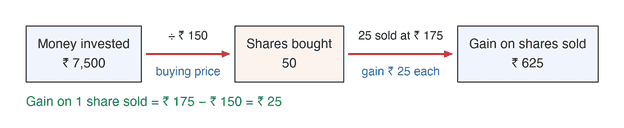
Check: The 25 shares cost ₹ 3,750 and were sold for ₹ 4,375, a gain of ₹ 625.
Watch out: The gain uses the market prices (₹ 150 bought, ₹ 175 sold), not the face value.
Therefore, (a) Prasoon purchased 50 shares, (b) his annual income is ₹ 300 and (c) his gain on the shares sold is ₹ 625.