Solution:
Concept: A share has a face value (also called nominal value, F.V.), printed on it, and a market value (M.V.), the price at which it is bought. The dividend is always a percentage of the face value, so the dividend on one share is the rate of dividend × F.V. The money invested is the number of shares × M.V., so the number of shares is the money invested ÷ M.V.
Given: Money invested ₹ 7,500; dividend 6%; face value ₹ 100; market value ₹ 150; after a year 50% of the shares sold at ₹ 175 each.
Step 1 — Find the number of shares (part a).
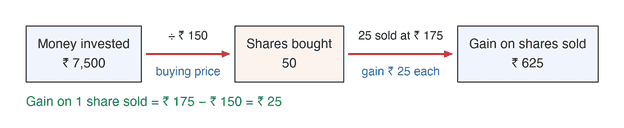
Each share costs ₹ 150, so we divide the money invested by ₹ 150.
Number of shares=1507,500=50
Step 2 — Find the annual income (part b).
The 6% dividend on a ₹ 100 share is ₹ 6, and he holds 50 shares.
Annual income=50×6=300
Step 3 — Find the number of shares sold.
He sells 50% of his 50 shares.
Shares sold=10050×50=25
Step 4 — Find the gain on one share.
He bought each share at ₹ 150 and sells it at ₹ 175.
Gain on one share=175−150=25
Step 5 — Find the total gain (part c).
He gains ₹ 25 on each of the 25 shares sold.
Total gain=25×25=625
Check: The 25 shares cost ₹ 3,750 and were sold for ₹ 4,375, a gain of ₹ 625.
Gain=4,375−3,750=625
Watch out: The gain uses the market prices (₹ 150 bought, ₹ 175 sold), not the face value.
Therefore, (a) Prasoon purchased 50 shares, (b) his annual income is ₹ 300 and (c) his gain on the shares sold is ₹ 625.
