Solution:
Concept: Find his income before and after the change. Selling the old shares gives money (number of shares × selling price), which buys new shares at their market price. The dividend on each kind of share is always on its own nominal value.
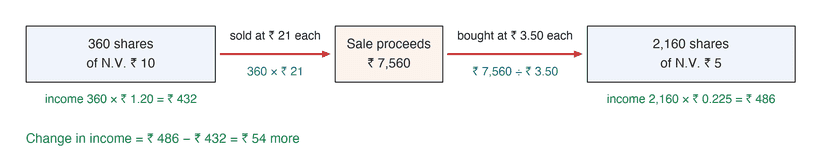
Given: Old shares: 360 shares of nominal value ₹ 10 paying 12%, sold at ₹ 21 each; new shares: nominal value ₹ 5, paying 4.5%, bought at ₹ 3.50 each.
Step 1 — Find the old income.
Each old share earns 12% of its nominal value ₹ 10.
Dividend on one old share=10012×10=1.2
All 360 shares earn ₹ 1.20 each.
Old income=360×1.2=432
So his old income is ₹ 432 a year.
Step 2 — Find the sale proceeds.
He sells all 360 shares at ₹ 21 each.
Sale proceeds=360×21=7,560
So he gets ₹ 7,560.
Step 3 — Find the number of new shares.
The ₹ 7,560 buys new shares at ₹ 3.50 each, so we divide.
Number of new shares=3.57,560=2,160
So he buys 2,160 new shares.
Step 4 — Find the new income.
Each new share earns 4.5% of its nominal value ₹ 5.
Dividend on one new share=1004.5×5=0.225
All 2,160 shares earn ₹ 0.225 each.
New income=2,160×0.225=486
So his new income is ₹ 486 a year.
Step 5 — Find the change in income.
We subtract the old income from the new income.
Change in income=486−432=54
The new income is larger, so his income increases by ₹ 54 a year.
Check: 2,160 shares at ₹ 3.50 cost exactly the sale proceeds.
2,160×3.5=7,560
Watch out: The 4.5% is on the new nominal value ₹ 5, not on the ₹ 3.50 he pays for each new share.
Therefore, his annual income increases by ₹ 54.
