
Question 373 marksMedium
A man sold 400 (₹ 20) shares of a company, paying 5% at ₹ 18 and invested the proceeds in (₹ 10) shares of another company paying 7% at ₹ 12. How many (₹ 10) shares did he buy and what was the change in his income?
Confirming your payment
Sign up now and get 250 free tokens.
Shares and Dividends · Question 37 of 62
A man sold 400 (₹ 20) shares of a company, paying 5% at ₹ 18 and invested the proceeds in (₹ 10) shares of another company paying 7% at ₹ 12. How many (₹ 10) shares did he buy and what was the change in his income?
Solution:
Concept: Shares are sold and bought at their market prices, but the dividend is always worked out on the nominal value. Compare the income from the old shares with the income from the new shares.
Given: Old shares: 400 shares of nominal value ₹ 20 paying 5%, sold at ₹ 18 each; new shares: nominal value ₹ 10, paying 7%, bought at ₹ 12 each.
Step 1 — Find the old income.
Each old share earns 5% of its nominal value ₹ 20.
All 400 shares earn ₹ 1 each.
So his old income is ₹ 400 a year.
Step 2 — Find the sale proceeds.
He sells all 400 shares at ₹ 18 each.
So he gets ₹ 7,200.
Step 3 — Find the number of ₹ 10 shares bought.
The ₹ 7,200 buys new shares at ₹ 12 each, so we divide.
So he buys 600 shares.
Step 4 — Find the new income.
Each new share earns 7% of its nominal value ₹ 10.
All 600 shares earn ₹ 0.70 each.
So his new income is ₹ 420 a year.
Step 5 — Find the change in income.
We subtract the old income from the new income.
The new income is larger, so his income increased by ₹ 20 a year.
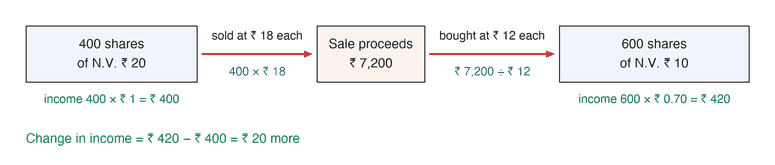
Check: 600 shares at ₹ 12 cost exactly the sale proceeds.
Watch out: The shares are sold at ₹ 18, not at their nominal value ₹ 20, so the proceeds are ₹ 7,200, not ₹ 8,000.
Therefore, he bought 600 shares of ₹ 10, and his income increased by ₹ 20 a year.