Solution:
Concept: Let the number of shares bought at first be x. Write the first income and the second income in terms of x; their difference is the change in income. Then sum invested = x × price paid for one share.
Given: First shares: 6%, nominal value ₹ 100, bought at ₹ 12 premium, sold at ₹ 96; second shares: 10%, nominal value ₹ 10, bought at ₹ 8; change in income = ₹ 540.
Step 1 — Write the first income.
Let him buy x hundred-rupee shares. Each earns 6% of ₹ 100.
Dividend on one old share=1006×100=6
So his first income is:
First income=6x
Step 2 — Write the sale proceeds.
He sells all x shares at ₹ 96 each.
Sale proceeds=96x
Step 3 — Find the number of ten-rupee shares bought.
The proceeds buy ten-rupee shares at ₹ 8 each, so we divide.
Number of new shares=896x=12x
Step 4 — Write the second income.
Each new share earns 10% of ₹ 10.
Dividend on one new share=10010×10=1
So his second income is:
Second income=12x×1=12x
Step 5 — Form the equation and solve it.
Since 12x is more than 6x, his income goes up, so the second income minus the first is ₹ 540. We subtract the like terms and divide both sides by 6.
12x−6x6xx=540=540=90
So he bought 90 shares at first.
Step 6 — Find the sum invested originally.
Each share cost its nominal value plus the ₹ 12 premium.
Price paid for one old share=100+12=112
All 90 shares cost ₹ 112 each.
Sum invested=90×112=10,080
So he invested ₹ 10,080 at first.
Check: 90 shares earn ₹ 540. Sold at ₹ 96 they bring ₹ 8,640, which buys 1,080 ten-rupee shares earning ₹ 1,080.
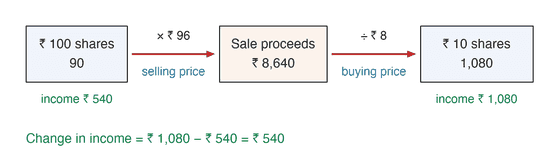
1,080−540=540
Watch out: The sum invested uses the buying price ₹ 112, not the selling price ₹ 96.
Therefore, he invested ₹ 10,080 originally.
