Solution:
Concept: Shares are bought and sold at their market value, but each share earns its dividend on its own nominal value (N.V.). Find the income before and after the change and compare.
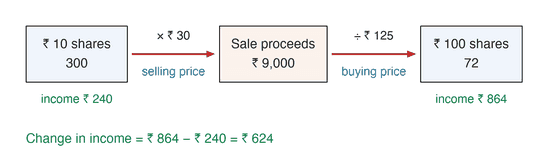
Given: Money invested = ₹ 4,500; first shares: 8%, nominal value ₹ 10, bought at ₹ 15, sold at ₹ 30; new shares: 12%, nominal value ₹ 100, bought at ₹ 125.
Step 1 — Find the number of shares first bought.
Each share cost ₹ 15, so we divide the money invested by ₹ 15.
Number of shares bought=154,500=300
So Vivek bought 300 shares.
Step 2 — Part (i): find the sale proceeds.
He sells all 300 shares at ₹ 30 each.
Sale proceeds=300×30=9,000
So the sale proceeds are ₹ 9,000.
Step 3 — Part (ii): find the number of new shares.
The “₹ 125 shares” are the ₹ 100 shares bought at ₹ 125 each, so we divide the proceeds by ₹ 125.
Number of new shares=1259,000=72
So he buys 72 shares.
Step 4 — Find the old income.
Each old share earns 8% of its nominal value ₹ 10.
Dividend on one old share=1008×10=0.8
His 300 shares earn ₹ 0.80 each.
Old income=300×0.8=240
So his old income is ₹ 240 a year.
Step 5 — Find the new income.
Each new share earns 12% of its nominal value ₹ 100.
Dividend on one new share=10012×100=12
His 72 shares earn ₹ 12 each.
New income=72×12=864
So his new income is ₹ 864 a year.
Step 6 — Part (iii): find the change in income.
We subtract the old income from the new income.
Change in income=864−240=624
The new income is larger, so his income increases by ₹ 624.
Watch out: The new dividend is 12% of the nominal value ₹ 100, not of the ₹ 125 he pays.
Therefore, (i) the sale proceeds are ₹ 9,000; (ii) he buys 72 shares; (iii) his annual income increases by ₹ 624.
