
Opening your dashboard
Class 10 Maths Chapter 1: GST Solutions
48 textbook questions with step-by-step answers, free to read, for ICSE 2026-27.
Get talked through Ch 1, not just shown the answer
Reading a finished solution is not the same as being able to do it. The AI tutor takes one question at a time and works it with you, in your own words, until you can.
- Ask it out loud, in your own words
- It gives you the next step, not the answer
- Stuck on part (ii)? Start there
48 questions with solutions
1–3 marks · Mixed difficulty
- 11 mark
Question 1
The marked price of an article is ₹ 1,500 and discount on it is 20%. How much money will be paid for this article, if rate of GST is 18% ?
Solve with AIAnswer
(A) ₹ 2,124
- Correct
(B) ₹ 1,416
(C) ₹ 1,770
(D) ₹ 216
Answer: (B) ₹ 1,416
Concept: A discount is taken off the marked price first. GST is then charged on the price after the discount, never on the marked price.
Step 1 — Find the discount.
The discount is 20% of the marked price of ₹ 1,500.
So the discount is ₹ 300.
Step 2 — Find the price after discount.
We subtract the discount from the marked price, because the buyer does not pay that part.
So the price after discount is ₹ 1,200.
Step 3 — Find the GST.
GST at 18% is charged on the price after discount.
So the GST is ₹ 216.
Step 4 — Find the money paid.
The buyer pays the price after discount plus the GST on it.
So the buyer pays ₹ 1,416.
Watch out: Do not charge GST on the marked price ₹ 1,500. The discount always comes off first.
Why the other options are wrong:
- (A) ₹ 2,124: this adds the discount instead of subtracting it (₹ 1,500 + ₹ 300 gives ₹ 1,800) and then adds 18% GST on ₹ 1,800. A discount is always subtracted.
- (C) ₹ 1,770: this is ₹ 1,500 plus 18% GST on ₹ 1,500. It forgets the discount altogether.
- (D) ₹ 216: this is only the GST. The buyer pays the price after discount as well as the GST.
Therefore, the money paid for the article is ₹ 1,416, option (B).
- 21 mark
Question 2
The following bill shows the GST rates and the marked price of articles A and B.
Articles Marked price Rate of GST A ₹ 1,000 5% B ₹ 2,000 12% The total amount to be paid for the above bill is :
Solve with AIAnswer
(A) ₹ 490
(B) ₹ 290
- Correct
(C) ₹ 3,290
(D) ₹ 3,510
Answer: (C) ₹ 3,290
Concept: When the articles in one bill carry different rates of GST, the GST on each article is found at its own rate. The bill is the total price plus the total GST.
Step 1 — Find the GST on article A.
Article A costs ₹ 1,000 and its rate of GST is 5%.
So the GST on A is ₹ 50.
Step 2 — Find the GST on article B.
Article B costs ₹ 2,000 and its rate of GST is 12%.
So the GST on B is ₹ 240.
Step 3 — Find the total price of the articles.
No discount is given, so we simply add the two marked prices.
So the articles cost ₹ 3,000.
Step 4 — Find the total GST.
We add the GST on the two articles.
So the total GST is ₹ 290.
Step 5 — Find the amount of the bill.
The bill is the total price plus the total GST.
So the bill comes to ₹ 3,290.
Watch out: Do not add the two rates (5% + 12% = 17%) and charge 17% on the whole ₹ 3,000. Each rate applies only to its own article.
Why the other options are wrong:
- (A) ₹ 490: the two articles alone cost ₹ 3,000, so the bill can never be less than ₹ 3,000.
- (B) ₹ 290: this is only the total GST. The bill must also include the price of the articles.
- (D) ₹ 3,510: this charges 17% (5% + 12%) on the whole ₹ 3,000, which gives ₹ 510 of tax. Each rate applies only to its own article.
Therefore, the total amount to be paid is ₹ 3,290, option (C).
- 31 mark
Question 3
A dealer in Rajasthan supplies goods and services to a dealer in Punjab. If the rate of GST is 28%, then rate of SGST is :
Solve with AIAnswer
(A) 28%
(B) 14%
- Correct
(C) 0%
(D) none of these
Answer: (C) 0%
Concept: A sale within one state is an intra-state sale: the GST is shared equally as CGST (for the Centre) and SGST (for the state). A sale from one state to another is an inter-state sale: the whole GST is charged as IGST, and CGST and SGST are nil.
Step 1 — Decide the type of sale.
The supplier is in Rajasthan and the buyer is in Punjab. These are two different states, so this is an inter-state sale.
Step 2 — Decide which taxes are charged.
In an inter-state sale the whole GST of 28% is charged as IGST. Nothing is charged as CGST or SGST.
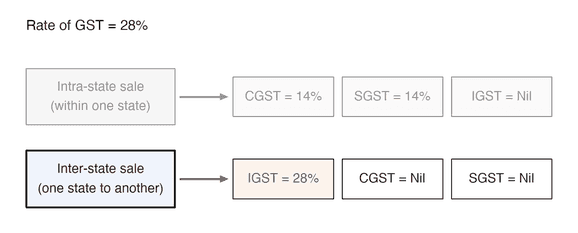
Step 3 — Read off the rate of SGST.
Since no SGST is charged in an inter-state sale, the rate of SGST is 0%.
Watch out: The equal split into CGST and SGST happens only when the buyer and the seller are in the same state.
Why the other options are wrong:
- (A) 28%: 28% is the rate of IGST for this sale, not of SGST.
- (B) 14%: 14% (half of 28%) would be the SGST only if both dealers were in the same state.
- (D) none of these: option (C), 0%, is correct, so “none of these” cannot be chosen.
Therefore, the rate of SGST is 0%, option (C).
- 41 mark
Question 4
In case of inter-state sales of goods or services, if GST rate is 18%, then :
Solve with AIAnswer
(A) IGST = 9%
(B) SGST = 9%
(C) CGST = 9%
- Correct
(D) IGST = 18%
Answer: (D) IGST = 18%
Concept: In an inter-state sale (from one state to another) the GST is not split. The whole rate is charged as IGST, and CGST and SGST are nil. The split into equal CGST and SGST happens only in an intra-state sale.
Step 1 — Recall how an inter-state sale is taxed.
For an inter-state sale, all of the GST goes into IGST, and CGST and SGST are both nil.
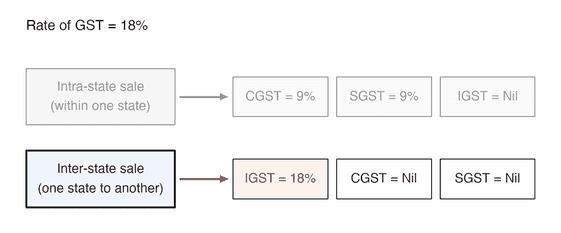
Step 2 — Apply it to a rate of 18%.
The rate of GST is 18% and the sale is inter-state, so the IGST is the full rate: IGST = 18%.
Watch out: IGST is never half of the GST rate. Halving happens only for CGST and SGST, and only in an intra-state sale.
Why the other options are wrong:
- (A) IGST = 9%: IGST is the full rate of GST, 18% here, not half of it.
- (B) SGST = 9%: SGST is charged only in a sale within one state. In an inter-state sale SGST is nil.
- (C) CGST = 9%: CGST is charged only in a sale within one state. In an inter-state sale CGST is nil.
Therefore, in an inter-state sale with GST at 18%, IGST = 18%, option (D).
- 51 mark
Question 5
The marked price of an article is ₹ 2,000. The GST on the article is 12% and discount is ₹ 500, the total amount to be paid is :
Solve with AIAnswer
(A) ₹ 2,800
- Correct
(B) ₹ 1,680
(C) ₹ 1,370
(D) ₹ 1,740
Answer: (B) ₹ 1,680
Concept: The discount is taken off first. GST is then charged on the price after discount. Here the discount is given as an amount (₹ 500), not as a percentage.
Step 1 — Find the price after discount.
We subtract the discount of ₹ 500 from the marked price of ₹ 2,000.
So the price after discount is ₹ 1,500.
Step 2 — Find the GST.
GST at 12% is charged on the price after discount.
So the GST is ₹ 180.
Step 3 — Find the amount to be paid.
The buyer pays the price after discount plus the GST on it.
So the amount to be paid is ₹ 1,680.
Watch out: Charging 12% GST on ₹ 2,000 first and then subtracting the ₹ 500 discount gives ₹ 1,740, which is wrong. GST is charged only after the discount.
Why the other options are wrong:
- (A) ₹ 2,800: this adds the discount instead of subtracting it (₹ 2,000 + ₹ 500 gives ₹ 2,500) and then adds 12% GST on ₹ 2,500.
- (C) ₹ 1,370: this is less than ₹ 1,500, the price after discount. Adding GST can only make the amount more than ₹ 1,500.
- (D) ₹ 1,740: this charges 12% GST on the marked price (₹ 2,000 + ₹ 240 gives ₹ 2,240) and only then takes off the ₹ 500 discount.
Therefore, the total amount to be paid is ₹ 1,680, option (B).
- 63 marks
Question 6
For the following transaction within Delhi, fill in the blanks to find the amount of bill :
MRP = ₹ 12,000
Discount% = 30%
GST% = 18%
Discount = ......................
Discounted value = ......................
CGST = ......................
SGST = ......................
IGST = ......................
Amount of bill = ......................
Solve with AIWritten solution
Solution:
Concept: A transaction within Delhi is an intra-state transaction. The GST of 18% is shared equally: CGST = 9% and SGST = 9%, and IGST is nil. All taxes are charged on the discounted value (MRP − discount).
Given: MRP = ₹ 12,000, discount = 30%, rate of GST = 18%, transaction within Delhi.
Step 1 — Find the discount.
The discount is 30% of the MRP.
So the discount is ₹ 3,600.
Step 2 — Find the discounted value.
We subtract the discount from the MRP.
So the discounted value is ₹ 8,400.
Step 3 — Find the CGST.
Within one state, CGST is half of 18%, that is 9%, charged on the discounted value.
So the CGST is ₹ 756.
Step 4 — Find the SGST and the IGST.
SGST is charged at the same rate as CGST, so the SGST is also ₹ 756. No IGST is charged on a sale within one state, so the IGST is nil.
Step 5 — Find the amount of bill.
The bill is the discounted value plus the CGST plus the SGST.
So the amount of bill is ₹ 9,912.

Filled blanks:
- Discount = ₹ 3,600
- Discounted value = ₹ 8,400
- CGST = ₹ 756
- SGST = ₹ 756
- IGST = Nil
- Amount of bill = ₹ 9,912
Check: Adding the full 18% GST on ₹ 8,400 in one go gives the same bill.
Watch out: GST is charged on the discounted value ₹ 8,400, not on the MRP ₹ 12,000.
Therefore, the amount of bill is ₹ 9,912.
- 73 marks
Question 7
For the following transaction from Delhi to Jaipur, fill in the blanks to find the amount of bill :
MRP = ₹ 50,000
Discount = 20%
GST = 28%
Discount = ......................
Discounted value = ......................
CGST = ......................
SGST = ......................
IGST = ......................
Amount of bill = ......................
Solve with AIWritten solution
Solution:
Concept: Delhi and Jaipur (in Rajasthan) are in different states, so this is an inter-state transaction. The whole GST of 28% is charged as IGST; CGST and SGST are nil. The tax is charged on the discounted value.
Given: MRP = ₹ 50,000, discount = 20%, rate of GST = 28%, transaction from Delhi to Jaipur.
Step 1 — Find the discount.
The discount is 20% of the MRP.
So the discount is ₹ 10,000.
Step 2 — Find the discounted value.
We subtract the discount from the MRP.
So the discounted value is ₹ 40,000.
Step 3 — Find the CGST and the SGST.
CGST and SGST are charged only on a sale within one state. This sale crosses a state border, so CGST = Nil and SGST = Nil.
Step 4 — Find the IGST.
The whole GST of 28% is charged as IGST on the discounted value.
So the IGST is ₹ 11,200.
Step 5 — Find the amount of bill.
The bill is the discounted value plus the IGST.
So the amount of bill is ₹ 51,200.

Filled blanks:
- Discount = ₹ 10,000
- Discounted value = ₹ 40,000
- CGST = Nil
- SGST = Nil
- IGST = ₹ 11,200
- Amount of bill = ₹ 51,200
Check: Adding 28% to ₹ 40,000 in one go gives the same bill.
Watch out: In an inter-state sale do not split 28% into 14% + 14%. All of it is IGST.
Therefore, the amount of bill is ₹ 51,200.
- 83 marks
Question 8
A computer mechanic in Delhi charges repairing cost from five different persons A, B, C, D and E with certain discounts.
The repairing costs and the corresponding discounts are as given below :
Name of the persons A B C D E Repairing cost (in ₹) 5,500 6,250 4,800 7,200 3,500 Discount% 30 40 30 20 40 If the rate of GST is 18%, find the total money (including GST) received by the mechanic.
Solve with AIWritten solution
Solution:
Concept: GST is charged on the cost after discount. A discount of 30% means the person pays 100% − 30%, that is 70%, of the cost. All five services carry the same rate of GST (18%), so we can add the five costs after discount and charge GST once on the total.
Given: Repairing costs and discounts as in the table; rate of GST = 18%.
Step 1 — Find the cost after discount for A.
We show person A in full; the others are worked the same way. First find the discount.
Then subtract it from the repairing cost.
So A pays ₹ 3,850 before GST. This is the same as 70% of ₹ 5,500.
Step 2 — Find the cost after discount for every person.
Each person pays (100 − discount)% of the repairing cost.
Person Repairing cost (₹) Discount Pays Cost after discount (₹) A 5,500 30% 70% 70% of 5,500 = 3,850 B 6,250 40% 60% 60% of 6,250 = 3,750 C 4,800 30% 70% 70% of 4,800 = 3,360 D 7,200 20% 80% 80% of 7,200 = 5,760 E 3,500 40% 60% 60% of 3,500 = 2,100 Step 3 — Add the five costs after discount.
Since the rate of GST is the same for everyone, we first find the total.
So the total cost after discount is ₹ 18,820.
Step 4 — Find the GST on the total.
GST at 18% is charged on the total cost after discount.
So the GST is ₹ 3,387.60. Nothing in the question mentions another state, so the service is intra-state: this GST is made up of CGST ₹ 1,693.80 and SGST ₹ 1,693.80.
Step 5 — Find the total money received.
The mechanic receives the total cost after discount plus the GST.
So the mechanic receives ₹ 22,207.60.
Watch out: Do not charge GST on the full repairing costs (₹ 27,250 in all). The discounts come off first.
Therefore, the total money received by the mechanic, including GST, is ₹ 22,207.60.
- 93 marks
Question 9
Find the amount of bill for the following intra-state transaction of goods/services. The GST rate is 5%.
Quantity (No. of items) MRP of each item (in ₹) Discount% 36 450 10 48 720 20 60 300 30 24 360 20 Solve with AIWritten solution
Solution:
Concept: For each row, first find the total MRP (quantity × MRP of one item) and take off the discount. GST is charged on the total value after discount. The sale is intra-state, so the GST of 5% is shared equally: CGST = 2.5% and SGST = 2.5%.
Given: Quantities, MRPs and discounts as in the table; intra-state sale; rate of GST = 5%.
Step 1 — Work out the first row in full.
We multiply the quantity by the MRP of one item to get the total MRP of the row.
Then we find the 10% discount on it.
Subtracting the discount gives the value after discount.
So the first row is worth ₹ 14,580 after discount. This is the same as 90% of ₹ 16,200.
Step 2 — Work out every row the same way.
Each row is worth (100 − discount)% of its total MRP.
Quantity MRP of each (₹) Total MRP (₹) Discount Value after discount (₹) 36 450 36 × 450 = 16,200 10% 90% of 16,200 = 14,580 48 720 48 × 720 = 34,560 20% 80% of 34,560 = 27,648 60 300 60 × 300 = 18,000 30% 70% of 18,000 = 12,600 24 360 24 × 360 = 8,640 20% 80% of 8,640 = 6,912 Step 3 — Add the values after discount.
All the items carry the same rate of GST, so we add the four values first.
So the total value after discount is ₹ 61,740.
Step 4 — Find the CGST and the SGST.
CGST is 2.5% of the total value after discount.
So the CGST is ₹ 1,543.50. In an intra-state sale SGST equals CGST, so the SGST is also ₹ 1,543.50.
Step 5 — Find the amount of bill.
The bill is the value after discount plus the CGST plus the SGST.
So the amount of bill is ₹ 64,827.
Check: Adding the full 5% GST in one go gives the same bill.
Watch out: Multiply the quantity by the MRP before taking the discount; the discount is a percentage of the whole row's MRP.
Therefore, the amount of bill is ₹ 64,827.
- 103 marks
Question 10
Find the amount of bill for the following inter-state transaction of goods/services. The GST rate is 18%.
Quantity (No. of items) 35 47 20 MRP of each item (in ₹) 420 600 350 Discount% 10 10 20 Solve with AIWritten solution
Solution:
Concept: For each item, find the total MRP (quantity × MRP of one item) and take off the discount. The sale is inter-state, so the whole GST of 18% is charged as IGST on the total value after discount; CGST and SGST are nil.
Given: Quantities, MRPs and discounts as in the table (each column is one item); inter-state sale; rate of GST = 18%.
Step 1 — Work out the first item in full.
We multiply the quantity by the MRP of one item.
Then we find the 10% discount on it.
Subtracting the discount gives the value after discount.
So the first item is worth ₹ 13,230 after discount.
Step 2 — Work out every item the same way.
Each item is worth (100 − discount)% of its total MRP.
Quantity MRP of each (₹) Total MRP (₹) Discount Value after discount (₹) 35 420 35 × 420 = 14,700 10% 90% of 14,700 = 13,230 47 600 47 × 600 = 28,200 10% 90% of 28,200 = 25,380 20 350 20 × 350 = 7,000 20% 80% of 7,000 = 5,600 Step 3 — Add the values after discount.
All the items carry the same rate, so we add the three values first.
So the total value after discount is ₹ 44,210.
Step 4 — Find the IGST.
In an inter-state sale the whole 18% is charged as IGST.
So the IGST is ₹ 7,957.80, and CGST and SGST are nil.
Step 5 — Find the amount of bill.
The bill is the value after discount plus the IGST.
So the amount of bill is ₹ 52,167.80.
Check: Adding the full 18% in one go gives the same bill.
Watch out: The table is laid out in columns here: each column is one item.
Therefore, the amount of bill is ₹ 52,167.80.
- 113 marks
Question 11
Find the amount of bill for the following intra-state transaction of goods/services.
MRP (in ₹) 12,000 15,000 9,500 18,000 Discount% 30 20 30 40 CGST% 6 9 14 2·5 Solve with AIWritten solution
Solution:
Concept: Each item has its own rate of tax, so the tax is found item by item, on the value after discount. The sale is intra-state, so for every item SGST is charged at the same rate as CGST (the book prints 2·5 for 2.5).
Given: MRPs, discounts and CGST rates as in the table (each column is one item); intra-state sale.
Step 1 — Work out the first item in full.
We find the 30% discount on the MRP of ₹ 12,000.
Subtracting it gives the value after discount.
CGST at 6% is charged on this value.
So the first item has CGST of ₹ 504.
Step 2 — Work out every item the same way.
Each item's CGST is its own rate applied to its own value after discount.
MRP (₹) Discount Value after discount (₹) CGST% CGST (₹) 12,000 30% 70% of 12,000 = 8,400 6% 6% of 8,400 = 504 15,000 20% 80% of 15,000 = 12,000 9% 9% of 12,000 = 1,080 9,500 30% 70% of 9,500 = 6,650 14% 14% of 6,650 = 931 18,000 40% 60% of 18,000 = 10,800 2.5% 2.5% of 10,800 = 270 Step 3 — Add the values after discount.
We add the four values after discount.
So the total value after discount is ₹ 37,850.
Step 4 — Add the CGST of the four items.
We add the CGST column.
So the total CGST is ₹ 2,785. In an intra-state sale SGST equals CGST item by item, so the total SGST is also ₹ 2,785.
Step 5 — Find the amount of bill.
The bill is the value after discount plus the CGST plus the SGST.
So the amount of bill is ₹ 43,420.
Watch out: The table gives the CGST rate, not the GST rate. SGST must be added as well, at the same rate.
Therefore, the amount of bill is ₹ 43,420.
- 123 marks
Question 12
For the data given above in question no. 7, find the amount of bill for the inter-state transaction.
Data from question no. 7 :
MRP (in ₹) 12,000 15,000 9,500 18,000 Discount% 30 20 30 40 CGST% 6 9 14 2·5 Solve with AIWritten solution
Solution:
Concept: In an inter-state sale there is no CGST and no SGST; the full rate of GST is charged as IGST. Since GST rate = CGST rate + SGST rate and the two are equal, the IGST rate is twice the CGST rate given in the table.
Given: The data of question 7 (MRPs, discounts and CGST rates); the transaction is now inter-state.
Step 1 — Find the IGST rate of each item.
We double each CGST rate in the table.
- Item 1: 2 × 6% = 12%
- Item 2: 2 × 9% = 18%
- Item 3: 2 × 14% = 28%
- Item 4: 2 × 2.5% = 5%
Step 2 — Work out the first item in full.
We find the 30% discount on the MRP of ₹ 12,000.
Subtracting it gives the value after discount.
IGST at 12% is charged on this value.
So the first item has IGST of ₹ 1,008.
Step 3 — Work out every item the same way.
Each item's IGST is its own IGST rate applied to its own value after discount.
MRP (₹) Discount Value after discount (₹) IGST% IGST (₹) 12,000 30% 70% of 12,000 = 8,400 12% 12% of 8,400 = 1,008 15,000 20% 80% of 15,000 = 12,000 18% 18% of 12,000 = 2,160 9,500 30% 70% of 9,500 = 6,650 28% 28% of 6,650 = 1,862 18,000 40% 60% of 18,000 = 10,800 5.0% 5.0% of 10,800 = 540 Step 4 — Add the IGST of the four items.
We add the IGST column.
So the total IGST is ₹ 5,570.
Step 5 — Find the amount of bill.
The bill is the total value after discount (₹ 37,850, as in question 7) plus the IGST.
So the amount of bill is ₹ 43,420.
Watch out: Do not charge the CGST rate alone as IGST. IGST is the whole GST rate, twice the CGST rate.
Note: The bill is the same as in question 7. Only the way the tax is shared changes: there the ₹ 5,570 of tax went as CGST ₹ 2,785 + SGST ₹ 2,785; here all of it is IGST.
Therefore, the amount of bill for the inter-state transaction is ₹ 43,420.
- 133 marks
Question 13
A dealer in Mumbai supplied some identical items at the following prices to a dealer in Delhi. Find the total amount of the bill.
Rate per item (in ₹) Quantity (no. of items) Discount% SGST% 180 10 — 9 260 20 20 9 310 30 — 9 175 20 30 9 Solve with AIWritten solution
Solution:
Concept: SGST is half of the GST rate, so SGST = 9% tells us that the rate of GST is 18%. The goods go from Mumbai (Maharashtra) to Delhi, which is an inter-state sale, so the whole 18% is charged as IGST on the value after discount.
Given: Rates, quantities and discounts as in the table; SGST = 9% for every item; sale from Mumbai to Delhi.
Step 1 — Find the rate of GST.
GST rate = CGST rate + SGST rate, and the two are equal, so the GST rate is twice the SGST rate.
Step 2 — Work out the second row in full.
We take the second row because it has a discount. First multiply the rate per item by the quantity.
Then find the 20% discount.
Subtracting it gives the value after discount.
So this row is worth ₹ 4,160 after discount.
Step 3 — Work out every row the same way.
A dash (—) means no discount, so the full value is taken.
Rate per item (₹) Quantity Total (₹) Discount Value after discount (₹) 180 10 180 × 10 = 1,800 — 1,800 260 20 260 × 20 = 5,200 20% 80% of 5,200 = 4,160 310 30 310 × 30 = 9,300 — 9,300 175 20 175 × 20 = 3,500 30% 70% of 3,500 = 2,450 Step 4 — Add the values after discount.
We add the four values.
So the total value after discount is ₹ 17,710.
Step 5 — Find the IGST.
In an inter-state sale the whole 18% is charged as IGST.
So the IGST is ₹ 3,187.80.
Step 6 — Find the total amount of the bill.
The bill is the value after discount plus the IGST.
So the bill comes to ₹ 20,897.80.
Check: Adding the full 18% in one go gives the same bill.
Watch out: The table prints an SGST rate, but this sale crosses a state border, so no SGST is actually charged. The 9% only tells us the GST rate.
Therefore, the total amount of the bill is ₹ 20,897.80.
- 143 marks
Question 14
M/s Unique Traders, Delhi, provided the following services to M/s Geeta Trading Company in Kanpur (UP). Find the amount of bill :
Number of services 8 12 10 16 Cost of each service (in ₹) 680 320 260 420 GST% 5 12 18 12 Solve with AIWritten solution
Solution:
Concept: The services go from Delhi to Kanpur (UP), which is an inter-state supply, so the GST is charged as IGST. Each service has its own rate, so the tax is found column by column and then added.
Given: Number of services, cost of each and GST rates as in the table; no discount; supply from Delhi to Kanpur (UP).
Step 1 — Work out the first service in full.
We multiply the number of services by the cost of each.
IGST at 5% is charged on this cost.
So the first service carries IGST of ₹ 272.
Step 2 — Work out every service the same way.
Each column is one kind of service with its own rate.
Number of services Cost of each (₹) Total cost (₹) GST% IGST (₹) 8 680 8 × 680 = 5,440 5% 5% of 5,440 = 272 12 320 12 × 320 = 3,840 12% 12% of 3,840 = 460.80 10 260 10 × 260 = 2,600 18% 18% of 2,600 = 468 16 420 16 × 420 = 6,720 12% 12% of 6,720 = 806.40 Step 3 — Add the costs.
We add the total-cost column.
So the services cost ₹ 18,600 before tax.
Step 4 — Add the IGST.
We add the IGST column.
So the total IGST is ₹ 2,007.20.
Step 5 — Find the amount of bill.
The bill is the total cost plus the total IGST.
So the amount of bill is ₹ 20,607.20.
Watch out: The rates differ from column to column, so do not charge one rate on the whole ₹ 18,600.
Therefore, the amount of bill is ₹ 20,607.20.
- 153 marks
Question 15
The tax invoice of a telecom service in Surat shows cost of services provided by it as ₹ 750. If the GST rate is 18%, find the amount of the bill.
Solve with AIWritten solution
Solution:
Concept: Amount of bill = cost of services + GST on it. Nothing in the question mentions another state, so the supply is taken as intra-state and the GST of 18% is shared equally: CGST = 9% and SGST = 9%.
Given: Cost of services = ₹ 750, rate of GST = 18%.
Step 1 — Find the CGST.
CGST is 9% of the cost of services.
So the CGST is ₹ 67.50.
Step 2 — Find the SGST.
In an intra-state supply SGST equals CGST, so the SGST is also ₹ 67.50.
Step 3 — Find the amount of the bill.
The bill is the cost of services plus the CGST plus the SGST.
So the bill comes to ₹ 885.
Check: The full GST is 18% of ₹ 750, which is ₹ 135, and the bill is the cost plus this GST.
Watch out: The bill includes both halves of the tax, CGST and SGST, not just one of them.
Therefore, the amount of the bill is ₹ 885.
- 163 marks
Question 16
Ms. Pratima took Health Insurance Policy for her family and paid ₹ 900 as SGST. Find the total annual premium, including GST, paid by her for this policy. The rate of GST being 18%.
Solve with AIWritten solution
Solution:
Concept: SGST is half of the GST. With GST at 18% (the rate given in the question), SGST = 9% and CGST = 9% of the premium. We know the SGST amount, so we work backwards to find the premium, then add both taxes.
Given: SGST paid = ₹ 900, rate of GST = 18%.
Step 1 — Form an equation.
Let the annual premium, before GST, be ₹ . SGST is 9% of , and this equals ₹ 900.
Step 2 — Solve for .
We multiply both sides by 100 and divide by 9.
So the premium before GST is ₹ 10,000.
Step 3 — Find the CGST.
In an intra-state supply CGST equals SGST, so the CGST is also ₹ 900.
Step 4 — Find the total premium including GST.
The total is the premium plus the CGST plus the SGST.
So the total annual premium is ₹ 11,800.

Check: 9% of ₹ 10,000 is ₹ 900, the SGST given. Also, adding the full 18% to the premium gives the same total.
Watch out: ₹ 900 is only the SGST, which is half of the GST. Do not take ₹ 900 as the whole tax.
Therefore, the total annual premium paid by Ms. Pratima, including GST, is ₹ 11,800.
- 173 marks
Question 17
Mr. Malik went on a tour to Goa. He took a room in a hotel for two days at the rate of ₹ 5,000 per day. On the same day, his friend John also joined him. The hotel provided an extra bed charging ₹ 1,000 per day for the bed. How much GST, at the rate of 28% is charged by the hotel in the bill to Mr. Malik, for both the days ?
Solve with AIWritten solution
Solution:
Concept: GST is charged on the total cost of all the services in the bill: the room and the extra bed, for both days.
Given: Room = ₹ 5,000 per day, extra bed = ₹ 1,000 per day, stay = 2 days, rate of GST = 28%.
Step 1 — Find the cost of the room.
The room costs ₹ 5,000 per day for 2 days.
So the room costs ₹ 10,000.
Step 2 — Find the cost of the extra bed.
John joined on the same day, so the extra bed is also used for 2 days at ₹ 1,000 per day.
So the extra bed costs ₹ 2,000.
Step 3 — Find the total cost of services.
We add the room and the extra bed.
So the services cost ₹ 12,000.
Step 4 — Find the GST.
GST at 28% is charged on the total cost of services.
So the GST in the bill is ₹ 3,360.
Check: GST for one day is 28% of ₹ 6,000, which is ₹ 1,680, so for two days it is twice that.
Watch out: Include the extra bed and both days. Charging GST on one day's room rent alone (₹ 5,000) would give only ₹ 1,400.
Therefore, the hotel charges ₹ 3,360 as GST in Mr. Malik's bill for both days.
- 181 mark
Question 18
Under GST 'value addition' refers to :
Solve with AIAnswer
(A) cost plus tax plus profit
(B) cost plus tax
- Correct
(C) expenses plus profit
(D) tax plus profit
Answer: (C) expenses plus profit
Concept: Value addition is the extra value a dealer adds to goods between buying them and selling them again. It is the difference between his selling price and his cost price, and it is made up of his expenses (transport, packing, labour and so on) and his profit.
Step 1 — See what the dealer starts with.
A dealer buys the goods at a cost price. This cost was already there before he did anything, so it is not value he adds.
Step 2 — See what the dealer adds.
Before selling, the dealer spends money on expenses and then keeps a profit. These two raise the price from the cost price to the selling price.
Step 3 — Link it with GST.
At each stage a dealer deposits (GST on his sale) − (GST on his purchase). When the rate is the same at both stages, this is exactly the GST on his value addition. That is why GST is called a tax on value addition.
Watch out: Tax is not part of the value added. GST is charged on the value; it is not itself value.
Why the other options are wrong:
- (A) cost plus tax plus profit: the cost was there before the dealer added anything, and tax is not value added to the goods.
- (B) cost plus tax: neither the cost nor the tax is added by the dealer, and the expenses and profit, which are the real value added, are missing.
- (D) tax plus profit: tax is not part of the value of the goods, and the dealer's expenses are left out.
Therefore, under GST, value addition means expenses plus profit, option (C).
- 191 mark
Question 19
If the rate of GST is 18%, the IGST for an inter-state sale is :
Solve with AIAnswer
(A) 9%
- Correct
(B) 18%
(C) 6%
(D) 12%
Answer: (B) 18%
Concept: In an inter-state sale (from one state to another) the GST is not split. The whole rate is charged as IGST, and CGST and SGST are nil.
Step 1 — Recall the two cases.
With GST at 18%, the tax is charged as follows.
- Intra-state sale: CGST = 9% and SGST = 9%; IGST is nil.
- Inter-state sale: IGST = 18%; CGST and SGST are nil.
Step 2 — Apply it here.
The sale is inter-state, so the IGST is the full rate of GST: IGST = 18%.
Watch out: IGST is never half of the GST rate; only CGST and SGST are halves, and only within one state.
Why the other options are wrong:
- (A) 9%: 9% is the CGST (or the SGST) rate in a sale within one state, not the IGST rate.
- (C) 6%: 6% would be the CGST or SGST rate if the GST rate were 12%. Here IGST is the full 18%.
- (D) 12%: 12% is a different GST slab. The rate given here is 18%, and IGST is all of it.
Therefore, the IGST for an inter-state sale with GST at 18% is 18%, option (B).
- 201 mark
Question 20
If a dealer supplies goods worth ₹ 3,000 to another local dealer with 28% GST, then the tax levied under CGST is :
Solve with AIAnswer
(A) ₹ 270
(B) ₹ 540
(C) ₹ 840
- Correct
(D) ₹ 420
Answer: (D) ₹ 420
Concept: A “local dealer” is in the same state, so the sale is intra-state. The GST is then shared equally between CGST (Centre) and SGST (state).
Step 1 — Find the rate of CGST.
CGST is half of the GST rate in an intra-state sale.
Step 2 — Find the CGST.
CGST at 14% is charged on the value of the goods, ₹ 3,000.
So the tax levied under CGST is ₹ 420.
Watch out: The question asks only for the CGST, which is half of the GST. The other half is the SGST.
Why the other options are wrong:
- (A) ₹ 270: ₹ 270 is 9% of ₹ 3,000, which would be the CGST if the rate of GST were 18%.
- (B) ₹ 540: ₹ 540 is 18% of ₹ 3,000. The rate here is 28%, and only half of it is CGST.
- (C) ₹ 840: ₹ 840 is the full GST (28% of ₹ 3,000). The CGST is only half of it.
Therefore, the tax levied under CGST is ₹ 420, option (D).
- 211 mark
Question 21
For a registered dealer, if input tax is ₹ and output tax is ₹ , then the tax liability on the dealer is :
Solve with AIAnswer
(A) ₹
(B) ₹
- Correct
(C) ₹
(D) ₹
Answer: (C) ₹
Concept: A registered dealer does not deposit all the GST he collects. He takes credit for the GST he has already paid on his purchase (input tax) and deposits only the rest of the GST he collected on his sale (output tax).
Step 1 — Name the two taxes.
We write down what each tax means.
- Input tax is the GST the dealer paid when buying: ₹ .
- Output tax is the GST the dealer collected when selling: ₹ .
Step 2 — Recall the rule.
The dealer's tax liability is the output tax minus the input tax.
Step 3 — Put in the values.
We replace the output tax by and the input tax by .
So the tax liability is ₹ .

Watch out: The subtraction is output minus input, not the other way round.
Why the other options are wrong:
- (A) ₹ : ₹ is only the input tax, which the dealer has already paid to his supplier.
- (B) ₹ : this subtracts the wrong way round. A dealer normally sells for more than he buys, so is larger than and would be negative.
- (D) ₹ : ₹ is the whole output tax. It forgets the credit for the input tax ₹ already paid.
Therefore, the tax liability on the dealer is ₹ , option (C).
- 221 mark
Question 22
John sells goods worth ₹ 2,000 to Manish belonging to the same state. John gives a discount of 20% and charges GST = 5%. Then John gets :
Solve with AIAnswer
(A) ₹ 20
(B) ₹ 850
- Correct
(C) ₹ 1,680
(D) ₹ 2,520
Answer: (C) ₹ 1,680
Concept: The discount is taken off first, and GST is charged on the price after discount. John collects this price plus the GST from Manish.
Step 1 — Find the discount.
The discount is 20% of the value of the goods.
So the discount is ₹ 400.
Step 2 — Find the price after discount.
We subtract the discount from ₹ 2,000.
So the price after discount is ₹ 1,600.
Step 3 — Find the GST.
GST at 5% is charged on the price after discount.
So the GST is ₹ 80. Both are in the same state, so this is CGST ₹ 40 + SGST ₹ 40.
Step 4 — Find the money John gets.
John gets the price after discount plus the GST.
So John gets ₹ 1,680.
Watch out: The discount is subtracted from ₹ 2,000 before GST is worked out.
Why the other options are wrong:
- (A) ₹ 20: ₹ 20 is 5% of the discount ₹ 400. It is not an amount John receives for the goods.
- (B) ₹ 850: ₹ 850 is less than the price after discount, ₹ 1,600. Adding GST can only make the amount more than ₹ 1,600.
- (D) ₹ 2,520: this adds the discount instead of subtracting it (₹ 2,000 + ₹ 400 gives ₹ 2,400) and then adds 5% GST on ₹ 2,400.
Therefore, John gets ₹ 1,680, option (C).
- 233 marks
Question 23
Fill in the blanks :
When the goods/services are sold for ₹ 15,000 under intra-state transaction from station A to station B and the rate of GST is 12%,
As per GST system
(a) S.P. (excluding GST) at station A = ......................
(b) CGST = ......................
SGST = ......................
(c) C.P. (excluding GST) at station B = ......................
(d) If profit = ₹ 5,000
S.P. at station B = ......................
Now the same goods/services are moved under inter-state transaction from station B to station C and the rate of tax is 12%.
(e) GST = ......................
(f) C.P. (excluding GST) at station C = ......................
Solve with AIWritten solution
Solution:
Concept: The price at which one station sells (excluding GST) is exactly the price at which the next station buys (excluding GST). GST is added on top and is never counted in the cost price or the selling price.
Given: Goods sold from A to B for ₹ 15,000 (intra-state); profit at B = ₹ 5,000; then sold from B to C (inter-state); rate of GST = 12% each time.
Step 1 — Part (a): S.P. at station A.
The goods are sold from A for ₹ 15,000, so the S.P. (excluding GST) at station A is ₹ 15,000.
Step 2 — Part (b): CGST and SGST.
The sale from A to B is intra-state, so the 12% GST is split equally: CGST = 6% and SGST = 6%.
So CGST = ₹ 900. SGST is at the same rate, so SGST = ₹ 900.
Step 3 — Part (c): C.P. at station B.
B buys at the price at which A sold, so the C.P. (excluding GST) at station B is ₹ 15,000.
Step 4 — Part (d): S.P. at station B.
The selling price is the cost price plus the profit of ₹ 5,000.
So the S.P. at station B is ₹ 20,000.
Step 5 — Part (e): GST on the sale from B to C.
This sale is inter-state, so the whole 12% is charged as IGST on B's selling price.
So the GST is ₹ 2,400.
Step 6 — Part (f): C.P. at station C.
C buys at the price at which B sold, so the C.P. (excluding GST) at station C is ₹ 20,000.
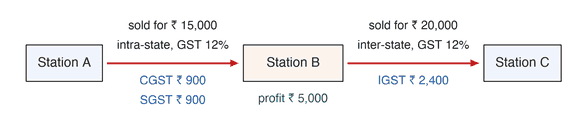
Watch out: The GST paid by B (₹ 1,800) is not added to B's cost price. Cost and selling prices under GST are always taken excluding the tax.
Therefore, (a) ₹ 15,000; (b) CGST = ₹ 900, SGST = ₹ 900; (c) ₹ 15,000; (d) ₹ 20,000; (e) ₹ 2,400; (f) ₹ 20,000.
- 243 marks
Question 24
Goods/services are sold from Agra (U.P.) to Kanpur (U.P.) for ₹ 20,000 and then from Kanpur to Jaipur (Rajasthan). If the rate of GST is 18% and the profit made at Kanpur is ₹ 5,000, find : the net GST payable by the dealer at Kanpur (GST received − GST paid).
Solve with AIWritten solution
Solution:
Concept: The dealer at Kanpur pays GST when he buys (input tax) and collects GST when he sells (output tax). He deposits only the difference: net GST payable = GST received − GST paid.
Given: Agra to Kanpur for ₹ 20,000; profit at Kanpur = ₹ 5,000; then Kanpur to Jaipur; rate of GST = 18%.
Step 1 — Find the GST paid by the Kanpur dealer.
Agra and Kanpur are both in U.P., so the sale is intra-state: CGST = 9% and SGST = 9% of ₹ 20,000.
SGST equals CGST, so SGST = ₹ 1,800 too. Adding the two halves gives the GST he paid.
So the input tax is ₹ 3,600.
Step 2 — Find the selling price at Kanpur.
The selling price is the cost price plus the profit.
So he sells for ₹ 25,000.
Step 3 — Find the GST received by the Kanpur dealer.
Kanpur (U.P.) and Jaipur (Rajasthan) are in different states, so the sale is inter-state and the whole 18% is charged as IGST on ₹ 25,000.
So the output tax is ₹ 4,500.
Step 4 — Find the net GST payable.
We subtract the GST paid from the GST received.
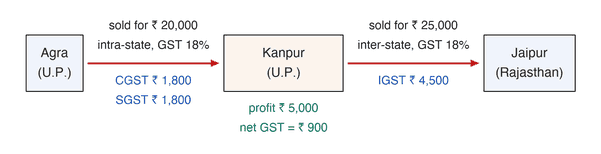
Check: The net GST is the GST on the dealer's value addition (his profit).
Watch out: The input tax was paid as CGST + SGST and the output tax is IGST, but both are GST at 18%, so they can be set off against each other.
Therefore, the net GST payable by the dealer at Kanpur is ₹ 900.
- 253 marks
Question 25
Goods/services are sold from Kota (Rajasthan) to Mumbai for ₹ 20,000 and then from Mumbai to Pune. If the rate of GST is 12% and the profit made at Mumbai is ₹ 5,000; find the net GST paid at Pune, if the dealer at Pune does not sell the goods further.
Solve with AIWritten solution
Solution:
Concept: The dealer at Pune does not sell the goods further, so he is the end-user. He collects no GST from anyone, so he has nothing to set his input tax against. The GST he pays when buying is his net GST.
Given: Kota to Mumbai for ₹ 20,000; profit at Mumbai = ₹ 5,000; then Mumbai to Pune; rate of GST = 12%.
Step 1 — Find the price at which the Pune dealer buys.
The Mumbai dealer sells at his cost price plus his profit.
So the Pune dealer buys for ₹ 25,000 (excluding GST).
Step 2 — Find the GST on the sale from Mumbai to Pune.
Mumbai and Pune are both in Maharashtra, so the sale is intra-state: CGST = 6% and SGST = 6% of ₹ 25,000.
SGST equals CGST, so SGST = ₹ 1,500 too. Adding the two halves gives the GST.
Step 3 — Find the net GST paid at Pune.
The Pune dealer pays ₹ 3,000 as GST and collects nothing, so his net GST is the whole ₹ 3,000.
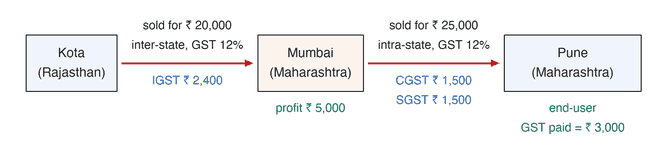
Check: This is the GST on the full final value, 12% of ₹ 25,000. Of it, ₹ 2,400 reaches the government through the Kota dealer (IGST on ₹ 20,000) and the rest through the Mumbai dealer.
Watch out: The Kota-to-Mumbai sale is inter-state (IGST) but the Mumbai-to-Pune sale is intra-state (CGST + SGST). Decide the type of each sale separately.
Therefore, the net GST paid at Pune is ₹ 3,000.
- 263 marks
Question 26
A is a dealer in Banaras (UP). He supplies goods/services worth ₹ 8,000 to a dealer B in Agra (UP). Dealer B, in turn, supplies the same goods/services to dealer C in Patna (Bihar) at a profit of ₹ 1,200. Find the input and output taxes for the dealer C under GST system; if the rate of GST is 18% and C does not sell his goods/services further.
Solve with AIWritten solution
Solution:
Concept: Input tax is the GST a dealer pays when he buys. Output tax is the GST a dealer collects when he sells. Dealer C buys from B but does not sell further.
Given: A sells to B for ₹ 8,000; B sells to C at a profit of ₹ 1,200; rate of GST = 18%; C does not sell further.
Step 1 — Find the price at which C buys.
B sells at his cost price plus his profit.
So C buys the goods for ₹ 9,200 (excluding GST).
Step 2 — Find the input tax for C.
Agra (UP) and Patna (Bihar) are in different states, so the sale from B to C is inter-state and the whole 18% is charged as IGST on ₹ 9,200.
So the input tax for C is ₹ 1,656.
Step 3 — Find the output tax for C.
C does not sell the goods further, so C collects no GST from anyone. The output tax for C is nil.

Watch out: The sale from A to B (both in UP; CGST ₹ 720 + SGST ₹ 720) is B's input tax. It does not enter C's input or output tax.
Therefore, for dealer C, the input tax is ₹ 1,656 and the output tax is nil.
- 273 marks
Question 27
A is a dealer in Meerut (UP). He supplies goods/services, worth ₹ 15,000 to a dealer B in Ratlam (M.P.). Dealer B, in turn, supplies the same goods/services to dealer C in Jabalpur (MP) at a profit of ₹ 3,000. If rate of tax (under GST system) is 18%, find :
(i) the cost (including GST) of goods/services to the dealer C in Jabalpur (assuming that the dealer C does not sell the goods/services further).
(ii) net tax payable by dealer B.
Solve with AIWritten solution
Solution:
Concept: Decide the type of sale at each stage first. Meerut (UP) to Ratlam (MP) is inter-state, so IGST is charged. Ratlam (MP) to Jabalpur (MP) is intra-state, so CGST and SGST are charged. A dealer's net tax = output tax − input tax.
Given: A sells to B for ₹ 15,000; B sells to C at a profit of ₹ 3,000; rate of GST = 18%; C does not sell further.
Step 1 — Find the tax on the sale from A to B.
This sale is inter-state, so the whole 18% is charged as IGST on ₹ 15,000. It is B's input tax.
So B's input tax is ₹ 2,700.
Step 2 — Find B's selling price.
B sells at his cost price plus his profit.
So B sells for ₹ 18,000.
Step 3 — Find the tax on the sale from B to C.
This sale is intra-state, so CGST = 9% and SGST = 9% of ₹ 18,000.
SGST equals CGST, so SGST = ₹ 1,620 too. Together they are B's output tax.
Step 4 — Part (i): cost to dealer C, including GST.
C pays B's selling price plus the CGST and the SGST.
So the cost to C is ₹ 21,240.
Step 5 — Part (ii): net tax payable by B.
B deposits his output tax minus his input tax.
So B pays ₹ 540.

Check: The net tax of B is the GST on B's profit.
Watch out: B's input tax is IGST and his output tax is CGST + SGST; the set-off still works because both are GST at 18%.
Therefore, (i) the cost to dealer C, including GST, is ₹ 21,240; (ii) the net tax payable by dealer B is ₹ 540.
- 283 marks
Question 28
A dealer X in Hapur (UP) supplies goods/services, worth ₹ 50,000 to some other dealer Y in the same city. Now the dealer Y supplies the same goods/services to dealer Z in Calcutta at a profit of ₹ 20,000. Find :
(i) output and input taxes for the dealer Y.
(ii) net GST payable by dealer Y.
[The rate of GST at each stage is 28%].
Solve with AIWritten solution
Solution:
Concept: For dealer Y, the input tax is the GST he pays when buying from X, and the output tax is the GST he collects when selling to Z. He deposits the difference.
Given: X sells to Y for ₹ 50,000; Y sells to Z at a profit of ₹ 20,000; rate of GST = 28% at each stage.
Step 1 — Find the input tax for Y.
X and Y are in the same city, Hapur (UP), so the sale is intra-state: CGST = 14% and SGST = 14% of ₹ 50,000.
SGST equals CGST, so SGST = ₹ 7,000 too. Adding the two halves gives Y's input tax.
Step 2 — Find Y's selling price.
Y sells at his cost price plus his profit.
So Y sells for ₹ 70,000.
Step 3 — Find the output tax for Y.
Hapur is in UP and Calcutta is in West Bengal, so the sale is inter-state and the whole 28% is charged as IGST on ₹ 70,000.
So Y's output tax is ₹ 19,600.
Step 4 — Part (i): output and input taxes.
From Steps 1 and 3, Y's output tax is ₹ 19,600 and his input tax is ₹ 14,000.
Step 5 — Part (ii): net GST payable by Y.
Y deposits the output tax minus the input tax.
So Y pays ₹ 5,600.

Check: The net GST is the GST on Y's profit.
Watch out: The input tax is the whole GST Y paid (CGST + SGST, ₹ 14,000), not just the CGST.
Therefore, (i) for Y, the output tax is ₹ 19,600 and the input tax is ₹ 14,000; (ii) the net GST payable by Y is ₹ 5,600.
- 293 marks
Question 29
Consultancy services, worth ₹ 50,000, are transferred from Delhi to Kolkata at the rate of GST 18% and then from Kolkata to Nainital (with profit = ₹ 20,000) at the same rate of GST. Find the output tax at :
(i) Delhi (ii) Kolkata (iii) Nainital
[Consider the dealer at Nainital as end-user].
Solve with AIWritten solution
Solution:
Concept: Output tax is the GST a dealer collects when he sells. Both transfers here are from one state to another, so IGST is charged each time.
Given: Services worth ₹ 50,000 go from Delhi to Kolkata; then from Kolkata to Nainital at a profit of ₹ 20,000; rate of GST = 18% each time; the dealer at Nainital is the end-user.
Step 1 — Part (i): output tax at Delhi.
Delhi and Kolkata (West Bengal) are in different states, so the sale is inter-state and the whole 18% is charged as IGST on ₹ 50,000.
So the output tax at Delhi is ₹ 9,000.
Step 2 — Find the selling price at Kolkata.
Kolkata sells at its cost price plus the profit.
So Kolkata sells for ₹ 70,000.
Step 3 — Part (ii): output tax at Kolkata.
Kolkata (West Bengal) and Nainital (Uttarakhand) are in different states, so this sale is also inter-state and IGST at 18% is charged on ₹ 70,000.
So the output tax at Kolkata is ₹ 12,600.
Step 4 — Part (iii): output tax at Nainital.
The dealer at Nainital is the end-user. He does not sell the services further, so he collects no GST. The output tax at Nainital is nil.
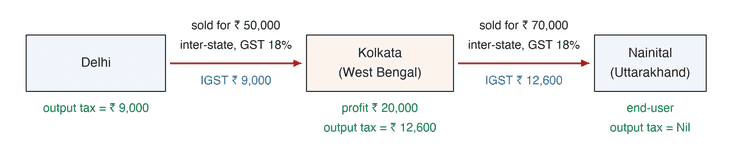
Watch out: Kolkata deposits only ₹ 12,600 − ₹ 9,000, that is ₹ 3,600, but the question asks for the output tax, which is the full ₹ 12,600.
Therefore, the output tax is (i) ₹ 9,000 at Delhi, (ii) ₹ 12,600 at Kolkata and (iii) nil at Nainital.
- 303 marks
Question 30
For a trader, marked price of a refrigerator = ₹ 15,680 exclusive of GST, (GST is 12%). Gagan, a customer for this refrigerator, asks the trader to reduce the price of the refrigerator to such an extent that its reduced price plus GST is equal to the marked price of the refrigerator. Find the required reduction.
Solve with AIWritten solution
Solution:
Concept: GST is charged on the reduced price. Gagan wants the reduced price plus the GST on it to equal the marked price of ₹ 15,680. So we let the reduced price be ₹ and form an equation.
Given: Marked price (exclusive of GST) = ₹ 15,680, rate of GST = 12%.
Step 1 — Form an equation.
Let the reduced price be ₹ . The reduced price plus 12% GST on it must equal the marked price.
Step 2 — Combine the terms on the left.
Taking common, 1 + 12/100 gives 112/100.
Step 3 — Solve for .
We multiply both sides by 100 and divide by 112.
So the reduced price is ₹ 14,000.
Step 4 — Find the reduction.
The reduction is the marked price minus the reduced price.
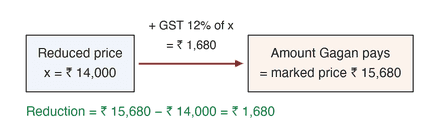
Check: GST on the reduced price is 12% of ₹ 14,000, which is ₹ 1,680, and the reduced price plus this GST is the marked price.
Watch out: Do not simply take 12% of ₹ 15,680 (₹ 1,881.60) off the price. GST is charged on the reduced price, so we must solve the equation.
Therefore, the required reduction is ₹ 1,680.
- 311 mark
Question 31
A retailer purchased an item for ₹ 8,000 from a wholesaler and sells to a customer at 15% profit. The sales are intra-state and the rate of GST is 10%. The amount of GST paid by the customer is :
Solve with AIAnswer
(A) ₹ 460
- Correct
(B) ₹ 920
(C) ₹ 1,840
(D) ₹ 92
Answer: (B) ₹ 920
Concept: The customer pays GST on the price at which the retailer sells to him, not on the retailer's cost price. In an intra-state sale this GST is shared equally as CGST and SGST, but the customer pays both halves.
Step 1 — Find the profit.
The profit is 15% of the retailer's cost price of ₹ 8,000.
So the profit is ₹ 1,200.
Step 2 — Find the selling price.
The selling price is the cost price plus the profit.
So the retailer sells for ₹ 9,200.
Step 3 — Find the GST paid by the customer.
GST at 10% is charged on the selling price.
So the customer pays ₹ 920 as GST. The sale is intra-state, so this is CGST ₹ 460 + SGST ₹ 460.
Watch out: The GST is charged on the selling price ₹ 9,200, not on the cost price ₹ 8,000.
Why the other options are wrong:
- (A) ₹ 460: ₹ 460 is only the CGST (or only the SGST). The customer pays both halves.
- (C) ₹ 1,840: ₹ 1,840 is twice the GST, as if CGST and SGST were each 10%. Each is 5%.
- (D) ₹ 92: ₹ 92 is 1% of ₹ 9,200, a slip of the decimal point. 10% of ₹ 9,200 is ₹ 920.
Therefore, the amount of GST paid by the customer is ₹ 920, option (B).
- 321 mark
Question 32
A retailer purchased an item for ₹ 8,000 from a wholesaler and sells to a customer at 15% profit. The sales are inter-state and the rate of GST paid by the customer is 10%. The amount of GST paid by the customer is:
Solve with AIAnswer
(A) ₹ 460
- Correct
(B) ₹ 920
(C) ₹ 1,840
(D) ₹ 92
Answer: (B) ₹ 920
Concept: Whether a sale is intra-state or inter-state changes who receives the tax, not how much tax the customer pays. In an inter-state sale the whole GST is charged as IGST.
Step 1 — Find the profit.
The profit is 15% of the retailer's cost price of ₹ 8,000.
So the profit is ₹ 1,200.
Step 2 — Find the selling price.
The selling price is the cost price plus the profit.
So the retailer sells for ₹ 9,200.
Step 3 — Find the GST paid by the customer.
The sale is inter-state, so the full 10% is charged as IGST on the selling price.
So the customer pays ₹ 920, all of it as IGST. This is the same amount as in Q1(a); there it was split into CGST and SGST.
Watch out: IGST is not split into halves. It is the full rate of GST.
Why the other options are wrong:
- (A) ₹ 460: ₹ 460 is half of the GST. IGST is not split; it is the full 10%.
- (C) ₹ 1,840: ₹ 1,840 doubles the tax. IGST is the full GST rate (10%), not twice it.
- (D) ₹ 92: ₹ 92 is 1% of ₹ 9,200, a slip of the decimal point. 10% of ₹ 9,200 is ₹ 920.
Therefore, the amount of GST paid by the customer is ₹ 920, option (B).
- 331 mark
Question 33
The cost of certain services is ₹ 10,000, excluding GST = ₹ 1,800. The rate of GST is:
Solve with AIAnswer
(A) 12%
(B) 5%
- Correct
(C) 18%
(D) 28%
Answer: (C) 18%
Concept: GST = rate of GST × cost (excluding GST). So the rate of GST is the GST written as a percentage of the cost excluding GST.
Step 1 — Read the data.
The question gives the cost of the services excluding GST as ₹ 10,000, and the GST on it as ₹ 1,800.
Step 2 — Write the GST as a percentage of the cost.
We divide the GST by the cost and multiply by 100.
So the rate of GST is 18%.
Watch out: Divide by the cost excluding GST (₹ 10,000), not by the cost including GST (₹ 11,800).
Why the other options are wrong:
- (A) 12%: 12% of ₹ 10,000 is ₹ 1,200, not ₹ 1,800.
- (B) 5%: 5% of ₹ 10,000 is ₹ 500, not ₹ 1,800.
- (D) 28%: 28% of ₹ 10,000 is ₹ 2,800, not ₹ 1,800.
Therefore, the rate of GST is 18%, option (C).
- 341 mark
Question 34
Manu purchases some goods for ₹ 2,000 and sells them for ₹ 2,500. If the rate of GST is 18%, the tax liability on Manu is :
Solve with AIAnswer
(A) ₹ 360
(B) ₹ 450
- Correct
(C) ₹ 90
(D) ₹ 900
Answer: (C) ₹ 90
Concept: A dealer's tax liability = output tax − input tax, that is, the GST he collects when selling minus the GST he paid when buying.
Step 1 — Find the input tax.
The input tax is the GST Manu paid on his purchase of ₹ 2,000.
So the input tax is ₹ 360.
Step 2 — Find the output tax.
The output tax is the GST Manu collected on his sale of ₹ 2,500.
So the output tax is ₹ 450.
Step 3 — Find the tax liability.
We subtract the input tax from the output tax.
So Manu's tax liability is ₹ 90.

Check: The liability is the GST on the value Manu adds, ₹ 2,500 − ₹ 2,000, that is ₹ 500.
Watch out: Manu deposits only the difference between the two taxes, not the whole tax he collects.
Why the other options are wrong:
- (A) ₹ 360: ₹ 360 is the input tax, the GST Manu paid when buying.
- (B) ₹ 450: ₹ 450 is the output tax, the GST Manu collected when selling. He deposits only the difference.
- (D) ₹ 900: ₹ 900 is ten times the correct value; it is 18% of ₹ 5,000 instead of 18% of ₹ 500.
Therefore, the tax liability on Manu is ₹ 90, option (C).
- 351 mark
Question 35
Reena buys certain goods for ₹ 4,000 and sells them to Ashok at a profit of ₹ 500. If Ashok does not sell the goods further and rate of GST = 5%, the output GST for Ashok is :
Solve with AIAnswer
(A) ₹ 225
(B) ₹ 175
(C) ₹ 25
- Correct
(D) ₹ 00
Answer: (D) ₹ 00
Concept: Output GST is the GST a person collects when he sells. A person who does not sell anything collects no GST, so his output GST is zero.
Step 1 — Look at Ashok's role.
Ashok buys the goods from Reena and does not sell them further, so he is the end-user (consumer).
Step 2 — Find Ashok's output GST.
Since Ashok sells nothing, he collects no GST. His output GST is ₹ 0, which the book prints as ₹ 00.
Watch out: Ashok pays GST of ₹ 225 when he buys (5% of ₹ 4,500), but that is his input tax, not his output tax.
Why the other options are wrong:
- (A) ₹ 225: ₹ 225 is 5% of ₹ 4,500, the GST Ashok pays when buying from Reena. It is his input tax, not his output tax.
- (B) ₹ 175: ₹ 175 is 5% of ₹ 3,500, which comes from subtracting the profit (₹ 4,000 − ₹ 500) instead of adding it; it is not Ashok's output tax either.
- (C) ₹ 25: ₹ 25 is 5% of the profit ₹ 500. It is the net GST that Reena deposits (₹ 225 − ₹ 200), not Ashok's output GST.
Therefore, the output GST for Ashok is ₹ 0, option (D).
- 361 mark
Question 36
The marked price of an article is ₹ 1,000, which is available at a discount of 20% with GST rate 12%.
Assertion (A) : The GST on the sale = 12% of discounted value
Reason (R) : The GST on this transaction = (100 − 20 + 12)% of marked price
Solve with AIAnswer
- Correct
(A) A is true, R is false.
(B) A is false, R is true.
(C) Both A and R are true and R is the correct reason for A.
(D) Both A and R are true and R is the incorrect reason for A.
Answer: (A) A is true, R is false.
Concept: GST is always charged on the price after discount (the discounted value). We test each statement with the numbers, then decide whether R explains A.
Step 1 — Find the discounted value.
The discount is 20% of the marked price of ₹ 1,000.
Subtracting it from the marked price gives the discounted value.
So the discounted value is ₹ 800.
Step 2 — Judge the Assertion.
GST is charged on the discounted value, so the GST is 12% of the discounted value.
So the GST is ₹ 96, and the Assertion is true.
Step 3 — Judge the Reason.
The Reason says the GST is (100 − 20 + 12)% of the marked price, that is 92% of ₹ 1,000.
The GST is ₹ 96, not ₹ 920, so the Reason is false. (₹ 920 is not even the total bill, which is ₹ 800 + ₹ 96, that is ₹ 896, because the 12% is charged on ₹ 800 and not on ₹ 1,000.)
Watch out: A discount and GST cannot be combined by simply adding and subtracting their percentages, because they are percentages of different amounts.
Why the other options are wrong:
- (B) A is false, R is true.: this has it the wrong way round: the Assertion is true and the Reason is false.
- (C) Both A and R are true and R is the correct reason for A.: the Reason is false, since it gives ₹ 920 while the GST is ₹ 96, so it cannot be the correct reason for the Assertion.
- (D) Both A and R are true and R is the incorrect reason for A.: this also needs the Reason to be true, and it is false.
Therefore, the Assertion is true and the Reason is false, option (A).
- 371 mark
Question 37
For a trader X, GST paid is ₹ 600 and GST collected is ₹ 720.
Assertion (A) : GST paid by the trader to the Government is ₹ 120.
Reason (R) : GST deposited with the Government = Output Tax − Input tax = GST collected − GST paid
Solve with AIAnswer
(A) A is true, R is false.
(B) A is false, R is true.
- Correct
(C) Both A and R are true and R is the correct reason for A.
(D) Both A and R are true and R is the incorrect reason for A.
Answer: (C) Both A and R are true and R is the correct reason for A.
Concept: A trader deposits with the government only the difference between the GST he collects on selling (output tax) and the GST he has paid on buying (input tax).
Step 1 — Judge the Reason.
The Reason states exactly this rule: GST deposited = output tax − input tax, that is, GST collected − GST paid. So the Reason is true.
Step 2 — Judge the Assertion.
We use the rule with GST collected ₹ 720 and GST paid ₹ 600.
So the trader pays ₹ 120 to the government, and the Assertion is true.
Step 3 — Decide whether the Reason explains the Assertion.
The ₹ 120 in the Assertion is found directly by using the rule in the Reason, so the Reason is the correct reason for the Assertion.
Why the other options are wrong:
- (A) A is true, R is false.: the Reason is the correct rule of GST, so it is not false.
- (B) A is false, R is true.: the Assertion is not false: ₹ 720 − ₹ 600 is ₹ 120.
- (D) Both A and R are true and R is the incorrect reason for A.: the Reason is not an incorrect reason; the Assertion is obtained directly from it.
Therefore, both the Assertion and the Reason are true and the Reason is the correct reason for the Assertion, option (C).
- 381 mark
Question 38
The invoice value of a toy is ₹ 4,220 and rate of GST is 5%.
Statement (1) : GST paid = 5% of ₹ 4,220
Statement (2) : The taxable value of the toy ₹ 4,220
Solve with AIAnswer
(A) Both the statements are true.
(B) Both the statements are false.
(C) Statement 1 is true, and statement 2 is false.
- Correct
(D) Statement 1 is false, and statement 2 is true.
Answer: (D) Statement 1 is false, and statement 2 is true.
Concept: Invoice value = taxable value + GST. So the invoice value already includes the GST, and the GST is charged on the taxable value only.
Step 1 — Judge statement 2.
Let the taxable value be ₹ . The taxable value plus 5% GST on it equals the invoice value.
Taking common, 1 + 5/100 gives 105/100.
Multiplying both sides by 100 and dividing by 105 gives the taxable value.
This is exactly statement 2, so statement 2 is true.
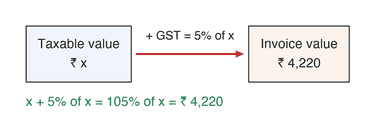
Step 2 — Judge statement 1.
GST is 5% of the taxable value , not 5% of the invoice value, because ₹ 4,220 already has the GST inside it. Working it out, is about ₹ 4,019.05, so the real GST is about ₹ 200.95, while 5% of ₹ 4,220 is ₹ 211. So statement 1 is false.
Watch out: Never charge GST on an amount that already includes GST.
Why the other options are wrong:
- (A) Both the statements are true.: statement 1 is false, because it charges GST on an amount that already includes GST.
- (B) Both the statements are false.: statement 2 is true, as Step 1 shows.
- (C) Statement 1 is true, and statement 2 is false.: this has it the wrong way round: statement 1 is the false one and statement 2 is the true one.
Therefore, statement 1 is false and statement 2 is true, option (D).
- 391 mark
Question 39
A dealer in Indore (M.P.) sells goods worth ₹ 75,000 to a dealer in Jaipur (Rajasthan) and the rate of GST is 18%.
Statement (1) : The CGST share of Rajasthan is 9% of ₹ 75,000.
Statement (2) : In inter-state transaction, GST is 18% of the whole transaction.
Solve with AIAnswer
(A) Both the statements are true.
(B) Both the statements are false.
(C) Statement 1 is true, and statement 2 is false.
- Correct
(D) Statement 1 is false, and statement 2 is true.
Answer: (D) Statement 1 is false, and statement 2 is true.
Concept: Indore (M.P.) to Jaipur (Rajasthan) is a sale from one state to another, an inter-state sale. In an inter-state sale only IGST is charged; there is no CGST and no SGST.
Step 1 — Judge statement 1.
No CGST is charged in an inter-state sale. Also, CGST always goes to the Central Government, never to a state such as Rajasthan. So statement 1 is false.
Step 2 — Judge statement 2.
In an inter-state sale the full 18% is charged on the whole value as IGST.
So the IGST is ₹ 13,500, which is 18% of the whole transaction. Statement 2 is true.
Watch out: A 50–50 split into CGST and SGST happens only when the buyer and the seller are in the same state.
Why the other options are wrong:
- (A) Both the statements are true.: statement 1 is false, since no CGST is charged in an inter-state sale.
- (B) Both the statements are false.: statement 2 is true: the GST is 18% of ₹ 75,000.
- (C) Statement 1 is true, and statement 2 is false.: this has it the wrong way round: statement 1 is the false one and statement 2 is the true one.
Therefore, statement 1 is false and statement 2 is true, option (D).
- 403 marks
Question 40
Mrs. Sharma bought the following articles from a departmental store.
Items Marked price Discount Rate of GST Face-cream ₹ 350 12% 12% Hair oil ₹ 720 – 5% Talcum powder ₹ 225 18% 18% Find the :
(i) total GST paid.
(ii) total bill amount including GST.
Solve with AIWritten solution
Solution:
Concept: For each item, take off its discount first, then find the GST on the reduced price at that item's own rate of GST. Then add up.
Given: Marked prices, discounts and GST rates of the three items as in the table.
Step 1 — Work out the face-cream in full.
We find the 12% discount on ₹ 350.
Subtracting it gives the price after discount.
GST at 12% is charged on this price.
So the face-cream carries GST of ₹ 36.96.
Step 2 — Work out the hair oil.
A dash (–) means no discount, so GST at 5% is charged on the full ₹ 720.
So the hair oil carries GST of ₹ 36.
Step 3 — Work out the talcum powder.
We find the 18% discount on ₹ 225.
Subtracting it gives the price after discount.
GST at 18% is charged on this price.
So the talcum powder carries GST of ₹ 33.21.
Step 4 — Part (i): total GST paid.
We add the GST on the three items.
So the total GST paid is ₹ 106.17.
Step 5 — Part (ii): total bill including GST.
First we add the three prices after discount.
The bill is this total plus the total GST.
So the total bill is ₹ 1,318.67.
Check: Item by item, Mrs. Sharma pays ₹ 344.96, ₹ 756 and ₹ 217.71, and these add up to the same bill.
Watch out: The discount rate and the GST rate happen to be equal for two items (12% and 18%), but they still apply to different amounts: the discount to the marked price, the GST to the reduced price.
Note: The book prints “Telecom powder”; this is a misprint for talcum powder, and the stem has been corrected.
Therefore, (i) the total GST paid is ₹ 106.17; (ii) the total bill amount including GST is ₹ 1,318.67.
- 413 marks
Question 41
Ashraf went to see a movie. He wanted to purchase a movie ticket for ₹ 80. As the ticket for ₹ 80 was not available, he purchased a ticket for ₹ 120 of upper class. How much extra GST did he pay for the ticket ? (GST for a ticket below ₹ 100 is 18% and GST for a ticket above ₹ 100 is 28%).
Solve with AIWritten solution
Solution:
Concept: Find the GST on the ticket he wanted and the GST on the ticket he bought, each at the rate the question gives for it. The difference is the extra GST.
Given: Ticket wanted = ₹ 80 (below ₹ 100, so GST = 18%); ticket bought = ₹ 120 (above ₹ 100, so GST = 28%).
Step 1 — Find the GST on the ₹ 80 ticket.
This ticket is below ₹ 100, so GST is 18% of its price.
So its GST is ₹ 14.40.
Step 2 — Find the GST on the ₹ 120 ticket.
This ticket is above ₹ 100, so GST is 28% of its price.
So its GST is ₹ 33.60.
Step 3 — Find the extra GST.
We subtract the GST he would have paid from the GST he actually paid.
Besides ₹ 40 more for the ticket itself, he paid this much more as tax, because the costlier ticket is also taxed at a higher rate.
Watch out: Do not find 28% − 18% = 10% of one price. The two rates apply to two different prices.
Therefore, Ashraf paid ₹ 19.20 extra as GST.
- 423 marks
Question 42
A shopkeeper sells an A.C. to Ms. Alka for ₹ 31,200 including GST at the rate of 28%. If the shopkeeper and Ms. Alka both are from the same city, find for the shopkeeper :
(i) total amount of GST
(ii) taxable value of A.C.
(iii) amount of CGST
(iv) amount of SGST.
Solve with AIWritten solution
Solution:
Concept: ₹ 31,200 includes the GST. So ₹ 31,200 = taxable value + 28% of the taxable value. We find the taxable value first, and the GST is the rest. The shopkeeper and Ms. Alka are in the same city, so the sale is intra-state and the GST is shared equally as CGST and SGST.
Given: Price paid, including GST = ₹ 31,200; rate of GST = 28%; intra-state sale.
Step 1 — Form an equation.
Let the taxable value be ₹ . The taxable value plus 28% GST on it equals the price paid.
Step 2 — Combine the terms on the left.
Taking common, 1 + 28/100 gives 128/100.
Step 3 — Part (ii): find the taxable value.
We multiply both sides by 100 and divide by 128.
So the taxable value of the A.C. is ₹ 24,375.
Step 4 — Part (i): find the total GST.
The GST is the price paid minus the taxable value.
So the total GST is ₹ 6,825.
Step 5 — Parts (iii) and (iv): find the CGST and the SGST.
In an intra-state sale CGST and SGST are each half of the GST.
So CGST = ₹ 3,412.50 and SGST = ₹ 3,412.50.
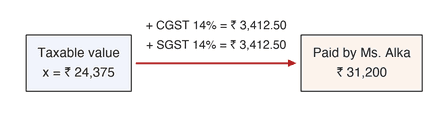
Check: 28% of ₹ 24,375 is ₹ 6,825, and the taxable value plus this GST gives back the price paid.
Watch out: 28% of ₹ 31,200 (₹ 8,736) is not the GST, because ₹ 31,200 already includes the GST.
Therefore, (i) total GST = ₹ 6,825; (ii) taxable value = ₹ 24,375; (iii) CGST = ₹ 3,412.50; (iv) SGST = ₹ 3,412.50.
- 433 marks
Question 43
A wholesaler dealing in electric goods, sells an article at its printed price of ₹ 45,000 to a dealer at 10% discount. The dealer sells the same article to a consumer at a discount of 4% on its printed price. If the sales are intra-state and the rate of GST is 18%, find :
(i) the amount of tax, under GST, paid by the dealer to the central and state governments.
(ii) the amount of tax, under GST, received by central and state governments.
(iii) the total amount, inclusive of tax, paid by the consumer for the article.
Solve with AIWritten solution
Solution:
Concept: The dealer pays GST when he buys (input tax) and collects GST when he sells (output tax); he deposits only the difference. The sales are intra-state, so every tax is split equally into CGST (to the Central Government) and SGST (to the State Government). Both discounts are on the printed price.
Given: Printed price = ₹ 45,000; wholesaler to dealer at 10% discount; dealer to consumer at 4% discount on the printed price; intra-state sales; rate of GST = 18%.
Step 1 — Find the price at which the dealer buys.
The wholesaler gives a 10% discount on the printed price.
Subtracting it gives the dealer's cost price.
So the dealer buys for ₹ 40,500.
Step 2 — Find the tax on the sale from wholesaler to dealer.
This is intra-state, so CGST = 9% and SGST = 9% of ₹ 40,500.
SGST equals CGST, so the dealer pays CGST ₹ 3,645 and SGST ₹ 3,645 (his input tax). The wholesaler deposits these.
Step 3 — Find the price at which the dealer sells.
The dealer gives a 4% discount on the printed price.
Subtracting it gives his selling price.
So the dealer sells for ₹ 43,200.
Step 4 — Find the tax on the sale from dealer to consumer.
This is also intra-state, so CGST = 9% and SGST = 9% of ₹ 43,200.
So the dealer collects CGST ₹ 3,888 and SGST ₹ 3,888 (his output tax).
Step 5 — Part (i): tax paid by the dealer.
For each government, the dealer deposits the tax collected minus the tax already paid.
The SGST works out the same way, so the dealer pays ₹ 243 to the Central Government and ₹ 243 to the State Government.
Step 6 — Part (ii): tax received by the governments.
Each government receives tax from the wholesaler and from the dealer.
In the same way the State Government receives SGST of ₹ 3,888. So each government receives ₹ 3,888, ₹ 7,776 in all.
Step 7 — Part (iii): amount paid by the consumer.
The consumer pays the dealer's selling price plus the CGST and the SGST.
So the consumer pays ₹ 50,976.
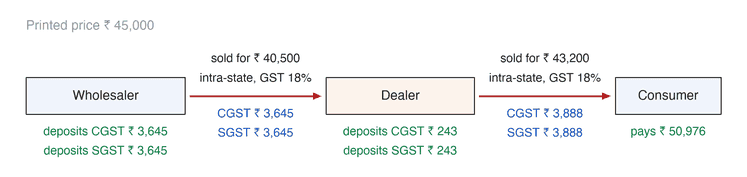
Check: The two governments together receive ₹ 7,776, which is exactly the GST the consumer pays.
Watch out: The dealer does not deposit all ₹ 3,888 of each tax he collects; he first takes off the ₹ 3,645 he paid on his purchase.
Therefore, (i) the dealer pays ₹ 243 as CGST to the Central Government and ₹ 243 as SGST to the State Government; (ii) the Central and State Governments each receive ₹ 3,888; (iii) the consumer pays ₹ 50,976.
- 443 marks
Question 44
Rohit purchased an article and paid GST of ₹ 10,400. He sold the article to Manish and collected GST of ₹ 11,000. Geeta purchased the same article from Manish and paid GST of ₹ 11,800. Find the amount of SGST and CGST payable at each stage if each transaction is intra-state.
Solve with AIWritten solution
Solution:
Concept: At each stage the seller deposits the GST he collects minus the GST he has already paid on his own purchase. Every sale is intra-state, so the amount payable at each stage is split equally into CGST and SGST.
Given: Rohit paid GST of ₹ 10,400 when buying; Rohit collected GST of ₹ 11,000 from Manish; Geeta paid GST of ₹ 11,800 to Manish; all sales intra-state.
Step 1 — Stage 1: the sale to Rohit.
The person who sold to Rohit collected ₹ 10,400 as GST. Nothing is said about any tax that seller paid earlier, so the whole ₹ 10,400 is payable at this stage, half as CGST and half as SGST.
So CGST = ₹ 5,200 and SGST = ₹ 5,200.
Step 2 — Stage 2: Rohit sells to Manish.
Rohit collected ₹ 11,000 and had already paid ₹ 10,400, so he deposits only the difference.
Half of this is CGST and half is SGST.
So CGST = ₹ 300 and SGST = ₹ 300.
Step 3 — Stage 3: Manish sells to Geeta.
Manish collected ₹ 11,800 from Geeta and had paid ₹ 11,000 to Rohit, so he deposits the difference.
Half of this is CGST and half is SGST.
So CGST = ₹ 400 and SGST = ₹ 400.

Check: The amounts payable at the three stages add up to the GST paid by Geeta, the final buyer.
The answer in one table:
Stage CGST payable SGST payable Seller to Rohit ₹ 5,200 ₹ 5,200 Rohit to Manish ₹ 300 ₹ 300 Manish to Geeta ₹ 400 ₹ 400 Watch out: At stages 2 and 3 the seller does not deposit the whole GST he collects; he first takes off the GST he paid when buying.
Therefore, the CGST and the SGST payable are ₹ 5,200 each at the first stage, ₹ 300 each at the second stage and ₹ 400 each at the third stage.
- 453 marks
Question 45
A retailer buys a TV from a manufacturer for ₹ 25,000. He marks the price of the TV 20% above his cost price and sells it to a consumer at 10% discount on the marked price. If the sales are inter-state and rate of GST is 12%, find :
(i) the marked price of the TV.
(ii) consumer's cost price of TV inclusive of tax under GST.
(iii) GST paid by the retailer to the Central and State Governments.
Solve with AIWritten solution
Solution:
Concept: First find the marked price, then the selling price after discount. The sales are inter-state, so GST is charged as IGST at each stage. The retailer deposits output tax − input tax.
Given: Retailer's cost price = ₹ 25,000; marked price 20% above the cost price; discount 10% on the marked price; inter-state sales; rate of GST = 12%.
Step 1 — Part (i): find the marked price.
The price is marked 20% above the cost price, so we find 20% of ₹ 25,000 and add it.
So the marked price is ₹ 30,000.
Step 2 — Find the selling price.
The retailer gives a 10% discount on the marked price.
Subtracting it gives the selling price.
So the retailer sells for ₹ 27,000.
Step 3 — Part (ii): find the consumer's cost price including GST.
The sale is inter-state, so the whole 12% is charged as IGST on ₹ 27,000.
The consumer pays the selling price plus this IGST.
So the consumer's cost is ₹ 30,240.
Step 4 — Part (iii): find the GST paid by the retailer.
The retailer's input tax is the IGST he paid when buying for ₹ 25,000.
His output tax is the IGST he collected, ₹ 3,240. He deposits the difference.
So the retailer pays ₹ 240. It is paid as IGST to the Central Government, which later passes on the share of the state where the TV is used.
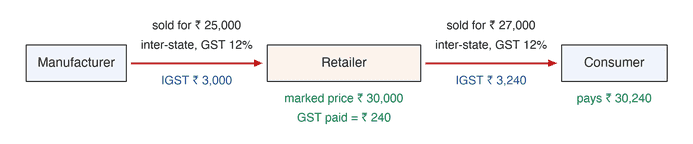
Check: The retailer's value addition is ₹ 27,000 − ₹ 25,000, that is ₹ 2,000, and the tax he pays is 12% of it.
Watch out: The input tax is on the retailer's cost price (₹ 25,000), not on the marked price (₹ 30,000).
Therefore, (i) the marked price is ₹ 30,000; (ii) the consumer's cost price including GST is ₹ 30,240; (iii) the GST paid by the retailer is ₹ 240.
- 463 marks
Question 46
A dealer buys an article at a discount of 30% from the wholesaler, the marked price being ₹ 6,000. The dealer sells it to a consumer at a discount of 10% on the marked price. If the sales are intra-state and rate of GST is 5%, find :
(i) the total amount paid by the consumer for the article.
(ii) the tax under GST paid by the dealer to the state government.
(iii) the amount of tax under GST received by the central government.
Solve with AIWritten solution
Solution:
Concept: The sales are intra-state and the rate of GST is 5%, so at every stage CGST = 2.5% (to the Central Government) and SGST = 2.5% (to the State Government). The dealer deposits tax collected − tax paid. Both discounts are on the marked price.
Given: Marked price = ₹ 6,000; dealer buys at 30% discount; dealer sells at 10% discount on the marked price; intra-state sales; rate of GST = 5%.
Step 1 — Find the price at which the dealer buys.
The wholesaler gives a 30% discount on the marked price.
Subtracting it gives the dealer's cost price.
So the dealer buys for ₹ 4,200.
Step 2 — Find the tax on the sale from wholesaler to dealer.
CGST is 2.5% of ₹ 4,200.
SGST equals CGST, so the dealer pays CGST ₹ 105 and SGST ₹ 105 when buying.
Step 3 — Find the price at which the dealer sells.
The dealer gives a 10% discount on the marked price.
Subtracting it gives his selling price.
So the dealer sells for ₹ 5,400.
Step 4 — Find the tax on the sale from dealer to consumer.
CGST is 2.5% of ₹ 5,400.
So the dealer collects CGST ₹ 135 and SGST ₹ 135.
Step 5 — Part (i): amount paid by the consumer.
The consumer pays the selling price plus the CGST and the SGST.
So the consumer pays ₹ 5,670.
Step 6 — Part (ii): tax paid by the dealer to the State Government.
The dealer deposits the SGST he collected minus the SGST he paid.
So the dealer pays ₹ 30 to the State Government.
Step 7 — Part (iii): tax received by the Central Government.
The Centre receives ₹ 105 of CGST from the wholesaler and ₹ 30 of CGST from the dealer.
So the Central Government receives ₹ 135.
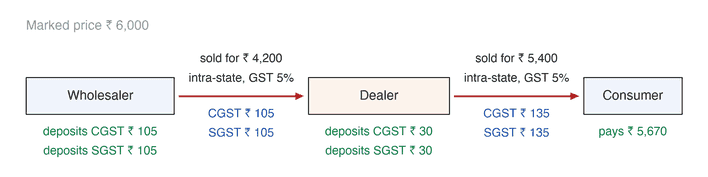
Check: In all, the Central Government receives the CGST on the final sale, 2.5% of ₹ 5,400.
Watch out: Part (ii) asks only for the tax to the State Government, which is the SGST part, not the whole GST.
Therefore, (i) the consumer pays ₹ 5,670; (ii) the dealer pays ₹ 30 to the State Government; (iii) the Central Government receives ₹ 135.
- 473 marks
Question 47
A shopkeeper in Punjab buys an article at a printed price of ₹ 20,000 from a wholesaler in Delhi. The shopkeeper sells the article to a customer in Punjab at a profit of 25% on the cost price. If the rate of GST is 18%, find :
(i) the price of the article (inclusive of GST) for the shopkeeper.
(ii) the amount of tax, under GST, paid by the shopkeeper to the Government.
Solve with AIWritten solution
Solution:
Concept: Delhi to Punjab is inter-state, so IGST is charged on the purchase. Punjab to Punjab is intra-state, so CGST and SGST are charged on the sale. The shopkeeper deposits output tax − input tax.
Given: Shopkeeper's purchase price = ₹ 20,000 (from Delhi); profit = 25% on the cost price; sold to a customer in Punjab; rate of GST = 18%.
Step 1 — Part (i): find the IGST on the purchase.
The wholesaler is in Delhi and the shopkeeper in Punjab, so the whole 18% is charged as IGST on ₹ 20,000.
So the shopkeeper pays IGST of ₹ 3,600. This is his input tax.
Step 2 — Part (i): find the price for the shopkeeper including GST.
He pays the printed price plus the IGST.
So the article costs the shopkeeper ₹ 23,600 including GST.
Step 3 — Find the selling price.
The profit is 25% of the cost price, and the cost price under GST excludes the tax (₹ 20,000).
So the shopkeeper sells for ₹ 25,000.
Step 4 — Find the output tax.
The shopkeeper and the customer are both in Punjab, so CGST = 9% and SGST = 9% of ₹ 25,000.
SGST equals CGST. Together they make the output tax.
Step 5 — Part (ii): find the tax paid by the shopkeeper.
He deposits the output tax minus the input tax.
So the shopkeeper pays ₹ 900 to the Government.
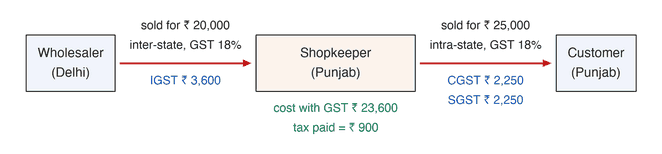
Check: The tax paid is the GST on the shopkeeper's profit.
Watch out: The profit is 25% of ₹ 20,000, the cost price excluding GST, not of ₹ 23,600.
Therefore, (i) the price of the article for the shopkeeper, inclusive of GST, is ₹ 23,600; (ii) the shopkeeper pays ₹ 900 to the Government.
- 483 marks
Question 48
A shopkeeper bought an A.C. from a distributor at a discount of 25% on the list price of ₹ 64,000. The shopkeeper sells the A.C. to a consumer at the list price. If the sales are intra-state and the rate of GST is 18%, then find :
(i) the S.P. of the A.C., including GST, by the distributor.
(ii) the tax paid by the distributor to the State Government.
(iii) the tax under GST paid by the shopkeeper to the Central Government.
(iv) the tax, under GST, received by the State Government.
(v) the price including tax under GST of the A.C. paid by the customer.
Solve with AIWritten solution
Solution:
Concept: The sales are intra-state and the rate of GST is 18%, so at each stage CGST = 9% (to the Central Government) and SGST = 9% (to the State Government). Each seller deposits the tax he collects minus the tax he paid on his own purchase.
Given: List price = ₹ 64,000; distributor to shopkeeper at 25% discount; shopkeeper to consumer at the list price; intra-state sales; rate of GST = 18%.
Step 1 — Find the distributor's selling price.
The distributor gives a 25% discount on the list price.
Subtracting it gives his selling price.
So the distributor sells for ₹ 48,000.
Step 2 — Find the tax on the sale from distributor to shopkeeper.
CGST is 9% of ₹ 48,000.
SGST equals CGST, so the distributor collects CGST ₹ 4,320 and SGST ₹ 4,320.
Step 3 — Part (i): S.P. of the A.C. by the distributor, including GST.
The shopkeeper pays the price plus the CGST and the SGST.
So the distributor's S.P. including GST is ₹ 56,640.
Step 4 — Part (ii): tax paid by the distributor to the State Government.
Nothing is said about any tax the distributor paid on his own purchase, so he deposits all the SGST he collects: ₹ 4,320.
Step 5 — Find the tax on the sale from shopkeeper to customer.
The shopkeeper sells at the list price, so CGST is 9% of ₹ 64,000.
So the shopkeeper collects CGST ₹ 5,760 and SGST ₹ 5,760.
Step 6 — Part (iii): tax paid by the shopkeeper to the Central Government.
He deposits the CGST he collected minus the CGST he paid.
So the shopkeeper pays ₹ 1,440 to the Central Government.
Step 7 — Part (iv): tax received by the State Government.
The State receives ₹ 4,320 of SGST from the distributor and, in the same way as Step 6, ₹ 1,440 of SGST from the shopkeeper.
So the State Government receives ₹ 5,760.
Step 8 — Part (v): price paid by the customer, including GST.
The customer pays the list price plus the CGST and the SGST.
So the customer pays ₹ 75,520.
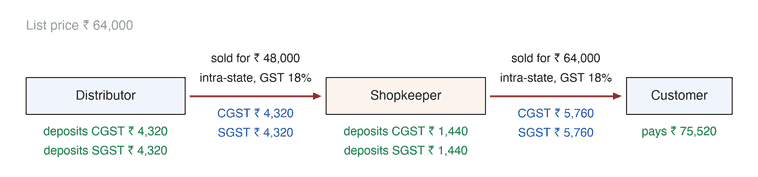
Check: Adding the full 18% to the list price in one go gives the same price.
Watch out: In part (iii) the shopkeeper does not deposit all ₹ 5,760 of CGST he collects; he first takes off the ₹ 4,320 he paid.
Therefore, (i) ₹ 56,640; (ii) ₹ 4,320; (iii) ₹ 1,440; (iv) ₹ 5,760; (v) ₹ 75,520.
What Class 10 Maths Ch 1 covers
The sections of the chapter, in the order the book takes them. Every question above comes from one of these.
- 01Introduction (1.1) – Direct and Indirect Taxes
- 02Goods and Services Tax (GST)
- 03More about GST
- 04GST Calculations
- 05GST on Value Addition
More ways to study this chapter
The same chapter asked three other ways. Practise it, revise it, and see what the board has set on Ch 1 before.
- Competency-Based Questions (CBQ)Case study questions: a situation, and the part of the chapter that answers it.40questionsOpen
- Previous Year QuestionsQuestions that have actually appeared in board papers, each tagged with its year.15questionsOpen
- Practice QuestionsExtra questions per chapter, for when one attempt at a method is not enough.40questionsOpen
Ch 1 in past ICSE papers
The same chapter as the board has actually asked it. These are worded differently from the textbook exercise, which is the point of reading them.
- 14 marks
Board paper question 1
Mr. Bedi visits the market and buys the following articles :
Medicines costing ₹ 950, GST @ 5%
A Pair of shoes costing ₹ 3000, GST @ 18%
A Laptop bag costing ₹ 1000 with a discount of 30% GST @ 18%
(i) Calculate the total amount of GST paid.
(ii) The total bill amount including GST paid by Mr. Bedi.
Solve with AIWritten solution
Solution:
Concept: GST (Goods and Services Tax) is charged on the taxable value of an article, which is its price after any discount. The GST on an article is its rate of GST multiplied by its taxable value, and the buyer pays the taxable value plus the GST. When articles carry different rates, the GST on each article is found at its own rate.
Given: Medicines ₹ 950 at 5% GST; shoes ₹ 3,000 at 18% GST; laptop bag ₹ 1,000 with a 30% discount, at 18% GST.
Step 1 — Find the taxable value of the laptop bag.
The bag has a 30% discount, so we first find the discount on its price of ₹ 1,000.
Then we subtract the discount, because GST is charged only on the price the buyer actually pays.
So the taxable value of the bag is ₹ 700. The medicines and the shoes have no discount, so their taxable values are their prices.
Step 2 — Find the GST on each article.
Each article is taxed at its own rate. The medicines are taxed at 5%:
The shoes are taxed at 18%:
The laptop bag is taxed at 18% of its taxable value:
Step 3 — Find the total GST (part i).
We add the three amounts of GST found in Step 2.
So the total GST paid is ₹ 713.50.
Step 4 — Find the total bill (part ii).
The bill is the total taxable value plus the total GST. First we add the taxable values:
Then we add the total GST to it:
So the total bill is ₹ 5,363.50.
Article Taxable value (₹) Rate of GST GST (₹) Amount (₹) Medicines 950 5% 47.50 997.50 Pair of shoes 3,000 18% 540 3,540 Laptop bag 700 18% 126 826 Total 4,650 713.50 5,363.50 Check: Adding the article amounts in the last column gives the same bill.
Watch out: Charge the 18% GST on the bag's price after the discount (₹ 700), not on ₹ 1,000.
Therefore, (i) the total GST paid is ₹ 713.50 and (ii) the total bill amount including GST is ₹ 5,363.50.
- 21 mark
Board paper question 2
The selling price of a shirt excluding GST is ₹ 800. If the rate of GST is 12% then the total price of the shirt is
Solve with AIAnswer
(A) ₹704
(B) ₹96
- Correct
(C) ₹896
(D) ₹848
Answer: (C) ₹896
Concept: GST (Goods and Services Tax) is charged on the taxable value of an article, which is its price after any discount. The GST on an article is its rate of GST multiplied by its taxable value, and the buyer pays the taxable value plus the GST.
Step 1 — Find the GST.
The GST is 12% of the selling price of ₹ 800.
So the GST is ₹ 96.
Step 2 — Find the total price.
The buyer pays the selling price plus the GST on it.
So the total price is ₹ 896.
Check: Paying 112% of ₹ 800 in one go gives the same total.
Watch out: GST is added to the selling price; it is never subtracted from it.
Why the other options are wrong:
- (A) ₹704: this is ₹ 800 − ₹ 96. GST is added to the price, not taken away.
- (B) ₹96: this is only the GST. The total price must also include the ₹ 800 price of the shirt.
- (D) ₹848: this adds only 6% of ₹ 800 (₹ 48), which is just the CGST half of the 12% tax.
Therefore, the total price of the shirt is ₹ 896, option (C).
- 32 marks
Board paper question 3
The marked price of an article is ₹ 5000. The shopkeeper gives a discount of 10%. If the rate of GST is 12%, then the amount paid by the customer including GST is
Solve with AIAnswer
- Correct
(A) ₹5040
(B) ₹6100
(C) ₹6272
(D) ₹6160
Answer: (A) ₹5040
Concept: A discount is taken off the marked price first. GST is then charged on the price after the discount, never on the marked price.
Step 1 — Find the discount.
The discount is 10% of the marked price of ₹ 5,000.
So the discount is ₹ 500.
Step 2 — Find the price after discount.
We subtract the discount from the marked price, because the customer does not pay that part.
So the price after discount is ₹ 4,500.
Step 3 — Find the GST.
GST at 12% is charged on the price after discount.
So the GST is ₹ 540.
Step 4 — Find the amount paid.
The customer pays the price after discount plus the GST on it.
So the customer pays ₹ 5,040.

Watch out: Do not charge GST on the marked price ₹ 5,000. The discount always comes off first.
Why the other options are wrong:
- (B) ₹6100: this adds the discount and 12% of ₹ 5,000 to the marked price (₹ 5,000 + ₹ 500 + ₹ 600). A discount is subtracted, and GST is on the discounted price.
- (C) ₹6272: this adds 12% twice (₹ 5,000 → ₹ 5,600 → ₹ 6,272) and ignores the discount.
- (D) ₹6160: this adds the discount instead of subtracting it (₹ 5,000 + ₹ 500 = ₹ 5,500) and then adds 12% GST on ₹ 5,500.
Therefore, the amount paid by the customer is ₹ 5,040, option (A).
- 41 mark
Board paper question 4
The printed price of an article is ₹ 3080. If the rate of GST is 10% then the GST charged is :
Solve with AIAnswer
(A) ₹ 154
- Correct
(B) ₹ 308
(C) ₹ 30.80
(D) ₹ 15.40
Answer: (B) ₹ 308
Concept: GST (Goods and Services Tax) is charged on the taxable value of an article, which is its price after any discount. The GST on an article is its rate of GST multiplied by its taxable value, and the buyer pays the taxable value plus the GST. Here no discount is given, so the taxable value is the printed price.
Step 1 — Identify the taxable value.
No discount is mentioned, so GST is charged on the whole printed price of ₹ 3,080.
Step 2 — Find the GST.
The GST is 10% of the printed price.
So the GST charged is ₹ 308.
Check: 10% is one-tenth, and one-tenth of ₹ 3,080 is ₹ 308.
Watch out: Move the decimal point only one place when finding 10%: one-tenth of 3,080 is 308, not 30.80.
Why the other options are wrong:
- (A) ₹ 154: ₹ 154 is 5% of ₹ 3,080, only half of the tax (the CGST or the SGST alone).
- (C) ₹ 30.80: ₹ 30.80 is 1% of ₹ 3,080, a slip in the decimal point.
- (D) ₹ 15.40: ₹ 15.40 is 0.5% of ₹ 3,080: half of the tax together with a slip in the decimal point.
Therefore, the GST charged is ₹ 308, option (B).
- 53 marks
Board paper question 5
Mrs. Arora bought the following articles from a departmental store :
S.No. Item Price Rate of GST Discount 1 Hair oil ₹ 1200 18% ₹ 100 2 Cashew nuts ₹ 600 12% - Find the :
(a) Total GST paid.
(b) Total bill amount including GST.
Solve with AIWritten solution
Solution:
Concept: GST (Goods and Services Tax) is charged on the taxable value of an article, which is its price after any discount. The GST on an article is its rate of GST multiplied by its taxable value, and the buyer pays the taxable value plus the GST. Each item is taxed at its own rate.
Given: Hair oil ₹ 1,200 with a discount of ₹ 100, GST 18%; cashew nuts ₹ 600 with no discount, GST 12%.
Step 1 — Find the taxable value of each item.
The hair oil has a discount of ₹ 100, so we subtract it from the price; GST is charged only on what remains.
The cashew nuts have no discount, so their taxable value is their price, ₹ 600.
Step 2 — Find the GST on each item.
The hair oil is taxed at 18% of its taxable value:
The cashew nuts are taxed at 12%:
Step 3 — Find the total GST (part a).
We add the two amounts of GST.
So the total GST paid is ₹ 270.
Step 4 — Find the total bill (part b).
The bill is the total taxable value plus the total GST. First we add the taxable values:
Then we add the total GST:
So the total bill is ₹ 1,970.
Item Taxable value (₹) Rate of GST GST (₹) Amount (₹) Hair oil 1,100 18% 198 1,298 Cashew nuts 600 12% 72 672 Total 1,700 270 1,970 Check: Adding the item amounts in the last column gives the same bill.
Watch out: Take off the ₹ 100 discount before charging GST on the hair oil; 18% of ₹ 1,200 (₹ 216) is wrong.
Therefore, (a) the total GST paid is ₹ 270 and (b) the total bill amount including GST is ₹ 1,970.
- 61 mark
Board paper question 6
For an Intra-state sale, the CGST paid by a dealer to the Central government is ₹120. If the marked price of the article is ₹2000, the rate of GST is:
Solve with AIAnswer
(A) 6%
(B) 10%
- Correct
(C) 12%
(D) 16.67%
Answer: (C) 12%
Concept: In an intra-state sale (buyer and seller in the same state) the GST is shared equally between the central government (CGST) and the state government (SGST), so CGST and SGST are each half of the GST. In an inter-state sale the whole GST is IGST. The rate of GST is the GST written as a percentage of the price.
Step 1 — Find the SGST.
The sale is intra-state, so the SGST equals the CGST, ₹ 120.
Step 2 — Find the total GST.
The total GST is the CGST plus the SGST.
So the total GST is ₹ 240.
Step 3 — Find the rate of GST.
The rate is the total GST as a percentage of the marked price of ₹ 2,000.

Check: 12% of ₹ 2,000 is ₹ 240, and half of it is the CGST, ₹ 120.
Watch out: ₹ 120 is only the CGST. Doubling it gives the GST; using ₹ 120 alone gives the CGST rate, 6%.
Why the other options are wrong:
- (A) 6%: 6% is the rate of CGST alone (₹ 120 out of ₹ 2,000), not the full rate of GST.
- (B) 10%: 10% of ₹ 2,000 is ₹ 200, which would make the CGST ₹ 100, not ₹ 120.
- (D) 16.67%: 16.67 comes from dividing the wrong way round: 2,000 ÷ 120 = 16.67 (to two decimal places).
Therefore, the rate of GST is 12%, option (C).
All 15 board paper questions for this chapter, solved the same way.
Class 10 Maths Ch 1 questions students ask
How many questions are there in Class 10 Maths Ch 1?
48 questions. Every one is solved step by step on this page.
Are these Class 10 Maths solutions free?
Yes. Every question and its full working is free to read, with no account needed.
Can I download the Class 10 Maths Ch 1 solutions as a PDF?
There is no PDF to download. Every solution is on this page instead, which means it is searchable, always the current syllabus, and readable on a phone. Use your browser's print option if you want it on paper.