
Opening your dashboard
Class 10 Maths Chapter 1 GST: Previous Year Questions
15 questions on Chapter 1, each solved step by step. Class 10 Maths, ICSE 2026-27.
15 questions with solutions
1–4 marks · Mixed difficulty
- 14 marks
Question 1
Mr. Bedi visits the market and buys the following articles :
Medicines costing ₹ 950, GST @ 5%
A Pair of shoes costing ₹ 3000, GST @ 18%
A Laptop bag costing ₹ 1000 with a discount of 30% GST @ 18%
(i) Calculate the total amount of GST paid.
(ii) The total bill amount including GST paid by Mr. Bedi.
Solve with AIWritten solution
Solution:
Concept: GST (Goods and Services Tax) is charged on the taxable value of an article, which is its price after any discount. The GST on an article is its rate of GST multiplied by its taxable value, and the buyer pays the taxable value plus the GST. When articles carry different rates, the GST on each article is found at its own rate.
Given: Medicines ₹ 950 at 5% GST; shoes ₹ 3,000 at 18% GST; laptop bag ₹ 1,000 with a 30% discount, at 18% GST.
Step 1 — Find the taxable value of the laptop bag.
The bag has a 30% discount, so we first find the discount on its price of ₹ 1,000.
Then we subtract the discount, because GST is charged only on the price the buyer actually pays.
So the taxable value of the bag is ₹ 700. The medicines and the shoes have no discount, so their taxable values are their prices.
Step 2 — Find the GST on each article.
Each article is taxed at its own rate. The medicines are taxed at 5%:
The shoes are taxed at 18%:
The laptop bag is taxed at 18% of its taxable value:
Step 3 — Find the total GST (part i).
We add the three amounts of GST found in Step 2.
So the total GST paid is ₹ 713.50.
Step 4 — Find the total bill (part ii).
The bill is the total taxable value plus the total GST. First we add the taxable values:
Then we add the total GST to it:
So the total bill is ₹ 5,363.50.
Article Taxable value (₹) Rate of GST GST (₹) Amount (₹) Medicines 950 5% 47.50 997.50 Pair of shoes 3,000 18% 540 3,540 Laptop bag 700 18% 126 826 Total 4,650 713.50 5,363.50 Check: Adding the article amounts in the last column gives the same bill.
Watch out: Charge the 18% GST on the bag's price after the discount (₹ 700), not on ₹ 1,000.
Therefore, (i) the total GST paid is ₹ 713.50 and (ii) the total bill amount including GST is ₹ 5,363.50.
- 21 mark
Question 2
The selling price of a shirt excluding GST is ₹ 800. If the rate of GST is 12% then the total price of the shirt is
Solve with AIAnswer
(A) ₹704
(B) ₹96
- Correct
(C) ₹896
(D) ₹848
Answer: (C) ₹896
Concept: GST (Goods and Services Tax) is charged on the taxable value of an article, which is its price after any discount. The GST on an article is its rate of GST multiplied by its taxable value, and the buyer pays the taxable value plus the GST.
Step 1 — Find the GST.
The GST is 12% of the selling price of ₹ 800.
So the GST is ₹ 96.
Step 2 — Find the total price.
The buyer pays the selling price plus the GST on it.
So the total price is ₹ 896.
Check: Paying 112% of ₹ 800 in one go gives the same total.
Watch out: GST is added to the selling price; it is never subtracted from it.
Why the other options are wrong:
- (A) ₹704: this is ₹ 800 − ₹ 96. GST is added to the price, not taken away.
- (B) ₹96: this is only the GST. The total price must also include the ₹ 800 price of the shirt.
- (D) ₹848: this adds only 6% of ₹ 800 (₹ 48), which is just the CGST half of the 12% tax.
Therefore, the total price of the shirt is ₹ 896, option (C).
- 32 marks
Question 3
The marked price of an article is ₹ 5000. The shopkeeper gives a discount of 10%. If the rate of GST is 12%, then the amount paid by the customer including GST is
Solve with AIAnswer
- Correct
(A) ₹5040
(B) ₹6100
(C) ₹6272
(D) ₹6160
Answer: (A) ₹5040
Concept: A discount is taken off the marked price first. GST is then charged on the price after the discount, never on the marked price.
Step 1 — Find the discount.
The discount is 10% of the marked price of ₹ 5,000.
So the discount is ₹ 500.
Step 2 — Find the price after discount.
We subtract the discount from the marked price, because the customer does not pay that part.
So the price after discount is ₹ 4,500.
Step 3 — Find the GST.
GST at 12% is charged on the price after discount.
So the GST is ₹ 540.
Step 4 — Find the amount paid.
The customer pays the price after discount plus the GST on it.
So the customer pays ₹ 5,040.

Watch out: Do not charge GST on the marked price ₹ 5,000. The discount always comes off first.
Why the other options are wrong:
- (B) ₹6100: this adds the discount and 12% of ₹ 5,000 to the marked price (₹ 5,000 + ₹ 500 + ₹ 600). A discount is subtracted, and GST is on the discounted price.
- (C) ₹6272: this adds 12% twice (₹ 5,000 → ₹ 5,600 → ₹ 6,272) and ignores the discount.
- (D) ₹6160: this adds the discount instead of subtracting it (₹ 5,000 + ₹ 500 = ₹ 5,500) and then adds 12% GST on ₹ 5,500.
Therefore, the amount paid by the customer is ₹ 5,040, option (A).
- 41 mark
Question 4
The printed price of an article is ₹ 3080. If the rate of GST is 10% then the GST charged is :
Solve with AIAnswer
(A) ₹ 154
- Correct
(B) ₹ 308
(C) ₹ 30.80
(D) ₹ 15.40
Answer: (B) ₹ 308
Concept: GST (Goods and Services Tax) is charged on the taxable value of an article, which is its price after any discount. The GST on an article is its rate of GST multiplied by its taxable value, and the buyer pays the taxable value plus the GST. Here no discount is given, so the taxable value is the printed price.
Step 1 — Identify the taxable value.
No discount is mentioned, so GST is charged on the whole printed price of ₹ 3,080.
Step 2 — Find the GST.
The GST is 10% of the printed price.
So the GST charged is ₹ 308.
Check: 10% is one-tenth, and one-tenth of ₹ 3,080 is ₹ 308.
Watch out: Move the decimal point only one place when finding 10%: one-tenth of 3,080 is 308, not 30.80.
Why the other options are wrong:
- (A) ₹ 154: ₹ 154 is 5% of ₹ 3,080, only half of the tax (the CGST or the SGST alone).
- (C) ₹ 30.80: ₹ 30.80 is 1% of ₹ 3,080, a slip in the decimal point.
- (D) ₹ 15.40: ₹ 15.40 is 0.5% of ₹ 3,080: half of the tax together with a slip in the decimal point.
Therefore, the GST charged is ₹ 308, option (B).
- 53 marks
Question 5
Mrs. Arora bought the following articles from a departmental store :
S.No. Item Price Rate of GST Discount 1 Hair oil ₹ 1200 18% ₹ 100 2 Cashew nuts ₹ 600 12% - Find the :
(a) Total GST paid.
(b) Total bill amount including GST.
Solve with AIWritten solution
Solution:
Concept: GST (Goods and Services Tax) is charged on the taxable value of an article, which is its price after any discount. The GST on an article is its rate of GST multiplied by its taxable value, and the buyer pays the taxable value plus the GST. Each item is taxed at its own rate.
Given: Hair oil ₹ 1,200 with a discount of ₹ 100, GST 18%; cashew nuts ₹ 600 with no discount, GST 12%.
Step 1 — Find the taxable value of each item.
The hair oil has a discount of ₹ 100, so we subtract it from the price; GST is charged only on what remains.
The cashew nuts have no discount, so their taxable value is their price, ₹ 600.
Step 2 — Find the GST on each item.
The hair oil is taxed at 18% of its taxable value:
The cashew nuts are taxed at 12%:
Step 3 — Find the total GST (part a).
We add the two amounts of GST.
So the total GST paid is ₹ 270.
Step 4 — Find the total bill (part b).
The bill is the total taxable value plus the total GST. First we add the taxable values:
Then we add the total GST:
So the total bill is ₹ 1,970.
Item Taxable value (₹) Rate of GST GST (₹) Amount (₹) Hair oil 1,100 18% 198 1,298 Cashew nuts 600 12% 72 672 Total 1,700 270 1,970 Check: Adding the item amounts in the last column gives the same bill.
Watch out: Take off the ₹ 100 discount before charging GST on the hair oil; 18% of ₹ 1,200 (₹ 216) is wrong.
Therefore, (a) the total GST paid is ₹ 270 and (b) the total bill amount including GST is ₹ 1,970.
- 61 mark
Question 6
For an Intra-state sale, the CGST paid by a dealer to the Central government is ₹120. If the marked price of the article is ₹2000, the rate of GST is:
Solve with AIAnswer
(A) 6%
(B) 10%
- Correct
(C) 12%
(D) 16.67%
Answer: (C) 12%
Concept: In an intra-state sale (buyer and seller in the same state) the GST is shared equally between the central government (CGST) and the state government (SGST), so CGST and SGST are each half of the GST. In an inter-state sale the whole GST is IGST. The rate of GST is the GST written as a percentage of the price.
Step 1 — Find the SGST.
The sale is intra-state, so the SGST equals the CGST, ₹ 120.
Step 2 — Find the total GST.
The total GST is the CGST plus the SGST.
So the total GST is ₹ 240.
Step 3 — Find the rate of GST.
The rate is the total GST as a percentage of the marked price of ₹ 2,000.

Check: 12% of ₹ 2,000 is ₹ 240, and half of it is the CGST, ₹ 120.
Watch out: ₹ 120 is only the CGST. Doubling it gives the GST; using ₹ 120 alone gives the CGST rate, 6%.
Why the other options are wrong:
- (A) 6%: 6% is the rate of CGST alone (₹ 120 out of ₹ 2,000), not the full rate of GST.
- (B) 10%: 10% of ₹ 2,000 is ₹ 200, which would make the CGST ₹ 100, not ₹ 120.
- (D) 16.67%: 16.67 comes from dividing the wrong way round: 2,000 ÷ 120 = 16.67 (to two decimal places).
Therefore, the rate of GST is 12%, option (C).
- 73 marks
Question 7
Rohan bought the following eatables for his friends :
Soham Sweet Mart : Bill
S.No. Item Price Quantity Rate of GST 1 Laddu ₹ 500 per kg 2 kg 5% 2 Pastries ₹ 100 per piece 12 pieces 18% Calculate :
(a) Total GST paid.
(b) Total bill amount including GST.
Solve with AIWritten solution
Solution:
Concept: The value of each item is its price multiplied by the quantity bought. GST (Goods and Services Tax) is charged on the taxable value of an article, which is its price after any discount. The GST on an article is its rate of GST multiplied by its taxable value, and the buyer pays the taxable value plus the GST. Each item is taxed at its own rate.
Given: Laddu at ₹ 500 per kg, 2 kg, GST 5%; pastries at ₹ 100 per piece, 12 pieces, GST 18%.
Step 1 — Find the value of each item.
We multiply the price by the quantity. For the laddu:
For the pastries:
Step 2 — Find the GST on each item.
No discount is given, so GST is charged on these values. The laddu is taxed at 5%:
The pastries are taxed at 18%:
Step 3 — Find the total GST (part a).
We add the two amounts of GST.
So the total GST paid is ₹ 266.
Step 4 — Find the total bill (part b).
The bill is the total value plus the total GST. First we add the values:
Then we add the total GST:
So the total bill is ₹ 2,466.
Item Value (₹) Rate of GST GST (₹) Amount (₹) Laddu 1,000 5% 50 1,050 Pastries 1,200 18% 216 1,416 Total 2,200 266 2,466 Check: Adding the item amounts in the last column gives the same bill.
Watch out: The price ₹ 500 is per kg and ₹ 100 is per piece. Multiply by the quantity before finding the GST.
Therefore, (a) the total GST paid is ₹ 266 and (b) the total bill amount including GST is ₹ 2,466.
- 81 mark
Question 8
The marked price of an article is ₹1,375. If the CGST is charged at a rate of 4%, then the price of the article including GST is:
Solve with AIAnswer
(A) ₹55
(B) ₹110
(C) ₹1,430
- Correct
(D) ₹1,485
Answer: (D) ₹1,485
Concept: In an intra-state sale (buyer and seller in the same state) the GST is shared equally between the central government (CGST) and the state government (SGST), so CGST and SGST are each half of the GST. In an inter-state sale the whole GST is IGST. So the rate of GST is twice the rate of CGST.
Step 1 — Find the rate of GST.
The SGST is charged at the same rate as the CGST, so we add the two rates.
So the rate of GST is 8%.
Step 2 — Find the GST.
The GST is 8% of the marked price of ₹ 1,375.
So the GST is ₹ 110.
Step 3 — Find the price including GST.
The buyer pays the marked price plus the GST.
So the price including GST is ₹ 1,485.
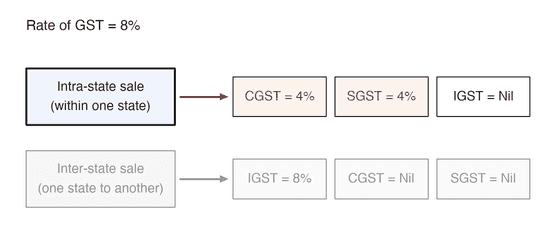
Check: CGST = 4% of ₹ 1,375 = ₹ 55 and SGST = ₹ 55, so the price is ₹ 1,375 + ₹ 55 + ₹ 55 = ₹ 1,485.
Watch out: 4% is only the CGST rate. The SGST at 4% must be added too.
Why the other options are wrong:
- (A) ₹55: ₹ 55 is the CGST alone, not a price.
- (B) ₹110: ₹ 110 is the total GST, not the price of the article.
- (C) ₹1,430: ₹ 1,430 adds only the CGST (₹ 55) and forgets the SGST.
Therefore, the price of the article including GST is ₹ 1,485, option (D).
- 94 marks
Question 9
Refer to the given bill. A customer paid ₹2,000 (rounded off to the nearest ₹10) to clear the bill.
Note: 5% discount is applicable on an article if 10 or more such articles are purchased.
Article M.P.(₹) Quantity G.S.T A 190 06 12% B 50 12 18% Check whether the total amount paid by the customer is correct or not. Justify your answer with necessary working.
Solve with AIWritten solution
Solution:
Concept: GST (Goods and Services Tax) is charged on the taxable value of an article, which is its price after any discount. The GST on an article is its rate of GST multiplied by its taxable value, and the buyer pays the taxable value plus the GST. A discount applies only where its condition holds, and the total is rounded to the nearest ₹ 10 only at the very end.
Given: Article A: M.P. ₹ 190, 6 pieces, GST 12%; article B: M.P. ₹ 50, 12 pieces, GST 18%; 5% discount on an article only if 10 or more are bought; the customer paid ₹ 2,000.
Step 1 — Decide which article gets the discount.
The discount rule needs 10 or more pieces of the same article. Article A has only 6 pieces, so it gets no discount. Article B has 12 pieces, so it gets the 5% discount.
Step 2 — Find the amount for article A.
We multiply the marked price by the number of pieces to get the value of A:
GST at 12% is charged on this value:
The amount for A is the value plus its GST:
Step 3 — Find the amount for article B.
First we find the value of the 12 pieces:
Since 12 pieces were bought, 5% is taken off:
We subtract the discount to get the taxable value:
GST at 18% is charged on the taxable value:
The amount for B is the taxable value plus its GST:
Step 4 — Find the total bill.
We add the amounts for A and B.
So the exact bill is ₹ 1,949.40.
Step 5 — Round off to the nearest ₹ 10.
₹ 1,949.40 lies between ₹ 1,940 and ₹ 1,950. It is ₹ 9.40 above ₹ 1,940 but only ₹ 0.60 below ₹ 1,950, so it rounds to ₹ 1,950.
Article Taxable value (₹) Rate of GST GST (₹) Amount (₹) A 1,140 12% 136.80 1,276.80 B 570 18% 102.60 672.60 Total 1,710 239.40 1,949.40 Step 6 — Compare with the amount paid.
The correct amount is ₹ 1,950, but the customer paid ₹ 2,000. So the amount paid is not correct: the customer paid ₹ 50 too much.
Watch out: The 5% discount is only for article B (12 pieces). Article A (6 pieces) gets no discount.
Note: Even if the discount on B were forgotten, the bill would be ₹ 1,276.80 + ₹ 708 = ₹ 1,984.80, which rounds to ₹ 1,980. So ₹ 2,000 is not correct either way.
Therefore, the amount paid is not correct: the bill is ₹ 1,949.40, which rounds to ₹ 1,950, not ₹ 2,000.
- 101 mark
Question 10
The GST of an article is reduced from 12% to 5% and due to this, the price paid for the article is cut down by ₹ 14. The original price of the article is:
Solve with AIAnswer
(A) ₹ 50
(B) ₹ 98
(C) ₹ 100
- Correct
(D) ₹ 200
Answer: (D) ₹ 200
Concept: The price of the article before tax does not change. Only the GST falls, from 12% to 5% of that price, so the saving in the price paid is (12 − 5)% of the price.
Step 1 — Find the fall in the rate.
We subtract the new rate of GST from the old one.
So the price paid falls by 7% of the price.
Step 2 — Form the equation.
Let the original price of the article (before GST) be ₹ . The fall of 7% of equals ₹ 14, so we write this as an equation and solve it by multiplying both sides by 100 and dividing by 7.
So the original price of the article is ₹ 200.
Check: At 12% the price paid is ₹ 200 + ₹ 24 = ₹ 224, and at 5% it is ₹ 200 + ₹ 10 = ₹ 210, a cut of ₹ 14.
Watch out: ₹ 14 is 7% of the price, not 12% or 5% of it. Use the fall in the rate.
Why the other options are wrong:
- (A) ₹ 50: a price of ₹ 50 would give a cut of only 7% of ₹ 50 = ₹ 3.50, not ₹ 14.
- (B) ₹ 98: ₹ 98 is 14 × 7, multiplying by 7 where we must divide; 7% of ₹ 98 is ₹ 6.86, not ₹ 14.
- (C) ₹ 100: this treats ₹ 14 as 14% of the price. For a price of ₹ 100 the cut would be only 7% of ₹ 100 = ₹ 7.
Therefore, the original price of the article is ₹ 200, option (D).
- 114 marks
Question 11
A retailer purchased an air conditioner (A.C.) for ₹30,000. He marked up its price by 20% and then allows a discount of 10% on the marked price to a customer. If the sale is intra-state and the rate of GST is 28%, find the:
(a) marked price of A.C.
(b) total amount paid by the customer including GST.
(c) tax collected by the central and the state governments respectively.
Solve with AIWritten solution
Solution:
Concept: The mark-up is a percentage of the cost price, the discount is a percentage of the marked price, and GST is charged on the price after the discount. In an intra-state sale (buyer and seller in the same state) the GST is shared equally between the central government (CGST) and the state government (SGST), so CGST and SGST are each half of the GST. In an inter-state sale the whole GST is IGST.
Given: Cost price ₹ 30,000; mark-up 20%; discount 10% on the marked price; intra-state sale; rate of GST 28%.
Step 1 — Find the marked price (part a).
The retailer raises the cost price by 20%, so we first find 20% of ₹ 30,000.
Then we add the mark-up to the cost price:
So the marked price is ₹ 36,000.
Step 2 — Find the selling price.
The discount is 10% of the marked price.
We subtract it from the marked price to get the selling price:
Step 3 — Find the amount paid (part b).
GST at 28% is charged on the selling price.
The customer pays the selling price plus the GST:
So the customer pays ₹ 41,472.
Step 4 — Find each government's tax (part c).
The sale is intra-state, so the 28% GST is split into CGST 14% (central) and SGST 14% (state), both on the selling price.
The SGST is the same, ₹ 4,536.

Check: CGST + SGST = ₹ 4,536 + ₹ 4,536 = ₹ 9,072, the GST found in Step 3.
Watch out: The discount is 10% of the marked price ₹ 36,000, not of the cost price, and GST is on the selling price ₹ 32,400.
Therefore, (a) the marked price is ₹ 36,000; (b) the customer pays ₹ 41,472; (c) the central government collects ₹ 4,536 and the state government collects ₹ 4,536.
- 121 mark
Question 12
The marked price of a refrigerator is ₹ 12,000 and GST paid by the customer is ₹ 2,160. The rate of GST is:
Solve with AIAnswer
(A) 5%
(B) 12%
- Correct
(C) 18%
(D) 28%
Answer: (C) 18%
Concept: GST = rate of GST × taxable value. So the rate of GST is the GST written as a percentage of the taxable value (here the marked price).
Step 1 — Write the rate as a percentage.
No discount is given, so the GST of ₹ 2,160 is charged on the marked price of ₹ 12,000. We divide the GST by the marked price and multiply by 100.
Check: 18% of ₹ 12,000 is ₹ 2,160, the GST given.
Watch out: Divide the GST by the marked price, not the marked price by the GST.
Why the other options are wrong:
- (A) 5%: 5% of ₹ 12,000 is ₹ 600, not ₹ 2,160.
- (B) 12%: 12% of ₹ 12,000 is ₹ 1,440, not ₹ 2,160.
- (D) 28%: 28% of ₹ 12,000 is ₹ 3,360, not ₹ 2,160.
Therefore, the rate of GST is 18%, option (C).
- 133 marks
Question 13
The cost price of a TV set is ₹ 20,000. The shopkeeper marked it for ₹ 24,000. He sells it to a customer at a discount of 10% on the marked price. If the sale is intra-state and the rate of GST is 12%, find the:
(a) discounted price of the TV set.
(b) amount paid by the customer to clear the bill.
Solve with AIWritten solution
Solution:
Concept: The discount is a percentage of the marked price (not the cost price), and GST is charged on the discounted price. The cost price is not needed in this question.
Given: Cost price ₹ 20,000; marked price ₹ 24,000; discount 10% on the marked price; intra-state sale; rate of GST 12%.
Step 1 — Find the discount.
The discount is 10% of the marked price of ₹ 24,000.
So the discount is ₹ 2,400.
Step 2 — Find the discounted price (part a).
We subtract the discount from the marked price.
So the discounted price is ₹ 21,600.
Step 3 — Find the GST.
GST at 12% is charged on the discounted price. Since the sale is intra-state, it is made up of CGST 6% and SGST 6% (₹ 1,296 each), but the total is the same.
Step 4 — Find the amount paid (part b).
The customer pays the discounted price plus the GST.
So the customer pays ₹ 24,192.
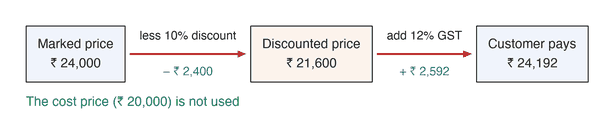
Check: Paying 112% of ₹ 21,600 in one go gives the same amount.
Watch out: The cost price ₹ 20,000 is extra information. The discount is on the marked price ₹ 24,000.
Therefore, (a) the discounted price is ₹ 21,600 and (b) the customer pays ₹ 24,192.
- 141 mark
Question 14
The marked price of a smart TV is ₹ 18,000. The rate of GST is 18%. The price paid by the customer for the smart TV is:
Solve with AIAnswer
(A) ₹12,960
(B) ₹19,620
(C) ₹18,000
- Correct
(D) ₹21,240
Answer: (D) ₹21,240
Concept: GST (Goods and Services Tax) is charged on the taxable value of an article, which is its price after any discount. The GST on an article is its rate of GST multiplied by its taxable value, and the buyer pays the taxable value plus the GST. Here no discount is given, so GST is charged on the marked price.
Step 1 — Find the GST.
The GST is 18% of the marked price of ₹ 18,000.
So the GST is ₹ 3,240.
Step 2 — Find the price paid.
The customer pays the marked price plus the GST.
So the customer pays ₹ 21,240.
Check: Paying 118% of ₹ 18,000 in one go gives the same price.
Watch out: GST is added to the marked price; it is never subtracted.
Why the other options are wrong:
- (A) ₹12,960: ₹ 12,960 is ₹ 18,000 − ₹ 5,040, which takes 28% off. GST is added to the price, and the rate here is 18%.
- (B) ₹19,620: ₹ 19,620 adds only 9% (₹ 1,620), which is just the CGST half of the tax.
- (C) ₹18,000: ₹ 18,000 is the marked price itself; the GST has been left out.
Therefore, the price paid by the customer is ₹ 21,240, option (D).
- 153 marks
Question 15
A computer mechanic charges repairing cost of different components as tabulated below:
Component Repairing cost (₹) Discount (%) A ₹5000 20% B ₹6500 30% The rate of GST is 18%. Find the total:
(a) discount
(b) amount of GST
Solve with AIWritten solution
Solution:
Concept: The discount on each component is its discount percentage of its repairing cost. GST is then charged on the cost left after the discount.
Given: Component A: ₹ 5,000 with 20% discount; component B: ₹ 6,500 with 30% discount; rate of GST 18%.
Step 1 — Find the discount on each component.
Component A has a 20% discount on ₹ 5,000:
Component B has a 30% discount on ₹ 6,500:
Step 2 — Find the total discount (part a).
We add the two discounts.
So the total discount is ₹ 2,950.
Step 3 — Find the cost after discount.
GST is charged only on what the customer pays for the repair, so we subtract each discount. For A:
For B:
Both components carry the same 18% rate, so we can add these and charge GST once:
Step 4 — Find the total GST (part b).
GST at 18% is charged on the total cost after discount.
So the total GST is ₹ 1,539.
Component Repairing cost (₹) Discount (₹) Cost after discount (₹) GST at 18% (₹) A 5,000 1,000 4,000 720 B 6,500 1,950 4,550 819 Total 11,500 2,950 8,550 1,539 Check: Taking the components one by one, the GST in the last column adds to the same total.
Watch out: Charge GST on ₹ 8,550 (after the discount), not on the full repairing cost ₹ 11,500.
Therefore, (a) the total discount is ₹ 2,950 and (b) the total amount of GST is ₹ 1,539.