Solution:
Concept: First find the marked price, then the selling price after discount. The sales are inter-state, so GST is charged as IGST at each stage. The retailer deposits output tax − input tax.
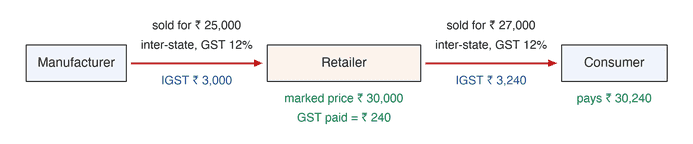
Given: Retailer's cost price = ₹ 25,000; marked price 20% above the cost price; discount 10% on the marked price; inter-state sales; rate of GST = 12%.
Step 1 — Part (i): find the marked price.
The price is marked 20% above the cost price, so we find 20% of ₹ 25,000 and add it.
Mark-up=10020×25,000=5,000
Marked price=25,000+5,000=30,000
So the marked price is ₹ 30,000.
Step 2 — Find the selling price.
The retailer gives a 10% discount on the marked price.
Discount=10010×30,000=3,000
Subtracting it gives the selling price.
Selling price=30,000−3,000=27,000
So the retailer sells for ₹ 27,000.
Step 3 — Part (ii): find the consumer's cost price including GST.
The sale is inter-state, so the whole 12% is charged as IGST on ₹ 27,000.
IGST=10012×27,000=3,240
The consumer pays the selling price plus this IGST.
Consumer’s cost=27,000+3,240=30,240
So the consumer's cost is ₹ 30,240.
Step 4 — Part (iii): find the GST paid by the retailer.
The retailer's input tax is the IGST he paid when buying for ₹ 25,000.
Input tax=10012×25,000=3,000
His output tax is the IGST he collected, ₹ 3,240. He deposits the difference.
GST paid by the retailer=3,240−3,000=240
So the retailer pays ₹ 240. It is paid as IGST to the Central Government, which later passes on the share of the state where the TV is used.
Check: The retailer's value addition is ₹ 27,000 − ₹ 25,000, that is ₹ 2,000, and the tax he pays is 12% of it.
10012×2,000=240
Watch out: The input tax is on the retailer's cost price (₹ 25,000), not on the marked price (₹ 30,000).
Therefore, (i) the marked price is ₹ 30,000; (ii) the consumer's cost price including GST is ₹ 30,240; (iii) the GST paid by the retailer is ₹ 240.
