Solution:
Concept: Output tax is the GST a dealer collects when he sells. Both transfers here are from one state to another, so IGST is charged each time.
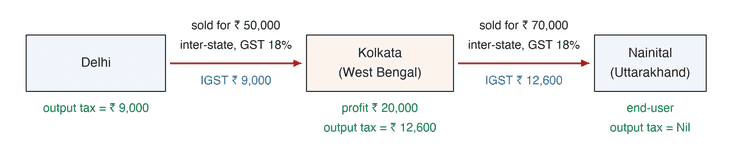
Given: Services worth ₹ 50,000 go from Delhi to Kolkata; then from Kolkata to Nainital at a profit of ₹ 20,000; rate of GST = 18% each time; the dealer at Nainital is the end-user.
Step 1 — Part (i): output tax at Delhi.
Delhi and Kolkata (West Bengal) are in different states, so the sale is inter-state and the whole 18% is charged as IGST on ₹ 50,000.
IGST=10018×50,000=9,000
So the output tax at Delhi is ₹ 9,000.
Step 2 — Find the selling price at Kolkata.
Kolkata sells at its cost price plus the profit.
S.P. at Kolkata=50,000+20,000=70,000
So Kolkata sells for ₹ 70,000.
Step 3 — Part (ii): output tax at Kolkata.
Kolkata (West Bengal) and Nainital (Uttarakhand) are in different states, so this sale is also inter-state and IGST at 18% is charged on ₹ 70,000.
IGST=10018×70,000=12,600
So the output tax at Kolkata is ₹ 12,600.
Step 4 — Part (iii): output tax at Nainital.
The dealer at Nainital is the end-user. He does not sell the services further, so he collects no GST. The output tax at Nainital is nil.
Watch out: Kolkata deposits only ₹ 12,600 − ₹ 9,000, that is ₹ 3,600, but the question asks for the output tax, which is the full ₹ 12,600.
Therefore, the output tax is (i) ₹ 9,000 at Delhi, (ii) ₹ 12,600 at Kolkata and (iii) nil at Nainital.
