Solution:
Concept: Delhi to Punjab is inter-state, so IGST is charged on the purchase. Punjab to Punjab is intra-state, so CGST and SGST are charged on the sale. The shopkeeper deposits output tax − input tax.
Given: Shopkeeper's purchase price = ₹ 20,000 (from Delhi); profit = 25% on the cost price; sold to a customer in Punjab; rate of GST = 18%.
Step 1 — Part (i): find the IGST on the purchase.
The wholesaler is in Delhi and the shopkeeper in Punjab, so the whole 18% is charged as IGST on ₹ 20,000.
IGST=10018×20,000=3,600
So the shopkeeper pays IGST of ₹ 3,600. This is his input tax.
Step 2 — Part (i): find the price for the shopkeeper including GST.
He pays the printed price plus the IGST.
Price for the shopkeeper=20,000+3,600=23,600
So the article costs the shopkeeper ₹ 23,600 including GST.
Step 3 — Find the selling price.
The profit is 25% of the cost price, and the cost price under GST excludes the tax (₹ 20,000).
Profit=10025×20,000=5,000
S.P.=20,000+5,000=25,000
So the shopkeeper sells for ₹ 25,000.
Step 4 — Find the output tax.
The shopkeeper and the customer are both in Punjab, so CGST = 9% and SGST = 9% of ₹ 25,000.
CGST=1009×25,000=2,250
SGST equals CGST. Together they make the output tax.
Output tax=2,250+2,250=4,500
Step 5 — Part (ii): find the tax paid by the shopkeeper.
He deposits the output tax minus the input tax.
Tax paid to the Government=4,500−3,600=900
So the shopkeeper pays ₹ 900 to the Government.
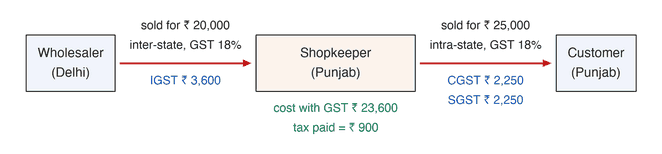
Check: The tax paid is the GST on the shopkeeper's profit.
10018×5,000=900
Watch out: The profit is 25% of ₹ 20,000, the cost price excluding GST, not of ₹ 23,600.
Therefore, (i) the price of the article for the shopkeeper, inclusive of GST, is ₹ 23,600; (ii) the shopkeeper pays ₹ 900 to the Government.
