Solution:
Concept: The price at which one station sells (excluding GST) is exactly the price at which the next station buys (excluding GST). GST is added on top and is never counted in the cost price or the selling price.
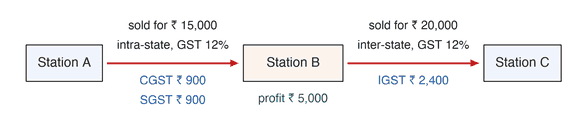
Given: Goods sold from A to B for ₹ 15,000 (intra-state); profit at B = ₹ 5,000; then sold from B to C (inter-state); rate of GST = 12% each time.
Step 1 — Part (a): S.P. at station A.
The goods are sold from A for ₹ 15,000, so the S.P. (excluding GST) at station A is ₹ 15,000.
Step 2 — Part (b): CGST and SGST.
The sale from A to B is intra-state, so the 12% GST is split equally: CGST = 6% and SGST = 6%.
CGST=1006×15,000=900
So CGST = ₹ 900. SGST is at the same rate, so SGST = ₹ 900.
Step 3 — Part (c): C.P. at station B.
B buys at the price at which A sold, so the C.P. (excluding GST) at station B is ₹ 15,000.
Step 4 — Part (d): S.P. at station B.
The selling price is the cost price plus the profit of ₹ 5,000.
S.P. at station B=15,000+5,000=20,000
So the S.P. at station B is ₹ 20,000.
Step 5 — Part (e): GST on the sale from B to C.
This sale is inter-state, so the whole 12% is charged as IGST on B's selling price.
GST (IGST)=10012×20,000=2,400
So the GST is ₹ 2,400.
Step 6 — Part (f): C.P. at station C.
C buys at the price at which B sold, so the C.P. (excluding GST) at station C is ₹ 20,000.
Watch out: The GST paid by B (₹ 1,800) is not added to B's cost price. Cost and selling prices under GST are always taken excluding the tax.
Therefore, (a) ₹ 15,000; (b) CGST = ₹ 900, SGST = ₹ 900; (c) ₹ 15,000; (d) ₹ 20,000; (e) ₹ 2,400; (f) ₹ 20,000.
