
Opening your dashboard
Class 10 Biology Chapter 7: Chemical Coordination in Plants Solutions
30 textbook questions with step-by-step answers, free to read, for ICSE 2026-27.
Get talked through Ch 7, not just shown the answer
Reading a finished solution is not the same as being able to do it. The AI tutor takes one question at a time and works it with you, in your own words, until you can.
- Ask it out loud, in your own words
- It gives you the next step, not the answer
- Stuck on part (ii)? Start there
30 questions with solutions
1–14 marks · Mixed difficulty
- 11 mark
Question 1
The only phytohormone which is a gas at ordinary temperature :
Solve with AIAnswer
(A) Ethane
(B) Ethyl alcohol
- Correct
(C) Ethylene
(D) Ethyne
Answer: (C) Ethylene
Concept: ethylene () is the only plant hormone (phytohormone) that is a gas at ordinary temperature.
Step 1 — List the plant hormones.
The five plant hormones are auxins, gibberellins, cytokinins, abscisic acid and ethylene.
Step 2 — Pick the gaseous one.
The first four are not gases; ethylene is a gas, given out mainly by ripening fruits.
Watch out: Ethane, ethylene and ethyne have similar names; only ethylene is a plant hormone.
Why the other options are wrong:
- (A) Ethane: ethane is a gas, but it is not a plant hormone.
- (B) Ethyl alcohol: ethyl alcohol is a liquid, and it is not a plant hormone.
- (D) Ethyne: ethyne (acetylene) is a gas, but it is not a plant hormone.
Therefore, the only gaseous phytohormone is ethylene, option (C).
- 21 mark
Question 2
The hormone which promotes the ripening of fruits is :
Solve with AIAnswer
(A) Auxins
(B) Gibberellins
(C) Cytokinins
- Correct
(D) Ethylene
Answer: (D) Ethylene
Concept: ethylene induces the ripening of fruits; it is the plant hormone most widely used for this in agriculture.
Step 1 — Recall the discovery.
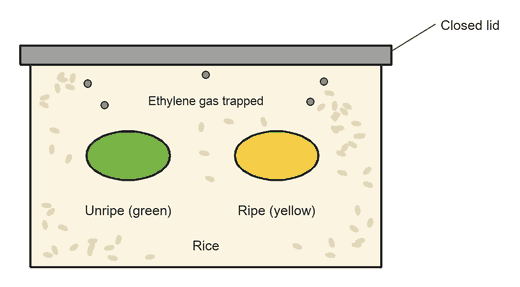
A gas given out by oranges was found to ripen bananas stored with them; that gas was ethylene.
Step 2 — Apply it.
Fruit kept in a closed space ripens faster, because the ethylene it gives out stays around it (cause → faster ripening).
Why the other options are wrong:
- (A) Auxins: auxins promote cell elongation and can induce parthenocarpy; they do not ripen fruits.
- (B) Gibberellins: gibberellins elongate the internodes and break seed dormancy.
- (C) Cytokinins: cytokinins stimulate cell division.
Therefore, the hormone that promotes fruit ripening is ethylene, option (D).
- 31 mark
Question 3
A growth inhibiting hormone in plants :
Solve with AIAnswer
(A) Gibberellins
(B) Indole-3 acetic acid
- Correct
(C) Abscisic Acid
(D) Cytokinins
Answer: (C) Abscisic Acid
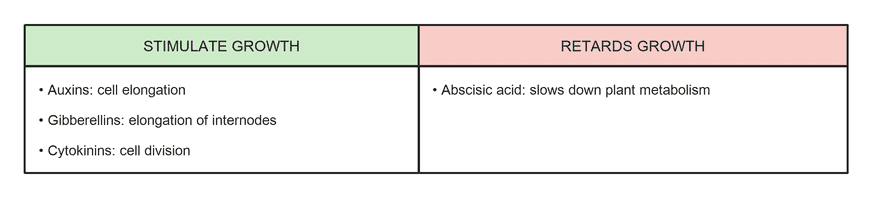
Concept: abscisic acid (ABA) is a growth-retarding hormone: it slows down plant metabolism and so acts as a general growth inhibitor.
Step 1 — Sort the hormones.
Auxins (such as IAA), gibberellins and cytokinins promote growth; abscisic acid inhibits it.
Step 2 — Recall what ABA does.
It inhibits seed germination, induces dormancy and closes the stomata, which is why it is called the "stress hormone".
Why the other options are wrong:
- (A) Gibberellins: gibberellins promote growth by elongating the internodes.
- (B) Indole-3 acetic acid: indole-3-acetic acid (IAA) is the main natural auxin, a growth promoter.
- (D) Cytokinins: cytokinins promote growth by cell division.
Therefore, the growth-inhibiting hormone is abscisic acid, option (C).
- 41 mark
Question 4
The hormone which stimulates cell division :
Solve with AIAnswer
(A) Auxins
- Correct
(B) Cytokinins
(C) Gibberellins
(D) Abscisic acid
Answer: (B) Cytokinins
Concept: cytokinins stimulate cell division, even in tissues that are not meristematic.
Step 1 — Two ways of growing.
A plant grows by making more cells (cell division) or by making cells longer (cell elongation).
Step 2 — Match the hormone.
Auxins and gibberellins act mainly by cell elongation; cytokinins act by cell division. Cytokinins are made in the root tips and carried upwards in the xylem.
Why the other options are wrong:
- (A) Auxins: auxins act mainly by cell elongation.
- (C) Gibberellins: gibberellins also act by cell elongation (of the internodes).
- (D) Abscisic acid: abscisic acid inhibits growth.
Therefore, the hormone that stimulates cell division is cytokinin, option (B).
- 51 mark
Question 5
Development of fruits without fertilization is called :
Solve with AIAnswer
(A) Parthenogenesis
(B) Parthenon
- Correct
(C) Parthenocarpy
(D) Dormancy
Answer: (C) Parthenocarpy
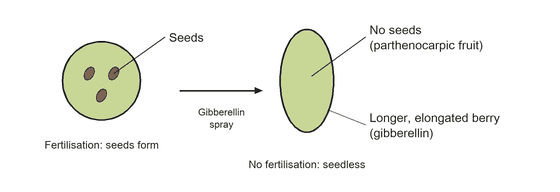
Concept: The development of fruits without fertilisation is called parthenocarpy; such fruits are parthenocarpic and seedless.
Step 1 — Why the fruit is seedless.
Seeds form from fertilised ovules. Without fertilisation no seeds form, so the fruit is seedless.
Step 2 — Which hormones cause it.
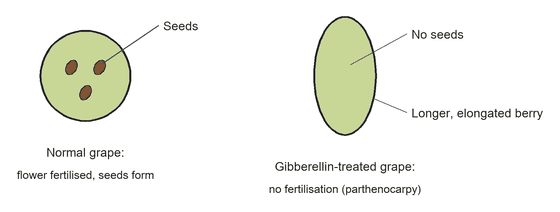
Auxins can induce it in apples, tomatoes and bananas; gibberellins can also induce it (as in seedless grapes).
Watch out: Parthenogenesis (an egg developing without fertilisation) is not the same as parthenocarpy (a fruit developing without fertilisation).
Why the other options are wrong:
- (A) Parthenogenesis: parthenogenesis is the development of an egg into a new individual without fertilisation; it does not refer to fruits.
- (B) Parthenon: "Parthenon" is not a biological term.
- (D) Dormancy: dormancy is the resting state of seeds or buds.
Therefore, fruit development without fertilisation is parthenocarpy, option (C).
- 61 mark
Question 6
The response by parts of the plant towards stimulus is called as :
Solve with AIAnswer
(A) Nastic movement
- Correct
(B) Tropism
(C) Tactic movement
(D) Senescence
Answer: (B) Tropism
Concept: A tropism is a growth movement of a plant part in response to an external stimulus, where the direction of the movement depends on the direction of the stimulus (towards it: positive; away: negative).
Step 1 — Look at the key words.
The question speaks of a plant part responding towards a stimulus, so the direction matters.
Step 2 — Name it.
A directional growth response is a tropism; for example, the shoot grows towards light and the root towards gravity.

Why the other options are wrong:
- (A) Nastic movement: nastic movements do not depend on the direction of the stimulus.
- (C) Tactic movement: tactic movements are movements of whole organisms or cells, not growth of plant parts.
- (D) Senescence: senescence means ageing, not a movement.
Therefore, the response of plant parts towards a stimulus is tropism, option (B).
- 71 mark
Question 7
Apical dominance is influenced by :
Solve with AIAnswer
(A) Gibberellins
(B) Ethylene
(C) Cytokinins
- Correct
(D) Auxins
Answer: (D) Auxins
Concept: auxins made in the apical bud promote its growth and suppress the growth of the lateral buds; this is apical dominance.
Step 1 — How apical dominance works.
Auxin made at the shoot tip moves down the stem and keeps the lateral buds from growing (cause → few branches).
Step 2 — What happens when the tip is removed.
When the apical bud is cut off, the auxin supply stops, so the lateral buds grow into branches and the plant becomes bushy (the idea behind pruning).

Why the other options are wrong:
- (A) Gibberellins: gibberellins mainly cause elongation of the internodes.
- (B) Ethylene: ethylene ripens fruits and promotes senescence.
- (C) Cytokinins: cytokinins oppose apical dominance; the phenomenon itself is caused by auxins.
Therefore, apical dominance is influenced by auxins, option (D).
- 81 mark
Question 8
The growth movement of plant parts which occurs due to touch stimulus is called :
Solve with AIAnswer
(A) Heliotropism
(B) Chemotropism
(C) Hydrotropism
- Correct
(D) Thigmotropism
Answer: (D) Thigmotropism
Concept: Growth of a plant part in response to touch (contact) is thigmotropism (thigmo = touch).
Step 1 — See the example.
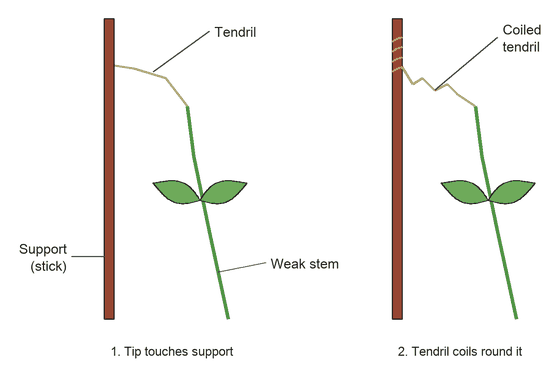
The tendrils of a sweet pea coil round a support that they touch.
Step 2 — How it happens.
The tip of the tendril senses the one-sided contact, the stimulus passes to the parts behind it, and the tendril twines round the support.
Why the other options are wrong:
- (A) Heliotropism: heliotropism is the turning of young flower-heads (e.g. sunflower) to follow the sun.
- (B) Chemotropism: chemotropism is growth in response to chemicals.
- (C) Hydrotropism: hydrotropism is growth in response to water or moisture.
Therefore, growth movement due to touch is thigmotropism, option (D).
- 91 mark
Question 9
The instrument which can be used to demonstrate geotropism is :
Solve with AIAnswer
(A) Manometer
(B) Thermostat
- Correct
(C) Clinostat
(D) Barometer
Answer: (C) Clinostat
Concept: A clinostat slowly rotates a potted plant held horizontally; it is used to demonstrate geotropism.
Step 1 — Set up two clinostats.
Two potted plants are fixed horizontally on two clinostats; one is kept still and the other is rotated slowly.
Step 2 — Compare them.
On the stationary clinostat gravity acts on one side, so the shoot bends up (negative geotropism) and the root bends down (positive geotropism). On the rotating clinostat every side faces gravity equally, so there is no bending.

Why the other options are wrong:
- (A) Manometer: a manometer measures the pressure of gases.
- (B) Thermostat: a thermostat keeps the temperature constant.
- (D) Barometer: a barometer measures atmospheric pressure.
Therefore, the instrument used to demonstrate geotropism is the clinostat, option (C).
- 101 mark
Question 10
The hormone which accelerates senescence (ageing) and abscission of leaves is :
Solve with AIAnswer
(A) IAA
(B)
- Correct
(C) ABA
(D)
Answer: (C) ABA
Concept: abscisic acid (ABA) speeds up senescence (ageing) and abscission (falling) of leaves, buds, flowers and fruits.
Step 1 — Sort the options.
IAA is an auxin; and are gibberellins; ABA is abscisic acid.
Step 2 — Match the effect.
Auxins and gibberellins are growth promoters and delay ageing and leaf fall; ABA does the opposite.
Why the other options are wrong:
- (A) IAA: IAA is an auxin; auxins delay the ageing and falling of leaves.
- (B) : (gibberellic acid) is a gibberellin; gibberellins delay senescence.
- (D) : is also a gibberellin, so it too delays senescence.
Therefore, the hormone that accelerates senescence and abscission is ABA, option (C).
- 111 mark
Question 11
Assertion (A): Both roots and shoots show positive phototropic movements.
Reason (R): Most parts of shoots are sensitive to light.
Solve with AIAnswer
(A) (1) A is True and R is False
- Correct
(B) (2) A is False and R is True
(C) (3) Both A and R are True
(D) (4) Both A and R are False
Answer: (B) (2) A is False and R is True
Concept: In an assertion–reason item, judge the Assertion (A) and the Reason (R) separately as true or false; only when both are true do we ask whether R correctly explains A. Shoots bend towards light (positively phototropic); roots grow away from light (negatively phototropic).
Step 1 — Judge the Assertion.
Only the shoot shows positive phototropism; exposed roots grow away from light. So A is false.
Step 2 — Judge the Reason.
Shoots are sensitive to light: under one-sided light, auxin collects on the shaded side, the cells there grow longer, and the shoot bends towards the light. So R is true.

Why the other options are wrong:
- (A) (1) A is True and R is False: it says A is true, but roots are negatively phototropic.
- (C) (3) Both A and R are True: it says both are true, but A is false.
- (D) (4) Both A and R are False: it says R is false, but shoots do respond to light.
Therefore, A is false and R is true, option (B).
- 121 mark
Question 12
Assertion (A): Plants do not have sense organs but they can still respond against different stimuli.
Reason (R): Plants have well-developed nervous and hormonal systems which enable them to respond against sunlight, gravity and water, etc.
Solve with AIAnswer
- Correct
(A) (1) A is True and R is False
(B) (2) A is False and R is True
(C) (3) Both A and R are True
(D) (4) Both A and R are False
Answer: (A) (1) A is True and R is False
Concept: In an assertion–reason item, judge the Assertion (A) and the Reason (R) separately as true or false; only when both are true do we ask whether R correctly explains A. Plants have no nervous system; their responses are controlled chemically by plant hormones.
Step 1 — Judge the Assertion.
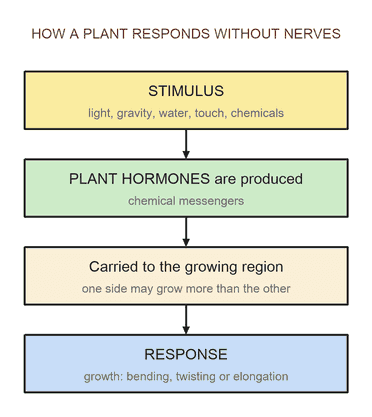
Plants have no sense organs, yet they respond to light, gravity, water, touch and chemicals. So A is true.
Step 2 — Judge the Reason.
Plants have no nervous system. They respond by producing phytohormones, which act as chemical messengers and bring about growth responses. So R is false.
Why the other options are wrong:
- (B) (2) A is False and R is True: it says A is false, but plants do respond to stimuli without sense organs.
- (C) (3) Both A and R are True: it says R is true, but plants have no nervous system.
- (D) (4) Both A and R are False: it says A is false, but A is true.
Therefore, A is true and R is false, option (A).
- 131 mark
Question 13
Assertion (A): Parthenocarpic fruits contain a large number of smaller seeds.
Reason (R): The process of development of fruits without fertilization is termed as parthenocarpy.
Solve with AIAnswer
(A) (1) A is True and R is False
- Correct
(B) (2) A is False and R is True
(C) (3) Both A and R are True
(D) (4) Both A and R are False
Answer: (B) (2) A is False and R is True
Concept: In an assertion–reason item, judge the Assertion (A) and the Reason (R) separately as true or false; only when both are true do we ask whether R correctly explains A. Seeds form only after fertilisation, so a fruit formed without fertilisation has no seeds.
Step 1 — Judge the Assertion.
Parthenocarpic fruits are seedless; they do not contain many small seeds. So A is false.
Step 2 — Judge the Reason.
The development of fruits without fertilisation is called parthenocarpy; this is its definition. So R is true.
Why the other options are wrong:
- (A) (1) A is True and R is False: it says A is true, but parthenocarpic fruits have no seeds.
- (C) (3) Both A and R are True: it says both are true, but A is false.
- (D) (4) Both A and R are False: it says R is false, but R is the definition of parthenocarpy.
Therefore, A is false and R is true, option (B).
- 141 mark
Question 14
Assertion (A): Auxin is a growth-retarding plant hormone.
Reason (R): Auxins are mainly synthesized in shoot apical meristems and young leaves.
Solve with AIAnswer
(A) (1) A is True and R is False
- Correct
(B) (2) A is False and R is True
(C) (3) Both A and R are True
(D) (4) Both A and R are False
Answer: (B) (2) A is False and R is True
Concept: In an assertion–reason item, judge the Assertion (A) and the Reason (R) separately as true or false; only when both are true do we ask whether R correctly explains A. Auxins are growth promoters; the growth-retarding hormone is abscisic acid.
Step 1 — Judge the Assertion.
Auxins promote growth of stems, roots and fruits by cell elongation; the name comes from a Greek word meaning "to grow". So A is false.
Step 2 — Judge the Reason.
Auxins are made mainly in the shoot apical meristems and young leaves. So R is true.
Why the other options are wrong:
- (A) (1) A is True and R is False: it says A is true, but auxins stimulate growth.
- (C) (3) Both A and R are True: it says both are true, but A is false.
- (D) (4) Both A and R are False: it says R is false, but R gives the correct site of auxin synthesis.
Therefore, A is false and R is true, option (B).
- 151 mark
Question 15
Assertion (A): Ethylene is the only hormone which is a gas at ordinary temperature.
Reason (R): It helps in the ripening of fruits and is produced in the roots.
Solve with AIAnswer
- Correct
(A) (1) A is True and R is False
(B) (2) A is False and R is True
(C) (3) Both A and R are True
(D) (4) Both A and R are False
Answer: (A) (1) A is True and R is False
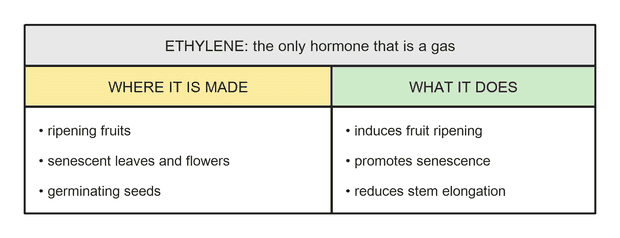
Concept: In an assertion–reason item, judge the Assertion (A) and the Reason (R) separately as true or false; only when both are true do we ask whether R correctly explains A. Ethylene is the only gaseous plant hormone. It is made mainly in ripening fruits, senescent (ageing) leaves and flowers, and germinating seeds, not specially in the roots.
Step 1 — Judge the Assertion.
Ethylene is the only plant hormone that is a gas at ordinary temperature. So A is true.
Step 2 — Judge the Reason.
Its first part is right: ethylene helps fruits ripen. Its second part is wrong: the roots are not where ethylene is mainly made (the hormone made chiefly in root tips is cytokinin). A statement with a wrong part is false, so R is false.
Watch out: Check every part of a two-part statement; one wrong part makes the whole statement false.
Why the other options are wrong:
- (B) (2) A is False and R is True: it says A is false, but ethylene is the only gaseous plant hormone.
- (C) (3) Both A and R are True: it says R is true, but ethylene is not mainly produced in the roots.
- (D) (4) Both A and R are False: it says A is false, but A is true.
Therefore, A is true and R is false, option (A).
- 164 marks
Question 16
Match the items in column A with those of column B
Column A Column B (a) Auxin (i) apical dominance (b) Gibberellin (ii) cell-division (c) Cytokinin (iii) fruit ripening (d) Ethylene (iv) internodal elongation Solve with AIWritten solution
Solution:
Concept: Match each hormone with its best-known effect on the plant.
Step 1 — Match the pairs.
The matched pairs are:
Column A Column B (a) Auxin (i) apical dominance (b) Gibberellin (iv) internodal elongation (c) Cytokinin (ii) cell-division (d) Ethylene (iii) fruit ripening Step 2 — Give the reasons.
Each pair follows from what the hormone does:
- auxins made in the apical bud suppress the lateral buds: apical dominance;
- gibberellins lengthen the internodes by cell elongation;
- cytokinins stimulate cell division;
- ethylene, the gaseous hormone, ripens fruits.

Therefore, (a)–(i), (b)–(iv), (c)–(ii), (d)–(iii).
- 175 marks
Question 17
Complete the following sentences :
(a) Growth of root towards water is .......... .
(b) .......... hormone inhibits apical dominance.
(c) .......... and .......... induce chemotropism of angiosperms and gymnosperms.
(d) .......... of sweet peas exhibit thigmotropism.
(e) .......... is also called as "stress hormone".
Solve with AIWritten solution
Solution:
Concept: Each blank is a term from the chapter for a tropism or a hormone.
Step 1 — Blank (a).
Hydrotropism is growth in response to water; the root grows towards water, so it is positive hydrotropism.

Step 2 — Blank (b).
Auxins cause apical dominance; cytokinins oppose it and let the lateral buds grow.
Step 3 — Blank (c).
The pollen tube grows towards sugars and peptones secreted in the ovule (female gametophyte); growth towards chemicals is chemotropism.
Step 4 — Blanks (d) and (e).
Tendrils of sweet peas coil round a support they touch (thigmotropism).
Abscisic acid (ABA) closes the stomata and helps the plant tolerate stresses, so it is called the stress hormone.
Therefore, (a) positive hydrotropism, (b) cytokinin, (c) sugars and peptones, (d) tendrils, (e) abscisic acid.
- 182 marks
Question 18
How is the movement in plants different from that of animals ?
Solve with AIWritten solution
Solution:
Concept: Plants make their own food, so they do not need to move from place to place; animals must find food, so body movement and locomotion are essential for them.
Step 1 — Compare the movements.
The differences are:
Movement in plants Movement in animals Slow; mostly growth movements such as bending, twisting and elongation of parts. Quick movements of body parts and locomotion of the whole body. Controlled chemically by hormones. Controlled by the nervous system and brought about by muscles. Step 2 — See an example.
A shoot takes days to bend towards a window, but an animal moves away from danger at once.
Therefore, plant movements are slow growth movements of parts, controlled by hormones, while animal movements are quick movements and locomotion, controlled by nerves and muscles.
- 194 marks
Question 19
Name the stimulus which causes the following movements in plants :
phototropism, thigmotropism, hydrotropism and geotropism.
Solve with AIWritten solution
Solution:
Concept: A tropism is named after its stimulus: the first part of the word tells what the plant responds to.
Step 1 — Read each prefix.
Photo = light, thigmo = touch, hydro = water, geo = earth (gravity).
Step 2 — Name the stimuli.
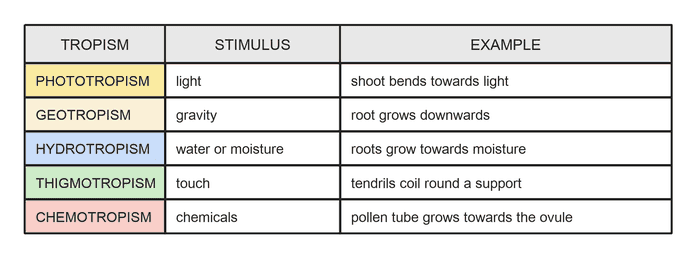
Each tropism with its stimulus and an example:
- phototropism: light (the shoot bends towards light);
- thigmotropism: touch (tendrils coil round a support);
- hydrotropism: water (roots grow towards moisture);
- geotropism: gravity (roots grow down, the shoot grows up).
Therefore, phototropism – light, thigmotropism – touch, hydrotropism – water, geotropism – gravity.
- 203 marks
Question 20
Name the following :
(a) A hormone that stimulates growth by cell division.
(b) A growth-retarding hormone in plants.
(c) The main auxin found in most plants.
Solve with AIWritten solution
Solution:
Concept: Recall the hormone that fits each description.
Step 1 — Part (a).
Cytokinin stimulates growth by cell division (auxins and gibberellins act by cell elongation).
Step 2 — Part (b).
Abscisic acid (ABA) retards growth by slowing down plant metabolism.
Step 3 — Part (c).
IAA (indole-3-acetic acid) is the main natural auxin in most plants.
Therefore, (a) cytokinin, (b) abscisic acid, (c) IAA (indole-3-acetic acid).
- 215 marks
Question 21
The box given below contains twelve words. Out of these, ten can be arranged in five suitable matching pairs. Make these five pairs in the form of a table.
Auxins, Abscisic acid, Fruit ripening, Cytokinins, Closure of stomata, Parthenocarpy, Ethylene, Gibberellins, Tropism, Stem elongation, Cuscuta, Cell division.
Solve with AIWritten solution
Solution:
Concept: The twelve words contain five hormones and five effects; pair each hormone with an effect it controls, and two words are left over.
Step 1 — Find the hormones.
The hormones are auxins, abscisic acid, ethylene, gibberellins and cytokinins.
Step 2 — Pair them.
The five pairs are:
Hormone Matching effect Auxins Parthenocarpy Abscisic acid Closure of stomata Ethylene Fruit ripening Gibberellins Stem elongation Cytokinins Cell division 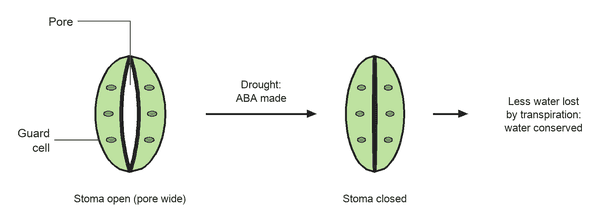
Step 3 — The words left over.
Tropism and Cuscuta are left out. Cuscuta is not a hormone or a hormone effect; it is a leafless parasitic plant whose stem twines round its host.
Auxins – Tropism is an equally correct pair, because auxins bring about tropic bending; in that case Parthenocarpy and Cuscuta are left out.
Therefore, Auxins – Parthenocarpy, Abscisic acid – Closure of stomata, Ethylene – Fruit ripening, Gibberellins – Stem elongation, Cytokinins – Cell division.
- 2214 marks
Question 22
Define the following terms :
(a) Phytohormones
(b) Tropism
(c) Clinostat
(d) Apical dominance
(e) Parthenocarpy
(f) Abscission
(g) Heliotropism
Solve with AIWritten solution
Solution:
Concept: Each definition must state the essential feature of the term; an example makes it complete.
Step 1 — Phytohormones and tropism: (a), (b).
(a) Phytohormones: chemical substances made in one part of a plant and carried to other parts, where they regulate growth and responses (e.g. auxins, gibberellins, cytokinins, ethylene, abscisic acid).
(b) Tropism: a growth movement of a plant part in response to a one-sided external stimulus, its direction depending on the direction of the stimulus (e.g. a shoot bending towards light).
Step 2 — Clinostat and apical dominance: (c), (d).
(c) Clinostat: an instrument that slowly rotates a potted plant so that all its sides are equally exposed to gravity; it is used to demonstrate geotropism.
(d) Apical dominance: the suppression of the growth of lateral buds by the apical bud, caused by auxins; the lateral buds grow only after the apical bud is removed.
Step 3 — Parthenocarpy and abscission: (e), (f).
(e) Parthenocarpy: the development of fruits without fertilisation; such fruits are seedless.
(f) Abscission: the falling (shedding) of leaves, buds, flowers and fruits; abscisic acid speeds it up.
Step 4 — Heliotropism: (g).
(g) Heliotropism: the turning of young flower-heads (e.g. sunflower) to follow the sun from east to west. Auxin collects on the shaded side of the stem, the cells there grow more, and the flower-head bends towards the sun.
Therefore, the seven terms are defined as above: phytohormones (growth regulators), tropism (directional growth movement), clinostat (rotating instrument for geotropism), apical dominance (lateral buds suppressed), parthenocarpy (seedless fruit without fertilisation), abscission (shedding of parts) and heliotropism (flower-heads following the sun).
- 233 marks
Question 23
List five plant growth hormones and mention one important role of each.
Solve with AIWritten solution
Solution:
Concept: The chapter describes five phytohormones; give each with its best-known role.
Step 1 — List the hormones and roles.
The five hormones are:
Plant hormone One important role Auxins Promote cell elongation (growth of stem and root); cause apical dominance. Gibberellins Promote elongation of internodes; break seed dormancy. Cytokinins Stimulate cell division; delay ageing of leaves. Ethylene Induces ripening of fruits. Abscisic acid Inhibits growth; closes the stomata (stress hormone). 
Step 2 — Group them.
The first three stimulate growth, abscisic acid retards it, and ethylene is the only one that is a gas.
Therefore, auxins (cell elongation), gibberellins (internode elongation), cytokinins (cell division), ethylene (fruit ripening) and abscisic acid (growth inhibition, closing of stomata).
- 248 marks
Question 24
Differentiate between :
(a) Thigmotropism and geotropism
(b) Positive and negative tropism
(c) Stimulus and response
(d) Phototropism and chemotropism
Solve with AIWritten solution
Solution:
Concept: For each pair, state the basis of the difference: the stimulus, the direction of growth, or cause and effect.
Step 1 — Thigmotropism and geotropism: (a).
The stimulus differs:
Thigmotropism Geotropism Growth movement in response to touch. Growth movement in response to gravity. Example: tendrils coiling round a support. Example: roots growing down. Step 2 — Positive and negative tropism: (b).
The direction of growth differs:
Positive tropism Negative tropism The part grows towards the stimulus. The part grows away from the stimulus. Example: shoot towards light. Example: root away from light. Step 3 — Stimulus and response: (c).
One is the cause and the other the effect:
Stimulus Response A change in the surroundings (or inside the body) that the organism detects. The action or movement of the organism caused by the stimulus. Example: light falling on a plant from one side. Example: the shoot bending towards that light. 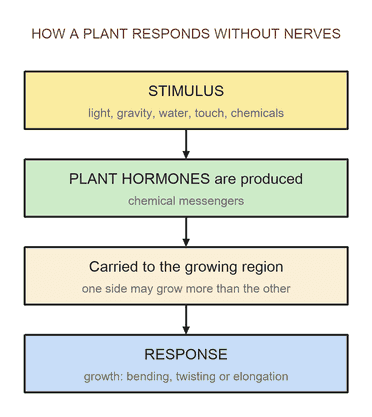
Step 4 — Phototropism and chemotropism: (d).
The stimulus differs:
Phototropism Chemotropism Growth movement in response to light. Growth movement in response to chemicals. Example: shoot bending towards a window. Example: pollen tube growing towards the ovule. Therefore, (a) touch vs gravity, (b) towards vs away from the stimulus, (c) the change detected vs the action it causes, (d) light vs chemicals.
- 253 marks
Question 25
Tea plants are never allowed to grow lengthwise. This is done by cutting their apical buds, a process known as pruning. In this way, tea plants get a dense growth and easy yield. Answer the following questions :
(a) Name the scientific phenomenon that is being overcome by pruning.
(b) What plant hormone is responsible for the scientific phenomenon mentioned in (a).
(c) Name one plant hormone which inhibits the said phenomenon.
Solve with AIWritten solution
Solution:
Concept: Removing the apical bud lets the lateral buds grow into branches, which gives a dense, bushy plant.
Step 1 — Name the phenomenon: (a).
Apical dominance: the suppression of lateral buds by the apical bud. Because of it, an uncut tea plant would grow tall with few branches.
Step 2 — The hormone responsible: (b).
Auxin, made in the apical bud, moves down the stem and suppresses the lateral buds.
Step 3 — A hormone that opposes it: (c).
Cytokinin inhibits (opposes) apical dominance and promotes the growth of lateral buds.
Step 4 — How pruning helps.
Cutting the apical buds removes the source of auxin (cause), so the lateral buds grow into many side branches (effect), giving a dense growth and more leaves to pick.
Therefore, (a) apical dominance, (b) auxin, (c) cytokinin.
- 263 marks
Question 26
The figure given below shows the stages of ripening in a banana. Answer the questions that follow :
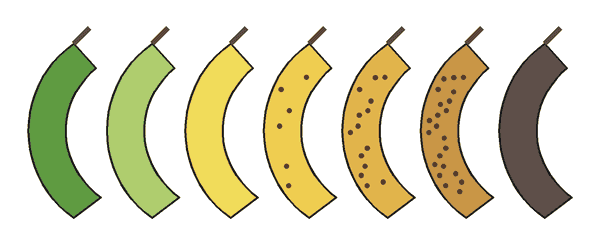
(a) Name the plant hormone responsible for the above changes.
(b) Mention two characteristic features of this hormone.
Solve with AIWritten solution
Solution:
Concept: A banana changing from green to yellow to brown-black is ripening, and ripening is brought about by the gaseous hormone ethylene.
Step 1 — Name the hormone: (a).
Ethylene induces the ripening of fruits. A gas given out by oranges was first found to ripen bananas stored with them; that gas was ethylene.
Step 2 — Its features: (b).
Any two of these:
- it is the only plant hormone that is a gas at ordinary temperature;
- it is made in the fruit itself, so its site of synthesis and site of action are the same;
- it promotes ripening and speeds up senescence; it also reduces stem elongation.

Therefore, (a) ethylene; (b) it is the only gaseous plant hormone, and it is made and acts in the same fruit (also: it promotes senescence).
- 278 marks
Question 27
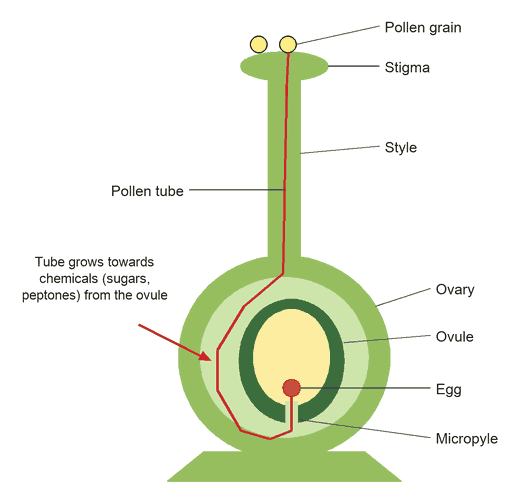
The diagram given alongside shows a type of tropism. Study the same and answer the questions that follow :

(a) Name and define the type of tropism shown in the diagram.
(b) Label the guidelines (1) to (4).
(c) Name two effective stimulants that help in the growth of part (2).
(d) Name two groups of plants where part (2) grows towards gametophyte with the help of the stimulants mentioned in (c).
Solve with AIWritten solution
Solution:
Concept: A pollen tube growing down the style towards the ovule is responding to chemicals given out in the ovule.
Step 1 — Name and define: (a).
Chemotropism: the growth movement of a plant organ in response to chemicals. Here the pollen tube grows towards the sugars and peptones given out in the ovule.
Step 2 — Label the guidelines: (b).
The pollen grain lies on the stigma; its tube runs down the style into the ovary and reaches the ovule.
- 1 — pollen grain;
- 2 — pollen tube;
- 3 — ovule;
- 4 — ovary.
Step 3 — The stimulants: (c).
Sugars and peptones, secreted in the ovule by the female gametophyte, attract the pollen tube.
Step 4 — The plant groups: (d).
Angiosperms and gymnosperms: in both, the pollen tube grows towards the female gametophyte under the influence of these chemicals.
Therefore, (a) chemotropism; (b) 1 pollen grain, 2 pollen tube, 3 ovule, 4 ovary; (c) sugars and peptones; (d) angiosperms and gymnosperms.
- 288 marks
Question 28
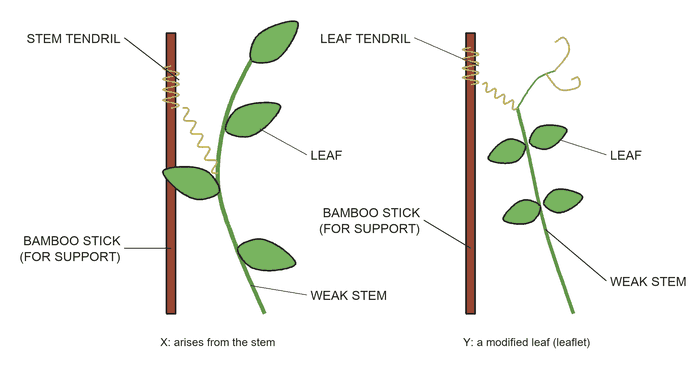
Study the diagrams given below and answer the following questions.

(a) Name the structures shown as X and Y in the figures (A) and (B), respectively.
(b) Write the functions performed by the structures X and Y.
(c) Name the phenomenon depicted and define it.
(d) How do the structures X and Y differ from each other?
(e) Give examples of the plants which show the said phenomenon.
Solve with AIWritten solution
Solution:
Concept: X and Y are both tendrils, thin coiling structures that help weak-stemmed plants climb; X is a modified stem and Y a modified leaf.
Step 1 — Name X and Y: (a).
X — stem tendril; Y — leaf tendril.
Step 2 — Their function: (b).
Both coil round a support, so the weak-stemmed plant can climb up and hold its leaves up to the light.
Step 3 — The phenomenon: (c).
Thigmotropism: the growth movement of a plant part in response to touch (contact). The tip of the tendril senses the one-sided contact, the stimulus passes to the parts behind it, and the tendril twines round the support.
Step 4 — How X and Y differ: (d).
The difference is in what each is a modification of:
X (stem tendril) Y (leaf tendril) A modified stem or branch. A modified leaf or leaflet. Arises from the stem (at a node, in a leaf axil). Arises at the tip of a compound leaf. Step 5 — Examples: (e).
Sweet pea and garden pea have leaf tendrils; grapevine, passion flower, cucumber and gourds have stem tendrils.
Therefore, (a) X stem tendril, Y leaf tendril; (b) both coil round a support to help the plant climb; (c) thigmotropism, growth in response to touch; (d) X is a modified stem, Y a modified leaf; (e) pea (leaf tendrils), grapevine, cucumber, gourds (stem tendrils).
- 298 marks
Question 29
Given below are the figures showing some kinds of tropic movements in plants. Study the same and answer the following questions :
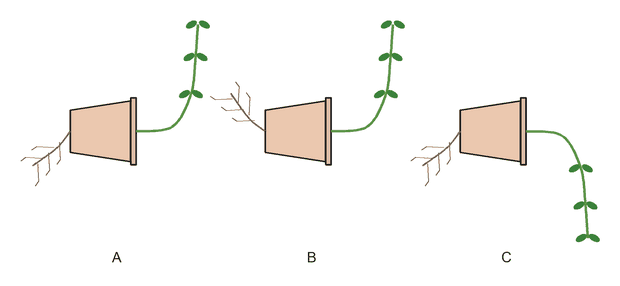
(a) Which one of these figures is correct ? Give reason in support of your answer.
(b) Name the kind of movements shown by the root system and shoot system. Define each.
(c) What are the two stimuli which affect root system and shoot system positively ? Name them.
(d) Which of the following stimuli affect the growth of the root strongly ?
(i) Gravity (ii) Water
(e) Draw a neat and labelled diagram of the longitudinal section of a pistil showing chemotropism in an angiospermic plant.
Solve with AIWritten solution
Solution:
Concept: Whatever the position of the pot, the root grows down towards gravity and the shoot grows up, away from it.
Step 1 — Which figure is correct: (a).
Figure A is correct: its root bends down (towards gravity) and its shoot bends up (away from gravity). In B the root grows up, and in C the shoot grows down; neither happens.
Step 2 — Name and define the movements: (b).
Root — positive geotropism: growth of a plant part towards the force of gravity.
Shoot — negative geotropism: growth of a plant part away from the force of gravity.
This suits the seedling: the root reaches into the soil and the shoot rises towards light.
Step 3 — Positive stimuli: (c).
Gravity affects the root positively, and light affects the shoot positively (the root is also positively hydrotropic).
Step 4 — The stronger stimulus for roots: (d).
(ii) Water. For roots, water is a stronger stimulus than gravity. Seeds germinating in moist sawdust on a wire netting send their radicles down through the netting first, but the radicles then bend back up towards the moist sawdust, against gravity.
Step 5 — Diagram: (e).
The pollen tube grows down the style towards the ovule, attracted by sugars and peptones; this growth towards chemicals is chemotropism.

Therefore, (a) A; (b) root positively and shoot negatively geotropic; (c) gravity for the root, light for the shoot; (d) water; (e) as drawn.
- 308 marks
Question 30
The figure given below depicts a kind of tropic movement in plants. Study the same and answer the following questions.
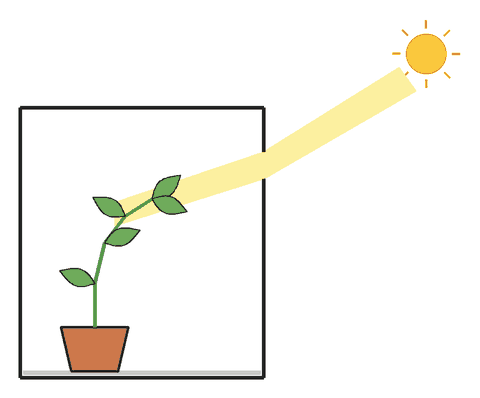
(a) What kind of a movement is shown in the figure ? Define it.
(b) How does this movement differ from geotropism ?
(c) Name the stimulus responsible for thigmotropism. Give one example of a plant showing thigmotropism.
(d) Name one stimulus which gives a positive response for the roots but negative response for the shoot.
(e) Draw a neat and labelled diagram of the part of a plant showing leaf tendril. Name the plant.
Solve with AIWritten solution
Solution:
Concept: The shoot bends towards the hole through which light enters the box, so the movement is a response to light from one side.
Step 1 — Name and define the movement: (a).
Positive phototropism: the growth movement of a plant part towards the source of light (in response to light from one side).
How it happens: auxin collects on the side of the shoot away from the light (cause); the cells there grow longer, so the shoot bends towards the light (effect).
Step 2 — How it differs from geotropism: (b).
The stimulus and the responses differ:
Phototropism Geotropism The stimulus is light. The stimulus is gravity. Shoot positive; root negative. Root positive; shoot negative. Step 3 — Thigmotropism: (c).
The stimulus is touch (contact); for example, the tendrils of the sweet pea coil round a support.
Step 4 — Positive for roots, negative for shoots: (d).
Gravity: the root grows towards it (positively geotropic) and the shoot grows away from it (negatively geotropic).
Step 5 — Leaf tendril diagram: (e).
Plant: pea (garden pea or sweet pea).
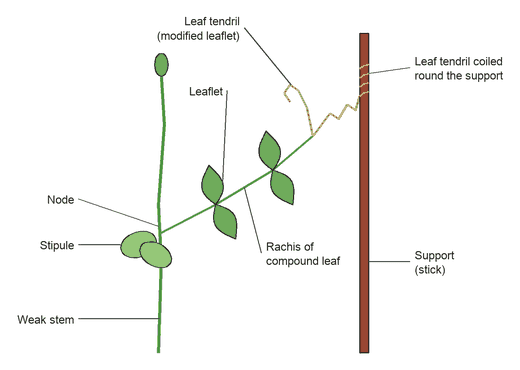
Therefore, (a) positive phototropism; (b) phototropism responds to light, geotropism to gravity; (c) touch, e.g. sweet pea; (d) gravity; (e) pea, as drawn.
What Class 10 Biology Ch 7 covers
The sections of the chapter, in the order the book takes them. Every question above comes from one of these.
- 01What Are Plant Hormones
- 02Auxins
- 03Gibberellins
- 04Cytokinins
- 05Ethylene
- 06Abscisic Acid (ABA)
More ways to study this chapter
The same chapter asked three other ways. Practise it, revise it, and see what the board has set on Ch 7 before.
- Competency-Based Questions (CBQ)Case study questions: a situation, and the part of the chapter that answers it.40questionsOpen
- Previous Year QuestionsQuestions that have actually appeared in board papers, each tagged with its year.22questionsOpen
- Practice QuestionsExtra questions per chapter, for when one attempt at a method is not enough.44questionsOpen
Ch 7 in past ICSE papers
The same chapter as the board has actually asked it. These are worded differently from the textbook exercise, which is the point of reading them.
- 11 mark
Board paper question 1
Expand the following biological abbreviations :
ABA
Solve with AIWritten solution
Solution:
Concept: Plant hormones are often written as short forms. ABA is the short form of the hormone that slows growth down and helps the plant through stress.
Step 1 — Read the letters.
The three letters stand for the words of the hormone's name: Abscisic Acid, where 'abscisic' comes from abscission (the falling of leaves and fruits), the effect it was first linked with.
Step 2 — Give the full form and what it does.
So ABA is abscisic acid. It is the main growth-retarding (growth-inhibiting) hormone. It keeps seeds and buds dormant, speeds up the ageing of leaves, and makes the stomata close when water is short, which is why it is called the stress hormone.
Watch out: Write 'abscisic', not 'absicic' or 'ascorbic'; ascorbic acid is vitamin C, not a plant hormone.
Therefore, ABA stands for abscisic acid.
- 21 mark
Board paper question 2
Expand the following biological abbreviations :
IAA
Solve with AIWritten solution
Solution:
Concept: Auxins are the plant hormones that make cells grow longer. The most common natural auxin has a chemical name that is shortened to IAA.
Step 1 — Read the letters.
The letters stand for Indole-3-Acetic Acid: an acetic acid group joined to an indole ring.
Step 2 — Say what it does.
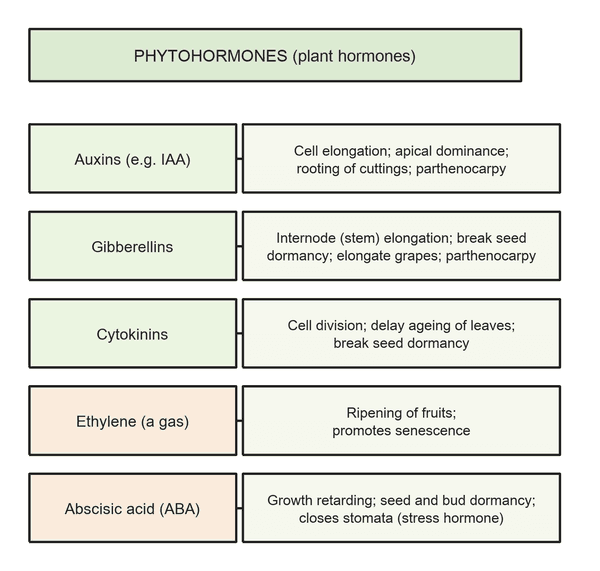
IAA is the main natural auxin. It is made at the tips of shoots and makes cells elongate, so it controls growth in length, keeps side buds dormant (apical dominance), helps cuttings form roots and makes a shoot bend towards light.
Watch out: IAA is indole-3-acetic acid; do not confuse it with ABA (abscisic acid), which slows growth.
Therefore, IAA stands for indole-3-acetic acid, the main natural auxin.
- 35 marks
Board paper question 3
Given below is an experimental setup to demonstrate a particular tropic movement in germinating seeds. Study the diagram and answer the questions that follow :
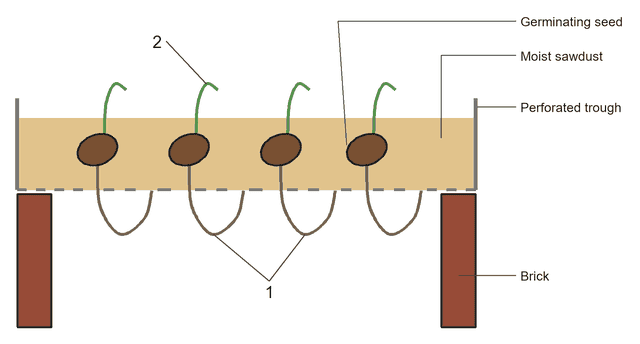
(i) Label the parts 1 and 2.
(ii) Name the tropic movement shown by part 1.
(iii) Part 1 is affected by two stimuli. Name them. Which one of the two is stronger?
(iv) What is Thigmotropism ? Give one example.
(v) What is meant by 'Positive' and 'Negative' tropic movements in plants?
Solve with AIWritten solution
Solution:
Concept: Germinating seeds are kept in moist sawdust in a trough whose base is wire netting. The radicles first grow straight down through the holes (pulled by gravity) and then bend back up towards the moist sawdust. This is hydrotropism, and it shows that water is a stronger stimulus than gravity for roots.
Step 1 — Label parts 1 and 2.
Part 1 marks the bent roots below the netting, and part 2 marks a growing shoot.
- 1 — Radicle (root) of the germinating seed.
- 2 — Plumule (shoot) of the germinating seed.
Step 2 — Name the movement of part 1.
The roots turn back towards the moist sawdust, which is the source of water. A growth movement towards water is positive hydrotropism.
Step 3 — Name the two stimuli and compare them.
Two stimuli act on the roots: gravity and water (moisture). At first the radicles grow down through the netting under gravity (positive geotropism). Soon they turn and grow upwards, against gravity, towards the moist sawdust. Since the roots obey water rather than gravity, water is the stronger stimulus.
Step 4 — Define thigmotropism with an example.
Thigmotropism is the growth movement of a plant part in response to touch (contact with a solid object).
Example: the tendrils of a pea plant coil round a stick or wire they touch, so the weak stem can climb up towards light.
Step 5 — Explain positive and negative tropic movements.
The words tell the direction of growth compared with the stimulus.
- Positive tropic movement: the part grows towards the stimulus. Examples: roots grow towards gravity (positive geotropism) and towards water (positive hydrotropism); shoots grow towards light (positive phototropism).
- Negative tropic movement: the part grows away from the stimulus. Examples: shoots grow away from gravity (negative geotropism); roots grow away from light (negative phototropism).
Watch out: In part (iii) the roots end up growing UP, against gravity; that is exactly why water is called the stronger stimulus.
Therefore, (i) 1 = radicle (root), 2 = plumule (shoot); (ii) hydrotropism (positive); (iii) gravity and water, with water the stronger; (iv) thigmotropism is growth in response to touch, e.g. pea tendrils; (v) positive = towards the stimulus, negative = away from it.
- 41 mark
Board paper question 4
State the main functions of the following :
Cytokinins
Solve with AIWritten solution
Solution:
Concept: Cytokinins are the plant hormones that act on cell division; their name comes from cytokinesis, the division of the cytoplasm.
Step 1 — State the main function.
Cytokinins stimulate cell division (cytokinesis) in plants, even in tissues that are not meristems, so new cells keep forming for growth.
Step 2 — Add the related effects.
They also delay the ageing (senescence) of leaves, keeping them green longer, and they can help to break the dormancy of some seeds.
Watch out: The MAIN function is cell division; cell elongation is the job of auxins and gibberellins.
Therefore, the main function of cytokinins is to stimulate cell division (and they delay the ageing of leaves).
- 51 mark
Board paper question 5
Answer the following questions briefly :
What is Parthenocarpy ? Give one example.
Solve with AIWritten solution
Solution:
Concept: Normally a fruit develops from the ovary after fertilisation, and the fertilised ovules become seeds. Some fruits can develop from the ovary without fertilisation.
Step 1 — Define the term.
Parthenocarpy is the development of a fruit without fertilisation. Since no ovule is fertilised, no seeds form, so such fruits are seedless (parthenocarpic fruits).
Step 2 — Give an example.
Banana is a natural example; seedless varieties of grape are another common example.
Parthenocarpy can also be brought about by spraying flowers with auxins or gibberellins, for example in tomato.
Watch out: Parthenocarpy is fruit WITHOUT fertilisation; a seedless fruit is the result, not the definition.
Therefore, parthenocarpy is the formation of seedless fruits without fertilisation; example: banana.
- 61 mark
Board paper question 6
Identify the ODD term in each set and name the CATEGORY to which the remaining three belong:
(i) Auxin, Ethylene, Adrenaline, Cytokinin
Solve with AIWritten solution
Solution:
Concept: An odd-one-out set has three terms that share a category and one that does not.
Step 1 — Sort the terms.
Auxin, ethylene and cytokinin are all made by plants and control plant growth, so they are plant hormones (phytohormones).
Step 2 — Find the odd term.
Adrenaline is an animal hormone. In humans it is secreted by the adrenal medulla and prepares the body for an emergency (the 'fight or flight' hormone).
Therefore, the odd term is adrenaline, and the other three belong to the category of plant hormones (phytohormones).
All 22 board paper questions for this chapter, solved the same way.
Class 10 Biology Ch 7 questions students ask
How many questions are there in Class 10 Biology Ch 7?
30 questions. Every one is solved step by step on this page.
Are these Class 10 Biology solutions free?
Yes. Every question and its full working is free to read, with no account needed.
Can I download the Class 10 Biology Ch 7 solutions as a PDF?
There is no PDF to download. Every solution is on this page instead, which means it is searchable, always the current syllabus, and readable on a phone. Use your browser's print option if you want it on paper.