
Question 248 marksEasy
Differentiate between :
(a) Thigmotropism and geotropism
(b) Positive and negative tropism
(c) Stimulus and response
(d) Phototropism and chemotropism
Confirming your payment
Sign up now and get 250 free tokens.
Chemical Coordination in Plants · Question 24 of 30
Differentiate between :
(a) Thigmotropism and geotropism
(b) Positive and negative tropism
(c) Stimulus and response
(d) Phototropism and chemotropism
Solution:
Concept: For each pair, state the basis of the difference: the stimulus, the direction of growth, or cause and effect.
Step 1 — Thigmotropism and geotropism: (a).
The stimulus differs:
| Thigmotropism | Geotropism |
|---|---|
| Growth movement in response to touch. | Growth movement in response to gravity. |
| Example: tendrils coiling round a support. | Example: roots growing down. |
Step 2 — Positive and negative tropism: (b).
The direction of growth differs:
| Positive tropism | Negative tropism |
|---|---|
| The part grows towards the stimulus. | The part grows away from the stimulus. |
| Example: shoot towards light. | Example: root away from light. |

Step 3 — Stimulus and response: (c).
One is the cause and the other the effect:
| Stimulus | Response |
|---|---|
| A change in the surroundings (or inside the body) that the organism detects. | The action or movement of the organism caused by the stimulus. |
| Example: light falling on a plant from one side. | Example: the shoot bending towards that light. |
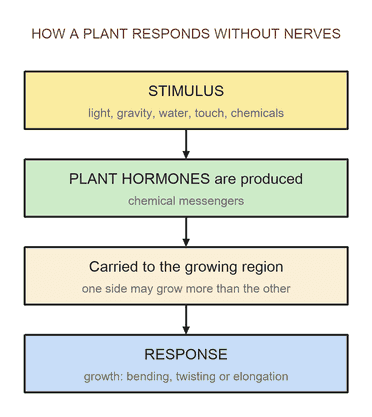
Step 4 — Phototropism and chemotropism: (d).
The stimulus differs:
| Phototropism | Chemotropism |
|---|---|
| Growth movement in response to light. | Growth movement in response to chemicals. |
| Example: shoot bending towards a window. | Example: pollen tube growing towards the ovule. |
Therefore, (a) touch vs gravity, (b) towards vs away from the stimulus, (c) the change detected vs the action it causes, (d) light vs chemicals.