Solution:
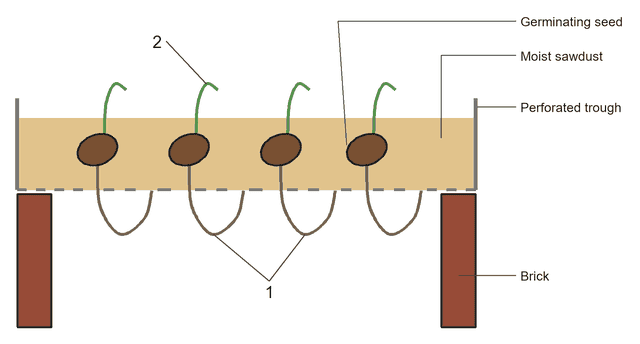
Concept: Germinating seeds are kept in moist sawdust in a trough whose base is wire netting. The radicles first grow straight down through the holes (pulled by gravity) and then bend back up towards the moist sawdust. This is hydrotropism, and it shows that water is a stronger stimulus than gravity for roots.
Step 1 — Label parts 1 and 2.
Part 1 marks the bent roots below the netting, and part 2 marks a growing shoot.
- 1 — Radicle (root) of the germinating seed.
- 2 — Plumule (shoot) of the germinating seed.
Step 2 — Name the movement of part 1.
The roots turn back towards the moist sawdust, which is the source of water. A growth movement towards water is positive hydrotropism.

Step 3 — Name the two stimuli and compare them.
Two stimuli act on the roots: gravity and water (moisture). At first the radicles grow down through the netting under gravity (positive geotropism). Soon they turn and grow upwards, against gravity, towards the moist sawdust. Since the roots obey water rather than gravity, water is the stronger stimulus.
Step 4 — Define thigmotropism with an example.
Thigmotropism is the growth movement of a plant part in response to touch (contact with a solid object).
Example: the tendrils of a pea plant coil round a stick or wire they touch, so the weak stem can climb up towards light.
Step 5 — Explain positive and negative tropic movements.
The words tell the direction of growth compared with the stimulus.
- Positive tropic movement: the part grows towards the stimulus. Examples: roots grow towards gravity (positive geotropism) and towards water (positive hydrotropism); shoots grow towards light (positive phototropism).
- Negative tropic movement: the part grows away from the stimulus. Examples: shoots grow away from gravity (negative geotropism); roots grow away from light (negative phototropism).

Watch out: In part (iii) the roots end up growing UP, against gravity; that is exactly why water is called the stronger stimulus.
Therefore, (i) 1 = radicle (root), 2 = plumule (shoot); (ii) hydrotropism (positive); (iii) gravity and water, with water the stronger; (iv) thigmotropism is growth in response to touch, e.g. pea tendrils; (v) positive = towards the stimulus, negative = away from it.