
Opening your dashboard
Class 10 Biology Chapter 7 Chemical Coordination in Plants: Previous Year Questions
22 questions on Chapter 7, each solved step by step. Class 10 Biology, ICSE 2026-27.
22 questions with solutions
1–5 marks · Mixed difficulty
- 11 mark
Question 1
Expand the following biological abbreviations :
ABA
Solve with AIWritten solution
Solution:
Concept: Plant hormones are often written as short forms. ABA is the short form of the hormone that slows growth down and helps the plant through stress.
Step 1 — Read the letters.
The three letters stand for the words of the hormone's name: Abscisic Acid, where 'abscisic' comes from abscission (the falling of leaves and fruits), the effect it was first linked with.
Step 2 — Give the full form and what it does.
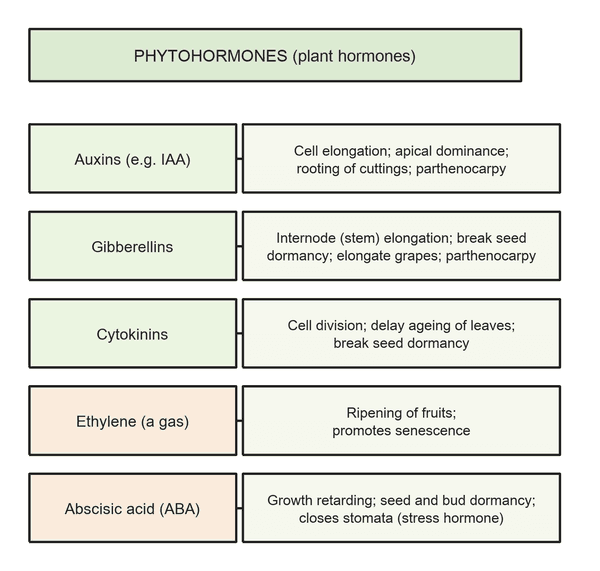
So ABA is abscisic acid. It is the main growth-retarding (growth-inhibiting) hormone. It keeps seeds and buds dormant, speeds up the ageing of leaves, and makes the stomata close when water is short, which is why it is called the stress hormone.
Watch out: Write 'abscisic', not 'absicic' or 'ascorbic'; ascorbic acid is vitamin C, not a plant hormone.
Therefore, ABA stands for abscisic acid.
- 21 mark
Question 2
Expand the following biological abbreviations :
IAA
Solve with AIWritten solution
Solution:
Concept: Auxins are the plant hormones that make cells grow longer. The most common natural auxin has a chemical name that is shortened to IAA.
Step 1 — Read the letters.
The letters stand for Indole-3-Acetic Acid: an acetic acid group joined to an indole ring.
Step 2 — Say what it does.
IAA is the main natural auxin. It is made at the tips of shoots and makes cells elongate, so it controls growth in length, keeps side buds dormant (apical dominance), helps cuttings form roots and makes a shoot bend towards light.
Watch out: IAA is indole-3-acetic acid; do not confuse it with ABA (abscisic acid), which slows growth.
Therefore, IAA stands for indole-3-acetic acid, the main natural auxin.
- 35 marks
Question 3
Given below is an experimental setup to demonstrate a particular tropic movement in germinating seeds. Study the diagram and answer the questions that follow :
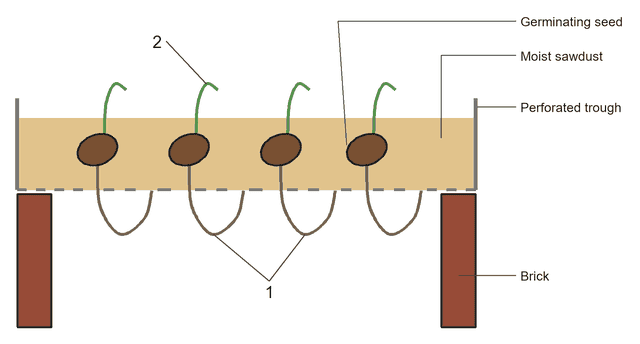
(i) Label the parts 1 and 2.
(ii) Name the tropic movement shown by part 1.
(iii) Part 1 is affected by two stimuli. Name them. Which one of the two is stronger?
(iv) What is Thigmotropism ? Give one example.
(v) What is meant by 'Positive' and 'Negative' tropic movements in plants?
Solve with AIWritten solution
Solution:
Concept: Germinating seeds are kept in moist sawdust in a trough whose base is wire netting. The radicles first grow straight down through the holes (pulled by gravity) and then bend back up towards the moist sawdust. This is hydrotropism, and it shows that water is a stronger stimulus than gravity for roots.
Step 1 — Label parts 1 and 2.
Part 1 marks the bent roots below the netting, and part 2 marks a growing shoot.
- 1 — Radicle (root) of the germinating seed.
- 2 — Plumule (shoot) of the germinating seed.
Step 2 — Name the movement of part 1.
The roots turn back towards the moist sawdust, which is the source of water. A growth movement towards water is positive hydrotropism.

Step 3 — Name the two stimuli and compare them.
Two stimuli act on the roots: gravity and water (moisture). At first the radicles grow down through the netting under gravity (positive geotropism). Soon they turn and grow upwards, against gravity, towards the moist sawdust. Since the roots obey water rather than gravity, water is the stronger stimulus.
Step 4 — Define thigmotropism with an example.
Thigmotropism is the growth movement of a plant part in response to touch (contact with a solid object).
Example: the tendrils of a pea plant coil round a stick or wire they touch, so the weak stem can climb up towards light.
Step 5 — Explain positive and negative tropic movements.
The words tell the direction of growth compared with the stimulus.
- Positive tropic movement: the part grows towards the stimulus. Examples: roots grow towards gravity (positive geotropism) and towards water (positive hydrotropism); shoots grow towards light (positive phototropism).
- Negative tropic movement: the part grows away from the stimulus. Examples: shoots grow away from gravity (negative geotropism); roots grow away from light (negative phototropism).

Watch out: In part (iii) the roots end up growing UP, against gravity; that is exactly why water is called the stronger stimulus.
Therefore, (i) 1 = radicle (root), 2 = plumule (shoot); (ii) hydrotropism (positive); (iii) gravity and water, with water the stronger; (iv) thigmotropism is growth in response to touch, e.g. pea tendrils; (v) positive = towards the stimulus, negative = away from it.
- 41 mark
Question 4
State the main functions of the following :
Cytokinins
Solve with AIWritten solution
Solution:
Concept: Cytokinins are the plant hormones that act on cell division; their name comes from cytokinesis, the division of the cytoplasm.
Step 1 — State the main function.
Cytokinins stimulate cell division (cytokinesis) in plants, even in tissues that are not meristems, so new cells keep forming for growth.
Step 2 — Add the related effects.
They also delay the ageing (senescence) of leaves, keeping them green longer, and they can help to break the dormancy of some seeds.
Watch out: The MAIN function is cell division; cell elongation is the job of auxins and gibberellins.
Therefore, the main function of cytokinins is to stimulate cell division (and they delay the ageing of leaves).
- 51 mark
Question 5
Answer the following questions briefly :
What is Parthenocarpy ? Give one example.
Solve with AIWritten solution
Solution:
Concept: Normally a fruit develops from the ovary after fertilisation, and the fertilised ovules become seeds. Some fruits can develop from the ovary without fertilisation.
Step 1 — Define the term.
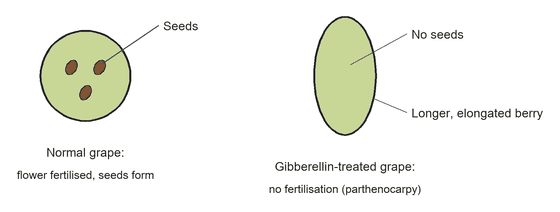
Parthenocarpy is the development of a fruit without fertilisation. Since no ovule is fertilised, no seeds form, so such fruits are seedless (parthenocarpic fruits).
Step 2 — Give an example.
Banana is a natural example; seedless varieties of grape are another common example.
Parthenocarpy can also be brought about by spraying flowers with auxins or gibberellins, for example in tomato.
Watch out: Parthenocarpy is fruit WITHOUT fertilisation; a seedless fruit is the result, not the definition.
Therefore, parthenocarpy is the formation of seedless fruits without fertilisation; example: banana.
- 61 mark
Question 6
Identify the ODD term in each set and name the CATEGORY to which the remaining three belong:
(i) Auxin, Ethylene, Adrenaline, Cytokinin
Solve with AIWritten solution
Solution:
Concept: An odd-one-out set has three terms that share a category and one that does not.
Step 1 — Sort the terms.
Auxin, ethylene and cytokinin are all made by plants and control plant growth, so they are plant hormones (phytohormones).
Step 2 — Find the odd term.
Adrenaline is an animal hormone. In humans it is secreted by the adrenal medulla and prepares the body for an emergency (the 'fight or flight' hormone).
Therefore, the odd term is adrenaline, and the other three belong to the category of plant hormones (phytohormones).
- 75 marks
Question 7
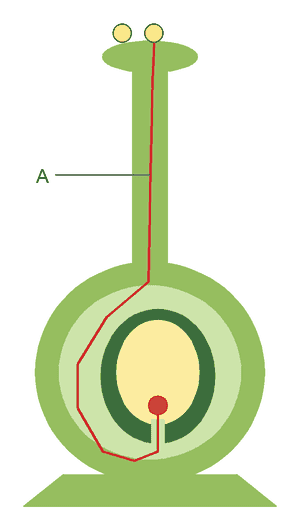
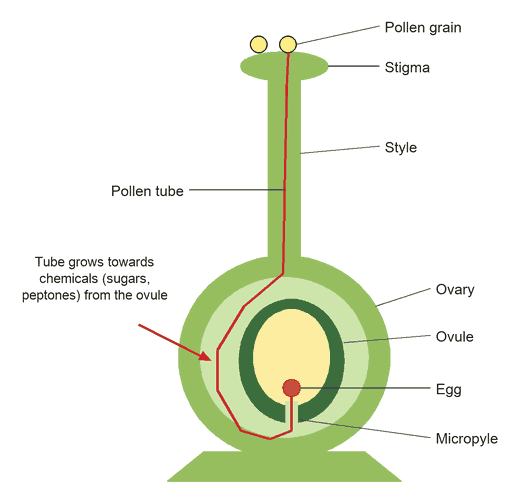
The diagram given below represents a plant movement. Answer the following questions.
(i) Name the tropic movement shown in the diagram.
(ii) Explain the tropic movement mentioned in (i).
(iii) Label the part marked 'A'.
(iv) What is part A attracted to?
(v) Give an example of plant which shows Thigmotropism.
Solve with AIWritten solution
Solution:
Concept: The figure is a lengthwise section of a pistil. A tube from a pollen grain on the stigma grows down the style into the ovary and reaches the ovule. It is guided by chemicals from the ovule, so the movement is chemotropism.
Step 1 — Name the movement.
The tube grows towards a chemical stimulus, so the tropic movement is chemotropism (positive chemotropism).
Step 2 — Explain the movement.
Chemotropism is the growth movement of a plant part in response to chemicals.
After pollination, the pollen grain on the stigma puts out a pollen tube. The tube grows down through the style towards the ovule, because the ovule gives out chemicals (such as sugars and peptones) that attract it. The tube enters the ovule through the micropyle and carries the male gametes to the egg, so fertilisation can take place.
Step 3 — Label part A.
A marks the tube inside the style, so A — pollen tube.
Step 4 — Say what attracts part A.
The pollen tube is attracted to the ovule, by the chemicals (sugars and peptones) that come from it; these lead it to the egg through the micropyle.
Step 5 — Give a plant that shows thigmotropism.
A plant with tendrils climbs by thigmotropism: the pea plant (garden pea or sweet pea), whose tendrils coil round any support they touch.
Watch out: The tube grows towards the OVULE, not towards the stigma or the ovary wall.
Therefore, (i) chemotropism; (ii) the pollen tube grows towards chemicals from the ovule; (iii) A = pollen tube; (iv) the ovule (its sugars and peptones); (v) pea plant.
- 81 mark
Question 8
State two functions of:
(ii) Ethylene
Solve with AIWritten solution
Solution:
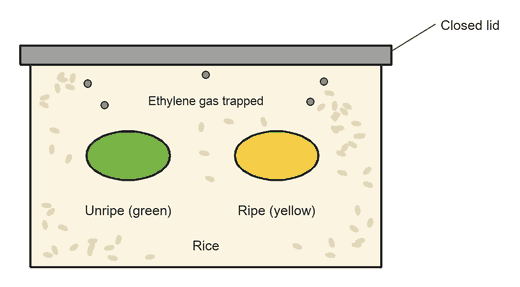
Concept: Ethylene is the only plant hormone that is a gas. Most plant parts make a little of it, and ripening fruits make a lot.
Step 1 — First function: ripening.
Ethylene promotes the ripening of fruits: the fruit softens, turns sweet and changes colour. This is why it is used commercially to ripen fruits evenly.
Step 2 — Second function: ageing.
Ethylene promotes senescence (ageing) of leaves and flowers and helps in their shedding.
Step 3 — Other effects.
It also helps to break the dormancy of buds, for example the sprouting of potato tubers, and it is used to start flowering in pineapple and mango.
Therefore, two functions of ethylene are: (1) it promotes the ripening of fruits; (2) it promotes the ageing (senescence) of leaves and flowers.
- 91 mark
Question 9
Name the following:
(e) A gaseous plant hormone which promotes ripening of fruits.
Solve with AIWritten solution
Solution:
Concept: Of the plant hormones, only one is a gas at ordinary temperature.
Step 1 — Match the clues.
The clues are 'gaseous' and 'promotes ripening of fruits'. Both fit ethylene.
Step 2 — Explain the ripening effect.
A ripening fruit gives out ethylene. In a closed space the gas collects and speeds up the ripening of that fruit and of the fruits around it.
Therefore, the gaseous plant hormone that promotes ripening of fruits is ethylene.
- 103 marks
Question 10
Study the diagram given below and answer the questions that follow:

(a) Name the phenomenon depicted by the shoot in the above diagram.
(b) Which plant hormone plays an important role in the above movement?
(c) Complete and rewrite the given statement by filling in the correct terms:
Shoots show positive ............... whereas, roots show positive ............... .
Solve with AIWritten solution
Solution:
Concept: Light enters the box from one side only, through the opening at the upper right. The shoot bends and grows towards it. This bending is caused by the hormone auxin, which collects on the shaded side of the shoot.
Step 1 — Name the phenomenon.
The shoot grows towards the light, so the phenomenon is phototropism (positive phototropism of the shoot).
Step 2 — Name the hormone and explain its role.
The hormone is auxin. Under one-sided light, auxin moves to the shaded side of the shoot tip. The cells there elongate faster than the cells on the lit side, so the shaded side grows longer and the shoot bends towards the light.

Step 3 — Complete the statement.
Shoots grow towards light, and roots grow towards gravity.
Shoots show positive phototropism whereas, roots show positive geotropism.
(Roots also show positive hydrotropism, but geotropism is the usual pair to phototropism.)
Watch out: Auxin collects on the SHADED side, not the lit side; the faster-growing shaded side pushes the tip towards the light.
Therefore, (a) phototropism; (b) auxin; (c) shoots show positive phototropism whereas roots show positive geotropism.
- 111 mark
Question 11
Name the following:
(c) The tropic movement of plant parts in response to chemicals.
Solve with AIWritten solution
Solution:
Concept: A tropic movement (tropism) is a growth movement of a plant part towards or away from a stimulus that comes from one direction. Growth towards the stimulus is called positive; growth away from it is called negative. Each tropism is named after its stimulus: photo = light, geo = gravity, hydro = water, chemo = chemicals, thigmo = touch.
Step 1 — Match the stimulus to the name.
The stimulus here is chemicals, and the prefix for chemicals is 'chemo', so the movement is chemotropism.
Step 2 — Give an example.
The pollen tube grows down the style towards the ovule, attracted by chemicals (sugars and peptones) from the ovule.
Therefore, the tropic movement of plant parts in response to chemicals is chemotropism.
- 123 marks
Question 12
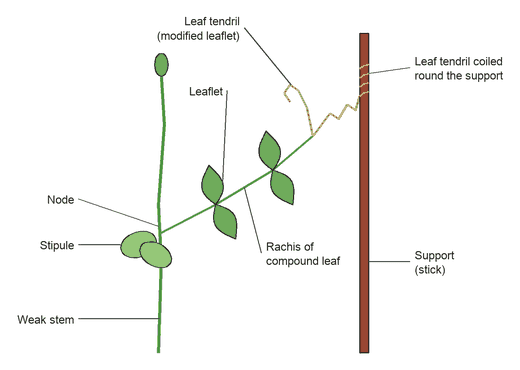
Ali has some pea plants in his garden which need a support to grow as seen in the picture given below:
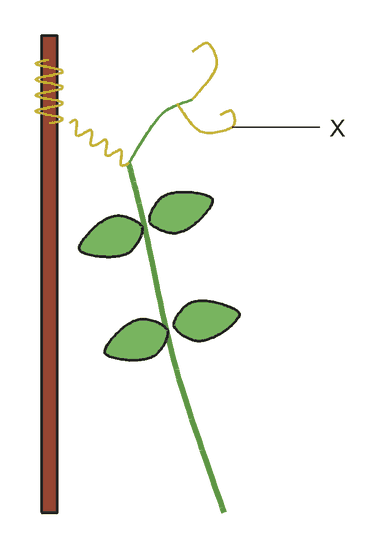
(a) Name the phenomenon depicted by the shoot in the given figure.
(b) Define the above phenomenon.
(c) Write the name of the part marked X.
Solve with AIWritten solution
Solution:
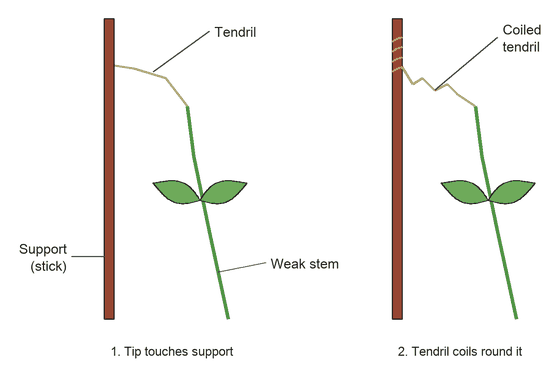
Concept: A pea plant has a weak stem. Thin, thread-like tendrils coil round a support when they touch it, so the plant can climb. This is a response to touch.
Step 1 — Name the phenomenon.
The tendrils coil round the stick because they touched it, so the phenomenon is thigmotropism.
Step 2 — Define it.
Thigmotropism is the growth movement of a plant part in response to the stimulus of touch (contact).
When the tip of a tendril touches a support, the side in contact grows more slowly than the outer side. This unequal growth makes the tendril twine (coil) round the support, and the coiling holds the weak stem up towards the light.
Step 3 — Name part X.
X is the thin, coiled, thread-like part at the tip of the leaf, so X — tendril. In the pea it is a leaf tendril: the end leaflets of the compound leaf are changed into tendrils.
Watch out: X is a tendril, a part of the LEAF in pea; it is not a root or a branch of the stem.
Therefore, (a) thigmotropism; (b) growth movement of a plant part in response to touch; (c) X = tendril (leaf tendril).
- 131 mark
Question 13
Sunil tried to match the tropic movements in plants with the stimulus they respond to. The tabulation is given below:
Tropism Stimulus P Thigmotropism Touch Q Geotropism Water R Chemotropism Chemicals S Phototropism Gravity Identify the correct pair:
Solve with AIAnswer
- Correct
(A) P and R
(B) Q and S
(C) R and S
(D) P and S
Answer: (A) P and R
Concept: A tropic movement (tropism) is a growth movement of a plant part towards or away from a stimulus that comes from one direction. Growth towards the stimulus is called positive; growth away from it is called negative. Each tropism is named after its stimulus: photo = light, geo = gravity, hydro = water, chemo = chemicals, thigmo = touch.
Step 1 — Check each row of the table.
Compare each tropism with its stimulus.
- P — Thigmotropism, Touch: correct.
- Q — Geotropism, Water: wrong. Geotropism is the response to gravity; the response to water is hydrotropism.
- R — Chemotropism, Chemicals: correct.
- S — Phototropism, Gravity: wrong. Phototropism is the response to light.
Step 2 — Pick the option.
The correctly matched rows are P and R, which is option (A).
Watch out: Read each row on its own; one correct row in an option does not make the option correct.
Why the other options are wrong:
- (B) Q and S: both Q and S are mismatched: geotropism is not a response to water, and phototropism is not a response to gravity.
- (C) R and S: R is correct, but S wrongly pairs phototropism with gravity.
- (D) P and S: P is correct, but S wrongly pairs phototropism with gravity.
Therefore, the correct pairs are P and R, option (A).
- 142 marks
Question 14
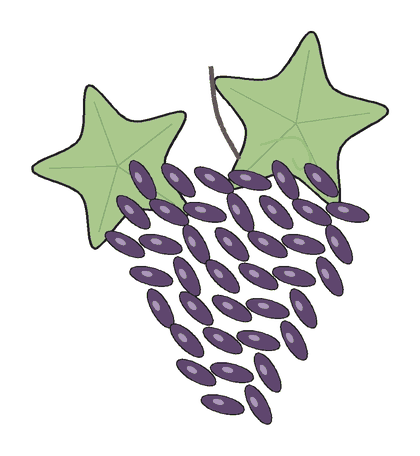
Ramesh is a farmer who has a vineyard and cultivates grapes. To improve the shape of the grapes and make them elongated he sprays a particular phytohormone at the time of fruiting.
(a) Name the phytohormone that Ramesh sprays on the plant at the time of fruiting.
(b) These grapes are said to be seedless. What is the technical term for the formation of such fruits?
Solve with AIWritten solution
Solution:
Concept: Gibberellins are plant hormones that make plant parts grow longer. Fruits formed without fertilisation have no seeds.
Step 1 — Name the hormone sprayed.
The farmer wants longer, better-shaped grapes. Gibberellins (gibberellic acid) make the berries grow longer, so they are sprayed on grape bunches at fruiting.
Step 2 — Name the formation of seedless fruits.
A fruit that develops without fertilisation has no seeds. This is parthenocarpy, and such fruits are parthenocarpic fruits. Gibberellins (and auxins) can themselves bring it about.
Watch out: The hormone that ELONGATES grapes is gibberellin; ethylene ripens fruits, it does not lengthen them.
Therefore, (a) gibberellin (gibberellic acid); (b) parthenocarpy.
- 151 mark
Question 15
Name the following:
(d) Hormone responsible for the bending of a plant shoot towards light.
Solve with AIWritten solution
Solution:
Concept: A shoot bends towards light because its two sides grow at different rates, and a growth hormone controls this.
Step 1 — Name the hormone.
The hormone that causes the bending is auxin.
Step 2 — Explain how it bends the shoot.
Under one-sided light, auxin collects on the shaded side of the shoot. The cells there elongate faster, so the shaded side grows longer and the shoot bends towards the light.
Therefore, the hormone responsible for the bending of a shoot towards light is auxin.
- 162 marks
Question 16
What are phytohormones? Give an example of the growth retarding hormone.
Solve with AIWritten solution
Solution:
Concept: Plants have no nervous system; they control their growth and responses with chemical messengers.
Step 1 — Define phytohormones.
Phytohormones (plant hormones) are chemical substances made in small amounts in one part of a plant that act there or are carried to other parts, where they control growth and the plant's responses to stimuli. The main ones are auxins, gibberellins, cytokinins, ethylene and abscisic acid.
Step 2 — Give the growth-retarding hormone.
Abscisic acid (ABA) slows down growth: it keeps seeds and buds dormant and makes stomata close during water shortage.
Therefore, phytohormones are chemical messengers that control growth in plants, and abscisic acid (ABA) is a growth-retarding hormone.
- 171 mark
Question 17
Expand the following abbreviations:
(b) ABA
Solve with AIWritten solution
Solution:
Concept: ABA is the short form of the growth-retarding plant hormone.
Step 1 — Read the letters.
The letters stand for Abscisic Acid.
Step 2 — Give the full form and what it does.
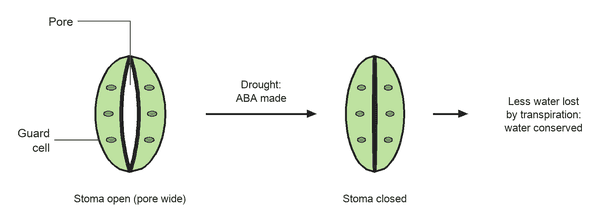
So ABA is abscisic acid. It is the main growth-retarding (growth-inhibiting) hormone. It keeps seeds and buds dormant, speeds up the ageing of leaves, and makes the stomata close when water is short, which is why it is called the stress hormone.
Watch out: Write 'abscisic', not 'absicic' or 'ascorbic'; ascorbic acid is vitamin C, not a plant hormone.
Therefore, ABA stands for abscisic acid.
- 181 mark
Question 18
Assertion (A): Abscisic acid promotes stomatal closure during a drought.
Reason (R): Abscisic acid helps the plant to conserve water during stress.
Solve with AIAnswer
(A) (A) is true and (R) is false
(B) (A) is false and (R) is true
- Correct
(C) Both (A) and (R) are true and (R) is the correct explanation of (A).
(D) Both (A) and (R) are true and (R) is not the correct explanation of (A).
Answer: (C) Both (A) and (R) are true and (R) is the correct explanation of (A).
Concept: In an assertion–reason item, judge the Assertion (A) and the Reason (R) separately as true or false; only when both are true do we ask whether R correctly explains A.
Step 1 — Judge the Assertion.
In a drought, abscisic acid is made in larger amounts and it makes the guard cells close the stomata. A is true.
Step 2 — Judge the Reason.
Abscisic acid is the stress hormone: it helps the plant survive water shortage and so conserve water. R is true.
Step 3 — Decide whether R explains A.
Most of a plant's water is lost by transpiration through the stomata. Closing them is the very way ABA conserves water, so the need to save water is why ABA closes the stomata. R correctly explains A.
Why the other options are wrong:
- (A) (A) is true and (R) is false: the Reason is not false; ABA does help the plant conserve water during stress.
- (B) (A) is false and (R) is true: the Assertion is not false; ABA does make the stomata close during a drought.
- (D) Both (A) and (R) are true and (R) is not the correct explanation of (A): both statements are true, but the Reason does explain the Assertion: conserving water is the purpose of closing the stomata.
Therefore, both A and R are true and R is the correct explanation of A, option (C).
- 191 mark
Question 19
Give the biological/technical terms for the following:
(a) The tropic movement wherein the tendrils of a pea plant twine around a support.
Solve with AIWritten solution
Solution:
Concept: A tropic movement (tropism) is a growth movement of a plant part towards or away from a stimulus that comes from one direction. Growth towards the stimulus is called positive; growth away from it is called negative. Each tropism is named after its stimulus: photo = light, geo = gravity, hydro = water, chemo = chemicals, thigmo = touch.
Step 1 — Find the stimulus.
A tendril twines round a support only after it touches it, so the stimulus is touch.
Step 2 — Name the movement.
A tropic movement in response to touch is thigmotropism. The side of the tendril in contact grows less than the outer side, so the tendril coils round the support and holds up the weak stem.
Therefore, the term is thigmotropism.
- 201 mark
Question 20
Choose the odd one out from the following terms and name the category to which the others belong:
(a) Auxin, Oxytocin, Gibberellin, Cytokinin
Solve with AIWritten solution
Solution:
Concept: An odd-one-out set has three terms that share a category and one that does not.
Step 1 — Sort the terms.
Auxin, gibberellin and cytokinin are made by plants and promote plant growth, so they are plant hormones (phytohormones).
Step 2 — Find the odd term.
Oxytocin is a human (animal) hormone. It is made in the hypothalamus and released by the posterior pituitary gland; it makes the uterus contract during childbirth and helps the release of milk.
Therefore, the odd one out is oxytocin, and the others belong to the category of plant hormones (phytohormones).
- 211 mark
Question 21
Sonu’s grandmother keeps mangoes in a rice bin to ripen. The mangoes ripen after a few days because of the phytohormone:
Solve with AIAnswer
(A) Auxin
- Correct
(B) Ethylene
(C) Abscisic acid
(D) Gibberellin
Answer: (B) Ethylene
Concept: Ethylene is the gaseous plant hormone that ripens fruits.
Step 1 — See where the hormone comes from.
Ripening mangoes give out ethylene gas.
Step 2 — See why the rice bin helps.
In a closed rice bin the gas cannot escape. It collects round the fruits and speeds up their ripening, so the mangoes ripen in a few days.
Why the other options are wrong:
- (A) Auxin: auxin makes cells elongate and shoots bend towards light; it does not ripen fruits.
- (C) Abscisic acid: abscisic acid slows growth, keeps buds and seeds dormant and closes stomata; it does not ripen fruits.
- (D) Gibberellin: gibberellin lengthens stems and breaks seed dormancy; it does not ripen fruits.
Therefore, the mangoes ripen because of ethylene, option (B).
- 222 marks
Question 22
Mention the function of the following plant hormones:
(a) Abscisic acid
(b) Gibberellins
Solve with AIWritten solution
Solution:
Concept: Abscisic acid slows growth and helps the plant survive stress; gibberellins promote growth in length.
Step 1 — Function of abscisic acid.
Abscisic acid is a growth inhibitor: it keeps seeds and buds dormant and makes the stomata close during water shortage, so it is called the stress hormone.
Step 2 — Function of gibberellins.
Gibberellins lengthen the stem (elongation of the internodes) and break seed dormancy, starting germination. They are also used to make grapes longer.
Therefore, (a) abscisic acid inhibits growth (dormancy of seeds and buds, closing of stomata); (b) gibberellins cause stem elongation and break seed dormancy.