Solution:
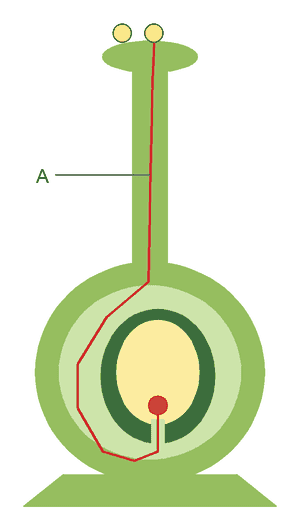
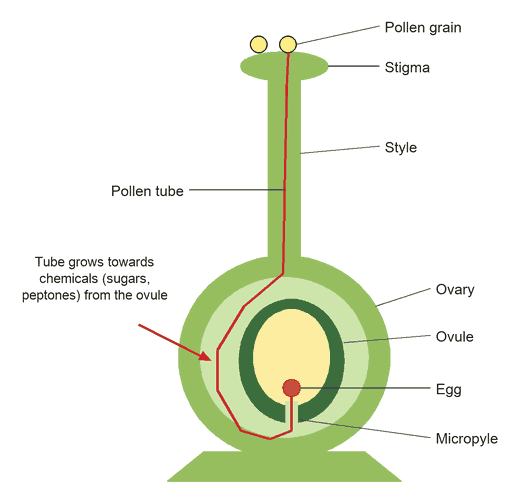
Concept: The figure is a lengthwise section of a pistil. A tube from a pollen grain on the stigma grows down the style into the ovary and reaches the ovule. It is guided by chemicals from the ovule, so the movement is chemotropism.
Step 1 — Name the movement.
The tube grows towards a chemical stimulus, so the tropic movement is chemotropism (positive chemotropism).
Step 2 — Explain the movement.
Chemotropism is the growth movement of a plant part in response to chemicals.
After pollination, the pollen grain on the stigma puts out a pollen tube. The tube grows down through the style towards the ovule, because the ovule gives out chemicals (such as sugars and peptones) that attract it. The tube enters the ovule through the micropyle and carries the male gametes to the egg, so fertilisation can take place.
Step 3 — Label part A.
A marks the tube inside the style, so A — pollen tube.
Step 4 — Say what attracts part A.
The pollen tube is attracted to the ovule, by the chemicals (sugars and peptones) that come from it; these lead it to the egg through the micropyle.
Step 5 — Give a plant that shows thigmotropism.
A plant with tendrils climbs by thigmotropism: the pea plant (garden pea or sweet pea), whose tendrils coil round any support they touch.
Watch out: The tube grows towards the OVULE, not towards the stigma or the ovary wall.
Therefore, (i) chemotropism; (ii) the pollen tube grows towards chemicals from the ovule; (iii) A = pollen tube; (iv) the ovule (its sugars and peptones); (v) pea plant.