Solution:
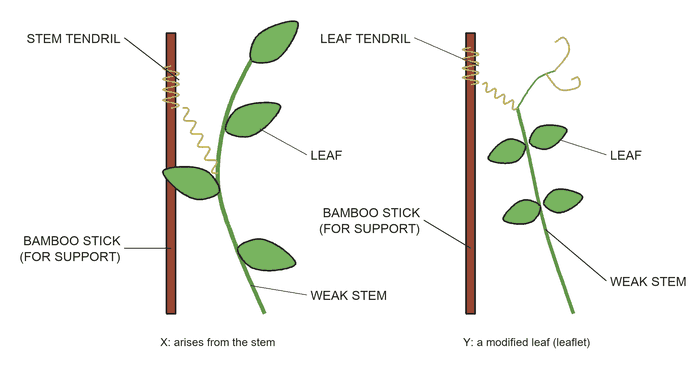
Concept: X and Y are both tendrils, thin coiling structures that help weak-stemmed plants climb; X is a modified stem and Y a modified leaf.
Step 1 — Name X and Y: (a).
X — stem tendril; Y — leaf tendril.
Step 2 — Their function: (b).
Both coil round a support, so the weak-stemmed plant can climb up and hold its leaves up to the light.
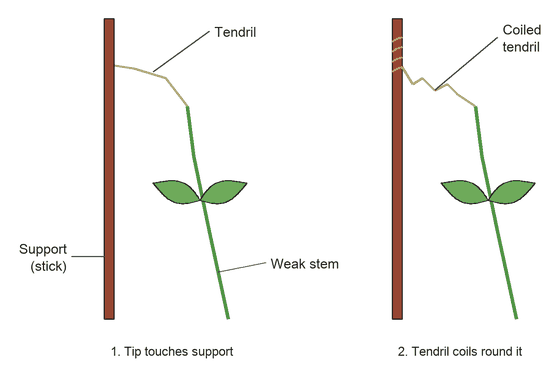
Step 3 — The phenomenon: (c).
Thigmotropism: the growth movement of a plant part in response to touch (contact). The tip of the tendril senses the one-sided contact, the stimulus passes to the parts behind it, and the tendril twines round the support.
Step 4 — How X and Y differ: (d).
The difference is in what each is a modification of:
| X (stem tendril) | Y (leaf tendril) |
|---|
| A modified stem or branch. | A modified leaf or leaflet. |
| Arises from the stem (at a node, in a leaf axil). | Arises at the tip of a compound leaf. |
Step 5 — Examples: (e).
Sweet pea and garden pea have leaf tendrils; grapevine, passion flower, cucumber and gourds have stem tendrils.
Therefore, (a) X stem tendril, Y leaf tendril; (b) both coil round a support to help the plant climb; (c) thigmotropism, growth in response to touch; (d) X is a modified stem, Y a modified leaf; (e) pea (leaf tendrils), grapevine, cucumber, gourds (stem tendrils).

