
Opening your dashboard
Class 10 Biology Chapter 7 Chemical Coordination in Plants: Competency-Based Questions (CBQ)
40 questions on Chapter 7, each worked through on its own page with the AI tutor. Class 10 Biology, ICSE 2026-27.
40 questions
1–5 marks · Mixed difficulty
- 11 mark
Question 1
Cognitive domain: Application
A student dusts pollen grains over a thin layer of nutrient jelly on a glass slide and places a tiny piece of ovule tissue at one edge of the jelly. The slide is kept flat in a dark, moist box. Two hours later most of the pollen tubes are seen growing towards the piece of ovule tissue. Which movement do the pollen tubes show ?
- 21 mark
Question 2
Cognitive domain: Analysis
The shoot tip of a young potted seedling was cut off. A little paste containing auxin was placed on the left half of the cut end, as shown. The pot was then kept upright in a dark room.

What is the stump most likely to do in the next few days, and why ?
- 31 mark
Question 3
Cognitive domain: Application
A factory makes malt for health drinks by letting soaked barley grains sprout. To make all the grains sprout quickly and at the same time, the grains are sprayed with a very dilute solution of a plant hormone. Which hormone is used, and which of its functions is being put to use ?
- 41 mark
Question 4
Cognitive domain: Analysis
A student recorded four plant movements in her field diary.
Movement Stimulus Response P The air becomes warmer all around a flower bud The petals open out equally on all sides Q Moist soil lies to the right of a root The root grows towards the right R A stick touches one side of a tendril The tendril coils around the stick S Light falls on a shoot from the left The shoot bends towards the left Which of these movements cannot be called a tropic movement ?
- 51 mark
Question 5
Cognitive domain: Understanding
Assertion (A): The whole tendril of a pea plant twines around a bamboo stick, although at first only its tip touches the stick.
Reason (R): The stimulus of touch perceived by the tip of a tendril is transmitted to its basal parts.
- 61 mark
Question 6
Cognitive domain: Understanding
Assertion (A): The shoot of a potted plant fixed horizontally on a slowly rotating clinostat grows straight, without bending upwards.
Reason (R): Shoots are negatively geotropic.
- 71 mark
Question 7
Cognitive domain: Application
A potted plant was not watered for a week. Tests on its leaves showed two changes: the amount of one growth-retarding hormone had risen sharply, and the rate of transpiration had fallen.
The hormone is ______, and the transpiration fell because this hormone stimulates the ______ of the stomata.
- 81 mark
Question 8
Cognitive domain: Understanding
In a tissue-culture laboratory, a small piece of non-meristematic tissue from a carrot root lay unchanged in a nutrient medium. When one plant hormone was added to the medium, the piece soon grew into a lump made of a very large number of small cells.
The hormone added was a ______, because it stimulates growth by cell ______ even in non-meristematic tissues.
- 91 mark
Question 9
Cognitive domain: Application
Reema pressed bean seeds against the glass of a jar lined with evenly wet blotting paper. She fixed them in different positions, some with the radicle pointing up, some down and some sideways, and kept the jar in a dark cupboard. A week later every root was growing downwards and every shoot upwards.
The stimulus that guided these seedlings was ______, and the response of their roots is called positive ______.
- 102 marks
Question 10
Cognitive domain: Evaluation
A shopkeeper selling garden chemicals gives a customer two pieces of advice:
- "Soak your stored seeds in abscisic acid and they will sprout sooner."
- "Spray ethylene on your leafy vegetables and their leaves will stay green and fresh for longer."
Judge each piece of advice, and name a hormone that would actually serve each purpose.
- 112 marks
Question 11
Cognitive domain: Application
In a dry district, a farmer waters each young papaya plant by burying an unglazed clay pot beside it and keeping the pot filled with water. The water seeps out slowly through the wall of the pot, and the rest of the soil stays dry. When one plant is dug out some months later, most of its roots are found crowded around the pot on one side, instead of going straight down.
Name the movement shown by the roots, and explain why they grew sideways towards the pot instead of straight down.
- 122 marks
Question 12
Cognitive domain: Analysis
Rahul kept unripe green tomatoes of the same age in three closed boxes at room temperature and noted when they turned red.
Box Contents Days taken by the tomatoes to turn red 1 6 green tomatoes 10 2 6 green tomatoes and 2 ripe bananas 5 3 6 green tomatoes, 2 ripe bananas and a sachet that absorbs ethylene 9 Explain the result of box 2. What does box 3 add to the conclusion ?
- 135 marks
Question 13
Cognitive domain: Analysis
Case: A gardener wanted bushy coleus plants. She took 30 young plants of the same age, kept them in the same light and watered them alike. They were treated in three groups of ten, and the side branches were counted after three weeks.
Group Treatment Average number of side branches per plant 1 Left intact 1 2 Shoot tip cut off; plain paste put on the cut end 6 3 Shoot tip cut off; paste containing auxin put on the cut end 1 (a) Name the phenomenon shown by the plants of group 1 and the hormone responsible for it. Where is this hormone mainly synthesised ?
(b) Explain why the plants of group 2 formed many side branches.
(c) What does group 3 prove that groups 1 and 2 alone cannot ? Why was plain paste used in group 2 ?
(d) Name the hormone which, if applied to the lateral buds of group 1, would make them grow out. State what the gardener should do to get bushy plants.
- 145 marks
Question 14
Cognitive domain: Evaluation
Case: Kiran wanted to prove that shoots bend towards light. She kept pot A, a bean seedling, inside a closed cardboard box with a small window cut in one side, as shown, and watered it every day. As a control she kept pot B, a wheat seedling, on the open terrace, but forgot to water it. After a week the shoot in A had bent towards the window, and the plant in B had drooped. She wrote: "A bent because light came from one side only. My control proves it."
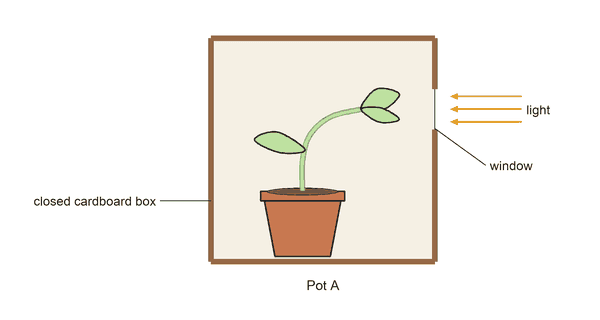
(a) Name the response shown by the shoot in pot A. State one advantage of this response to the plant.
(b) Is pot B a satisfactory control ? Give two reasons.
(c) Describe the control that Kiran should have set up.
(d) Explain, in terms of a hormone, how the shoot in A came to bend. Predict what will happen if the box is now turned so that the window faces the opposite side.
- 155 marks
Question 15
Cognitive domain: Creativity
Case: The students of a school are raising pea plants in their kitchen garden. The plants have weak stems and thread-like tendrils. The students want to give them the best kind of support, but they do not know whether a pea tendril holds a thin support better than a thick one. They have cotton string, pencils, thick bamboo poles and several pea plants of the same age growing in pots.
(a) Name the growth movement that lets a pea plant climb, and describe how a tendril comes to hold a support.
(b) Design a fair test to find out which of the three supports the tendrils grip best. State what you would change, what you would keep the same and what you would record.
(c) Using what you know about the tropic movements of shoots and tendrils, sketch in words a plan of supports for the pea bed in the garden. Give a reason for each feature of your plan.
- 163 marks
Question 16
CISCE Competency-Focused Practice Questions (2024) · Cognitive domain: Analysis
The statements given below are false. Correct and rewrite the complete statements:
(a) Fruit ripening is induced by Abscisic acid.
(b) Roots show negative Hydrotropism.
(c) Thigmotropism can be demonstrated by using a Clinostat.
- 171 mark
Question 17
Cognitive domain: Analysis
A student extracted four substances, P, Q, R and S, from a plant and tested each one. (Hypothetical data.)
Substance Made in Acts in Amount needed What it does P Root tips Leaves, far from the roots Very small Slows down the yellowing of leaves Q Chloroplasts of leaf cells The same chloroplasts Large Traps light energy for photosynthesis R Green leaves Roots and fruits, far from the leaves Large Gives energy when it is broken down in respiration S Stem cells The same cell walls Large Makes the cell wall strong Which of the substances is a plant hormone ?
- 181 mark
Question 18
Cognitive domain: Application
An orange grower wants the fruits to stay on the tree for some more weeks without the rind getting old too early. A plant scientist advises him to spray a growth-promoting hormone that delays senescence (ageing). Which hormone should he spray, and what is the reason ?
- 191 mark
Question 19
Cognitive domain: Application
The owner of a mango orchard wants his trees to flower. An agricultural officer suggests a plant hormone that is a gas at ordinary temperature. Which hormone is it, and what other job will it do in the orchard when the fruits are formed ?
- 201 mark
Question 20
Cognitive domain: Analysis
The leaf blades were cut off from 30 identical young plants, leaving only the leaf stalks (petioles). The cut end of each stalk was covered with a paste, in three groups of ten stalks. The table shows the mean number of days after which the stalks fell off. (Hypothetical data.)
Paste on the cut end Mean days taken by the stalk to fall off Plain paste 8 Paste with auxin 14 Paste with abscisic acid 3 Which conclusion do the readings support best ?
- 211 mark
Question 21
Cognitive domain: Understanding
To show how a hormone helps a young stem to grow longer, a student uses a thick rubber band as the cellulose wall of a stem cell. She finds that the band stretches much more easily after she softens it. Which statement about auxins does her model show best ?
- 221 mark
Question 22
Cognitive domain: Application
A bean seedling was kept in a dark room between two lamps, P and Q. The lamps are at the same distance from the seedling, as shown. Lamp P is dim and lamp Q is bright. Only these two lamps were switched on for several days.

What will the shoot do, and why ?
- 231 mark
Question 23
Cognitive domain: Analysis
A student listed four growth movements.
P: The pollen tube grows towards the sugars and peptones given out by the female gametophyte.
Q: The tentacles of a Drosera plant bend towards an insect that has landed on the leaf.
R: The thread-like parts of a fungus grow towards a region that is richer in food.
S: The young flower-head of a sunflower follows the Sun across the sky.
Which one of these is not an example of chemotropism ?
- 241 mark
Question 24
Cognitive domain: Understanding
A tulsi plant on a balcony slowly bends towards the Sun. Meena wrote four sentences about it. Which sentence is correct ?
- 251 mark
Question 25
Cognitive domain: Understanding
Assertion (A): When the roots of a bean seedling grow in a glass-sided tank that is lit from the right, they bend towards the left.
Reason (R): Roots are negatively phototropic.
- 261 mark
Question 26
Cognitive domain: Analysis
Assertion (A): The seeds inside a ripe, juicy tomato usually do not sprout inside the fruit, although they are surrounded by moisture.
Reason (R): Fruits and seeds contain the least amount of abscisic acid.
- 272 marks
Question 27
Cognitive domain: Application
A farmer finds that his groundnut (peanut) seeds are slow to start germinating. The seed supplier treats the seeds with a plant hormone that is a gas at ordinary temperature, and the seeds then start to germinate.
(a) Name the hormone.
(b) State one other effect of this hormone on the roots of a plant.
- 282 marks
Question 28
Cognitive domain: Application
A thin, yellow, thread-like stem of Cuscuta grows over a hedge. Wherever its stem touches the branch of a hedge plant on one side, the stem coils round that branch.
(a) Name the movement of the Cuscuta stem and name its stimulus.
(b) Is this movement positive or negative ? Give a reason.
- 292 marks
Question 29
Cognitive domain: Analysis
Two cut shoots of the same plant, with the same number of leaves, were kept in water. Shoot A had grown new roots in the water. On shoot B, the new roots were snipped off every day. After eight days the leaves of B were yellow, while those of A were still green.
(a) Name the hormone whose supply to the leaves of B was cut off.
(b) Explain the difference between the leaves of A and B.
- 302 marks
Question 30
Cognitive domain: Evaluation
Ria wrote three statements in her notebook.
1. Plants coordinate their activities through a nervous system and sense organs, as animals do.
2. Plant hormones are chemical messengers that are made in one area of the plant and have their effect at a place far from where they were made.
3. Every plant hormone speeds up the growth of the plant.
Which of her statements are wrong ? Rewrite each wrong statement correctly.
- 312 marks
Question 31
Cognitive domain: Analysis
A tall variety and a dwarf variety of the same plant were grown for four weeks. Some plants of each variety were sprayed with a dilute solution of gibberellins. (Hypothetical data.)
Variety Height without spray (cm) Height with spray (cm) Tall Dwarf (a) By how many centimetres did the spray increase the height of each variety ?
(b) What does this suggest about the dwarf variety ?
- 322 marks
Question 32
Cognitive domain: Analysis
Equal pieces of a young root and a young stem were kept in solutions that supplied different amounts of auxin. The graph shows the increase in length of each piece. (Hypothetical data.)
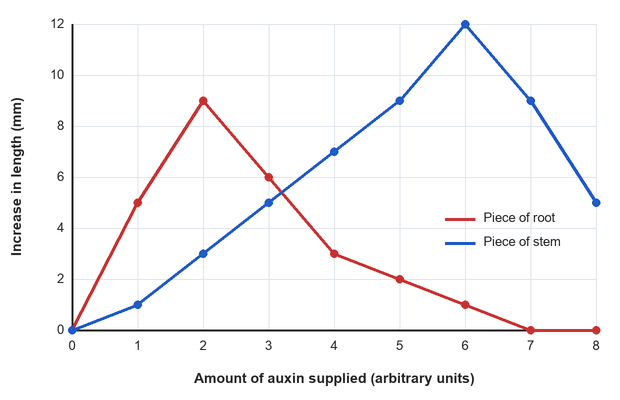
(a) For what amount of auxin did the root piece grow the longest, and for what amount did the stem piece grow the longest ?
(b) Which organ needs more auxin for its greatest elongation, and how many times as much does it need ?
- 333 marks
Question 33
Cognitive domain: Analysis
A student tested three unknown plant hormones, P, Q and R, and wrote the results in a table.
Test Hormone P Hormone Q Hormone R Cells of a young stem grow longer by elongation Yes Yes No Growth of the lateral buds Held back No effect No effect Dormant seeds No effect They sprout They stay dormant Stomata of a leaf No effect No effect They close Name the hormones P, Q and R. Give one reason for each.
- 343 marks
Question 34
Cognitive domain: Application
A sugarcane farmer finds that the plants of his field have short internodes, and the sugar is stored in the stem between the nodes. An agricultural officer advises him to spray a dilute solution of gibberellins.
(a) Explain how gibberellins can make the stem longer.
(b) Why would longer internodes help this farmer ?
(c) Would spraying abscisic acid instead help him ? Give a reason.
- 353 marks
Question 35
Cognitive domain: Evaluation
Three students described tropic movements.
Asha: “In a tropic movement the plant part always grows towards the stimulus.”
Bilal: “Shoots are positively phototropic and negatively geotropic, while roots are positively geotropic and negatively phototropic.”
Chitra: “A tropic movement is the response to a stimulus that acts on the plant equally from all sides at the same time.”
Which student is correct ? Find the mistake in each of the other two statements and correct it.
- 363 marks
Question 36
Cognitive domain: Analysis
A student let the roots of bean seedlings hang down between two vertical pads of cotton wool in each of two set-ups. In set-up 1, the left pad was kept wet and the right pad was kept dry. In set-up 2, both pads were kept equally wet. After a week she counted the roots. (Hypothetical data.)
Set-up Roots that bent to the left Roots that grew straight down 1 (left pad wet, right pad dry) 2 (both pads equally wet) (a) Name the movement shown in set-up 1 and say whether it is positive or negative.
(b) Find the percentage of the roots that bent to the left in set-up 1.
(c) What does set-up 2 prove about the bending in set-up 1 ?
- 373 marks
Question 37
Cognitive domain: Evaluation
Case: A nursery owner kept cm tall tomato seedlings in two identical closed glass rooms, with the same light and temperature, and watered them equally. In room 1 a heap of ripening mangoes was also stored; room 2 had no fruit. The table shows the readings after five days. (Hypothetical data.)
Room Height of the seedlings (cm) Leaves that turned yellow (out of 10) 1 (with ripening mangoes) 2 (no fruit) She says, "The seedlings in room 1 got less water."
(a) Name the hormone that may have caused the difference and say where it came from.
(b) How many times as much did the seedlings in room 2 grow as those in room 1 ? Name the two effects of the hormone that the readings show.
(c) Judge her statement, and advise her.
- 385 marks
Question 38
Cognitive domain: Evaluation
Case: In a laboratory, plants of a normal tomato variety (N) and plants of a mutant variety (M) that cannot make abscisic acid were not watered for six days. The table shows the percentage of stomata that were open, and the total water lost by one plant in these six days. (Hypothetical data.)
Day Open stomata in N (%) Open stomata in M (%) Water lost in six days: N, mL; M, mL.
(a) Why did the stomata of N close as the soil became dry ?
(b) How much more water did M lose than N, and how many times as much as N did it lose ?
(c) A student says, “Variety M is better for a dry region, because it keeps its stomata open.” Evaluate this statement.
- 394 marks
Question 39
Cognitive domain: Analysis
Case: Arjun laid a pot with a young bean seedling on its side in a dark cupboard, so that its shoot and its root both lay flat. After six hours he measured the amount of auxin in the upper half and in the lower half of the shoot, just behind its tip, and of the root, just behind its tip. (Hypothetical data, in arbitrary units.)
Part of the seedling Auxin in the upper half Auxin in the lower half Shoot Root Root cells need far less auxin than stem cells. An amount of auxin that makes stem cells elongate faster is too much for root cells and slows down their elongation.
(a) For the shoot and for the root, find the percentage of the auxin that was in the lower half.
(b) Which half of the shoot will grow faster ? Use this to explain the direction in which the shoot tip turns.
(c) The root also had more auxin in its lower half, yet its tip turns downwards. Explain this, and state how each of the two responses helps the seedling.
- 405 marks
Question 40
Cognitive domain: Creativity
Case: A teacher gives you three unlabelled spray bottles. One contains plain water, one a dilute solution of gibberellins and one a dilute solution of abscisic acid. You also have seeds that are slightly dormant, three Petri dishes with blotting paper, and a warm cupboard.
(a) Describe how you would set up the experiment to find which bottle holds which liquid.
(b) What would you expect to see in each dish after a week, and how would you name the bottles from it ?
(c) Name two conditions that you would keep the same, and say why.