
Opening your dashboard
Class 10 Biology Chapter 3: Genetics – Some Basic Fundamentals Solutions
45 textbook questions with step-by-step answers, free to read, for ICSE 2026-27.
Get talked through Ch 3, not just shown the answer
Reading a finished solution is not the same as being able to do it. The AI tutor takes one question at a time and works it with you, in your own words, until you can.
- Ask it out loud, in your own words
- It gives you the next step, not the answer
- Stuck on part (ii)? Start there
45 questions with solutions
1–13 marks · Mixed difficulty
- 13 marks
Question 1
Mention if the following statements are True (T) or False (F) :
(i) Genetics and heredity are the same thing. T/F
(ii) "Like begets like", this applies only to animals. T/F
(iii) The entire human population shows variations. T/F
Solve with AIWritten solution
Solution:
Concept: heredity is the passing of characters from parents to offspring; genetics is the study of heredity and its laws; variations are the small differences among members of one species.
Step 1 — (i) Genetics and heredity.
Heredity is a process (the transmission of characters), while genetics is the branch of biology that studies this process. A process and its study are not the same thing, so the statement is False.
Step 2 — (ii) 'Like begets like'.
The phrase means that offspring resemble their parents. It holds for all organisms: cats give kittens, a mango seed grows into a mango tree, curd bacteria give the same bacteria. It is not only for animals, so the statement is False.
Step 3 — (iii) Variations in the human population.
Human races and tribes look different, members of a tribe differ, and even members of one family differ in features. So the whole human population shows variations, and the statement is True.
Watch out: Genetics is the study; heredity is what is studied.
Therefore, (i) F, (ii) F, (iii) T.
- 22 marks
Question 2
Which of the following in humans are established genetic traits ? (Tick-mark the correct ones) in the box provided.
(i) Capacity to be a good cricketer
(ii) Curly hair
(iii) Left-handedness
(iv) Quality of voice
(v) Red-green colour blindness
Solve with AIWritten solution
Solution:
Concept: A genetic trait is an inherited form of a character, passed on through genes; a skill gained by practice or training is acquired, not inherited.
Step 1 — Test each item.
Ask of each item: is it fixed by genes from the parents, or built up by practice, training or age?
Step 2 — Tick the inherited traits.
These are established genetic traits:
- (ii) Curly hair: hair shape is inherited (curly or straight).
- (iii) Left-handedness: hand use is inherited (right- or left-handed).
- (v) Red-green colour blindness: an inherited disorder caused by a recessive gene on the X chromosome.
Step 3 — Leave the others unticked.
These are not established genetic traits:
- (i) Capacity to be a good cricketer: a skill built by coaching and practice.
- (iv) Quality of voice: it changes with age, training and use.
Watch out: A talent may run in a family, but a skill gained by training is not an established genetic trait.
Therefore, tick (ii) curly hair, (iii) left-handedness and (v) red-green colour blindness.
- 32 marks
Question 3
Mention the following :
(i) Total number of pairs of chromosomes in each body cell in humans ..........
(ii) Number of pairs of autosomes in one cell of humans. ..........
Solve with AIWritten solution
Solution:
Concept: Chromosomes occur in pairs; a human body cell has 46 chromosomes, which is 23 pairs.
Step 1 — (i) Total pairs.
46 chromosomes in pairs make 23 pairs in each body cell.
Step 2 — (ii) Pairs of autosomes.
One of the 23 pairs is the pair of sex chromosomes (XX in females, XY in males); the rest are autosomes.
Autosomes (pairs 1 to 22) control general body features such as complexion and height.
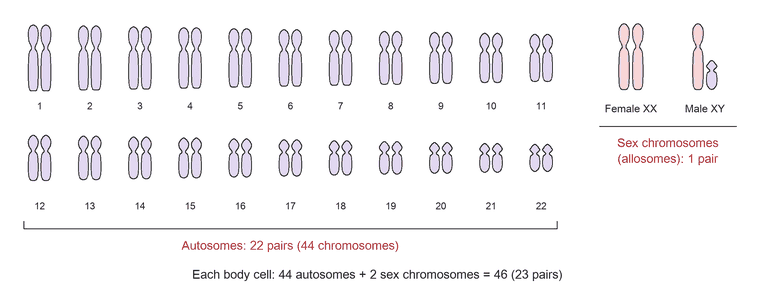
Therefore, (i) 23 pairs in all and (ii) 22 pairs of autosomes.
- 42 marks
Question 4
A certain couple got only four daughters in a row and no son. Does it mean that the husband does not produce Y-bearing sperms? Explain.
Solve with AIWritten solution
Solution:
Concept: The sex of a child depends on the kind of sperm that fertilises the egg, and which kind does so is a matter of chance at every birth.
Step 1 — Recall the eggs.
The mother is XX, so every egg carries one X chromosome.
Step 2 — Recall the sperms.
The father is XY, so half his sperms are X-bearing and half are Y-bearing.
Step 3 — See what each sperm gives.
Egg (X) + X-sperm → XX → daughter; egg (X) + Y-sperm → XY → son. So at every birth the chance of a daughter is 1/2, whatever happened before.

Step 4 — Work out the chance of four daughters.
The four births are independent, so the chances multiply.
About 1 in 16 families with four children has four daughters by chance alone, so it is not unusual.
Step 5 — Conclude.
The husband did produce Y-bearing sperms each time; an X-bearing sperm simply happened to fertilise the egg all four times.
Watch out: Each birth is a fresh 50 : 50 chance; earlier births do not change it.
Therefore, no: four daughters in a row do not mean the husband makes no Y-bearing sperms; it happened by chance.
- 51 mark
Question 5
Write the basic unit of heredity ?
Solve with AIWritten solution
Solution:
Concept: Chromosomes carry the units that pass characters from parents to offspring.
Step 1 — Name the unit.
The basic unit of heredity is the gene.
Step 2 — Say what a gene is.
A gene is a specific part (a segment of DNA) of a chromosome that decides a hereditary character; for example, the gene for tongue rolling decides whether a person can roll the tongue.
Therefore, the basic unit of heredity is the gene.
- 65 marks
Question 6
Define the following terms :-
(i) Allele
(ii) Dominant gene
(iii) Genotype
(iv) Phenotype
(v) Recessive gene
Solve with AIWritten solution
Solution:
Concept: Every gene is present as a pair, one copy on each chromosome of a homologous pair. These terms describe the forms of the gene and what the pair produces.
Step 1 — Define allele.
Allele: an alternative form of a gene, found at the same position (locus) on homologous chromosomes and affecting the same character in a different way.
Example: R (rolling) and r (non-rolling) are alleles of the tongue-rolling gene.
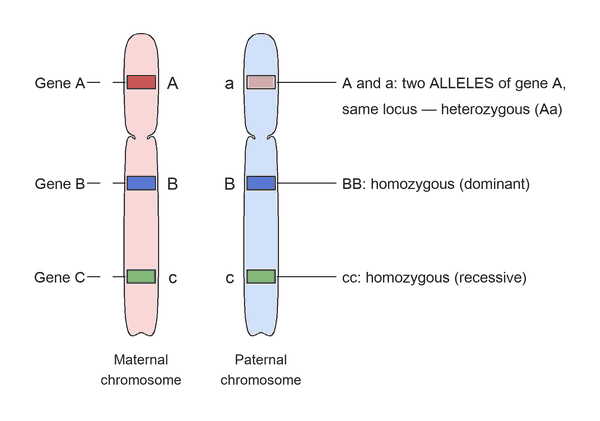
Step 2 — Define dominant gene.
Dominant gene: the allele that expresses itself whether or not the other allele of the pair is present; it is written with a capital letter.
Example: T (tall) in garden pea, so a Tt plant is tall.
Step 3 — Define genotype.
Genotype: the set of genes present in the cells of an organism (its genetic make-up).
Example: TT, Tt or tt for height in pea.
Step 4 — Define phenotype.
Phenotype: the observable characteristics of an organism that are controlled by its genes.
Example: tall or dwarf.
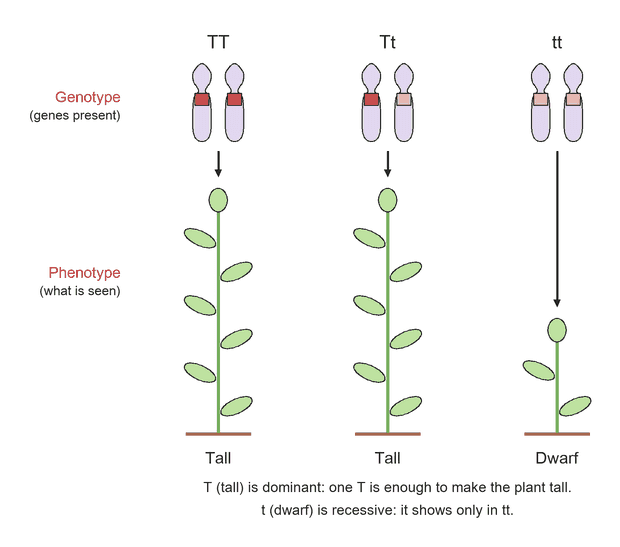
Step 5 — Define recessive gene.
Recessive gene: the allele whose expression is suppressed when the dominant allele is present; it shows only when both alleles are recessive (homozygous), and is written with a small letter.
Example: t (dwarf) in pea; only a tt plant is dwarf.
Watch out: Genotype is the genes (cannot be seen); phenotype is what is seen.
Therefore, the five terms are defined as above: allele, dominant gene, genotype, phenotype and recessive gene.
- 72 marks
Question 7
Mention the number of paired homozygous chromosomes in
(i) Human female
(ii) Human male
Solve with AIWritten solution
Solution:
Concept: 'paired homozygous chromosomes' here means homologous pairs, whose two members are alike in size and shape. All 22 autosome pairs are like this; the sex chromosomes are alike only as XX.
Step 1 — (i) Human female.
She has 22 pairs of autosomes and the XX pair, whose two members are alike.
Step 2 — (ii) Human male.
He has the same 22 pairs of autosomes, but his XY pair is not alike: the Y chromosome is much smaller than the X. So only 22 pairs are similar.
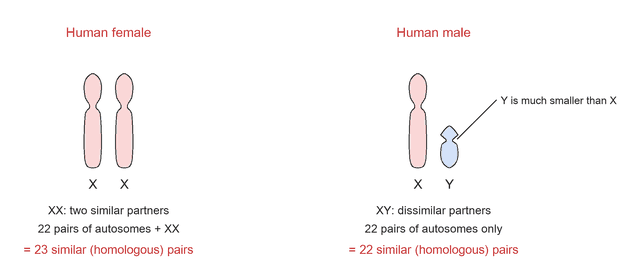
Therefore, (i) a human female has 23 such pairs and (ii) a human male has 22.
- 82 marks
Question 8
Can there be a heterozygous recessive ? Explain.
Solve with AIWritten solution
Solution:
Concept: heterozygous means the two alleles of a pair are different, one dominant and one recessive; in such a pair the dominant allele is the one expressed.
Step 1 — Write the heterozygous pair.
A heterozygous person has Rr: one dominant allele (R) and one recessive allele (r).
Step 2 — See which allele shows.
The recessive allele is suppressed when the dominant allele is present, so Rr shows the dominant trait (tongue roller). It is called heterozygous dominant.
Step 3 — See when the recessive trait shows.
A recessive trait shows only when both alleles are recessive (rr). Such a pair is alike, so it is homozygous.

Therefore, no: there cannot be a heterozygous recessive; anyone showing a recessive trait is homozygous recessive.
- 91 mark
Question 9
List any four characters along with their traits in humans which you can easily study just by observing and making family charts.
Solve with AIWritten solution
Solution:
Concept: A character is an inherited feature and its traits are the alternative forms of that character. Traits that can be seen directly can be recorded for each family member in a family (pedigree) chart.
Step 1 — Choose characters that are easy to see.
Any four of these can be studied by looking at family members:
Character Traits (dominant / recessive) Tongue rolling Rolling / non-rolling Ear lobe Free / attached Hand use Right-handedness / left-handedness Eye colour Brown / blue Lips Thick / thin Cheek Dimpled / normal Step 2 — Record one in a family chart.
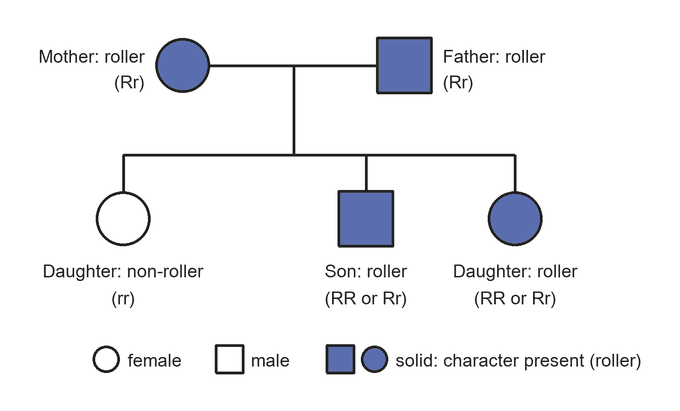
In a pedigree chart squares are males, circles are females, and a solid symbol means the trait is present. The chart below follows tongue rolling.
Therefore, any four such as tongue rolling (rolling/non-rolling), ear lobe (free/attached), hand use (right/left-handed) and eye colour (brown/blue).
- 101 mark
Question 10
Who discovered for the first time the basic principles of genetics?
Solve with AIWritten solution
Solution:
Concept: The basic principles of genetics came from breeding experiments on garden pea in the mid-nineteenth century.
Step 1 — Name the scientist.
They were discovered by Gregor Johann Mendel (1822–1884), an Austrian monk.
Step 2 — Say why he is remembered.
His findings are called Mendel's laws of inheritance, and he is known as the Father of Genetics.
Therefore, the basic principles of genetics were first discovered by Gregor Mendel.
- 111 mark
Question 11
Give the common and scientific names of the organism on which Gregor Mendel had worked.
Solve with AIWritten solution
Solution:
Concept: Mendel needed a plant with many varieties showing contrasting forms that could be bred easily.
Step 1 — Give the names.
Common name: garden pea. Scientific name: Pisum sativum.
Step 2 — Say why it suited him.
Pure-breeding varieties were available, its flowers are normally self-pollinated but can be cross-pollinated by hand, and its life span is short.
Therefore, Mendel worked on the garden pea, Pisum sativum.
- 125 marks
Question 12
Distinguish between the following pairs :
(i) Monohybrid and Dihybrid cross
(ii) Genotype and Phenotype
(iii) Character and Trait
(iv) Dominant and Recessive Allele
(v) Autosomes and Sex chromosomes
Solve with AIWritten solution
Solution:
Concept: Compare each pair point against point on the same basis, with an example.
Step 1 — Monohybrid and dihybrid cross.
Compare how many characters are followed:
Basis Monohybrid cross Dihybrid cross Characters One pair of contrasting traits. Two pairs of contrasting traits together. Example Tall × dwarf pea. Round yellow × wrinkled green seeds. F₂ phenotypic ratio 3 : 1 9 : 3 : 3 : 1 Step 2 — Genotype and phenotype.
Compare genes with what is seen:
Basis Genotype Phenotype Meaning The set of genes in the cells. The observable characters controlled by genes. Seen? Cannot be seen; written as TT, Tt or tt. Can be seen: tall or dwarf. Link Two genotypes (TT, Tt) give tall plants. Both TT and Tt show one phenotype (tall). 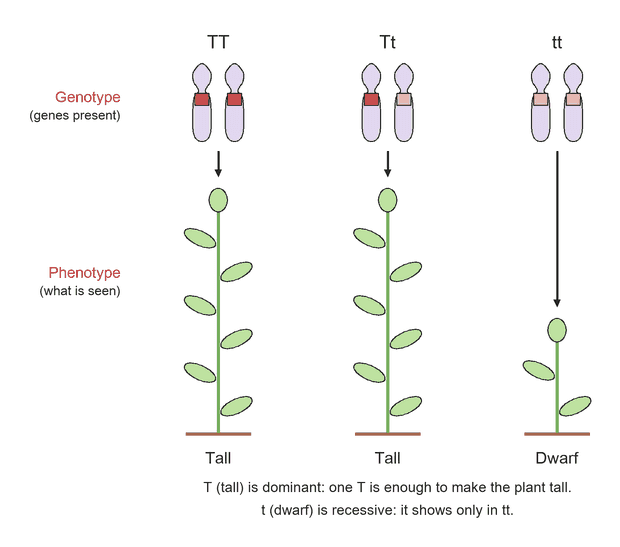
Step 3 — Character and trait.
Compare the feature with its forms:
Basis Character Trait Meaning Any inheritable feature. An alternative form of a character. Example Height of pea plant; hair shape. Tall or dwarf; curly or straight. Step 4 — Dominant and recessive allele.
Compare when each one shows:
Basis Dominant allele Recessive allele Expression Expresses itself even with the other allele. Suppressed by the dominant allele. Shows in TT and Tt. Only tt. Symbol Capital letter, e.g. T. Small letter, e.g. t. Step 5 — Autosomes and sex chromosomes.
Compare what they decide and how many there are:
Basis Autosomes Sex chromosomes Decide General body features. The sex of the individual. Number in humans 22 pairs (1 to 22). 1 pair (the 23rd). Partners Alike in both sexes. Alike in females (XX), unlike in males (XY). 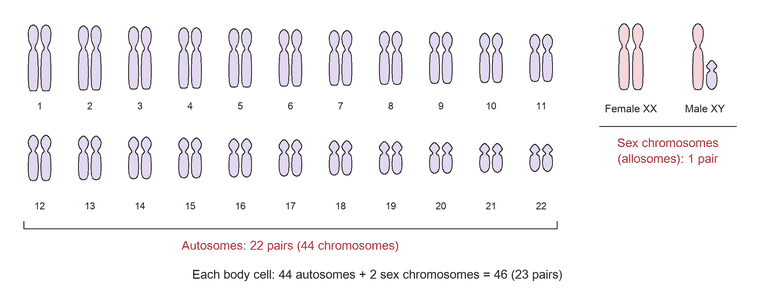
Therefore, the five pairs differ as tabulated: one vs two characters; genes vs visible form; feature vs its forms; expressed vs suppressed; body features vs sex.
- 131 mark
Question 13
Write two characters of pea pod with their alternative traits.
Solve with AIWritten solution
Solution:
Concept: Two of the seven pairs of contrasting features that Mendel studied in garden pea belong to the pod.
Step 1 — Name the pod characters and their traits.
The two characters of the pod, with their dominant and recessive traits, are:
Character of the pod Dominant trait Recessive trait Pod colour Green Yellow Pod shape Inflated Constricted 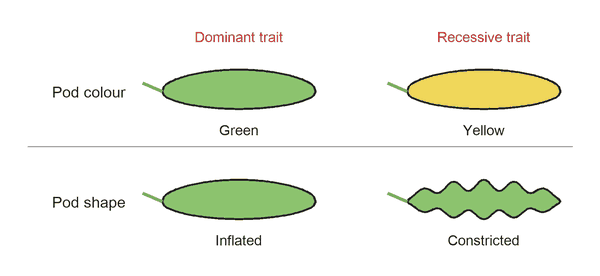
Therefore, pod colour (green / yellow) and pod shape (inflated / constricted).
- 141 mark
Question 14
Which one of the following is the phenotypic monohybrid ratio in generation ?
Solve with AIAnswer
- Correct
(A) 3 : 1
(B) 1 : 2 : 1
(C) 2 : 2
(D) 1 : 3
Answer: (A) 3 : 1
Concept: A monohybrid cross follows one character with two traits. The phenotypic ratio counts the forms seen; the genotypic ratio counts the gene pairs.
Step 1 — Make the F₁.
Pure tall (TT) × pure dwarf (tt) gives an F₁ that is all Tt (hybrid tall).
Step 2 — Make the F₂.
Selfing the F₁ (Tt × Tt) gives 1 TT : 2 Tt : 1 tt.
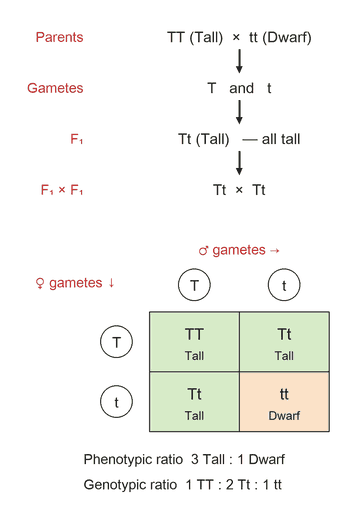
Step 3 — Count what is seen.
TT and Tt both look tall because T is dominant, so the visible forms are 1 + 2 = 3 tall to 1 dwarf.
Watch out: 1 : 2 : 1 is the genotypic ratio; the question asks for the phenotypic one.
Why the other options are wrong:
- (B) 1 : 2 : 1: 1 : 2 : 1 is the genotypic monohybrid ratio (1 TT : 2 Tt : 1 tt).
- (C) 2 : 2: 2 : 2 would mean equal numbers of each form, but the dominant form is three times as common.
- (D) 1 : 3: 1 : 3 turns the ratio round; the dominant form is the larger class.
Therefore, the F₂ phenotypic monohybrid ratio is 3 : 1, option (A).
- 151 mark
Question 15
If a pure tall plant is crossed with a pure dwarf plant, the offsprings will be :
Solve with AIAnswer
- Correct
(A) all tall
(B) all dwarf
(C) 3 tall 1 dwarf
(D) 50% tall 50% dwarf
Answer: (A) all tall
Concept: A pure tall plant is TT and a pure dwarf plant is tt; when the two alleles meet, only the dominant one (T) is expressed (law of dominance).
Step 1 — Find the gametes.
TT makes only T gametes; tt makes only t gametes.
Step 2 — Combine them.
Every offspring gets T from one parent and t from the other, so every offspring is Tt.
Step 3 — Decide the appearance.
In Tt the allele T suppresses t, so all the offspring are tall (hybrid tall).

Why the other options are wrong:
- (B) all dwarf: dwarfness is recessive and shows only in tt; no offspring here is tt.
- (C) 3 tall 1 dwarf: 3 tall : 1 dwarf appears only in the F₂, when the hybrids are selfed (Tt × Tt).
- (D) 50% tall 50% dwarf: 50% : 50% needs a hybrid parent (Tt × tt); here both parents are pure.
Therefore, all the offspring will be tall, option (A).
- 161 mark
Question 16
The 9 : 3 : 3 : 1 dihybrid ratio is due to :
Solve with AIAnswer
(A) Segregation
(B) crossing over
- Correct
(C) independent assortment
(D) homologous pairing
Answer: (C) independent assortment
Concept: law of independent assortment: with two pairs of characters, the alleles of one pair go into the gametes independently of the alleles of the other pair.
Step 1 — Make the hybrid.
Round yellow (RRYY) × wrinkled green (rryy) gives the F₁ hybrid RrYy.
Step 2 — Form its gametes.
R or r goes into a gamete independently of Y or y, so the hybrid makes four kinds of gametes in equal numbers: RY, Ry, rY and ry.

Step 3 — Combine them.
4 kinds of male × 4 kinds of female gametes give 16 combinations, which show four phenotypes in the ratio 9 : 3 : 3 : 1.
Why the other options are wrong:
- (A) Segregation: segregation separates the two alleles of ONE pair; alone it gives the 3 : 1 ratio, not the new two-character combinations.
- (B) crossing over: crossing over is an exchange between chromatids in meiosis; Mendel's dihybrid ratio does not depend on it.
- (D) homologous pairing: homologous pairing only brings the chromosomes of a pair together; it does not explain four equal kinds of gametes.
Therefore, the 9 : 3 : 3 : 1 ratio is due to independent assortment, option (C).
- 171 mark
Question 17
A plant with green pods and smooth seeds with genotype Ggss will give rise to the following gametes :
Solve with AIAnswer
(A) Gg and Ss
(B) Gs and ss
- Correct
(C) Gs and gs
(D) Gg and gs
Answer: (C) Gs and gs
Concept: A gamete gets only one allele of each gene, so every gamete of Ggss carries one allele for pod colour and one for the seed.
Step 1 — Pod colour, Gg.
The two alleles separate, so a gamete gets G or g.
Step 2 — Seed, ss.
Both alleles are the same, so every gamete gets s.
Step 3 — Combine.
G with s gives Gs; g with s gives gs. The plant makes two kinds of gametes, half Gs and half gs.

Watch out: A gamete never carries two alleles of the same gene, such as Gg or ss.
Why the other options are wrong:
- (A) Gg and Ss: Gg and Ss each hold two alleles of one gene, which a gamete never carries; the plant has no S at all.
- (B) Gs and ss: Gs is right, but ss has two seed alleles and no pod-colour allele.
- (D) Gg and gs: gs is right, but Gg has two pod-colour alleles and no seed allele.
Therefore, the gametes are Gs and gs, option (C).
- 181 mark
Question 18
The disease colour blindness is a :
Solve with AIAnswer
- Correct
(A) Recessive X-linked disease
(B) Dominant Y-linked disease
(C) Recessive Y-linked disease
(D) Dominant X-linked disease
Answer: (A) Recessive X-linked disease
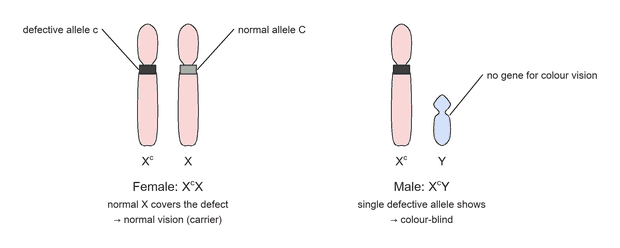
Concept: Colour blindness is caused by a recessive gene on the X chromosome, which is why it is more common in males.
Step 1 — It is X-linked.
The allele is carried on the X chromosome; the Y chromosome has no allele for colour vision.
Step 2 — It is recessive.
A woman with the allele on one X () has normal vision, because the normal allele on her other X is expressed; she is a carrier.
Step 3 — See the effect in males.
A man has only one X; if it carries the allele (), nothing suppresses it and he is colour-blind.
Why the other options are wrong:
- (B) Dominant Y-linked disease: the allele is neither dominant nor on the Y chromosome.
- (C) Recessive Y-linked disease: recessive is right, but a Y-linked allele could never reach a daughter, yet daughters become carriers.
- (D) Dominant X-linked disease: X-linked is right, but a dominant allele would show in every woman who has it; carrier women see normally.
Therefore, colour blindness is a recessive X-linked disease, option (A).
- 191 mark
Question 19
The physical expression of a character is called :
Solve with AIAnswer
(A) Genotype
(B) Alleles
- Correct
(C) Phenotype
(D) Traits
Answer: (C) Phenotype
Concept: The phenotype is the expressed (observable) form of a character; the genotype is the set of genes behind it.
Step 1 — List the genotypes.
For height in pea the gene pairs can be TT, Tt or tt; these are genotypes and cannot be seen.
Step 2 — See the expression.
What we see is a tall plant (TT or Tt) or a dwarf plant (tt). This physical expression is the phenotype (phene = to show).

Why the other options are wrong:
- (A) Genotype: the genotype is the set of genes (such as Tt), not what is seen.
- (B) Alleles: alleles are the alternative forms of a gene (such as T and t).
- (D) Traits: traits are the alternative forms of a character (tall, dwarf); the physical expression of an individual's genes is its phenotype.
Therefore, the physical expression of a character is the phenotype, option (C).
- 201 mark
Question 20
Purity of gametes is linked to :
Solve with AIAnswer
(A) Law of dominance
(B) Law of independent assortment
- Correct
(C) Law of segregation
(D) Law of limiting factor
Answer: (C) Law of segregation
Concept: The law of segregation is also called the law of purity of gametes: the two members of a pair of factors separate when gametes form.
Step 1 — Look at a hybrid.
A hybrid tall plant has Tt; the two alleles stay together in the plant but do not blend.
Step 2 — Form the gametes.
When gametes form, T and t separate (segregate) into different gametes.
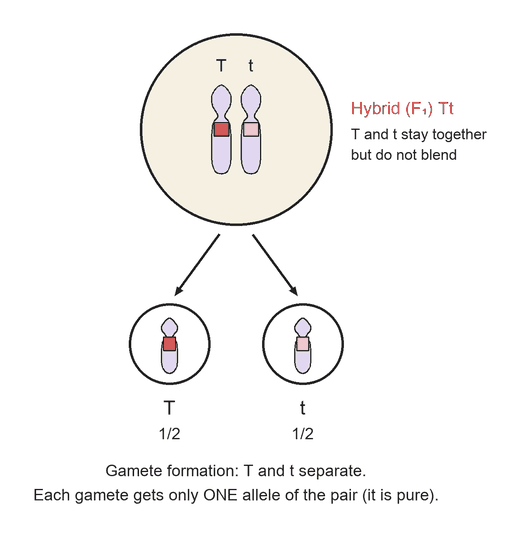
Step 3 — See why gametes are 'pure'.
Each gamete gets only one allele of the pair, T or t, never both, so it is pure for that character.
Why the other options are wrong:
- (A) Law of dominance: the law of dominance tells which of two contrasting alleles is expressed.
- (B) Law of independent assortment: independent assortment is about two pairs of characters sorting independently.
- (D) Law of limiting factor: the law of limiting factors belongs to photosynthesis, not to Mendel's laws.
Therefore, purity of gametes is linked to the law of segregation, option (C).
- 211 mark
Question 21
The phenotypic dihybrid ratio of generation is:
Solve with AIAnswer
(A) 9 : 3 : 1 : 1
(B) 9 : 1 : 3 : 1
(C) 9 : 1 : 3 : 3
- Correct
(D) 9 : 3 : 3 : 1
Answer: (D) 9 : 3 : 3 : 1
Concept: A dihybrid cross follows two pairs of contrasting characters together; its F₂ shows four phenotypes.
Step 1 — Make the F₁.
Round yellow (RRYY) × wrinkled green (rryy) gives F₁ plants that are all round yellow (RrYy).
Step 2 — Set up the F₂ square.
Each F₁ plant makes four kinds of gametes (RY, Ry, rY, ry), so the square for RrYy × RrYy has 4 × 4 = 16 boxes.

Step 3 — Count the phenotypes.
Counting the 16 boxes gives:
Phenotype Out of 16 Round, yellow 9 Round, green 3 Wrinkled, yellow 3 Wrinkled, green 1 Watch out: The ratio runs from both-dominant (9) to both-recessive (1), so the 1 comes last.
Why the other options are wrong:
- (A) 9 : 3 : 1 : 1: 9 : 3 : 1 : 1 adds up to 14, not 16.
- (B) 9 : 1 : 3 : 1: 9 : 1 : 3 : 1 also adds up to 14, not 16.
- (C) 9 : 1 : 3 : 3: 9 : 1 : 3 : 3 has the right numbers in the wrong order; the both-recessive class (1) comes last.
Therefore, the F₂ dihybrid phenotypic ratio is 9 : 3 : 3 : 1, option (D).
- 221 mark
Question 22
In the human male, a sperm contains autosomes and :
Solve with AIAnswer
(A) X and Y chromosomes
(B) Only X chromosome
- Correct
(C) X or Y chromosome
(D) Only Y chromosome
Answer: (C) X or Y chromosome
Concept: A man's body cell has 22 pairs of autosomes and XY. Sperms are made by meiosis, so a sperm gets only one chromosome of each pair.
Step 1 — Autosomes.
From the 22 pairs, each sperm gets 22 autosomes.
Step 2 — Sex chromosome.
From the XY pair it gets either X or Y: half the sperms are X-bearing and half Y-bearing.
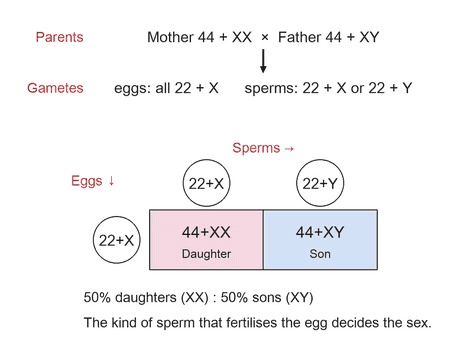
Step 3 — Check with the children.
An X-sperm with the egg gives a daughter (XX); a Y-sperm gives a son (XY).
Why the other options are wrong:
- (A) X and Y chromosomes: X and Y separate in meiosis, so no sperm carries both.
- (B) Only X chromosome: only half the sperms carry X; it is the egg that always carries X.
- (D) Only Y chromosome: only half the sperms carry Y; if all did, no daughter would ever be born.
Therefore, a sperm contains autosomes and an X or a Y chromosome, option (C).
- 231 mark
Question 23
If the mother is normal and the father is haemophilic, then their two daughters will be :
Solve with AIAnswer
(A) Normal
(B) Haemophilic
- Correct
(C) Carrier
(D) None
Answer: (C) Carrier
Concept: Haemophilia is caused by a recessive gene on the X chromosome; a daughter gets one X from her mother and one X from her father.
Step 1 — Write the parents.
The normal mother is XX. The haemophilic father is , where stands for the X carrying the haemophilia allele.
Step 2 — Find the daughters.
A daughter gets her father's only X () and a normal X from her mother, so each daughter is .

Step 3 — Decide their condition.
The normal allele on her other X is expressed, so her blood clots normally, but she carries the allele and can pass it on: she is a carrier.
Why the other options are wrong:
- (A) Normal: their blood clots normally, but they are not free of the allele; 'carrier' is the exact answer.
- (B) Haemophilic: a daughter is haemophilic only with two affected X chromosomes; the mother gives a normal X.
- (D) None: the father has only one X to give a daughter, so a definite answer (carrier) exists.
Therefore, both daughters will be carriers, option (C).
- 241 mark
Question 24
Susheel, a colourblind man, is married to Susheela, a woman with normal vision. Which of the following combinations would be possible in their children ?
Solve with AIAnswer
(A) Colourblind daughters and colourblind sons
(B) Normal daughters and normal sons
- Correct
(C) Carrier daughters and normal sons
(D) Carrier daughters and colourblind sons
Answer: (C) Carrier daughters and normal sons
Concept: Colour blindness is due to a recessive gene on the X chromosome. A father gives his X to every daughter and his Y to every son.
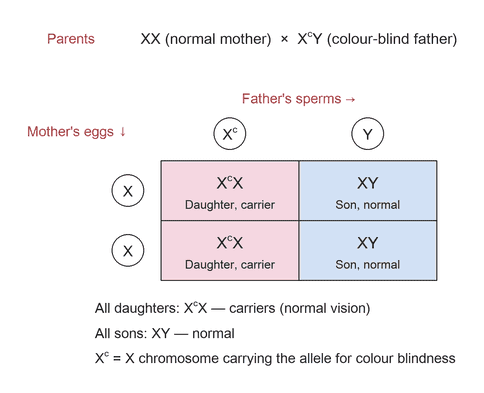
Step 1 — Write the parents.
Susheel = (colour-blind); Susheela = XX (normal vision).
Step 2 — Find the daughters.
from the father + X from the mother = : normal vision, but carriers.
Step 3 — Find the sons.
Y from the father + X from the mother = XY: normal, with no allele at all.
Why the other options are wrong:
- (A) Colourblind daughters and colourblind sons: no child can be colour-blind, because the mother gives a normal X to every child.
- (B) Normal daughters and normal sons: the sons are normal, but every daughter carries her father's .
- (D) Carrier daughters and colourblind sons: a son gets his only X from the normal mother, so he cannot be colour-blind.
Therefore, the children will be carrier daughters and normal sons, option (C).
- 251 mark
Question 25
The following questions are Assertion-Reason based questions. Choose the answer based on the codes given below.
(1) A is True and R is False (2) A is False and R is True
(3) Both A and R are True (4) Both A and R are False
Assertion (A): Heredity is the basic fundamental unit of Genetics.
Reason (R): Genes carry hereditary information from the offsprings to their parents.
Solve with AIAnswer
(A) (1) A is True and R is False
(B) (2) A is False and R is True
(C) (3) Both A and R are True
- Correct
(D) (4) Both A and R are False
Answer: (D) (4) Both A and R are False
Concept: In an assertion–reason item, judge the Assertion (A) and the Reason (R) separately as true or false; only when both are true do we ask whether R correctly explains A.
Step 1 — Judge the Assertion.
A is false. Heredity is the passing of characters from parents to offspring; it is a process, not a unit. The basic unit is the gene, a segment of DNA on a chromosome.
Step 2 — Judge the Reason.
R is false. Genes carry hereditary information from the parents to the offspring. R states the direction the wrong way round.
Step 3 — Decide the option.
Both A and R are false, so the matching option is (D) (4).
Why the other options are wrong:
- (A) (1) A is True and R is False: it says A is true, but the basic unit is the gene, not heredity.
- (B) (2) A is False and R is True: it says R is true, but R reverses the direction of inheritance.
- (C) (3) Both A and R are True: it says both are true, but neither is.
Therefore, the answer is (D): both A and R are false.
- 261 mark
Question 26
The following questions are Assertion-Reason based questions. Choose the answer based on the codes given below.
(1) A is True and R is False (2) A is False and R is True
(3) Both A and R are True (4) Both A and R are False
Assertion (A): Karyotype is the division of nucleus during cell-division.
Reason (R): Karyon means nucleus and type explains the number, shape and size of the chromosome.
Solve with AIAnswer
(A) (1) A is True and R is False
- Correct
(B) (2) A is False and R is True
(C) (3) Both A and R are True
(D) (4) Both A and R are False
Answer: (B) (2) A is False and R is True
Concept: In an assertion–reason item, judge the Assertion (A) and the Reason (R) separately as true or false; only when both are true do we ask whether R correctly explains A.
Step 1 — Judge the Assertion.
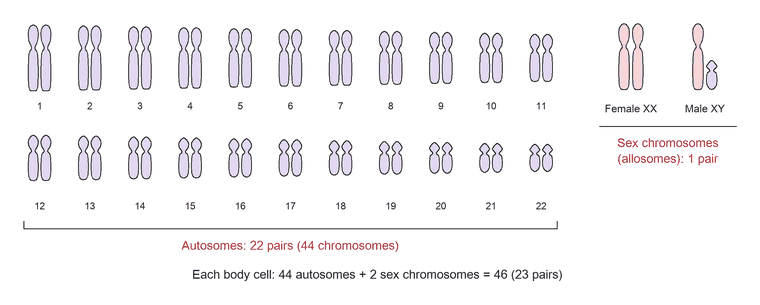
A is false. A karyotype is a chart of the chromosomes of a cell, photographed in a dividing nucleus and arranged in pairs by size and shape. The division of the nucleus itself is karyokinesis.
Step 2 — Judge the Reason.
R is true. Karyon means nucleus, and 'type' refers to the number, shape and size of the chromosomes; the human karyotype shows 23 pairs.
Step 3 — Decide the option.
A is false and R is true, so the matching option is (B) (2).
Watch out: KaryoTYPE is a chart of chromosomes; karyoKINESIS is division of the nucleus.
Why the other options are wrong:
- (A) (1) A is True and R is False: it has the statements the wrong way round: A is false and R is true.
- (C) (3) Both A and R are True: it says A is true, but a karyotype is a chart, not a division.
- (D) (4) Both A and R are False: it says R is false, but R gives the correct meaning of the word.
Therefore, the answer is (B): A is false and R is true.
- 271 mark
Question 27
The following questions are Assertion-Reason based questions. Choose the answer based on the codes given below.
(1) A is True and R is False (2) A is False and R is True
(3) Both A and R are True (4) Both A and R are False
Assertion (A): Dominant alleles can express themselves only in homozygous condition.
Reason (R): Dominant alleles support recessive alleles and allow them to express, even in heterozygous condition.
Solve with AIAnswer
(A) (1) A is True and R is False
(B) (2) A is False and R is True
(C) (3) Both A and R are True
- Correct
(D) (4) Both A and R are False
Answer: (D) (4) Both A and R are False
Concept: In an assertion–reason item, judge the Assertion (A) and the Reason (R) separately as true or false; only when both are true do we ask whether R correctly explains A.
Step 1 — Judge the Assertion.
A is false. A dominant allele is expressed in the homozygous condition (RR) and in the heterozygous condition (Rr); both are tongue rollers. It is the recessive allele that shows only when homozygous (rr).
Step 2 — Judge the Reason.
R is false. In Rr the dominant allele does not support the recessive one; it suppresses it, so r is not expressed.

Step 3 — Decide the option.
Both A and R are false, so the matching option is (D) (4).
Why the other options are wrong:
- (A) (1) A is True and R is False: it says A is true, but a dominant allele also shows in the heterozygous pair.
- (B) (2) A is False and R is True: it says R is true, but the dominant allele suppresses the recessive one.
- (C) (3) Both A and R are True: it says both are true, but neither is.
Therefore, the answer is (D): both A and R are false.
- 281 mark
Question 28
The following questions are Assertion-Reason based questions. Choose the answer based on the codes given below.
(1) A is True and R is False (2) A is False and R is True
(3) Both A and R are True (4) Both A and R are False
Assertion (A): Genotype is the genetic make up of a cell.
Reason (R): Phenotype is the set of genes present in the cells of an organism that expresses internal characters.
Solve with AIAnswer
- Correct
(A) (1) A is True and R is False
(B) (2) A is False and R is True
(C) (3) Both A and R are True
(D) (4) Both A and R are False
Answer: (A) (1) A is True and R is False
Concept: In an assertion–reason item, judge the Assertion (A) and the Reason (R) separately as true or false; only when both are true do we ask whether R correctly explains A.
Step 1 — Judge the Assertion.
A is true. The genotype is the genetic make-up (the set of genes) of a cell or organism, for example RR, Rr or rr for tongue rolling.
Step 2 — Judge the Reason.
R is false. R gives the meaning of genotype under the name phenotype. A phenotype is not a set of genes; it is the character that can be observed, such as roller or non-roller.
Step 3 — Decide the option.
A is true and R is false, so the matching option is (A) (1).
Why the other options are wrong:
- (B) (2) A is False and R is True: it has the statements the wrong way round: A is true and R is false.
- (C) (3) Both A and R are True: it says R is true, but R describes the genotype, not the phenotype.
- (D) (4) Both A and R are False: it says A is false, but A is the correct meaning of genotype.
Therefore, the answer is (A): A is true and R is false.
- 291 mark
Question 29
The following questions are Assertion-Reason based questions. Choose the answer based on the codes given below.
(1) A is True and R is False (2) A is False and R is True
(3) Both A and R are True (4) Both A and R are False
Assertion (A): A daughter can resemble only her mother and not her father.
Reason (R): Sex chromosomes of the daughter (XX) are received from both the parents.
Solve with AIAnswer
(A) (1) A is True and R is False
- Correct
(B) (2) A is False and R is True
(C) (3) Both A and R are True
(D) (4) Both A and R are False
Answer: (B) (2) A is False and R is True
Concept: In an assertion–reason item, judge the Assertion (A) and the Reason (R) separately as true or false; only when both are true do we ask whether R correctly explains A.
Step 1 — Judge the Assertion.
A is false. A daughter gets one chromosome of every pair from her mother and the other from her father, so she carries genes from both and can resemble either parent in different features.
Step 2 — Judge the Reason.
R is true. Every egg carries an X, and a daughter forms when an X-bearing sperm fertilises it, so one X of her XX comes from each parent.
Step 3 — Decide the option.
A is false and R is true, so the matching option is (B) (2).
Why the other options are wrong:
- (A) (1) A is True and R is False: it has the statements the wrong way round: A is false and R is true.
- (C) (3) Both A and R are True: it says A is true, but a daughter also inherits features from her father.
- (D) (4) Both A and R are False: it says R is false, but each parent does give her one X.
Therefore, the answer is (B): A is false and R is true.
- 305 marks
Question 30
Match the terms in column I with their explanations in column II.
Column I (Term) Column II (Explanation) a. Genetics (i) Chromosomes similar in size and shape b. Autosomes (ii) The alternative forms of a gene c. Recessive gene (iii) Study of laws of inheritance of characters d. Allele (iv) A gene that can express only when in a similar pair e. Homologous chromosomes (v) Chromosomes other than the pair of sex chromosomes. Solve with AIWritten solution
Solution:
Concept: Pick the one phrase in column II that defines each term in column I.
Step 1 — A. Genetics.
Genetics is the study of heredity and its laws, so it matches (iii) study of laws of inheritance of characters.
Step 2 — B. Autosomes.
Of the 23 pairs in humans, the 22 pairs other than the sex chromosomes are autosomes: (v).
Step 3 — C. Recessive gene.
A recessive gene is suppressed by the dominant one, so it shows only in a similar pair such as rr: (iv).
Step 4 — D. Allele.
R and r, for example, are alternative forms of the tongue-rolling gene: (ii).
Step 5 — E. Homologous chromosomes.
The two chromosomes of a homologous pair, one from each parent, are alike in size and shape: (i).
Step 6 — Write the matches.
The completed matching is:
Column I (Term) Column II (Explanation) a. Genetics (iii) Study of laws of inheritance of characters b. Autosomes (v) Chromosomes other than the pair of sex chromosomes c. Recessive gene (iv) A gene that can express only when in a similar pair d. Allele (ii) The alternative forms of a gene e. Homologous chromosomes (i) Chromosomes similar in size and shape Therefore, a – (iii), b – (v), c – (iv), d – (ii), e – (i).
- 311 mark
Question 31
Name any two genetic diseases in humans.
Solve with AIWritten solution
Solution:
Concept: A genetic disease is caused by a defective gene and is passed on from parents to children.
Step 1 — Name two.
Haemophilia and colour blindness (thalassaemia and sickle cell anaemia are also correct).
Step 2 — Say what each does.
In haemophilia the blood does not clot properly, so even a small wound bleeds for long. In colour blindness the person cannot tell certain colours apart, mostly red and green.
Therefore, two genetic diseases are haemophilia and colour blindness.
- 321 mark
Question 32
Which one of the following genotypes is homozygous dominant and which one homozygous recessive in regard to tongue rolling : Rr, rr, RR.
Solve with AIWritten solution
Solution:
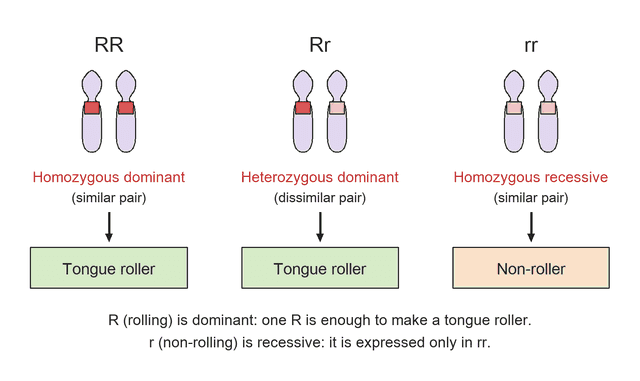
Concept: homozygous means the two alleles of the pair are alike. Capital R is the dominant allele (rolling); small r is the recessive allele (non-rolling).
Step 1 — Find the homozygous dominant.
Both alleles dominant and alike: RR (tongue roller).
Step 2 — Find the homozygous recessive.
Both alleles recessive and alike: rr (non-roller).
Step 3 — Place the third genotype.
Rr has unlike alleles, so it is heterozygous (dominant), also a tongue roller.
Therefore, RR is homozygous dominant and rr is homozygous recessive.
- 335 marks
Question 33
Rewrite the correct form of the statement by changing the first or the last word only :
(a) Duplicated chromosomes remain attached at a point termed as centrosome.
(b) The full complement of DNA of an organism is termed as genetics.
(c) The inheritable feature of an organism is termed as heredity.
(d) Terminal flower position is a dominant trait of pea flower.
(e) Alternative forms of a gene are called traits.
Solve with AIWritten solution
Solution:
Concept: In each statement only the first or the last word is wrong; replace it with the correct term.
Step 1 — (a) Where duplicated chromosomes stay joined.
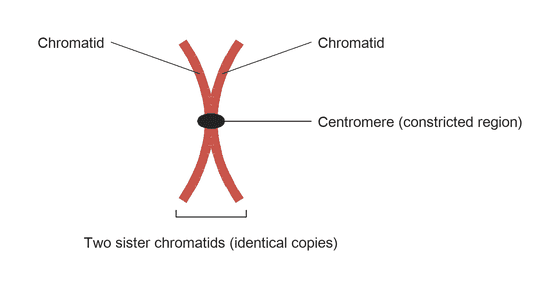
The two chromatids are joined at the centromere; the centrosome is a different structure in the cytoplasm.
Correct: duplicated chromosomes remain attached at a point termed as centromere.
Step 2 — (b) All the DNA of an organism.
Genetics is the study of heredity; the full set of DNA, with all its genes, is the genome.
Correct: the full complement of DNA of an organism is termed as genome.
Step 3 — (c) An inheritable feature.
Heredity is the passing on of characters; each inheritable feature is a character.
Correct: the inheritable feature of an organism is termed as character.
Step 4 — (d) Flower position in pea.
In pea, axial (axillary) flowers are dominant and terminal flowers are recessive, so the first word must change.
Correct: Axial flower position is a dominant trait of pea flower.
Step 5 — (e) Alternative forms of a gene.
Traits are forms of a character; forms of a gene are alleles.
Correct: alternative forms of a gene are called alleles.
Therefore, the corrected words are (a) centromere, (b) genome, (c) character, (d) Axial, (e) alleles.
- 342 marks
Question 34
Among lion, tiger and domestic cat, all the three have the same number of 38 chromosomes, yet they have different appearances. How do you account for such differences ?
Solve with AIWritten solution
Solution:
Concept: An organism's characteristics come from the genes on its chromosomes, not from the number of chromosomes.
Step 1 — See what the number tells.
The number 38 only says how many chromosomes each body cell has; it is the same in the lion, the tiger and the domestic cat.
Step 2 — Recall what chromosomes carry.
Chromosomes carry genes, the DNA segments that decide the hereditary characters.
Step 3 — Compare the genes.
The genes on the 38 chromosomes are different in the three animals.
Step 4 — Link genes to appearance.
These different genes give each animal its own size, colour, appearance and behaviour.
Watch out: The same chromosome number does not mean the same genes.
Therefore, the three animals look different because the genes on their 38 chromosomes are different.
- 352 marks
Question 35
List any three features of garden pea with their dominant and recessive traits.
Solve with AIWritten solution
Solution:
Concept: Mendel studied seven pairs of contrasting features in garden pea; in each pair one trait is dominant and the other recessive.
Step 1 — List three features.
Any three of these, with their traits:
Feature (character) Dominant trait Recessive trait Plant height Tall Dwarf Seed shape Round Wrinkled Seed colour Yellow Green Flower colour Purple White Pod colour Green Yellow Pod shape Inflated Constricted Flower position Axial (axillary) Terminal 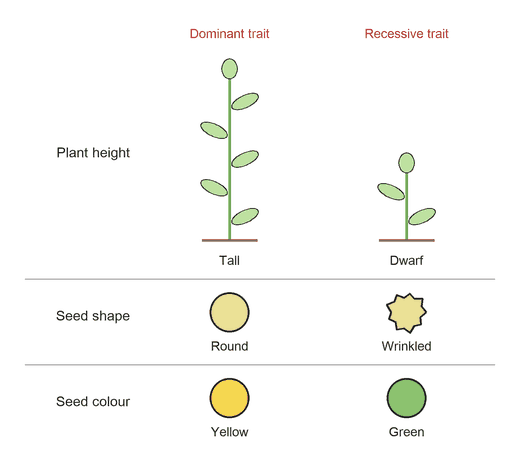
Step 2 — Say how the dominant trait is known.
The dominant trait is the one that appears in all the F₁ hybrids when two pure forms are crossed; for example, tall × dwarf gives all tall plants.
Therefore, any three such as plant height (tall / dwarf), seed shape (round / wrinkled) and seed colour (yellow / green).
- 362 marks
Question 36
Explain why generally only the male child suffers from colour blindness and not the female?
Solve with AIWritten solution
Solution:
Concept: Colour blindness is caused by a recessive gene on the X chromosome. A male has one X; a female has two.
Step 1 — In a male (XY).
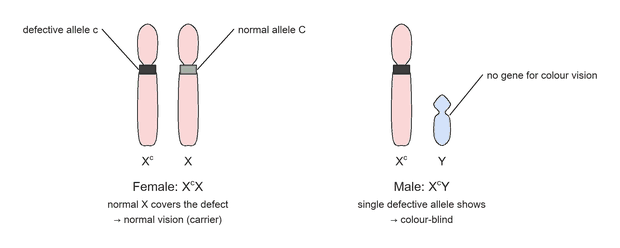
He has a single X, and the Y chromosome has no allele for colour vision. If that X carries the defective allele (), there is no normal allele to suppress it, so he is colour-blind.
Step 2 — In a female (XX).
With the defective allele on one X (), the normal allele on her other X is expressed, so she sees normally and is only a carrier.
She is colour-blind only if both X chromosomes carry the allele (), which needs a colour-blind father and a carrier (or colour-blind) mother; this is rare.
Step 3 — Check with a cross.
A carrier mother and a normal father can have a colour-blind son, but none of their daughters is colour-blind.
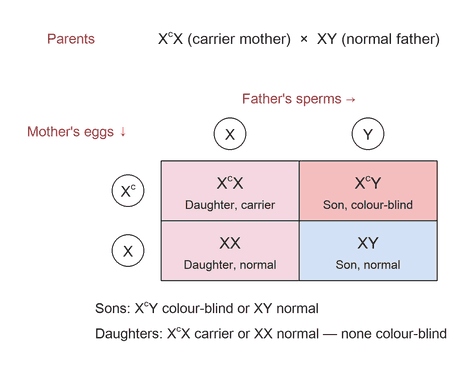
Therefore, one defective allele makes a male colour-blind but a female needs two, so generally only male children suffer from colour blindness.
- 376 marks
Question 37
Define the following terms :
(a) Pedigree chart
(b) Variations
(c) Mutation
Solve with AIWritten solution
Solution:
Concept: These terms cover how a character is followed in a family, how individuals differ, and how the hereditary material itself can change.
Step 1 — Define pedigree chart.
Pedigree chart: a family chart showing how a particular character is inherited through the generations of a family.
Squares are males and circles are females; a solid symbol means the character is present. In the chart below both parents are rollers, yet one daughter is a non-roller (rr); she must have got one r from each parent, so both parents are Rr.
Step 2 — Define variations.
Variations: the small differences among individuals of the same species.
Example: even members of one family differ in eye colour, hair shape and ear lobes.
Step 3 — Define mutation.
Mutation: a sudden change in one or more genes, or in the number or structure of chromosomes.
It changes the hereditary material, so some character changes. Example: sickle cell anaemia, where a change in one base of a gene gives sickle-shaped red blood cells.

Therefore, the three terms are defined as above: pedigree chart, variations and mutation.
- 383 marks
Question 38
State the three Mendel's laws of inheritance.
Solve with AIWritten solution
Solution:
Concept: Mendel's conclusions from his breeding experiments on garden pea are summed up as three laws.
Step 1 — Law of Dominance.
Of a pair of contrasting characters present together, only one expresses itself and the other stays suppressed; the expressed one is dominant and the other recessive.
Example: TT × tt gives Tt hybrids that are all tall.

Step 2 — Law of Segregation (purity of gametes).
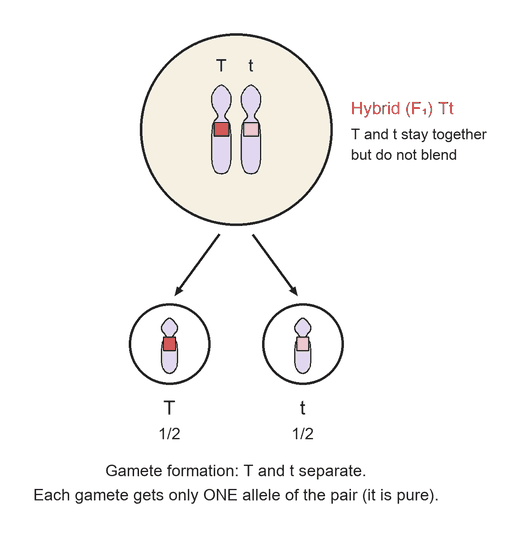
The two members of a pair of factors separate when gametes form; they do not blend, and each gamete gets one.
Example: a Tt plant makes two kinds of gametes, T and t.
Step 3 — Law of Independent Assortment.
With two pairs of characters, the alleles of one pair go into the gametes independently of the alleles of the other pair.
Example: RrYy makes four kinds of gametes: RY, Ry, rY and ry.
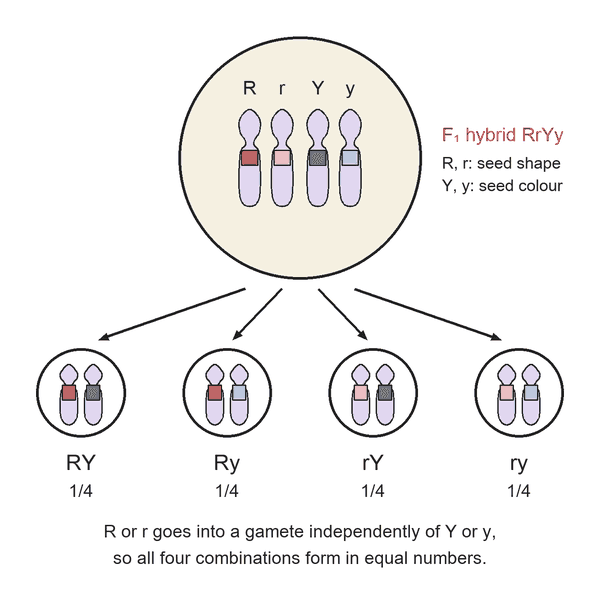
Therefore, Mendel's three laws are the law of dominance, the law of segregation and the law of independent assortment, stated as above.
- 393 marks
Question 39
Does the sex of the child depend on the father or it is just a matter of chance? Discuss.
Solve with AIWritten solution
Solution:
Concept: The sex of the child depends on the kind of sperm from the father that fertilises the egg, but which sperm does so is a matter of chance.
Step 1 — The eggs.
The mother is XX, so every egg carries one X; all eggs are alike.
Step 2 — The sperms.
The father is XY, so half his sperms are X-bearing and half are Y-bearing.
Step 3 — Fertilisation.
The kind of sperm decides the sex:
- Egg (X) + X-bearing sperm → XX → daughter.
- Egg (X) + Y-bearing sperm → XY → son.
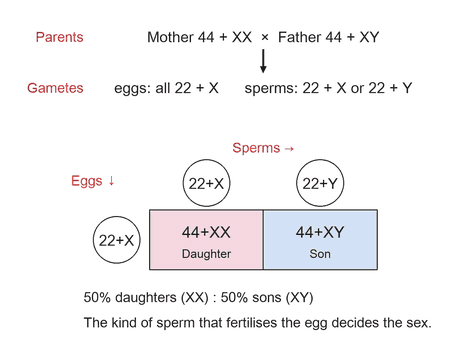
Step 4 — The role of chance.
Both kinds of sperm are present in equal numbers, and which one fuses with the egg is pure chance, so each birth has a 50% chance of a son and 50% of a daughter.
Watch out: The mother gives an X to every child, so she does not decide the sex.
Therefore, both are true: the sex depends on the father's sperm (only he can give a Y), but which sperm fertilises the egg is a matter of chance.
- 406 marks
Question 40
Distinguish between the following pairs :
(a) Karyotype and Karyokinesis
(b) Autosomes and Sex chromosomes
(c) Homozygous and Heterozygous chromosomes
Solve with AIWritten solution
Solution:
Concept: Compare each pair point against point on the same basis, with an example.
Step 1 — Karyotype and karyokinesis.
Compare what each word means:
Basis Karyotype Karyokinesis Meaning A chart of a cell's chromosomes in pairs by size and shape. The division of the nucleus in cell division. Shows / does The number, shape and size of chromosomes (23 pairs in humans). Shares the chromosomes between two daughter nuclei. 
Step 2 — Autosomes and sex chromosomes.
Compare what they decide and how many there are:
Basis Autosomes Sex chromosomes Decide General body features. The sex. Number in humans 22 pairs. 1 pair. Partners Alike in both sexes. Alike in females (XX), unlike in males (XY). Step 3 — Homozygous and heterozygous.
Compare the two alleles on the homologous chromosomes:
Basis Homozygous Heterozygous Alleles Alike. Unlike. Example RR or rr. Rr. Gametes One kind for that gene. Two kinds (R and r). 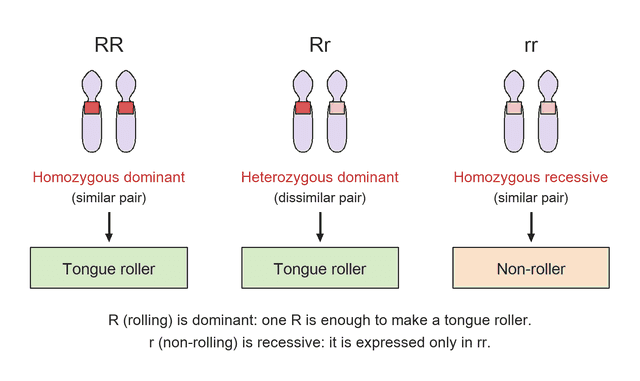
Therefore, the pairs differ as tabulated: chart vs nuclear division; body features vs sex; alike vs unlike alleles.
- 412 marks
Question 41
In a certain species of animals, black fur (B) is dominant over brown fur (b). Predict the genotypic and phenotypic ratios of the offspring when both parents are 'Bb' or have heterozygous black fur.
Solve with AIWritten solution
Solution:
Concept: Each heterozygous parent (Bb) makes two kinds of gametes, B and b, in equal numbers; a Punnett square shows every way they can combine.
Step 1 — Write the gametes.
Black fur (B) is dominant over brown (b). Each Bb parent gives B or b.
Step 2 — Fill the Punnett square.
Combine every gamete of one parent with every gamete of the other:

Step 3 — Count the genotypes.
The four boxes hold 1 BB, 2 Bb and 1 bb.
Step 4 — Count the phenotypes.
BB and Bb are black because B is dominant; only bb is brown.
Therefore, the genotypic ratio is 1 BB : 2 Bb : 1 bb and the phenotypic ratio is 3 black : 1 brown.
- 422 marks
Question 42
Two pairs (A & B) of rabbits were crossed as given below :

(a) Can you tell which coat colour (black or white) is dominant? ..........
(b) Is the coat colour sex-linked? ..........
Solve with AIWritten solution
Solution:
Concept: When parents with contrasting traits give offspring showing only one of them, that trait is dominant. If the result is the same whichever sex carries the trait, the character is not sex-linked.
Step 1 — (a) Which colour is dominant.
In both pairs one parent is white and the other black, yet the offspring is black. The offspring also got the white allele from its white parent, but it stays hidden. So black is dominant and white is recessive.
Step 2 — (b) Is it sex-linked.
Pair A (white male × black female) and pair B (black male × white female) are the same cross with the sexes swapped. Both give black offspring, a male in A and a female in B, so the colour is inherited the same way through either sex: it is not sex-linked.
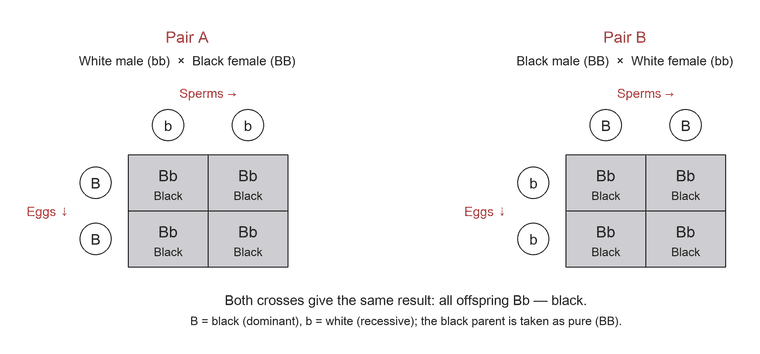
Step 3 — Check with symbols.
Taking B for black and b for white with pure parents, both crosses are BB × bb, and every offspring is Bb (black).
Therefore, (a) black coat colour is dominant and (b) no, the coat colour is not sex-linked.
- 434 marks
Question 43
Make a Punnett square and find out the genotypic and phenotypic ratios of generation in the progeny of a genetic cross between :
(a) A pure tall (TT) pea plant with a pure dwarf (tt) pea plant.
(b) Red flower variety of pea (RR) with white flower variety of pea (rr).
Solve with AIWritten solution
Solution:
Concept: Pure (homozygous) parents give an F₁ that is all hybrid; the F₂ comes from selfing the F₁, so its Punnett square is hybrid × hybrid.
Step 1 — (a) Make the F₁ of TT × tt.
TT gives only T and tt gives only t gametes, so the F₁ is all Tt (hybrid tall).
Step 2 — (a) Make the F₂ (Tt × Tt).
Each F₁ plant makes T and t gametes; the square is:

It holds 1 TT, 2 Tt and 1 tt; TT and Tt are tall and tt is dwarf.
Step 3 — (b) Make the F₁ of RR × rr.
RR gives only R and rr gives only r gametes, so the F₁ is all Rr (red, as red is dominant).
Step 4 — (b) Make the F₂ (Rr × Rr).
Each F₁ plant makes R and r gametes; the square is:

It holds 1 RR, 2 Rr and 1 rr; RR and Rr are red and rr is white.
Step 5 — Check.
Both are monohybrid crosses, so both give genotypic 1 : 2 : 1 and phenotypic 3 : 1 in the F₂.
Therefore, (a) genotypic 1 TT : 2 Tt : 1 tt and phenotypic 3 tall : 1 dwarf; (b) genotypic 1 RR : 2 Rr : 1 rr and phenotypic 3 red : 1 white.
- 4413 marks
Question 44
Mendel crossed a homozygous pea plant having round seeds (RR) with a homozygous pea plant having wrinkled seeds (rr). He got different results. On the basis of it, answer the following questions :

(a) Which character of seed is studied in the experiment?
(b) Which of the above two traits is dominant ?
(c) Write the phenotype and genotype of offsprings.
(d) Mention and state the Mendel's law shown in the above cross.
(e) Make a Punnett square for generation when two plants of offspring are crossed with each other.
(f) Write the phenotypic ratio of progeny.
(g) What will be the genotypic ratio of offsprings ?
(h) What are the two traits of seed colour ? Also mention which is dominant and recessive ?
(i) Write the scientific name of garden pea.
(j) Write two main features of pea plant due to which Mendel had selected it for his hybridisation studies.
Solve with AIWritten solution
Solution:
Concept: This is a monohybrid cross for one character, seed shape: RR × rr gives an F₁ of Rr, and crossing two F₁ plants (Rr × Rr) gives the F₂.
Step 1 — (a) The character studied.
The character is seed shape, with the traits round and wrinkled.
Step 2 — (b) The dominant trait.
Every F₁ seed (Rr) is round although it also carries the wrinkled allele, so round is dominant and wrinkled recessive.
Step 3 — (c) The F₁.
Phenotype: round seeds. Genotype: Rr (heterozygous).
Step 4 — (d) The law shown.
The cross shows the Law of Dominance: of a pair of contrasting characters present together, only one expresses itself and the other stays suppressed; the expressed one is dominant, the other recessive. Here R is expressed and r suppressed in every F₁ plant.
Step 5 — (e) The F₂ Punnett square.
F₁ × F₁ is Rr × Rr; each parent makes R and r gametes:

Step 6 — (f) Phenotypic ratio.
RR and Rr are round, rr is wrinkled, so the ratio is 3 round : 1 wrinkled.
Step 7 — (g) Genotypic ratio.
The four boxes hold 1 RR : 2 Rr : 1 rr.
Step 8 — (h) Seed colour.
The two traits are yellow (dominant) and green (recessive).
Step 9 — (i) Scientific name.
Garden pea is Pisum sativum.
Step 10 — (j) Why Mendel chose pea.
Any two of these features:
- Many varieties with contrasting forms of a character.
- Pure-breeding varieties, giving the same type generation after generation.
- Normally self-pollinated, but can be cross-pollinated by hand.
- A short life span, so many generations can be studied quickly.
Therefore, (a) seed shape; (b) round; (c) round, Rr; (d) law of dominance; (e) square as shown; (f) 3 round : 1 wrinkled; (g) 1 RR : 2 Rr : 1 rr; (h) yellow dominant, green recessive; (i) Pisum sativum; (j) as listed.
- 457 marks
Question 45
A homozygous plant having round (R) and yellow (Y) seed is crossed with another homozygous plant having wrinkled (r) and green (y) seeds. Answer the following questions :
(a) Give the genotype of the generation.
(b) Mention the phenotype of the offsprings.
(c) Give the possible combinations of gametes that can be obtained from hybrids.
(d) Give the dihybrid phenotypic ratio and the phenotype of the offsprings of the generation when two plants of generation are crossed.
(e) Name and state the law which explains the dihybrid phenotypic ratio.
Solve with AIWritten solution
Solution:
Concept: This is a dihybrid cross: seed shape and seed colour are followed together. Round (R) and yellow (Y) are dominant; wrinkled (r) and green (y) are recessive.
Step 1 — Write the parents and their gametes.
RRYY (round, yellow) × rryy (wrinkled, green); their gametes are RY and ry.
Step 2 — (a) Genotype of F₁.
RY + ry gives RrYy.
Step 3 — (b) Phenotype of F₁.
Both dominant alleles are expressed, so the seeds are round and yellow.
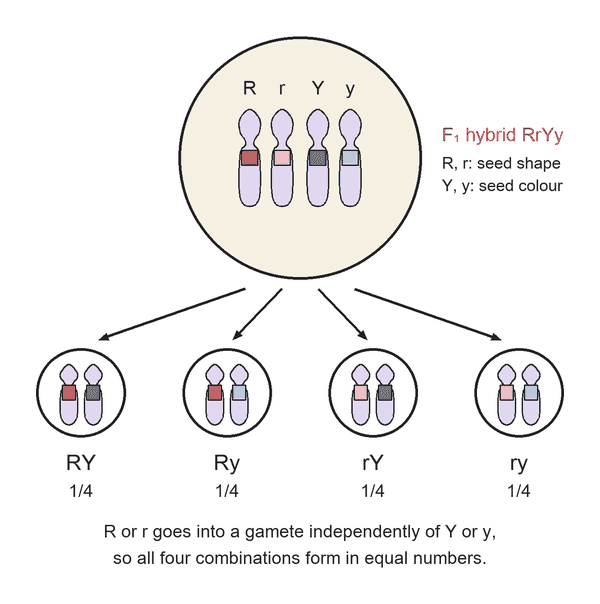
Step 4 — (c) Gametes of the F₁.
R or r goes into a gamete independently of Y or y, giving four kinds in equal numbers: RY, Ry, rY and ry.
Step 5 — (d) The F₂.
RrYy × RrYy: 4 kinds of male and 4 kinds of female gametes give 16 combinations.
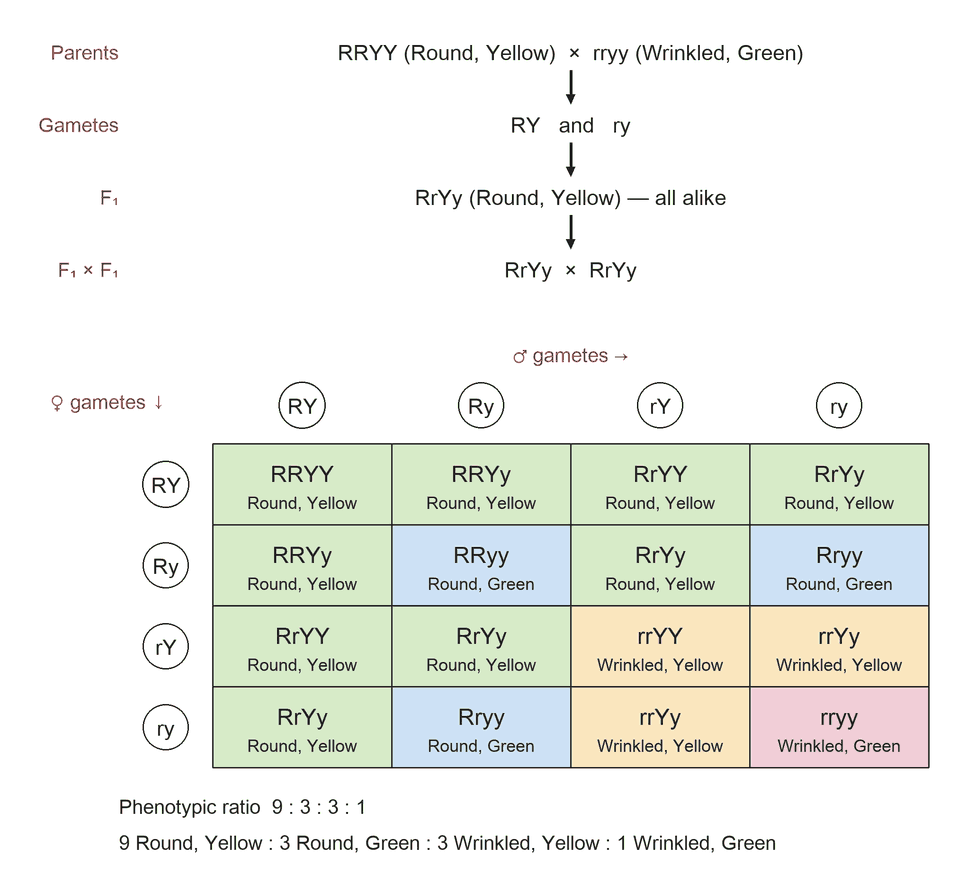
Counting the boxes gives:
Phenotype of F₂ Out of 16 Round, yellow 9 Round, green 3 Wrinkled, yellow 3 Wrinkled, green 1 So the dihybrid phenotypic ratio is 9 : 3 : 3 : 1.
Step 6 — (e) The law.
Law of Independent Assortment: with two pairs of characters, the alleles of one pair go into the gametes independently of the alleles of the other pair.
This is why the F₁ makes RY, Ry, rY and ry gametes equally, giving the new combinations (round green, wrinkled yellow) and the 9 : 3 : 3 : 1 ratio.
Therefore, (a) RrYy; (b) round yellow; (c) RY, Ry, rY, ry; (d) 9 round yellow : 3 round green : 3 wrinkled yellow : 1 wrinkled green; (e) law of independent assortment.
What Class 10 Biology Ch 3 covers
The sections of the chapter, in the order the book takes them. Every question above comes from one of these.
- 01What Is Genetics
- 02Variations in Population
- 03Chromosomes – The Carriers of Heredity
- 04Autosomes and Sex Chromosomes
- 05Sex Determination – Son or Daughter
- 06Genes and Their Alleles
More ways to study this chapter
The same chapter asked three other ways. Practise it, revise it, and see what the board has set on Ch 3 before.
- Competency-Based Questions (CBQ)Case study questions: a situation, and the part of the chapter that answers it.40questionsOpen
- Previous Year QuestionsQuestions that have actually appeared in board papers, each tagged with its year.39questionsOpen
- Practice QuestionsExtra questions per chapter, for when one attempt at a method is not enough.41questionsOpen
Ch 3 in past ICSE papers
The same chapter as the board has actually asked it. These are worded differently from the textbook exercise, which is the point of reading them.
- 11 mark
Board paper question 1
In each set of terms given below, there is an odd one and cannot be grouped in the same category to which the other three belong. Identify the odd term in each set and name the category to which the remaining three belong.
Example: Ovary, Fallopian tube, Ureter, Uterus. Odd term: Ureter Category: Parts of female reproductive system.
Typhoid, Haemophilia, Albinism, Colour blindness.
Solve with AIWritten solution
Solution:
Concept: A genetic (hereditary) disorder is caused by a faulty gene and is passed on from parents to children; an infectious disease is caused by a germ (virus, bacterium or protozoan) and is caught, not inherited.
Step 1 — Sort the four terms.
We ask of each term whether it is caught from a germ or inherited through genes.
- Typhoid — caused by a bacterium (Salmonella Typhi) spread through contaminated food and water; caught, not inherited.
- Haemophilia — a genetic disorder caused by a recessive gene on the X chromosome.
- Albinism — a genetic disorder caused by a recessive gene; the body cannot make the pigment melanin.
- Colour blindness — a genetic disorder caused by a recessive gene on the X chromosome.
Step 2 — Name the odd term and the category.
Typhoid is the only infection, so it is the odd term; the other three are genetic disorders.
Therefore, the odd term is Typhoid, and the category of the other three is Genetic (hereditary) disorders.
- 21 mark
Board paper question 2
Give the Biological / technical term for the following:
An alteration in the genetic material that can be inherited.
Solve with AIWritten solution
Solution:
Concept: A mutation is a sudden change in one or more genes, or in the number or the structure of chromosomes. A change in the genetic material of the gametes is passed on to the next generation.
Step 1 — Recall the term.
An alteration in the genetic material that can be inherited is a mutation.
Step 2 — Give an example.
Sickle cell anaemia is caused by a gene mutation: one base of the haemoglobin gene changes, the red blood cells become sickle-shaped, and the changed gene is inherited.

Therefore, the term is mutation.
- 31 mark
Board paper question 3
Give scientific reasons for the following statements:
Colour blindness is more common in men than in women.
Solve with AIWritten solution
Solution:
Concept: Colour blindness and haemophilia are caused by recessive alleles on the X chromosome; the Y chromosome has no matching gene. A male (XY) shows the disorder with ONE such X; a female (XX) shows it only with TWO, and with one she is a normal carrier. A son always gets his X from his mother and his Y from his father.
Step 1 — A man has only one X.
A male is XY. If his single X carries the defective allele, written , there is no second X to cover it, so he is colour-blind.
Step 2 — A woman has two X chromosomes.
A female is XX. With one defective X () the normal allele on her other X is dominant, so she has normal vision and is only a carrier. She is colour-blind only if both her X chromosomes carry the defective allele (), which is much rarer.

Step 3 — Compare the chances.
One defective allele is enough to make a man colour-blind, but a woman needs two, one from each parent.
Watch out: The Y chromosome carries NO gene for colour vision, so nothing on it can cover the defect.
Therefore, colour blindness is more common in men because the recessive gene is on the X chromosome: a man, with a single X, is colour-blind with one defective allele, while a woman needs two.
- 45 marks
Board paper question 4
A homozygous tall plant (T) bearing red coloured (R) flowers is crossed with a homozygous dwarf (t) plant bearing white (r) flowers :
(i) Give the genotype and phenotype of the plants of generation.
(ii) Mention the possible combinations of the gametes that can be obtained from the hybrid plant.
(iii) State the Mendel's law of Independent Assortment.
(iv) Mention the phenotypes of the offspring's obtained in F_2 generation.
(v) What is the phenotypic ratio obtained in F_2 generation?
Solve with AIWritten solution
Solution:
Concept: This is a dihybrid cross: two pairs of contrasting characters (height and flower colour) are followed together. Tall (T) and red (R) are dominant; dwarf (t) and white (r) are recessive. Law of Independent Assortment: when there are two pairs of characters, the distribution of the alleles of one character into the gametes is independent of the distribution of the alleles of the other character.
Step 1 — Part (i): the F₁ generation.
The parents are TTRR (tall, red) and ttrr (dwarf, white). Their gametes are TR and tr, so every F₁ plant has the genotype TtRr. T and R are dominant, so every F₁ plant is tall with red flowers.
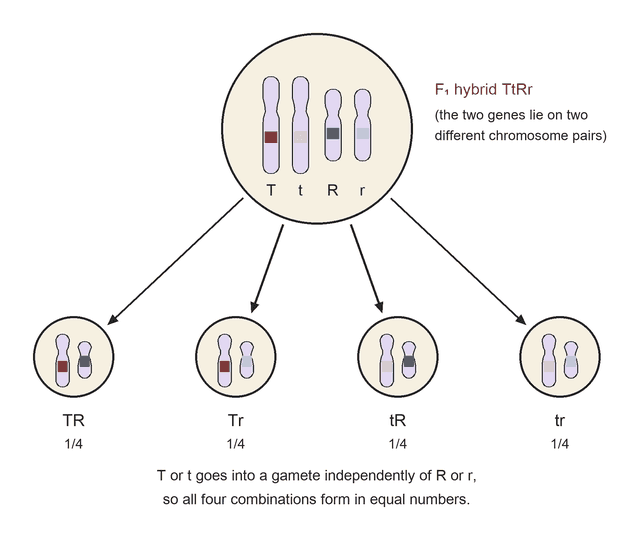
Step 2 — Part (ii): gametes of the F₁ hybrid.
Each gamete gets one allele of each pair, in every possible combination, so TtRr forms four kinds of gametes in equal numbers: TR, Tr, tR, tr.
Step 3 — Part (iii): the law of independent assortment.
When there are two pairs of characters, the distribution of the alleles of one character into the gametes is independent of the distribution of the alleles of the other character. That is why T or t can go into a gamete with R or with r.
Step 4 — Part (iv): phenotypes in F₂.
Crossing two F₁ plants (TtRr × TtRr) gives four kinds of plants: tall with red flowers, tall with white flowers, dwarf with red flowers and dwarf with white flowers. Two of them (tall white, dwarf red) are new combinations not seen in either parent.
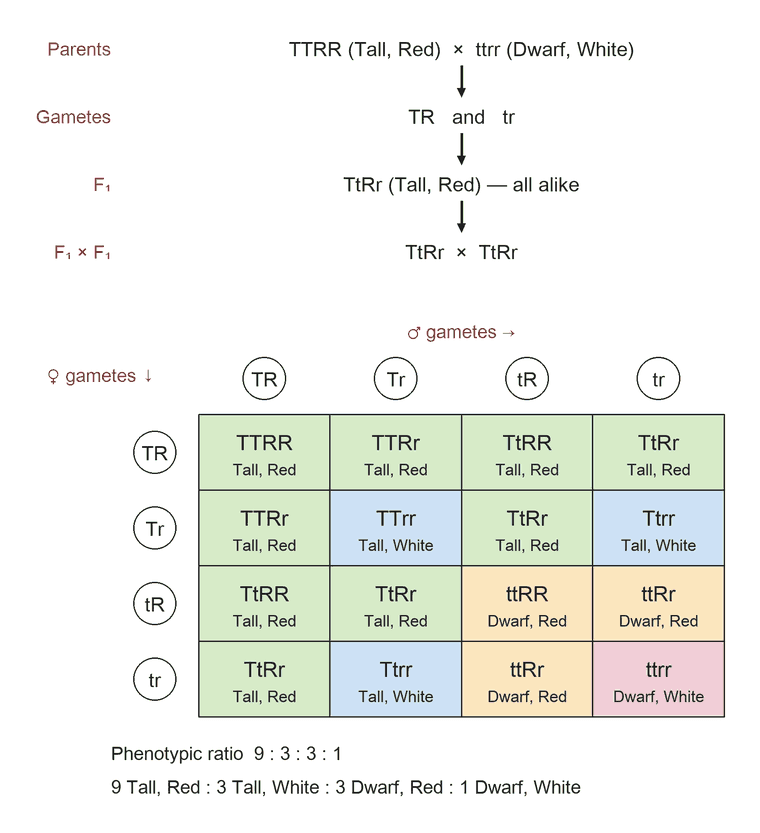
Step 5 — Part (v): phenotypic ratio in F₂.
Counting the 16 boxes of the Punnett square gives 9 tall red, 3 tall white, 3 dwarf red and 1 dwarf white.
Watch out: In F₂ count PHENOTYPES (what the plants look like), not genotypes; 9 + 3 + 3 + 1 = 16 boxes.
Therefore, (i) F₁: genotype TtRr, phenotype tall with red flowers; (ii) gametes TR, Tr, tR, tr; (iii) the law as stated in Step 3; (iv) tall red, tall white, dwarf red, dwarf white; (v) 9 : 3 : 3 : 1.
- 51 mark
Board paper question 5
Given below are groups of terms. In each group the first pair indicates the relationship between the two terms. Rewrite and complete the second pair on a similar basis.
Example: Oxygen : Inspiration : : Carbondioxide : Expiration
TT : Homozygous : : Tt : ...............
Solve with AIWritten solution
Solution:
Concept: Alleles are the alternative forms of a gene. They occupy the same position (locus) on a pair of homologous chromosomes and affect the same character in different ways, e.g. T (tall) and t (dwarf).
Step 1 — Find the relation in the first pair.
TT has two similar alleles of the gene, so it is homozygous.
Step 2 — Complete the second pair.
Tt has two dissimilar alleles, one dominant (T) and one recessive (t), so it is heterozygous. Such a plant is tall but can pass on either allele.
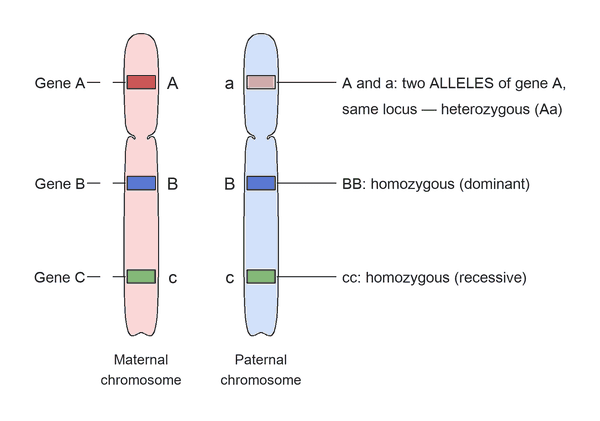
Therefore, TT : Homozygous : : Tt : Heterozygous.
- 61 mark
Board paper question 6
Give appropriate biological / technical terms for the following:
The suppressed allele of a gene.
Solve with AIWritten solution
Solution:
Concept: Alleles are the alternative forms of a gene. They occupy the same position (locus) on a pair of homologous chromosomes and affect the same character in different ways, e.g. T (tall) and t (dwarf). Law of Dominance: out of a pair of contrasting characters present together, only one is able to express itself while the other remains suppressed. The one that expresses itself is the dominant character and the one that stays unexpressed is the recessive character.
Step 1 — Recall the term.
The allele whose expression is suppressed when the other allele is present is the recessive allele (recessive gene).
Step 2 — Give an example.
In a Tt pea plant the dwarf allele t is suppressed by T, so the plant is tall; t shows itself only in a tt plant, which is dwarf.
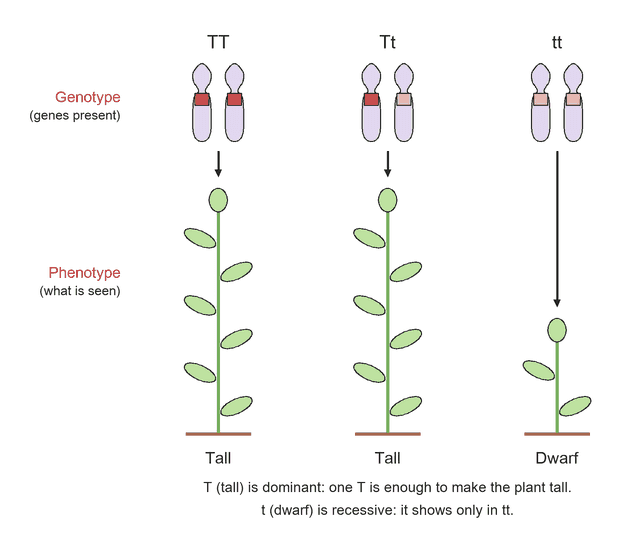
Therefore, the term is recessive allele.
All 39 board paper questions for this chapter, solved the same way.
Class 10 Biology Ch 3 questions students ask
How many questions are there in Class 10 Biology Ch 3?
45 questions. Every one is solved step by step on this page.
Are these Class 10 Biology solutions free?
Yes. Every question and its full working is free to read, with no account needed.
Can I download the Class 10 Biology Ch 3 solutions as a PDF?
There is no PDF to download. Every solution is on this page instead, which means it is searchable, always the current syllabus, and readable on a phone. Use your browser's print option if you want it on paper.