
Question 125 marksMedium
Distinguish between the following pairs :
(i) Monohybrid and Dihybrid cross
(ii) Genotype and Phenotype
(iii) Character and Trait
(iv) Dominant and Recessive Allele
(v) Autosomes and Sex chromosomes
Confirming your payment
Sign up now and get 250 free tokens.
Genetics – Some Basic Fundamentals · Question 12 of 45
Distinguish between the following pairs :
(i) Monohybrid and Dihybrid cross
(ii) Genotype and Phenotype
(iii) Character and Trait
(iv) Dominant and Recessive Allele
(v) Autosomes and Sex chromosomes
Solution:
Concept: Compare each pair point against point on the same basis, with an example.
Step 1 — Monohybrid and dihybrid cross.
Compare how many characters are followed:
| Basis | Monohybrid cross | Dihybrid cross |
|---|---|---|
| Characters | One pair of contrasting traits. | Two pairs of contrasting traits together. |
| Example | Tall × dwarf pea. | Round yellow × wrinkled green seeds. |
| F₂ phenotypic ratio | 3 : 1 | 9 : 3 : 3 : 1 |
Step 2 — Genotype and phenotype.
Compare genes with what is seen:
| Basis | Genotype | Phenotype |
|---|---|---|
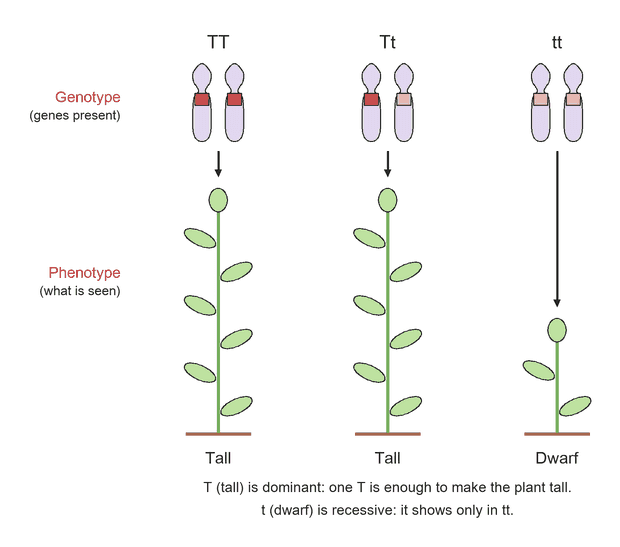
| Meaning | The set of genes in the cells. | The observable characters controlled by genes. |
| Seen? | Cannot be seen; written as TT, Tt or tt. | Can be seen: tall or dwarf. |
| Link | Two genotypes (TT, Tt) give tall plants. | Both TT and Tt show one phenotype (tall). |
Step 3 — Character and trait.
Compare the feature with its forms:
| Basis | Character | Trait |
|---|---|---|
| Meaning | Any inheritable feature. | An alternative form of a character. |
| Example | Height of pea plant; hair shape. | Tall or dwarf; curly or straight. |
Step 4 — Dominant and recessive allele.
Compare when each one shows:
| Basis | Dominant allele | Recessive allele |
|---|---|---|
| Expression | Expresses itself even with the other allele. | Suppressed by the dominant allele. |
| Shows in | TT and Tt. | Only tt. |
| Symbol | Capital letter, e.g. T. | Small letter, e.g. t. |
Step 5 — Autosomes and sex chromosomes.
Compare what they decide and how many there are:
| Basis | Autosomes | Sex chromosomes |
|---|---|---|
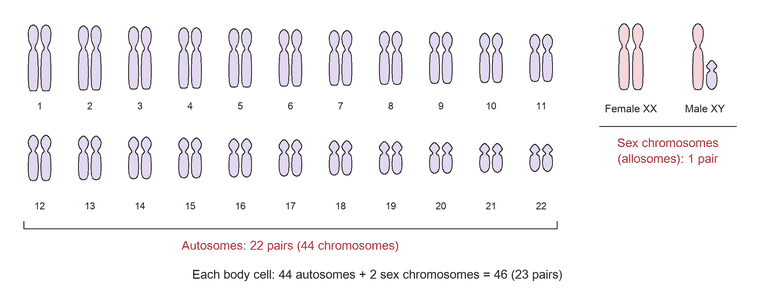
| Decide | General body features. | The sex of the individual. |
| Number in humans | 22 pairs (1 to 22). | 1 pair (the 23rd). |
| Partners | Alike in both sexes. | Alike in females (XX), unlike in males (XY). |
Therefore, the five pairs differ as tabulated: one vs two characters; genes vs visible form; feature vs its forms; expressed vs suppressed; body features vs sex.