
Opening your dashboard
Class 10 Biology Chapter 3 Genetics – Some Basic Fundamentals: Competency-Based Questions (CBQ)
40 questions on Chapter 3, each worked through on its own page with the AI tutor. Class 10 Biology, ICSE 2026-27.
40 questions
1–5 marks · Mixed difficulty
- 11 mark
Question 1
Cognitive domain: Application
Camptodactyly (inability to straighten the little finger) is a dominant hereditary trait. Mr. Nair has camptodactyly, but his mother can straighten her little fingers. Mrs. Nair can also straighten her little fingers. What is the chance that a child of Mr. and Mrs. Nair will have camptodactyly ?
- 21 mark
Question 2
Cognitive domain: Analysis
The pedigree chart shows a family. Squares are males and circles are females. A solid symbol shows a person who has a certain hereditary trait; a hollow symbol shows a person who does not have it.
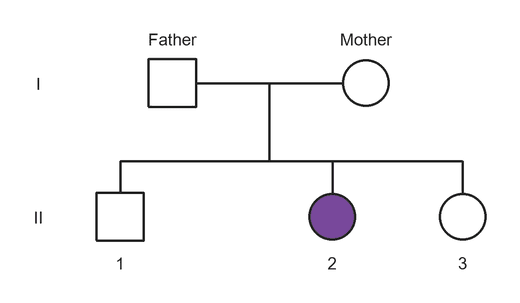
Which conclusion about this trait is supported by the chart ?
- 31 mark
Question 3
Cognitive domain: Application
A school eye camp finds that Anu, a girl of Class X, is red-green colour-blind. Which of the following must be true of her parents ?
- 41 mark
Question 4
Cognitive domain: Analysis
A student grew four pea plants, P, Q, R and S, from round seeds. Each plant was allowed to self-pollinate, and the seeds it produced were counted.
Plant Round seeds Wrinkled seeds P 298 102 Q 400 0 R 400 0 S 305 95 Which of these plants were hybrids (Rr) ?
- 51 mark
Question 5
Cognitive domain: Understanding
Assertion (A): A dwarf pea plant of the generation, when self-pollinated, produces only dwarf plants.
Reason (R): A recessive trait is expressed only when both the alleles are recessive, so a dwarf plant has no allele for tallness to pass on.
- 61 mark
Question 6
Cognitive domain: Understanding
Assertion (A): A person with the genotype Rr for tongue rolling is able to roll the tongue.
Reason (R): The chromosome that carries the allele R is dominant over the chromosome that carries the allele r.
- 71 mark
Question 7
Cognitive domain: Understanding
Asha and her brother can both roll their tongues, but their father cannot. (R is the allele for tongue rolling and r is the allele for non-rolling.)
So the genotype of both Asha and her brother must be ______, because each of them has received the allele ______ from their father.
- 81 mark
Question 8
Cognitive domain: Application
A student self-pollinated hybrid tall pea plants (Tt) and raised plants in the next generation. As expected, of them were tall and were dwarf. He wants to collect seeds only from the tall plants that will breed true.
Of the tall plants, about ______ are expected to be pure tall (TT), and the remaining ______ are hybrids.
- 91 mark
Question 9
Cognitive domain: Application
Rohit is red-green colour-blind. Both his parents have normal colour vision.
Rohit must have received the allele for colour blindness from his ______, because from his other parent he received the ______ chromosome.
- 102 marks
Question 10
Cognitive domain: Evaluation
Rina is healthy, but her brother has haemophilia. Their parents are both healthy. Rina is about to marry a healthy man. Her aunt says, "Both of you are healthy, so going for genetic counselling is a waste of time."
Do you agree with the aunt ? Justify your answer using the way haemophilia is inherited.
- 112 marks
Question 11
Cognitive domain: Evaluation
A plant breeder has two pure varieties of garden pea. One is tall with wrinkled seeds and the other is dwarf with round seeds. He wants a dwarf plant with wrinkled seeds. His helper says, "That is impossible. Neither parent variety has these two traits together, so no offspring can have them."
Evaluate the helper's statement, naming the law of Mendel on which your answer is based. In which generation should the breeder look for the plant he wants ?
- 122 marks
Question 12
Cognitive domain: Analysis
Rekha photographed the chromosomes of dividing body cells of three organisms and counted them. Her counts were , and . Her teacher accepted the first two counts but asked her to count the third one again.
Why did the teacher doubt the count of ? For the organism with chromosomes, state the number of homologous pairs and the number of chromosomes that came from each parent.
- 135 marks
Question 13
Cognitive domain: Analysis
Case: A seed company tested its garden pea plants for the character flower colour. Three crosses were made and the offspring were counted.
Cross Parents Offspring with purple flowers Offspring with white flowers 1 Purple (variety X) White 120 0 2 An offspring of cross 1, self-pollinated 89 31 3 An offspring of cross 1 White 62 58 (a) Which flower colour is dominant ? Give the evidence from the table.
(b) Using P for the dominant allele and p for the recessive allele, write the genotypes of the two parents in cross 1 and of their offspring.
(c) Work out the approximate ratio of purple to white in cross 2 and in cross 3.
(d) Explain, with the gametes formed by each parent, why cross 3 gives a different ratio from cross 2.
- 144 marks
Question 14
Cognitive domain: Application
Case: Many people with diabetes need regular doses of the hormone insulin. A medicine company produces insulin in large steel tanks in which a special strain of bacteria is grown. Scientists had earlier introduced the insulin-producing gene of mammals into the chromosome of this bacterium.
(a) Name the technique used to produce this strain of bacteria. What exactly is changed in the bacterium by this technique ?
(b) What is such an altered organism called ? Why is a bacterium a good choice for obtaining the hormone in large quantities ?
(c) The bacteria in the tanks today are the descendants, after thousands of generations, of the first altered bacterium. Explain why they still produce insulin.
(d) The gene came from a mammal, yet it works inside a bacterium. What does this suggest about what a gene is and what it does ?
- 155 marks
Question 15
Cognitive domain: Creativity
Case: Your biology club wants to show Mendel's law of segregation to Class VIII students without growing any plants. You are given two opaque boxes, red beads, white beads of the same size, and a notebook. The cross to be shown is between two hybrid tall pea plants (Tt Tt).
(a) State what each of these will represent in your model: the two boxes, a red bead, a white bead, and a pair of beads formed by taking one bead from each box.
(b) Describe how you will set up the boxes and carry out the activity, and draw the table in which the results will be recorded.
(c) State the result you expect for pairs. Give one reason why the actual numbers may not match the expected numbers exactly.
(d) How will you change the set-up to show the cross Tt tt ? What result do you expect then ?
- 162 marks
Question 16
CISCE Competency-Focused Practice Questions (2024) · Cognitive domain: Analysis
An atomic explosion in 1945 in Japan led to a large number of persisting deformities in the bodies of plants and animals. What might have happened?
- 172 marks
Question 17
CISCE Competency-Focused Practice Questions (2024) · Cognitive domain: Analysis
Differentiate between genotype and phenotype.
- 183 marks
Question 18
CISCE Competency-Focused Practice Questions (2024) · Cognitive domain: Analysis & Application
Two heterozygous pea plants having round seeds (Rr) are crossed with each other.
(a) Write the Phenotypic ratio of the offspring.
(b) What will the genotypic ratio of the offspring be?
(c) Which of the above two traits is recessive?
- 191 mark
Question 19
Cognitive domain: Analysis
A teacher recorded how many of the students of a class can roll the tongue into a U-shape. (Hypothetical data.)
Tongue rolling Number of students Can roll the tongue Cannot roll the tongue Treat tongue rolling, as our book does, as a trait controlled by one gene: rolling is dominant (allele R), and non-rolling is recessive (allele r). Which conclusion about the class is correct ?
- 201 mark
Question 20
Cognitive domain: Analysis
Four cells were taken from one healthy man, and a student listed the chromosomes found in the nucleus of each cell. (Hypothetical data.)
Cell Autosomes Sex chromosomes P X and Y Q X R Y S X and Y One row of the table cannot be correct for any cell of a healthy man. Which row is it, and why ?
- 211 mark
Question 21
Cognitive domain: Analysis
The hospitals of a large town recorded the babies born in one year: boys and girls. (Hypothetical data.) A student wants to explain these figures using the way sex is decided in human beings. Which explanation is supported by the figures ?
- 221 mark
Question 22
Cognitive domain: Understanding
Assertion (A): A man and a woman both carry two copies of the gene for tongue rolling.
Reason (R): The gene for tongue rolling lies on an autosome, and autosomes occur in similar pairs in males as well as in females.
- 231 mark
Question 23
Cognitive domain: Analysis
Assertion (A): In Mendel's dihybrid cross between a pure plant with round yellow seeds and a pure plant with wrinkled green seeds, all the plants have round yellow seeds.
Reason (R): The two pairs of alleles separate independently of each other when the gametes are formed.
- 241 mark
Question 24
Cognitive domain: Analysis
Polydactyly (extra fingers) is a dominant trait. Let P be the allele for extra fingers and p the allele for five fingers. The pedigree chart shows a family. A solid symbol shows a person with extra fingers.
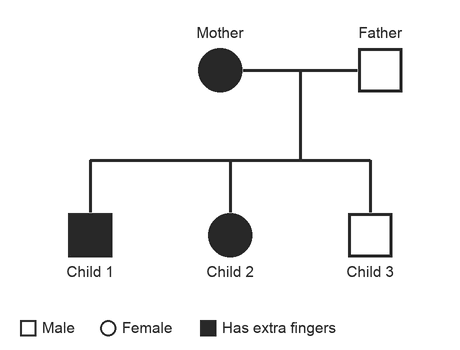
Which statement about this family is correct ?
- 251 mark
Question 25
Cognitive domain: Understanding
Read the three situations.
P. A young couple, in whose families some members have thalassaemia, meet a specialist who explains the chance that their children will inherit the disease.
Q. A gene of a mammal that makes a hormone is introduced into the chromosome of a bacterium, and the bacteria are grown in large tanks to obtain the hormone.
R. A farmer keeps the seeds of his best-yielding wheat plants and sows them in the next season.
Genetic counselling and genetic engineering are two modern applications of genetics. Which option names correctly what each situation shows ?
- 261 mark
Question 26
Cognitive domain: Understanding
Mendel's law of segregation says that the two alleles of a pair separate from each other when gametes are formed, so each gamete carries only one of them. Which observation in a monohybrid cross gives the best direct evidence for this law ?
- 271 mark
Question 27
Cognitive domain: Application
A man and his wife are both heterozygous tongue rollers (Rr). Rolling (R) is dominant over non-rolling (r). They plan to have a child. What is the chance that their first child is a girl who cannot roll her tongue ?
- 282 marks
Question 28
Cognitive domain: Evaluation
A student says, "Mendel did not need garden pea. He could have studied inheritance using a mango tree or a cat." The table compares the three organisms. (Approximate, simplified data.)
Organism Time for one generation Offspring from one cross Pure-breeding varieties for a trait Garden pea A few months Many seeds Many available Mango tree Several years Few fruits with a seed each Hard to obtain Cat About a year or more A few kittens in a litter Hard to obtain Evaluate the student's statement. Give two reasons from the table why garden pea was a better choice.
- 292 marks
Question 29
Cognitive domain: Evaluation
A magazine article says, "Haemophilia is passed from a father to his sons, which is why only boys of a haemophilic man's family suffer from it." (h is the allele for haemophilia, which lies on the X chromosome.)
Evaluate this statement for a haemophilic man () who marries a woman with normal blood clotting who is not a carrier (XX).
- 302 marks
Question 30
Cognitive domain: Evaluation
An advertisement says: "Use this skin-lightening cream every day for a year and your genes will change, so your children will also be born fair-skinned."
Evaluate the claim. State what heredity needs for a character to pass on to the children.
- 312 marks
Question 31
Cognitive domain: Understanding
Each body cell of a certain animal has chromosomes.
(a) How many chromosomes does one sperm of this animal contain ?
(b) Suppose the sperm and the egg each contained chromosomes. State what the zygote would have, and say why the number of chromosomes in this species does not keep on increasing in this way.
- 322 marks
Question 32
Cognitive domain: Analysis
Ravi says, "The allele Y for yellow seeds and the allele R for round seeds are alleles of each other, because both are dominant."
Is Ravi right ? Explain what alleles are, and name the allele of Y.
- 333 marks
Question 33
Cognitive domain: Analysis
In a field of white-flowered plants of one species, a farmer found a single plant with pink flowers. He collected its seeds and sowed them in the same field, among the white-flowered plants. The plants raised from these seeds also bore pink flowers. (Hypothetical data.)
(a) Name the kind of change in the plant that probably caused the pink colour.
(b) Explain why sowing the seeds in the same field helps to show that the pink colour is not due to the soil.
(c) Would the pink colour pass to the next generation if the change had taken place only in a cell of one leaf ? Give a reason.
- 343 marks
Question 34
Cognitive domain: Analysis
Dev is a boy and he has an elder sister, Meera. Their parents are Mr. and Mrs. Iyer. The children want to find out which of their grandparents their sex chromosomes came from.
(a) From which parent did Dev get his Y chromosome, and from which grandparent did that parent get it ?
(b) Dev's X chromosome came from his mother. Can it have come from Mrs. Iyer's father ? Can it have come from Mrs. Iyer's mother ? Explain.
(c) Can the X chromosome that Meera got from her father have come from her paternal grandfather ? Give a reason.
- 353 marks
Question 35
Cognitive domain: Analysis
The figure is a schematic picture of the chromosomes of one body cell of a fruit fly, arranged in pairs by size and shape. In the fruit fly, as in human beings, a male has one X and one Y chromosome, and a female has two X chromosomes.
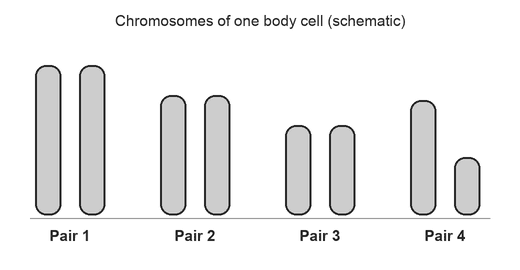
(a) State the number of autosomes and the number of sex chromosomes in this cell.
(b) Is this fly a male or a female ? Give a reason.
(c) State the number of chromosomes in a sperm or an egg of this fly.
- 363 marks
Question 36
Cognitive domain: Creativity
In the garden pea, axial flowers (A) are dominant over terminal flowers (a). A pure axial plant was crossed with a pure terminal plant, and the plants were self-pollinated. The generation had plants with axial flowers and plants with terminal flowers.
Plan a simple investigation, using only breeding and counting, to find out which of the axial-flowered plants are pure (AA) and which are hybrid (Aa). Say what you would do and what result you would expect for each kind.
- 373 marks
Question 37
Cognitive domain: Application
The figure shows a pair of homologous chromosomes in a cell of a plant. Three genes are marked at positions 1, 2 and 3, with their alleles. P is the allele for purple flowers, p for white flowers, L for long leaves and s for small fruit. (Schematic, hypothetical plant.)

(a) Name the gene whose alleles are different and the genes whose alleles are alike. Which word is used for each case ?
(b) Write the genotype of this plant for the three genes.
(c) State how many different kinds of gametes this plant can form for these three genes, and write them.
- 385 marks
Question 38
Cognitive domain: Analysis
Case: A genetic counsellor collected the records of four families about red-green colour blindness. (Hypothetical data.) Let be the allele for colour blindness, which is recessive and lies on the X chromosome.
Family Father Mother Children 1 Colour-blind Colour-blind Two daughters and one son, all colour-blind 2 Normal vision Normal vision, but her father was colour-blind One colour-blind son and two children with normal vision 3 Colour-blind Carrier with normal vision One colour-blind daughter, one colour-blind son and one daughter with normal vision 4 Normal vision Normal vision One colour-blind daughter (a) One of the four family records cannot be correct. Name it and give the reason.
(b) For Family 1, write the genotypes of the father, the mother, the daughters and the son.
(c) For Family 3, draw a Punnett square and state what fraction of the children is expected to be colour-blind.
- 395 marks
Question 39
Cognitive domain: Analysis
Case: A breeder wants a new pea variety that always gives green seeds and inflated pods. He crossed a pure plant with yellow seeds and inflated pods (YYII) with a pure plant with green seeds and constricted pods (yyii). All the plants had yellow seeds and inflated pods. The plants were self-pollinated, and the plants of the generation were sorted. (Hypothetical data.)
class Number of plants Yellow seeds, inflated pods Yellow seeds, constricted pods Green seeds, inflated pods Green seeds, constricted pods (a) Which class in the table contains the plants the breeder wants ? Name the law of Mendel that allows this class to appear, although neither parent had this combination.
(b) The breeder kept all plants of that class. Write the two genotypes found among them, and estimate how many of the plants will breed true for green seeds and inflated pods.
(c) Out of all plants, how many are expected to breed true for both characters ? Name their genotypes.
- 404 marks
Question 40
Cognitive domain: Analysis
Case: The table gives the number of chromosomes in a body cell of some organisms.
Organism Chromosomes in a body cell Fruit fly Garden pea Rice Human being Chimpanzee Horse (a) For the garden pea, rice and the horse, find the number of pairs of chromosomes and the number of chromosomes in one egg.
(b) Use two examples from the table to show that the number of chromosomes does not tell us how highly developed an organism is.
(c) A human body cell has only pairs of chromosomes, yet human beings have about genes. Explain how so few chromosomes can carry so many genes. How many copies of a gene that lies on an autosome are present in a body cell, and how many in an egg ?