
Opening your dashboard
Class 10 Biology Chapter 3 Genetics – Some Basic Fundamentals: Practice Questions
41 questions on Chapter 3, each worked through on its own page with the AI tutor. Class 10 Biology, ICSE 2026-27.
41 questions
1–5 marks · Mixed difficulty
- 11 mark
Question 1
Bloom's level: Remember
The sex-linked diseases included in the scope of this chapter are :
- 21 mark
Question 2
Bloom's level: Remember
The first product obtained by genetic engineering, using bacteria into which a mammalian gene had been introduced, was the hormone :
- 31 mark
Question 3
Bloom's level: Remember
A chart in which photographs of the chromosomes of a dividing cell are arranged in pairs according to their size and shape is called a :
- 41 mark
Question 4
Bloom's level: Understand
Which of the following statements about human chromosomes is correct?
- 51 mark
Question 5
Bloom's level: Apply
Dimpled cheeks (D) are dominant over normal cheeks (d). A man homozygous for dimpled cheeks marries a woman with normal cheeks. Their children will be :
- 61 mark
Question 6
Bloom's level: Apply
In garden pea, green pod (G) is dominant over yellow pod (g). Hybrid (Gg) plants are self-pollinated and 400 plants are raised. The expected number of plants with yellow pods is :
- 71 mark
Question 7
Bloom's level: Understand
Which observation best shows variation rather than "like begets like"?
- 81 mark
Question 8
Bloom's level: Analyse
Free ear lobe (F) is dominant over attached ear lobe (f). A woman with attached ear lobes and a man with free ear lobes have four children: two with free and two with attached ear lobes. The father's genotype must be :
- 91 mark
Question 9
Bloom's level: Apply
Predict the children of a mother whose genotype is and a father whose genotype is XY (c = allele for colour blindness).
- 101 mark
Question 10
Bloom's level: Understand
Assertion (A): The sex of a child is decided by the kind of sperm that fertilises the egg.
Reason (R): Every egg carries one X chromosome, while half the sperms carry X and half carry Y.
- 111 mark
Question 11
Bloom's level: Evaluate
Assertion (A): In Mendel's dihybrid cross, round-green and wrinkled-yellow seeds appeared in the generation, although neither parent had these combinations.
Reason (R): According to the law of segregation, the two alleles of a gene blend together in the hybrid.
- 121 mark
Question 12
Bloom's level: Analyse
Assertion (A): In the generation of a monohybrid cross, the genotypic ratio (1 : 2 : 1) is different from the phenotypic ratio (3 : 1).
Reason (R): Homozygous dominant and heterozygous individuals show the same phenotype.
- 131 mark
Question 13
Bloom's level: Remember
Name one rather uncommon hereditary trait in humans that is dominant and one that is recessive.
- 142 marks
Question 14
Bloom's level: Understand
Explain the statement "Like begets like, and yet there are variations" with one example of each part.
- 152 marks
Question 15
Bloom's level: Understand
Explain why the chromosomes in a body cell occur in pairs. What are such pairs called?
- 162 marks
Question 16
Bloom's level: Apply
A couple already has two daughters. (a) What is the chance that their third child will be a son? (b) For a couple planning three children, what is the chance that all three will be daughters?
- 172 marks
Question 17
Bloom's level: Apply
In pea, green pod (G) is dominant over yellow pod (g), and axial flower (A) is dominant over terminal flower (a). A pure green-podded, axial-flowered plant is crossed with a yellow-podded, terminal-flowered plant, and the plants are self-pollinated. Out of 1600 plants, how many are expected in each phenotypic class?
- 182 marks
Question 18
Bloom's level: Understand
Rh-positive (R) is dominant over Rh-negative (r). Explain, with genotypes, how two people can have the same phenotype but different genotypes.
- 192 marks
Question 19
Bloom's level: Analyse
Polydactyly (extra fingers) is a dominant trait. Both parents in a family have the normal five fingers. Analyse whether they can have a child with polydactyly, giving their genotypes.
- 202 marks
Question 20
Bloom's level: Evaluate
Kabir says, "Colour blindness is a disease of men only; a woman can never be colour-blind." Is he right? Justify your answer with genotypes.
- 212 marks
Question 21
Bloom's level: Apply
The body cells of a dog contain 78 chromosomes, with sex determined by X and Y chromosomes as in humans. Work out (a) the number of pairs of autosomes in a body cell, and (b) the chromosomes present in a sperm of the dog.
- 222 marks
Question 22
Bloom's level: Understand
When a baby is born, relatives often argue about whether it looks more like the father or the mother. Explain why a child usually resembles both parents in some ways but is an exact copy of neither.
- 234 marks
Question 23
Bloom's level: Apply
Case: Mr and Mrs Rao both have normal blood clotting. Their son Arjun bleeds for a very long time even from a small cut, and the doctor tells them he has haemophilia.
(a) Which parent passed the haemophilia allele to Arjun? Give the genotypes of both parents.
(b) Draw a Punnett square for the parents and find the chance that their next son will be haemophilic.
(c) Can their daughter be haemophilic? Can she be a carrier? Explain.
- 244 marks
Question 24
Bloom's level: Apply
Case: Meena is Rh-negative and her husband Raj is Rh-positive. Their first child, Tara, is Rh-negative. (Rh-positive, R, is dominant over Rh-negative, r.)
(a) Write the genotypes of Meena, Raj and Tara. Explain how you decided Raj's genotype.
(b) Draw a Punnett square for the cross between Meena and Raj.
(c) What is the chance that their next child will be Rh-positive?
- 254 marks
Question 25
Bloom's level: Analyse
In his monohybrid crosses, Mendel counted the offspring. Some of his counts were :
Character Dominant form Recessive form Seed colour 6022 yellow 2001 green Seed shape 5474 round 1850 wrinkled Flower position 651 axial 207 terminal (a) For each character, divide the dominant count by the recessive count (give the answer to two decimal places).
(b) What simple ratio do all three results approach? Which form of each character is dominant?
(c) Why are the results not exactly in this ratio, and why did Mendel study such large numbers?
- 264 marks
Question 26
Bloom's level: Analyse
A pure pea plant with yellow seeds and axial flowers was crossed with a plant with green seeds and terminal flowers. All plants had yellow seeds and axial flowers. The plants were self-pollinated, and the plants were :
Yellow, axial Yellow, terminal Green, axial Green, terminal 272 88 92 28 (a) Which traits are dominant? Give a reason.
(b) Find the total, and show that the result is close to the ratio 9 : 3 : 3 : 1.
(c) Which of Mendel's laws is shown by the appearance of yellow-terminal and green-axial plants? Explain.
- 274 marks
Question 27
Bloom's level: Evaluate
To show a cross between two heterozygous tongue rollers (Rr × Rr), a student wrote :
- Gametes of each parent: Rr and Rr
- Offspring: RR, Rr, Rr, rr
- "Genotypic ratio = 3 : 1 and phenotypic ratio = 1 : 2 : 1"
(a) Find the mistake in the student's gametes. Which law of Mendel did the student ignore?
(b) Correct the two ratios.
(c) Draw the correct Punnett square.
- 285 marks
Question 28
Bloom's level: Create
Plan a class project to study how a human character – free or attached ear lobes – is passed on in families.
(a) Write the steps of your survey, including how you will collect the information from classmates' families.
(b) Design a recording table for your data, and show the symbols you will use to draw pedigree charts.
(c) Frame two questions that your completed charts could help you answer, and say what result would answer each.
- 295 marks
Question 29
Bloom's level: Create
Construct a three-generation pedigree chart to show how colour blindness can "skip" a generation : a colour-blind grandfather, his daughter with normal vision, and her colour-blind son.
(a) Draw the chart (as a description or a sketch) using the standard symbols, and write the genotype beside each person. Include the grandmother and the daughter's husband, both with normal vision and not carriers.
(b) Explain, generation by generation, how the allele travels from the grandfather to the grandson.
(c) Explain why this pattern is called criss-cross inheritance.
- 303 marks
Question 30
Bloom's level: Apply
A heterozygous tall pea plant (Tt) is crossed with a dwarf pea plant (tt).
(a) Write the gametes formed by each parent.
(b) Draw a Punnett square for the cross.
(c) Give the genotypic and phenotypic ratios of the offspring.
- 311 mark
Question 31
In humans, brown eye colour (B) is dominant over blue eye colour (b). A brown-eyed man and his brown-eyed wife have a blue-eyed child. The genotypes of the two parents are :
- 321 mark
Question 32
Which one of the following is a dominant trait of the garden pea studied by Mendel ?
- 331 mark
Question 33
Assertion (A): Haemophilia is far more common in men than in women.
Reason (R): Haemophilia is caused by a recessive gene located on the X chromosome, and a man has only one X chromosome.
- 342 marks
Question 34
Each body cell of a human being has 46 chromosomes.
(i) How many of these 46 are autosomes, and how many are sex chromosomes ? What kind of features do the autosomes determine ?
(ii) Write the sex chromosomes of a woman and of a man. In which of the two are the partners dissimilar, and how do these partners differ in size ?
- 352 marks
Question 35
The chart shows how the sex of a child is determined in humans. Four of the circles have been left blank and numbered 1 to 4.

(i) Write the sex chromosome or chromosomes that should appear in each of the circles 1, 2, 3 and 4.
(ii) Which of the two children, 3 or 4, is a son ? Whose sex cell — the father's or the mother's — decides the sex of the child ? Give a reason.
- 362 marks
Question 36
In the garden pea, the gene for the height of the plant has two alleles — T for tall and t for dwarf.
(i) Where exactly are the two alleles of this gene located in a cell of the plant ?
(ii) A pea plant has the alleles T and t together. Which of the two will express itself ? What is the other allele called, and in which condition can it express itself ?
- 372 marks
Question 37
(i) What is a karyotype ? Why can the photographs needed for it be taken only when the nucleus of a cell is about to divide ?
(ii) Each body cell of an onion plant has 16 chromosomes. How many homologous pairs do they form ? From where does the plant get the two chromosomes of each pair ?
- 384 marks
Question 38
In the garden pea, yellow seed colour (Y) is dominant over green seed colour (y). A pure-breeding plant with yellow seeds was crossed with a pure-breeding plant with green seeds. The plants were then self-pollinated.
(i) Write the genotypes of the two parent plants, and the genotype and the phenotype of the generation.
(ii) Draw a Punnett square for the self-pollination of the plants. From it, write the phenotypic ratio and the genotypic ratio of the generation.
(iii) 320 seeds were collected in the generation. How many of them are expected to be green ? How many are expected to be yellow seeds that will breed true ?
- 393 marks
Question 39
The pedigree chart shows the inheritance of the shape of the ear lobes in a family. The four children are numbered 1 to 4.
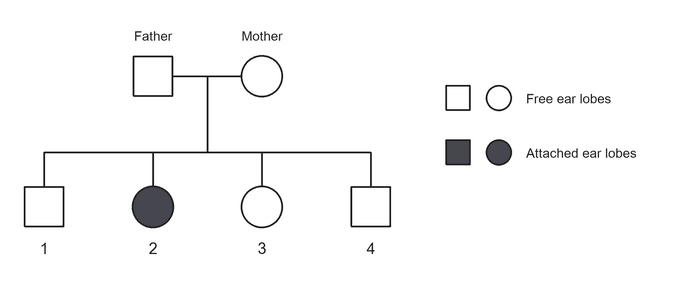
(i) Which sex is shown by the squares and which by the circles ? How many daughters does this couple have ?
(ii) Which of the two traits — free ear lobes or attached ear lobes — is recessive ? Give a reason from the chart.
(iii) Using F for the dominant allele and f for the recessive allele, write the genotypes of the father, the mother and child 2. What are the possible genotypes of child 1 ?
- 404 marks
Question 40
In the garden pea, tall plant (T) is dominant over dwarf plant (t), and yellow seed (Y) is dominant over green seed (y). A pea plant has the genotype TtYy.
(i) Write the phenotype of this plant and all the kinds of gametes it can produce.
(ii) Name and state the law of Mendel that accounts for the formation of these kinds of gametes.
(iii) When this plant was self-pollinated, 480 offspring were obtained. Write the phenotypes of the offspring with their ratio, and calculate the expected number of offspring of each phenotype.
- 415 marks
Question 41
Class 10 Sample Paper 2 · Section B
In pea plants, the axial position of flowers (A) is dominant over the terminal position (a). Answer the following questions.
(i) Mention the phenotype and the genotype of the generation if a plant bearing pure axial flowers is crossed with a plant bearing pure terminal flowers.
(ii) Draw a Punnett square to show the gametes and the offspring when both the parent plants are heterozygous for axial flowers.
(iii) State Mendel's law of dominance.