Answer: (B) (2) A is False and R is True
Concept: In an assertion–reason item, judge the Assertion (A) and the Reason (R) separately as true or false; only when both are true do we ask whether R correctly explains A.
Step 1 — Judge the Assertion.
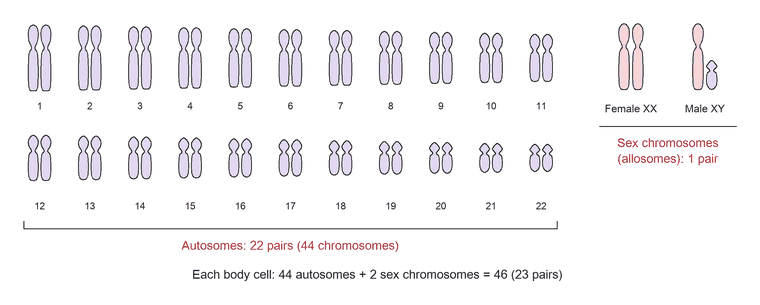
A is false. A karyotype is a chart of the chromosomes of a cell, photographed in a dividing nucleus and arranged in pairs by size and shape. The division of the nucleus itself is karyokinesis.
Step 2 — Judge the Reason.
R is true. Karyon means nucleus, and 'type' refers to the number, shape and size of the chromosomes; the human karyotype shows 23 pairs.
Step 3 — Decide the option.
A is false and R is true, so the matching option is (B) (2).
Watch out: KaryoTYPE is a chart of chromosomes; karyoKINESIS is division of the nucleus.
Why the other options are wrong:
- (A) (1) A is True and R is False: it has the statements the wrong way round: A is false and R is true.
- (C) (3) Both A and R are True: it says A is true, but a karyotype is a chart, not a division.
- (D) (4) Both A and R are False: it says R is false, but R gives the correct meaning of the word.
Therefore, the answer is (B): A is false and R is true.
