
Opening your dashboard
Class 12 Physics Chapter 8 Torque on a Current-Carrying Loop - Moving Coil Galvanometer: Previous Year Questions
10 questions on Chapter 8, each solved step by step. Class 12 Physics, ICSE 2026-27.
10 questions with solutions
1–3 marks · Mixed difficulty
- 11 mark
Question 1
State how a moving coil galvanometer can be converted into an ammeter.
Solve with AIWritten solution
Solution:
Key idea: An ammeter must measure a large current and must have a very low resistance, because it is joined in series in a circuit. A galvanometer alone can carry only a small current for full-scale deflection.
Step 1 — Connect a shunt.
We connect a suitable low resistance , called a shunt, in parallel with the galvanometer coil of resistance . Most of the current then passes through the shunt, and only passes through the coil.

Step 2 — Choose the value of the shunt.
The galvanometer and the shunt are in parallel, so the potential difference across them is the same.
Here is the required range of the ammeter. The scale is then marked to read the total current .
Therefore, a moving coil galvanometer is converted into an ammeter by connecting a low resistance (shunt) in parallel with it.
- 22 marks
Question 2
A moving coil galvanometer has a coil of resistance . It shows a full scale deflection for a current of . How will you convert it to an ammeter having a range of to ?
Solve with AIWritten solution
Solution:
Key idea: A galvanometer gives full-scale deflection for a small current . To make it an ammeter of range , a low resistance , called a shunt, is connected in parallel with its coil. The shunt carries the extra current , and because and are in parallel they have the same potential difference across them.
Step 1 — Write the data in S.I. units.
The coil resistance is .
The full-scale current is , so in amperes .
The required range is .
Step 2 — Find the current through the shunt.
The shunt carries the rest of the current.
Step 3 — Equate the voltages and find .
The voltage across equals the voltage across , so .

Therefore, a shunt of should be connected in parallel with the galvanometer to make an ammeter of range to .
- 31 mark
Question 3
How will you convert a moving coil galvanometer into a voltmeter?
Solve with AIWritten solution
Solution:
Key idea: A voltmeter is connected in parallel across the points whose potential difference it measures, so it must have a very high resistance and must draw only a tiny current.
Step 1 — Connect a high resistance in series.
We connect a suitable high resistance in series with the galvanometer of coil resistance .

Step 2 — Choose the value of .
For a range of to , the full-scale current must flow when the voltage across the whole combination is .
The scale is then marked in volts.
Therefore, a moving coil galvanometer is converted into a voltmeter by connecting a high resistance in series with it.
- 41 mark
Question 4
Why are the pole pieces of a horseshoe magnet in moving coil galvanometer made cylindrical in shape?
Solve with AIWritten solution
Solution:
Key idea: The deflecting torque on the coil is , where is the angle between the normal to the coil and the field. For the deflection to be proportional to the current, must stay equal to 1 in every position of the coil.
Step 1 — Say what the cylindrical shape does.
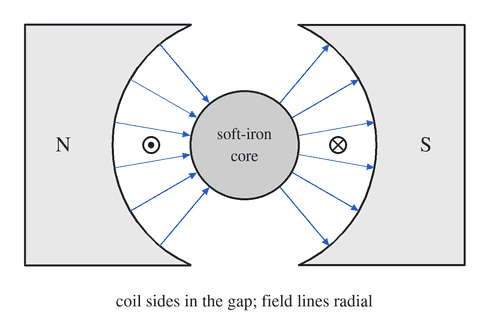
The pole pieces are made concave (cylindrical), and a soft-iron cylinder is placed at the centre between them. This makes the magnetic field in the gap radial: the field lines point along radii, towards or away from the axis of the coil.
Step 2 — Explain why this is needed.
In a radial field the plane of the coil always lies along the field lines, whatever the deflection. So the normal to the coil is always perpendicular to the field, , and the torque is always . Balancing it against the spring's restoring torque gives a deflection , which is proportional to the current.
Therefore, the pole pieces are made cylindrical (concave) to produce a radial magnetic field, so that the torque on the coil is always and the galvanometer has a linear (evenly spaced) scale.
- 52 marks
Question 5
A rectangular loop of area , has 50 turns and carries a current of 1A. It is held in a uniform magnetic field of 0.1T, at an angle of . Calculate the torque experienced by the coil.
Solve with AIWritten solution
Solution:
Key idea: A coil of turns, area , carrying current in a uniform field has a magnetic moment along its normal.
The torque on it is , where is the angle between the normal to the coil (its magnetic moment) and the field.
Step 1 — Write the data.
The data are , , and .
Step 2 — Find the angle between the normal and the field.
The loop itself is held at to the field, so we take as the angle between the plane of the coil and the field. The normal is perpendicular to the plane, so the angle between the normal and the field is the complement of .
Step 3 — Find the maximum torque .
We multiply the four quantities.
Step 4 — Multiply by .
With , , which is about .
The torque tends to turn the coil so that its normal lines up with the field.
Note: The paper does not say whether is measured from the plane of the coil or from its normal. If it is the angle between the field and the normal, then , and .
Therefore, taking between the plane of the coil and the field, the torque experienced by the coil is (it would be if the were measured from the normal).
- 61 mark
Question 6
How can a moving coil galvanometer be converted into a voltmeter?
Solve with AIWritten solution
Solution:
Key idea: A voltmeter is joined in parallel across the part of a circuit being tested, so it must have a very high resistance and take only a very small current. A galvanometer gives full-scale deflection for a small current .
Step 1 — Connect a high resistance in series.
We connect a high resistance in series with the galvanometer, whose coil resistance is .
Step 2 — Choose for the required range.
For a range of to , the current through the combination must be when the voltage across it is .
The scale is then marked directly in volts.
Therefore, a galvanometer is converted into a voltmeter by connecting a high resistance in series with it.
- 72 marks
Question 7
A moving coil galvanometer of resistance produces a full scale deflection for a current of . How will you convert it into an ammeter having a range of ?
Solve with AIWritten solution
Solution:
Key idea: A galvanometer gives full-scale deflection for a small current . To make it an ammeter of range , a low resistance , called a shunt, is connected in parallel with its coil. The shunt carries the extra current , and because and are in parallel they have the same potential difference across them.
Step 1 — Write the data in S.I. units.
The coil resistance is .
The full-scale current is , so in amperes .
The required range is .
Step 2 — Find the current through the shunt.
The shunt must carry the rest of the current.
Step 3 — Equate the voltages and find .
Since and are in parallel, .

Therefore, a shunt of should be connected in parallel with the galvanometer to convert it into an ammeter of range –.
- 81 mark
Question 8
Assertion: When an electric current is passed through a moving coil galvanometer, its coil gets deflected.
Reason: A circular coil produces a uniform magnetic field around itself when an electric current is passed through it.
Solve with AIAnswer
(A) Both Assertion and Reason are true and Reason is the correct explanation for Assertion.
(B) Both Assertion and Reason are true but Reason is not the correct explanation for Assertion.
- Correct
(C) Assertion is true and Reason is false.
(D) Assertion is false and Reason is true.
Answer: (C) Assertion is true and Reason is false.
Key idea: A current-carrying coil placed in a magnetic field feels a torque . In a galvanometer the field comes from the permanent magnet, not from the coil itself.
Step 1 — Judge the Assertion.
When a current passes through the coil of a moving coil galvanometer, the coil lies in the radial field of the permanent magnet and feels a torque . It turns until the spring's restoring torque balances this torque. So the coil is deflected, and the Assertion is true.
Step 2 — Judge the Reason.
The field produced by a circular current-carrying coil is not uniform around it: it is strongest near the wire, has a particular value at the centre, and becomes weaker with distance along the axis. So the Reason is false.
Step 3 — Decide the option.
The Assertion is true and the Reason is false. The deflection is caused by the magnet's field acting on the current in the coil, not by the coil's own field.
Why the others are wrong:
- (A) The Reason is false, so it cannot be true or explain the Assertion.
- (B) This needs the Reason to be true, but a coil's own field is not uniform.
- (D) The Assertion is true; the coil does deflect when current passes.
Therefore, the correct option is (C): the Assertion is true and the Reason is false.
- 93 marks
Question 9
A galvanometer having a resistance of shows a full scale deflection with a current of . How can it be converted into a voltmeter with a range of –?
Solve with AIWritten solution
Solution:
Key idea: To make a voltmeter of range to , a high resistance is joined in series with the galvanometer so that the full-scale current flows when the voltage across the combination is :
Step 1 — Write the data in S.I. units.
The galvanometer resistance is .
The full-scale current is , so in amperes .
The required range is .
Step 2 — Find the total resistance needed.
The whole combination must pass when is applied.
Step 3 — Subtract the galvanometer's own resistance.
The series resistance makes up the rest.
Step 4 — Describe the connection.
A resistance of is connected in series with the galvanometer, and the scale is marked from to .
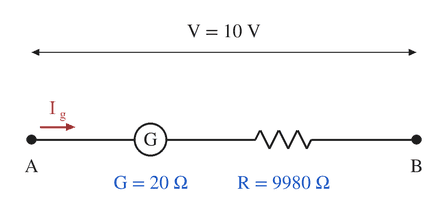
Therefore, the galvanometer is converted into a – voltmeter by connecting a resistance of in series with it.
- 103 marks
Question 10
(a) Two moving coil galvanometers and are identical except for the following features:
Features Number of turns 50 60 Area of the coil Resistance of the coil Perform calculations to determine which galvanometer has greater current sensitivity.
(b) In a moving coil galvanometer, how is magnetic field made radial?
Solve with AIWritten solution
Solution:
Key idea: The current sensitivity of a moving coil galvanometer is the deflection per unit current, , where is the number of turns, the area of the coil, the magnetic field and the torsion constant of the spring. It does not depend on the coil's resistance.
Step 1 — Note what is the same (part a).
The galvanometers are identical except for the features in the table, so and are the same for both. The current sensitivity is therefore proportional to the product .
Step 2 — Work out for each (part a).
For we multiply 50 turns by .
For we multiply 60 turns by .
Step 3 — Compare (part a).
We take the ratio of the two sensitivities.
So is 1.6 times as sensitive to current. The resistances ( and ) do not enter the current sensitivity; they matter only for the voltage sensitivity .
Step 4 — Explain how the field is made radial (part b).
The pole pieces of the permanent magnet are made concave (cylindrical), and a soft-iron cylinder is placed at the centre, inside the coil, coaxial with the pole faces. The soft iron concentrates the field lines, and between the curved faces and the cylinder they run along radii. So the plane of the coil always lies along the field, and the torque is always .
Therefore, (a) has the greater current sensitivity (1.6 times that of ), and (b) the field is made radial by using concave (cylindrical) pole pieces with a soft-iron cylinder at the centre of the coil.