
Question 93 marksAsked 2025Medium
A galvanometer having a resistance of shows a full scale deflection with a current of . How can it be converted into a voltmeter with a range of –?
Confirming your payment
Sign up now and get 250 free tokens.
Previous Year Questions · Question 9 of 10
A galvanometer having a resistance of shows a full scale deflection with a current of . How can it be converted into a voltmeter with a range of –?
Solution:
Key idea: To make a voltmeter of range to , a high resistance is joined in series with the galvanometer so that the full-scale current flows when the voltage across the combination is :
Step 1 — Write the data in S.I. units.
The galvanometer resistance is .
The full-scale current is , so in amperes .
The required range is .
Step 2 — Find the total resistance needed.
The whole combination must pass when is applied.
Step 3 — Subtract the galvanometer's own resistance.
The series resistance makes up the rest.
Step 4 — Describe the connection.
A resistance of is connected in series with the galvanometer, and the scale is marked from to .
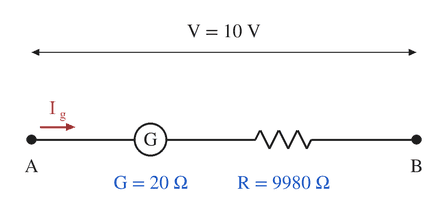
Therefore, the galvanometer is converted into a – voltmeter by connecting a resistance of in series with it.