Solution:
Key idea: The current sensitivity of a moving coil galvanometer is the deflection per unit current, Iϕ=kNAB, where N is the number of turns, A the area of the coil, B the magnetic field and k the torsion constant of the spring. It does not depend on the coil's resistance.
Step 1 — Note what is the same (part a).
The galvanometers are identical except for the features in the table, so B and k are the same for both. The current sensitivity is therefore proportional to the product NA.
Step 2 — Work out NA for each (part a).
For G1 we multiply 50 turns by 30 cm2.
N1A1=50×30
N1A1=1500 cm2
For G2 we multiply 60 turns by 40 cm2.
N2A2=60×40
N2A2=2400 cm2
Step 3 — Compare (part a).
We take the ratio of the two sensitivities.
S1S2=15002400
S1S2=1.6
So G2 is 1.6 times as sensitive to current. The resistances (4 Ω and 6 Ω) do not enter the current sensitivity; they matter only for the voltage sensitivity kRNAB.
Step 4 — Explain how the field is made radial (part b).
The pole pieces of the permanent magnet are made concave (cylindrical), and a soft-iron cylinder is placed at the centre, inside the coil, coaxial with the pole faces. The soft iron concentrates the field lines, and between the curved faces and the cylinder they run along radii. So the plane of the coil always lies along the field, and the torque is always NIAB.
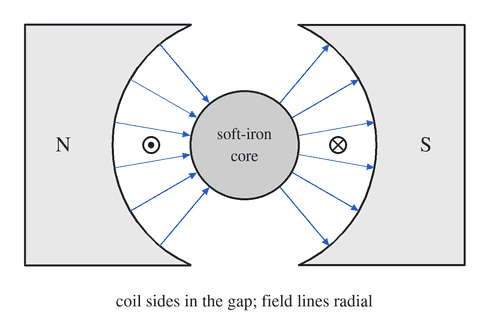
Therefore, (a) G2 has the greater current sensitivity (1.6 times that of G1), and (b) the field is made radial by using concave (cylindrical) pole pieces with a soft-iron cylinder at the centre of the coil.
