
Opening your dashboard
Class 12 Maths Chapter 26 Past Paper Questions — Beyond Current Syllabus: Previous Year Questions
36 questions on Chapter 26, each solved step by step. Class 12 Maths, ICSE 2026-27.
36 questions with solutions
2–5 marks · Mixed difficulty
The first 8 solutions are on this page. This chapter is a long one, so the rest open on their own page to keep this one quick to load.
- 13 marks
Question 1
Find the equation of an ellipse whose latus rectum is 8 and eccentricity is .
Solve with AIWritten solution
Solution:
This past paper question is beyond the current ISC syllabus; it is included for extra practice.
Key idea: For the ellipse with , the length of the latus rectum is , and the eccentricity is linked to and by .
Step 1 — Choose the standard form.
The question gives no position for the ellipse, so we take its centre at the origin and its major axis along the -axis. Here is the semi-major axis and is the semi-minor axis.
Step 2 — Use the length of the latus rectum.
The latus rectum is 8 units long, so we set equal to 8.
Step 3 — Use the eccentricity.
We put the given value of into the relation .
Step 4 — Find .
Both results are equal to , so we equate them. Since , we may divide both sides by .
Step 5 — Find and .
Now we square , and we use from Step 2.
Step 6 — Write the equation.
We put and into the standard form and clear the fraction in the first denominator.
Check: The latus rectum is , which gives 8 as required.
Note: If the major axis is taken along the -axis instead, the same working gives .
Therefore, the equation of the ellipse is .
- 23 marks
Question 2
Using L'Hospital's rule, evaluate:
Solve with AIWritten solution
Solution:
This past paper question is beyond the current ISC syllabus; it is included for extra practice.
Key idea: L'Hospital's rule says that if takes the form as , then , provided the second limit exists. We may use the rule again as long as the new fraction is still of the form .
Step 1 — Check the form of the limit.
When we put , the numerator becomes 0 and the denominator also becomes 0. So the limit has the form , and the rule can be used.
Step 2 — Apply the rule once.
We differentiate the numerator and the denominator separately. The denominator is a product, so we use the product rule.
When we put , the new numerator and the new denominator both become 0, so the form is still .
Step 3 — Apply the rule a second time.
The derivative of is . The derivative of is , which we collect as .
At this is again .
Step 4 — Apply the rule a third time.
The derivative of is . The derivative of the denominator is , which we collect as .
Step 5 — Put .
Now the denominator is not zero at , so we substitute directly. We use and .
Watch out: Differentiate the numerator and the denominator separately. Do not use the quotient rule on the whole fraction.
Therefore, .
- 33 marks
Question 3
The two lines of regressions are and . Find the correlation co-efficient between and .
Solve with AIWritten solution
Solution:
This past paper question is beyond the current ISC syllabus; it is included for extra practice.
Key idea: We write the regression line of on as , and the regression line of on as .
The coefficient of correlation then satisfies , and , and all have the same sign. Because , the product of the two regression coefficients can never exceed 1; this tells us which line is which.
Step 1 — Try the first line as on .
Suppose is the line of on and is the line of on . We make the subject of the first and the subject of the second.
These give and .
Their product is , which is greater than 1. This is impossible, so this choice is wrong.
Step 2 — Take the lines the other way round.
Now let be the line of on and be the line of on .
So and .
Step 3 — Find .
We multiply the two regression coefficients.
This is less than 1, so this choice is the correct one.
Step 4 — Choose the sign of .
Taking the square root gives . Both regression coefficients are negative, and must have the same sign as them, so we take the negative root.
Therefore, the coefficient of correlation between and is .
- 43 marks
Question 4
If , and are the cube roots of unity, prove that
Solve with AIWritten solution
Solution:
This past paper question is beyond the current ISC syllabus; it is included for extra practice.
Key idea: If , and are the cube roots of unity, then and . Multiplying an expression by a power of moves each coefficient on to the next power, because returns to 1.
Step 1 — Multiply the denominator by .
We look for a power of that turns the denominator into the numerator. We try and multiply each term.
Step 2 — Reduce the powers of .
Since , we can reduce as follows.
We replace by 1 and by .
Rearranging, . So the numerator is exactly times the denominator.
Step 3 — Divide.
The fraction is given, so its denominator is not zero, and we may cancel it.
Therefore, , as required.
- 55 marks
Question 5
A, B and C represent switches in 'on' position and A', B' and C' represent them in 'off' position. Construct a switching circuit representing the polynomial ABC + AB'C + A'B'C. Using Boolean Algebra, prove that the given polynomial can be simplified to C(A + B'). Construct an equivalent switching circuit.
Solve with AIWritten solution
Solution:
This past paper question is beyond the current ISC syllabus; it is included for extra practice.
Key idea: In a switching circuit, a product such as means switches in series (all must be on), and a sum means branches in parallel (at least one branch must be on). The switch is on exactly when is off. We simplify with the laws , and the distributive law .
Step 1 — Construct the circuit for the given polynomial.
The polynomial has three terms, so the circuit has three branches in parallel. Each branch has the three switches of its term in series.
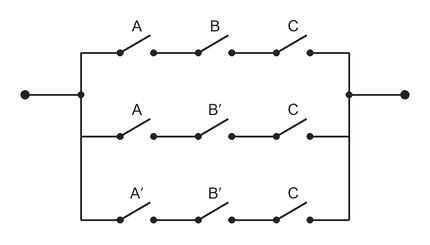
Step 2 — Combine the first two terms.
The first two terms share the factor , so we take it out. Then we use (complement law) and (identity law).
Step 3 — Take common from the whole polynomial.
We now add the third term and take out the common factor .
Step 4 — Simplify the bracket.
We use the distributive law .
Here is , is and is , and we also use .
Step 5 — Write the simplified polynomial.
We put the result of Step 4 back into Step 3.
This proves the required result.
Step 6 — Construct the equivalent circuit.
In , switch is in series with a pair of switches and that are in parallel with each other.

The new circuit does the same job with 3 switches instead of 9.
Therefore, , and the equivalent circuit is switch in series with switches and joined in parallel.
- 65 marks
Question 6
Verify Lagrange's Mean Value Theorem for the following function:
Solve with AIWritten solution
Solution:
This past paper question is beyond the current ISC syllabus; it is included for extra practice.
Key idea: Lagrange's Mean Value Theorem says: if is continuous on and differentiable on , then there is at least one in with . To verify it, we check both conditions and then find such a .
Step 1 — Check continuity on .
The functions and are continuous for every real . A sum of continuous functions is continuous, so is continuous on .
Step 2 — Check differentiability on .
We differentiate term by term. The derivative exists for every real , so is differentiable on .
Step 3 — Find the slope of the chord.
We work out at the two end points. The sine of each of , and is 0.
So the slope of the chord joining the end points is .
Step 4 — Solve .
We need equal to the slope of the chord. We divide by 2 and write to get a quadratic in .
So or .
Step 5 — Keep the value inside the open interval.
The value for gives , which is an end point and not inside , so we reject it. The value for gives , which lies in .
Check: For , the values of and are and , so the two terms of cancel to give 0.
Therefore, both conditions hold and satisfies the theorem, so Lagrange's Mean Value Theorem is verified.
- 75 marks
Question 7
Find the equation of the hyperbola whose foci are and passing through the point .
Solve with AIWritten solution
Solution:
This past paper question is beyond the current ISC syllabus; it is included for extra practice.
Key idea: A hyperbola with its foci on the -axis and its centre at the origin has the equation . Its foci are , where .
Step 1 — Choose the form of the equation.
The foci and lie on the -axis, and their mid-point is the origin. So the centre is the origin and the transverse axis is the -axis. We use .
Step 2 — Use the foci.
The distance from the centre to a focus is . Squaring and using gives the first equation.
Step 3 — Use the point .
The hyperbola passes through , so we put and into the equation.
Step 4 — Solve for .
Let . From Step 2, . We substitute and multiply both sides by .
Step 5 — Reject the impossible root.
If , then would be , which is negative. This is impossible because must be positive. So . We now find and .
Step 6 — Write the equation.
We put and into the form from Step 1 and multiply by 5.
Check: At we get , and puts the foci at .
Therefore, the equation of the hyperbola is .
- 85 marks
Question 8
Given that the observations are:
.
Find the two lines of regression and estimate the value of when .
Solve with AIWritten solution
Solution:
This past paper question is beyond the current ISC syllabus; it is included for extra practice.
Key idea: The regression line of on is , and the regression line of on is . With pairs of values, and . To estimate from a given , we use the line of on .
Step 1 — Make the table of sums.
There are pairs. We list , , , and for each pair and add each column.
9 −4 81 16 −36 10 −3 100 9 −30 11 −1 121 1 −11 12 0 144 0 0 13 1 169 1 13 14 3 196 9 42 15 5 225 25 75 16 8 256 64 128 Total: 100 9 1292 125 181 Step 2 — Find the means.
We divide each column total of and by .
Step 3 — Work out the three building blocks.
These three quantities appear in the formulas for and .
Step 4 — Find the regression coefficients.
We divide as the formulas say and simplify.
Step 5 — Write the line of on .
We put the means and into and multiply both sides by 84 to clear the fractions.
In decimal form, this line is .
Step 6 — Write the line of on .
We put the means and into and multiply both sides by 919.
In decimal form, this line is .
Step 7 — Estimate when .
We are estimating from a known , so we use the line of on from Step 5.
Watch out: Do not use the line of on to estimate . Each line is meant only for estimating the variable on its left-hand side.
Therefore, the line of on is , the line of on is , and the estimated value of when is about 2.76.
- 95 marks
Question 9
In a contest the competitors are awarded marks out of 20 by two judges. The scores of the 10 competitors are given below. Calculate Spearman's rank correlation.
Competitors A B C D E F G H I J Judge A 2 11 11 18 6 5 8 16 13 15 Judge B 6 11 16 9 14 20 4 3 13 17 - 105 marks
Question 10
If , and , find the locus of and illustrate it in the Argand Plane.
- 113 marks
Question 11
Prove that the line touches the conics . Also, find the point of contact.
- 123 marks
Question 12
Using L'Hospital's Rule, evaluate:
- 133 marks
Question 13
The two lines of regressions are and and the variance of is 12. Find the variance of and the coefficient of correlation.
- 143 marks
Question 14
Express in the form of . Find its modulus and argument.
- 155 marks
Question 15
Write the Boolean function corresponding to the switching circuit given below:
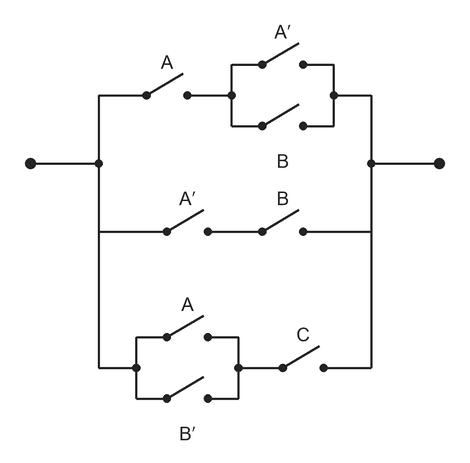
A, B and C represent switches in 'on' position and A', B' and C' represent them in 'off' position. Using Boolean algebra, simplify the function and construct an equivalent switching circuit.
- 165 marks
Question 16
Verify the conditions of Rolle's Theorem for the following function:
Find a point in the interval, where the tangent to the curve is parallel to -axis.
- 175 marks
Question 17
Find the equation of the standard ellipse, taking its axes as the coordinate axes, whose minor axis is equal to the distance between the foci and whose length of latus rectum is 10. Also, find its eccentricity.
- 185 marks
Question 18
Calculate Karl Pearson's coefficient of correlation between and for the following data and interpret the result:
- 195 marks
Question 19
The marks obtained by 10 candidates in English and Mathematics are given below:
Marks in English 20 13 18 21 11 12 17 14 19 15 Marks in Mathematics 17 12 23 25 14 8 19 21 22 19 Estimate the probable score for Mathematics if the marks obtained in English are 24.
- 205 marks
Question 20
Find the locus of a complex number, , satisfying the relation
Illustrate the locus of in the Argand plane.
- 213 marks
Question 21
If touches the conic , find the value of k.
- 223 marks
Question 22
Using L'Hospital's Rule, evaluate:
- 233 marks
Question 23
By using the data , ; and , find:
(a) The regression equation y on x.
(b) What is the most likely value of y when x = 60?
(c) What is the coefficient of correlation between x and y?
- 243 marks
Question 24
If prove that and
- 255 marks
Question 25
If A, B and C are the elements of Boolean algebra, simplify the expression (A' + B')(A + C') + B'(B + C). Draw the simplified circuit.
- 265 marks
Question 26
Verify Lagrange's mean value theorem for the function:
and find the value of 'c' in the interval
- 275 marks
Question 27
Find the coordinates of the centre, foci and equation of directrix of the hyperbola .
- 285 marks
Question 28
Calculate the Spearman's rank correlation coefficient for the following data and interpret the result:
X 35 54 80 95 73 73 35 91 83 81 Y 40 60 75 90 70 75 38 95 75 70 - 295 marks
Question 29
Find the line of best fit for the following data, treating x as the dependent variable (Regression equation x on y):
X 14 12 13 14 16 10 13 12 Y 14 23 17 24 18 25 23 24 Hence, estimate the value of x when y = 16.
- 305 marks
Question 30
Prove that locus of z is circle and find its centre and radius if is purely imaginary.
- 312 marks
Question 31
The binary operation is defined as Find .
- 324 marks
Question 32
Verify Rolle's theorem for the following function:
on
- 332 marks
Question 33
Using L'Hospital's Rule evaluate
- 342 marks
Question 34
Determine whether the binary operation on R defined by is commutative. Also find the value of
- 354 marks
Question 35
Verify Rolle's theorem for the function, in the interval
- 364 marks
Question 36
Using L'Hospital's rule, evaluate: