
Question 255 marksAsked 2017Medium
If A, B and C are the elements of Boolean algebra, simplify the expression (A' + B')(A + C') + B'(B + C). Draw the simplified circuit.
Confirming your payment
Sign up now and get 250 free tokens.
Previous Year Questions · Question 25 of 36
If A, B and C are the elements of Boolean algebra, simplify the expression (A' + B')(A + C') + B'(B + C). Draw the simplified circuit.
Solution:
This past paper question is beyond the current ISC syllabus; it is included for extra practice.
Concept: In Boolean algebra, means OR (switches in parallel) and a product means AND (switches in series). The laws we need are: distributive law ; complement laws and ; identity laws and ; and .
Step 1 — Expand the first product.
We multiply out term by term using the distributive law:
Step 2 — Remove the term .
By the complement law, , and adding changes nothing:
Step 3 — Simplify the second product.
We expand and use :
Step 4 — Add the two results.
The whole expression becomes
Step 5 — Combine the last two terms.
We take out of and use :
So the expression is now .
Step 6 — Absorb into .
We take out of and use :
So the simplified expression is
Step 7 — Check with a truth table.
The original expression and give the same value for all eight combinations of , and . For example, take and as and as ; then and are and is . The original expression gives
The simplified form gives
Step 8 — Draw the simplified circuit.
The term is a series pair of switches and . The sign joins this pair in parallel with a single switch . Current can pass from P to Q either through or through and together:
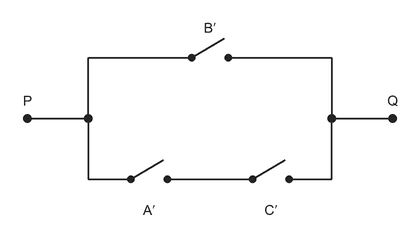
Therefore, , and the circuit is switch in parallel with switches and in series.