
Question 105 marksAsked 2015Medium
If , and , find the locus of and illustrate it in the Argand Plane.
Confirming your payment
Sign up now and get 250 free tokens.
Previous Year Questions · Question 10 of 36
If , and , find the locus of and illustrate it in the Argand Plane.
Solution:
This past paper question is beyond the current ISC syllabus; it is included for extra practice.
Key idea: For complex numbers, , and for real and . So means the numerator and the denominator of have equal moduli, which gives an equation in and .
Step 1 — Write the numerator in terms of and .
Since and , we first find and then .
Step 2 — Write the denominator in terms of and .
We double and subtract , collecting the real and imaginary parts.
Step 3 — Use .
The condition means that the numerator and the denominator of have equal moduli. The denominator must not be zero, so . We square both moduli and expand.
Step 4 — Recognise the curve.
We divide by 3 and complete the square in .
This is a circle with centre , which is the point , and radius .
Step 5 — Check the excluded point.
The point is . Its distance from the centre is , not , so it is not on the circle. The whole circle is the locus.
Step 6 — Illustrate the locus in the Argand plane.
We find where the circle meets the axes. Putting in the equation of Step 4 leaves the following.
So the circle meets the real axis at and . Putting leaves an equation in alone.
So the circle meets the imaginary axis at and .
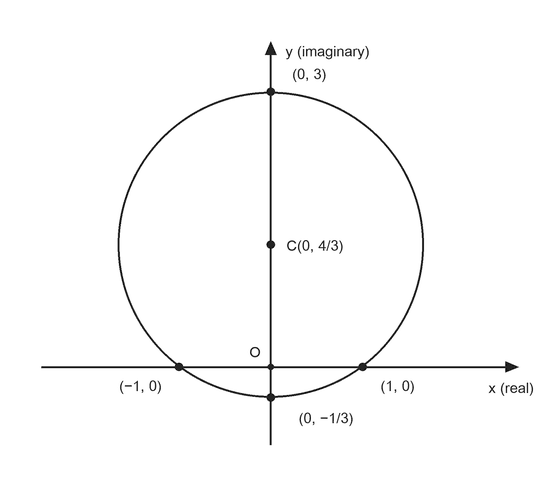
Therefore, the locus of is the circle , with centre and radius .