Solution:
This past paper question is beyond the current ISC syllabus; it is included for extra practice.
Key idea: Switches in series multiply (AND), and branches in parallel add (OR). The switch A′ is on exactly when A is off. We simplify with XX′=0, X+X′=1, X+YZ=(X+Y)(X+Z) and the absorption law X+XY=X.
Step 1 — Read the function from the circuit.
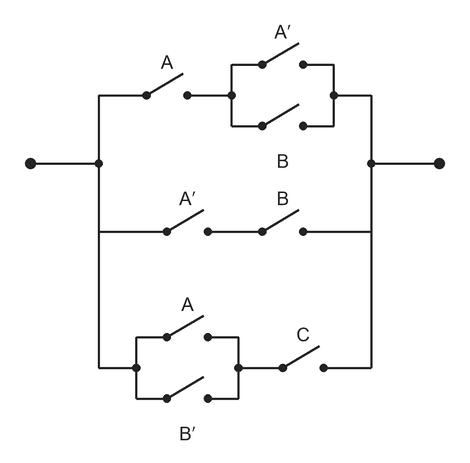
The circuit has three branches in parallel between the two terminals. The top branch is A in series with the parallel pair A′, B, so it gives A(A′+B). The middle branch is A′ in series with B, so it gives A′B. The bottom branch is the parallel pair A, B′ in series with C, so it gives (A+B′)C. Adding the three branches gives the function.
F=A(A′+B)+A′B+(A+B′)C
Step 2 — Expand the brackets.
We multiply out each bracket.
F=AA′+AB+A′B+AC+B′C
Step 3 — Remove the term AA′.
A switch and its complement are never on together, so AA′=0.
F=AB+A′B+AC+B′C
Step 4 — Combine AB+A′B.
We take B out of the first two terms. Then A+A′=1.
AB+A′B=B(A+A′)
AB+A′B=B
So the function becomes the following.
F=B+AC+B′C
Step 5 — Combine B+B′C.
We use the distributive law with X as B, Y as B′ and Z as C. Then we use B+B′=1.
B+B′C=(B+B′)(B+C)
B+B′C=B+C
So the function becomes the following.
F=B+C+AC
Step 6 — Absorb the term AC.
By the absorption law, C+AC=C(1+A), and 1+A=1, so C+AC=C.
F=B+C
Step 7 — Construct the equivalent circuit.
The function B+C is two switches B and C joined in parallel.
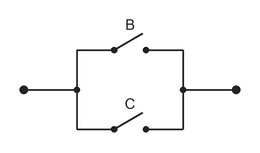
Check: The original circuit is on whenever B is on (through the top branch if A is on, the middle branch if A is off), and whenever C is on with B off (the bottom branch through B′). If B and C are both off, every branch is broken. This is exactly B+C.
Therefore, the Boolean function of the circuit is A(A′+B)+A′B+(A+B′)C, it simplifies to B+C, and the equivalent circuit is switches B and C in parallel.