Solution:
This past paper question is beyond the current ISC syllabus; it is included for extra practice.
Key idea: In a switching circuit, a product such as ABC means switches in series (all must be on), and a sum means branches in parallel (at least one branch must be on). The switch A′ is on exactly when A is off. We simplify with the laws X+X′=1, X⋅1=X and the distributive law X+YZ=(X+Y)(X+Z).
Step 1 — Construct the circuit for the given polynomial.
The polynomial ABC+AB′C+A′B′C has three terms, so the circuit has three branches in parallel. Each branch has the three switches of its term in series.
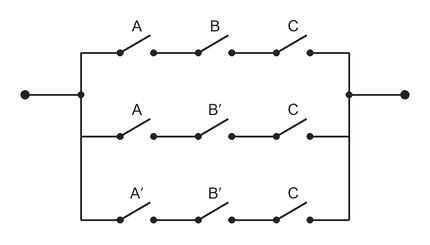
Step 2 — Combine the first two terms.
The first two terms share the factor AC, so we take it out. Then we use B+B′=1 (complement law) and AC⋅1=AC (identity law).
ABC+AB′C=AC(B+B′)
ABC+AB′C=AC
Step 3 — Take C common from the whole polynomial.
We now add the third term and take out the common factor C.
ABC+AB′C+A′B′C=AC+A′B′C
ABC+AB′C+A′B′C=C(A+A′B′)
Step 4 — Simplify the bracket.
We use the distributive law X+YZ=(X+Y)(X+Z).
Here X is A, Y is A′ and Z is B′, and we also use A+A′=1.
A+A′B′=(A+A′)(A+B′)
A+A′B′=A+B′
Step 5 — Write the simplified polynomial.
We put the result of Step 4 back into Step 3.
ABC+AB′C+A′B′C=C(A+B′)
This proves the required result.
Step 6 — Construct the equivalent circuit.
In C(A+B′), switch C is in series with a pair of switches A and B′ that are in parallel with each other.

The new circuit does the same job with 3 switches instead of 9.
Therefore, ABC+AB′C+A′B′C=C(A+B′), and the equivalent circuit is switch C in series with switches A and B′ joined in parallel.
