
Opening your dashboard
Class 9 Physics Chapter 6: Heat and Energy Solutions
123 textbook questions with step-by-step answers, free to read, for ICSE 2026-27.
Get talked through Ch 6, not just shown the answer
Reading a finished solution is not the same as being able to do it. The AI tutor takes one question at a time and works it with you, in your own words, until you can.
- Ask it out loud, in your own words
- It gives you the next step, not the answer
- Stuck on part (ii)? Start there
123 questions with solutions
1–5 marks · Mixed difficulty
- 11 mark
Question 1
The energy which flows from a hot body to a cold body is called :
Solve with AIAnswer
(A) mechanical energy
(B) fuel energy
(C) solar energy
- Correct
(D) heat energy
Answer: (D) heat energy
Concept: Heat is the energy that flows from a body at a higher temperature to a body at a lower temperature when they are in contact.
Step 1 — Picture the situation.
When a hot body touches a cold body, the hot body cools down and the cold body warms up. So something is passing from the hot body to the cold body.
Step 2 — Name what passes.
What passes is energy, and it passes only because one body is hotter than the other. Energy that flows because of a difference of temperature is called heat energy (or simply heat).
Watch out: Heat is not the energy a body 'has'; it is the energy that moves from hot to cold.
Why the other options are wrong:
- (A) mechanical energy: Mechanical energy is the energy a body has because of its motion or position as a whole; it is not what flows from hot to cold.
- (B) fuel energy: Fuel energy is the chemical energy stored in a fuel; it is released only when the fuel burns.
- (C) solar energy: Solar energy is the energy given out by the sun; it is not the name for energy flowing between any hot and cold bodies.
Therefore, the energy which flows from a hot body to a cold body is called heat energy, option (D).
- 21 mark
Question 2
Calorie is the unit of :
Solve with AIAnswer
- Correct
(A) heat
(B) work
(C) temperature
(D) food
Answer: (A) heat
Concept: Heat is a form of energy. It is measured in joule (S.I. unit) or in the older unit calorie.
Step 1 — Recall what a calorie measures.
One calorie is the amount of heat needed to raise the temperature of 1 g of water by 1 °C. So the calorie measures an amount of heat.
Step 2 — Compare it with the S.I. unit.
The S.I. unit of heat is the joule, and the two units are related as shown.
Watch out: Food packets quote energy in calories (really kilocalories), but that does not make the calorie a unit of food.
Why the other options are wrong:
- (B) work: Work is measured in joule; the calorie is not used as the unit of work.
- (C) temperature: Temperature is measured in kelvin (S.I.), degree Celsius or degree Fahrenheit, not in calories.
- (D) food: Food is not a physical quantity, so it has no unit; only the energy value of food is quoted in calories.
Therefore, calorie is the unit of heat, option (A).
- 31 mark
Question 3
1 J equals to :
Solve with AIAnswer
- Correct
(A) 0.24 cal
(B) 4.18 cal
(C) 1 cal
(D) 1 kcal
Answer: (A) 0.24 cal
Concept: The joule and the calorie are both units of heat, related by 1 cal = 4.186 J. A joule is the smaller unit.
Step 1 — Write the relation between the units.
One calorie of heat is equal to 4.186 joule.
Step 2 — Turn it round.
To find how many calories make one joule, divide both sides by 4.186.
Watch out: 4.18 is the number of joules in one calorie; do not read it as the number of calories in one joule.
Why the other options are wrong:
- (B) 4.18 cal: 4.18 cal would be about 17.5 J; 4.18 is the number of joules in one calorie, the other way round.
- (C) 1 cal: A joule is smaller than a calorie (1 cal is about 4.2 J), so 1 J cannot equal 1 cal.
- (D) 1 kcal: 1 kcal is 1000 cal, which is about 4186 J, far more than 1 J.
Therefore, 1 J is about 0.24 cal, option (A).
- 41 mark
Question 4
1 Joule is equal to :
Solve with AIAnswer
(A) erg
(B) erg
- Correct
(C) erg
(D) erg
Answer: (C) 10⁷ erg
Concept: The joule (S.I.) and the erg (C.G.S.) are both units of energy; 1 erg is the work done by a force of 1 dyne through 1 cm.
Step 1 — Recall the units of energy.
The S.I. unit of energy (and heat) is the joule, and the C.G.S. unit is the erg.
Step 2 — Relate them.
One joule is the work done by a force of 1 newton through 1 metre, and 1 N is 10⁵ dyne while 1 m is 10² cm. Multiplying the two factors gives the number of ergs in a joule.
Note: the printed answer list gives the letter (a) beside the value 10⁷ erg; the value is right, and it is option (C) here.
Why the other options are wrong:
- (A) 10⁶ erg is only one-tenth of a joule; the power of ten is one too small.
- (B) 10⁵ is the number of dynes in one newton, not the number of ergs in one joule.
- (D) 10⁹ erg would be 100 J; the power of ten is two too large.
Therefore, 1 joule is equal to 10⁷ erg, option (C).
- 51 mark
Question 5
.......... determines the direction of flow of heat.
Solve with AIAnswer
(A) Heat
- Correct
(B) Temperature
(C) Coldness
(D) None of these
Answer: (B) Temperature
Concept: Temperature is the degree of hotness of a body. It decides the direction of heat flow: heat flows from higher to lower temperature until both temperatures are equal.
Step 1 — See what makes heat flow.
Heat always flows from a body at a higher temperature to a body at a lower temperature, whatever the amounts of heat the two bodies contain.
Step 2 — Use an example.
A bucket of warm water holds much more heat than a red-hot iron nail, yet when the nail is dropped in, heat flows from the nail to the water, because the nail is at the higher temperature.
Step 3 — Conclude.
So it is the temperature, and not the quantity of heat, that decides which way heat flows.
Watch out: A body containing more heat does not always give heat to a body containing less.
Why the other options are wrong:
- (A) Heat: The quantity of heat does not fix the direction; the warm bucket holds more heat but still receives heat from the hot nail.
- (C) Coldness: Coldness is only a feeling, not a physical quantity, so it cannot decide the direction of heat flow.
- (D) None of these: This is wrong because option (B), temperature, does decide the direction.
Therefore, temperature determines the direction of flow of heat, option (B).
- 61 mark
Question 6
The amount of heat energy contained by a body depends on :
Solve with AIAnswer
(A) the mass of the body
(B) the temperature of the body
(C) the nature of the material of the body
- Correct
(D) all of the above
Answer: (D) all of the above
Concept: The heat energy in a body is the total energy of the random motion of all its molecules. It depends on how many molecules there are, how energetic they are, and what the substance is.
Step 1 — Think of mass.
A larger body has more molecules, and each molecule holds some energy, so a larger mass holds more heat at the same temperature.
Step 2 — Think of temperature.
At a higher temperature each molecule moves faster and has more energy, so the same body holds more heat when it is hotter.
Step 3 — Think of the material.
Equal masses of different materials at the same temperature hold different amounts of heat (for example water stores much more heat than iron), so the material also matters.
Why the other options are wrong:
- (A) the mass of the body: Mass is one factor, but this option leaves out temperature and the nature of the material.
- (B) the temperature of the body: Temperature is one factor, but this option leaves out mass and the nature of the material.
- (C) the nature of the material of the body: The material is one factor, but this option leaves out mass and temperature.
Therefore, the heat contained in a body depends on its mass, its temperature and its material, option (D).
- 71 mark
Question 7
The S.I. unit of temperature is :
Solve with AIAnswer
(A) Celsius
(B) Fahrenheit
- Correct
(C) Kelvin
(D) None of these
Answer: (C) Kelvin
Concept: Temperature is measured on the Kelvin, Celsius and Fahrenheit scales; the S.I. unit is the kelvin (K).
Step 1 — Recall the S.I. base units.
The S.I. system has seven base units, and the one for temperature is the kelvin, written K (with no degree sign).
Step 2 — Place the other scales.
The Celsius and Fahrenheit scales are in everyday use, but they are not the S.I. unit.
Watch out: Write 300 K, not 300 °K: the kelvin is used without the degree sign.
Why the other options are wrong:
- (A) Celsius: The degree Celsius is a common unit of temperature, but it is not the S.I. unit.
- (B) Fahrenheit: The degree Fahrenheit is used in some countries, but it is not the S.I. unit.
- (D) None of these: This is wrong because option (C), kelvin, is the S.I. unit.
Therefore, the S.I. unit of temperature is the kelvin, option (C).
- 81 mark
Question 8
Celsius and Kelvin scales are related as :
Solve with AIAnswer
- Correct
(A)
(B)
(C)
(D)
Answer: (A) T (K) = 273 + t (°C)
Concept: The Kelvin and Celsius scales have degrees of the same size; only their zeros differ, by 273 degrees.
Step 1 — Compare the two scales.
A one-degree change is the same size on the Kelvin and Celsius scales, but the Kelvin scale starts 273 degrees lower: the ice point is 0 °C and also 273 K.
Step 2 — Write the relation.
So the Kelvin reading is always 273 more than the Celsius reading.
Step 3 — Check with an example.
Room temperature 27 °C should be 300 K.
Watch out: Add 273 to go from °C to K; subtract 273 to go from K to °C.
Why the other options are wrong:
- (B) Subtracting would make 27 °C equal to 246 K, which is wrong (it is 300 K).
- (C) The two readings differ by 273; they are not in a fixed ratio, so their quotient is not 273.
- (D) This again treats the scales as a ratio, which is wrong; they differ by a constant 273.
Therefore, the relation is T (K) = 273 + t (°C), option (A).
- 91 mark
Question 9
The temperature of a body depends on the average .......... of the molecules.
Solve with AIAnswer
(A) potential energy
- Correct
(B) kinetic energy
(C) elastic energy
(D) atomic energy
Answer: (B) kinetic energy
Concept: The molecules of every body are in constant random motion. The faster they move on average, the hotter the body is.
Step 1 — See what heating does to molecules.
When a body is heated, its molecules move (or vibrate) faster. Their energy of motion, kinetic energy, increases and the body's temperature rises.
Step 2 — Name the quantity.
So the temperature of a body is a measure of the average kinetic energy of its molecules due to their random motion.
Why the other options are wrong:
- (A) potential energy: Potential energy of the molecules changes during a change of state (melting, boiling) while the temperature stays the same, so it does not decide the temperature.
- (C) elastic energy: Elastic energy is the energy of a stretched or compressed body; it does not decide the temperature.
- (D) atomic energy: Atomic (nuclear) energy is locked inside the nuclei of atoms; it does not decide the temperature.
Therefore, temperature depends on the average kinetic energy of the molecules, option (B).
- 101 mark
Question 10
The temperature at which pressure and volume of a gas becomes zero is :
Solve with AIAnswer
(A) 0°C
- Correct
(B) 0 K
(C) 0°F
(D) 273 K
Answer: (B) 0 K
Concept: Absolute zero, 0 K (−273 °C), is the lowest possible temperature. It is the zero of the Kelvin scale.
Step 1 — Recall what happens on cooling a gas.
When a gas is cooled, the pressure (at constant volume) or the volume (at constant pressure) falls steadily, by the same fraction for each degree.
Step 2 — Extend the straight-line graph.
If the graph of pressure (or volume) against temperature is extended backwards, it reaches zero at −273 °C. This temperature is called absolute zero, and it is 0 K on the Kelvin scale.
Step 3 — Say what it means.
At 0 K the molecules have the least possible energy, so no lower temperature is possible.
Watch out: A real gas turns into a liquid before it reaches 0 K; the 'zero pressure and volume' is what the straight-line graph of an ideal gas gives when extended.
Why the other options are wrong:
- (A) 0°C: 0 °C is the ice point, which is 273 K, far above absolute zero.
- (C) 0°F: 0 °F is about −17.8 °C, which is still far above absolute zero.
- (D) 273 K: 273 K is the same as 0 °C, the ice point, not absolute zero.
Therefore, the temperature at which the pressure and volume of a gas would become zero is 0 K, option (B).
- 111 mark
Question 11
The steam point on Fahrenheit scale is :
Solve with AIAnswer
(A) 273°F
(B) 100°F
(C) 213°F
- Correct
(D) 212°F
Answer: (D) 212°F
Concept: The Fahrenheit and Celsius readings are related by F = (9/5)C + 32; the ice point is 32 °F.
Step 1 — Write the steam point in °C.
Pure water boils at normal pressure at 100 °C; this is the steam point.
Step 2 — Convert to °F.
We put C = 100 into the relation between the two scales.
Watch out: Do not forget to add 32; (9/5) × 100 alone gives 180, not the steam point.
Why the other options are wrong:
- (A) 273°F: 273 is the ice point on the Kelvin scale (in K), not the steam point in °F.
- (B) 100°F: 100 is the steam point on the Celsius scale, not on the Fahrenheit scale.
- (C) 213°F: 213 °F is one degree more than the true steam point, 212 °F.
Therefore, the steam point on the Fahrenheit scale is 212 °F, option (D).
- 121 mark
Question 12
Celsius and Fahrenheit scales are related as :
Solve with AIAnswer
- Correct
(A)
(B)
(C)
(D)
Answer: (A) C/5 = (F − 32)/9
Concept: Two temperature scales are related through their fixed points: each reading is the same fraction of the way from the ice point to the steam point.
Step 1 — Note the fixed points.
The ice point is 0 °C and 32 °F; the steam point is 100 °C and 212 °F. So 100 Celsius degrees cover the same interval as 180 Fahrenheit degrees.
Step 2 — Write equal fractions of the interval.
A temperature lies the same fraction of the way from the ice point to the steam point on both scales.
Step 3 — Simplify.
Dividing both denominators by 20 gives the standard form.
Step 4 — Check.
Putting C = 100 into this relation should give the steam point, 212 °F.
Why the other options are wrong:
- (B) Putting the ice point C = 0 into it gives F as −32 instead of 32 °F, so it is wrong.
- (C) At the ice point C is 0, so its left side is 0, but its right side 9/(F + 32) can never be 0; so it is wrong.
- (D) Putting the ice point C = 0 into it gives F as −32 instead of 32 °F, so it is wrong.
Therefore, the scales are related by C/5 = (F − 32)/9, option (A).
- 131 mark
Question 13
The increase in the length of a solid on heating is called :
Solve with AIAnswer
(A) contraction
- Correct
(B) linear expansion
(C) cubical expansion
(D) superficial expansion
Answer: (B) linear expansion
Concept: A solid on heating expands in length, area and volume; each has its own name.
Step 1 — Match the change to its name.
Expansion in one dimension, length, is called linear expansion.
Step 2 — Recall the other kinds.
The increase in area is superficial expansion and the increase in volume is cubical expansion.
Why the other options are wrong:
- (A) contraction: Contraction is a decrease in size, which happens on cooling, not an increase on heating.
- (C) cubical expansion: Cubical expansion is the increase in volume, not in length.
- (D) superficial expansion: Superficial expansion is the increase in area, not in length.
Therefore, the increase in length of a solid on heating is called linear expansion, option (B).
- 141 mark
Question 14
On heating, liquids expand ............ than solids and gases expand ............. than liquids.
Solve with AIAnswer
(A) more, less
(B) less, more
- Correct
(C) more, much more
(D) less, less
Answer: (C) more, much more
Concept: For the same rise in temperature, the expansion of a substance depends on how strongly its molecules are held together.
Step 1 — Compare the forces between molecules.
In a solid the molecules are held strongly, in a liquid less strongly, and in a gas they are almost free.
Step 2 — Link the forces to expansion.
The weaker the forces, the more the molecules spread apart for the same rise in temperature. So liquids expand more than solids, and gases expand much more than liquids.
Why the other options are wrong:
- (A) more, less: The first blank is right, but gases expand more than liquids, not less.
- (B) less, more: Liquids expand more than solids, not less.
- (D) less, less: Both blanks are the wrong way round.
Therefore, liquids expand more than solids, and gases expand much more than liquids, option (C).
- 151 mark
Question 15
Water is cooled from 4°C to 0°C. It :
Solve with AIAnswer
(A) contracts
- Correct
(B) expands
(C) first contracts, then expands
(D) first expands, then contracts.
Answer: (B) expands
Concept: Water behaves unusually: on cooling it contracts only down to 4 °C, and from 4 °C to 0 °C it expands.
Step 1 — Recall where the volume is least.
Water has its minimum volume (maximum density) at 4 °C.
Step 2 — Follow the cooling.
Cooling water from 4 °C to 0 °C therefore takes it away from its minimum volume, so its volume increases all the way: it expands. This is the anomalous expansion of water.
Watch out: Most liquids contract on cooling; water between 4 °C and 0 °C does the opposite.
Why the other options are wrong:
- (A) contracts: Water contracts on cooling only above 4 °C; below 4 °C it expands.
- (C) first contracts, then expands: The volume does not decrease at all between 4 °C and 0 °C, so there is no 'first contracts' part.
- (D) first expands, then contracts: The volume keeps increasing down to 0 °C; it does not contract at the end.
Therefore, water cooled from 4 °C to 0 °C expands, option (B).
- 161 mark
Question 16
The change in volume of water when it is cooled from ......°C to ......°C is known as anomalous expansion of water.
Solve with AIAnswer
(A) 0, 4
- Correct
(B) 4, 0
(C) 1, 0
(D) 0, 1
Answer: (B) 4, 0
Concept: Water expands on cooling between 4 °C and 0 °C, which is the opposite of normal behaviour.
Step 1 — Recall the definition.
Anomalous expansion of water is the expansion of water when it is cooled from 4 °C down to 0 °C.
Step 2 — Fill the blanks in order.
The blanks say 'cooled from … to …', so the first is 4 and the second is 0.
Why the other options are wrong:
- (A) 0, 4: Going from 0 °C to 4 °C means heating, not cooling, and the water contracts in that range.
- (C) 1, 0: The anomalous range starts at 4 °C, not at 1 °C.
- (D) 0, 1: From 0 °C to 1 °C is heating, and the anomalous range starts at 4 °C.
Therefore, anomalous expansion is the change in volume of water when cooled from 4 °C to 0 °C, option (B).
- 171 mark
Question 17
Density of water is maximum at :
Solve with AIAnswer
(A) 0°C
(B) 100°C
- Correct
(C) 4°C
(D) 15°C
Answer: (C) 4°C
Concept: Density = mass ÷ volume. Water has its smallest volume, and so its largest density, at 4 °C.
Step 1 — Use density = mass ÷ volume.
For a fixed mass of water, the density is greatest where the volume is least.
Step 2 — Find where the volume is least.
Water has its least volume at 4 °C, so its density is greatest at 4 °C. The maximum density is about 1 g cm⁻³ (1000 kg m⁻³).
Why the other options are wrong:
- (A) 0°C: At 0 °C water has expanded again, so its density (about 0.99984 g cm⁻³) is less than at 4 °C.
- (B) 100°C: At 100 °C water has expanded a great deal, so its density is much less (about 0.958 g cm⁻³).
- (D) 15°C: At 15 °C water has expanded above 4 °C, so its density is less (about 0.9991 g cm⁻³).
Therefore, the density of water is maximum at 4 °C, option (C).
- 181 mark
Question 18
The property of ice which prevents the flow of heat from water of a pond (or lake) to the atmosphere is :
Solve with AIAnswer
(A) conduction
- Correct
(B) insulation
(C) low specific heat
(D) none of the above
Answer: (B) insulation
Concept: A poor conductor of heat acts as an insulator: it hardly lets heat pass through it.
Step 1 — Note what the ice does.
In winter a layer of ice forms on top of a pond and separates the water below from the very cold air.
Step 2 — Recall the property of ice.
Ice is a poor conductor of heat, so very little heat can pass through it. The ice layer acts as an insulating blanket, and the water below stays liquid.
Why the other options are wrong:
- (A) conduction: Ice conducts heat poorly; if it conducted heat well, the pond would lose heat quickly and freeze right through.
- (C) low specific heat: Specific heat decides how much heat is needed to warm a body; it is not what stops heat flowing through the ice layer.
- (D) none of the above: This is wrong because option (B), insulation, is the property.
Therefore, the property of ice that prevents the flow of heat from the pond to the atmosphere is insulation, option (B).
- 191 mark
Question 19
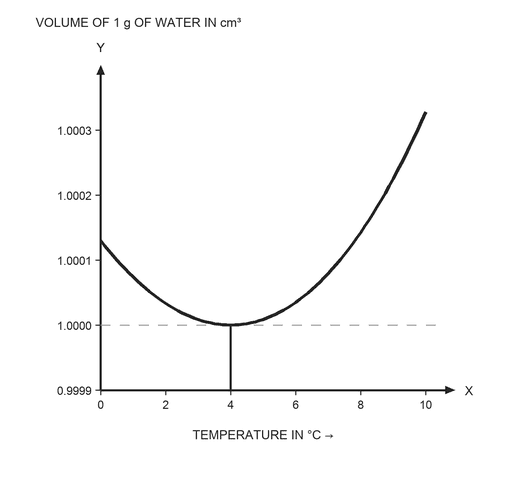
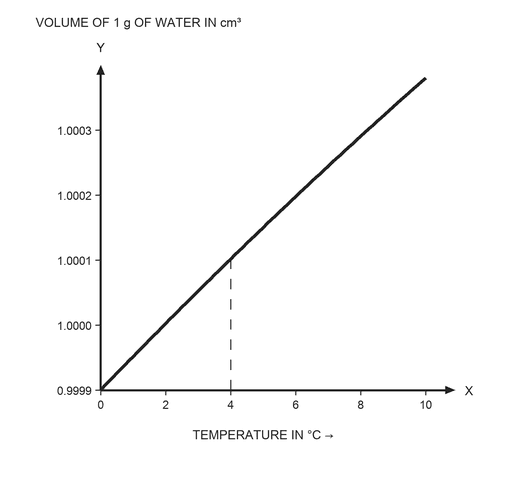
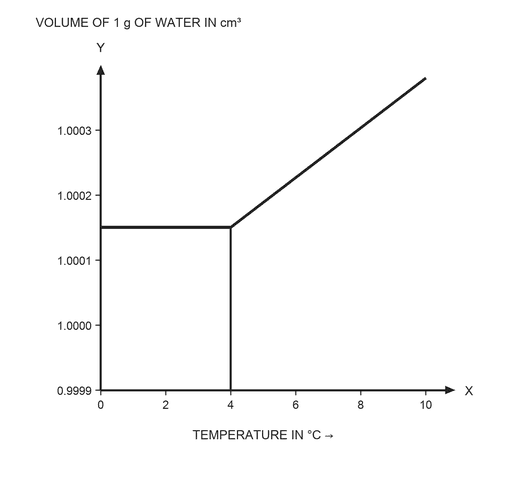
Identify the correct graph showing the variation in the volume of water with temperaure :
Solve with AIAnswer
- Correct
(A)
(B)

(C)
(D)
Answer: (A) the U-shaped graph with its lowest point at 4 °C
Concept: Water has its minimum volume at 4 °C (anomalous expansion between 0 °C and 4 °C).
Step 1 — Describe how the volume changes.
When water is heated from 0 °C, its volume first decreases until 4 °C and then increases on heating above 4 °C.
Step 2 — Turn this into a shape.
So the correct graph falls from 0 °C to a lowest point at 4 °C and then rises: a U-shaped curve. Graph (A) has exactly this shape, with the least volume (1.0000 cm³ for 1 g) at 4 °C.
Watch out: A curve with a highest point at 4 °C is the density graph, not the volume graph.
Why the other options are wrong:
- (B) This graph shows a maximum volume at 4 °C, which is the opposite of the truth (it is the shape of the density graph).
- (C) This graph shows the volume rising steadily from 0 °C, as for a normal liquid; it ignores the decrease from 0 °C to 4 °C.
- (D) This graph shows a constant volume from 0 °C to 4 °C, but the volume actually decreases in this range.
Therefore, the correct graph is (A), the U-shaped curve with its lowest point at 4 °C.
- 202 marks
Question 20
What is heat ? Write its S.I. unit.
Solve with AIWritten solution
Solution:
Concept: Heat is energy in transit: it moves only because of a difference of temperature.
Step 1 — Say what heat is.
Heat is the form of energy that passes from one body to another because of a difference in their temperatures. It always flows from the hotter body to the colder body.
Step 2 — Give an example.
A hot cup of tea left on a table cools down because heat flows from the tea to the cooler air around it.
Step 3 — Write the S.I. unit.
Since heat is a form of energy, its S.I. unit is the unit of energy, the joule (J).
Therefore, heat is the energy that flows from a hotter body to a colder body because of their difference in temperature, and its S.I. unit is the joule (J).
- 211 mark
Question 21
Two bodies at different temperatures are placed in contact. State the direction in which heat will flow.
Solve with AIWritten solution
Solution:
Concept: Temperature decides the direction in which heat flows.
Step 1 — Compare the temperatures.
Of the two bodies, one is at a higher temperature and the other at a lower temperature.
Step 2 — State the direction.
Heat flows from the body at the higher temperature to the body at the lower temperature.
Step 3 — Say when it stops.
The flow continues until both bodies reach the same temperature (thermal equilibrium).
Watch out: The direction is decided by temperature, not by which body holds more heat.
Therefore, heat flows from the body at the higher temperature to the body at the lower temperature, until their temperatures become equal.
- 222 marks
Question 22
Name the S.I. unit of heat. How is it related to the unit calorie ?
Solve with AIWritten solution
Solution:
Concept: The joule and the calorie are both units of heat; the calorie is the older unit, about 4.2 times larger.
Step 1 — Name the S.I. unit.
Heat is a form of energy, so its S.I. unit is the joule (J).
Step 2 — Relate it to the calorie.
One calorie, the heat needed to warm 1 g of water by 1 °C, equals 4.186 joule.
Step 3 — Write it the other way round.
Dividing by 4.186 gives the size of one joule in calories.
Therefore, the S.I. unit of heat is the joule, and 1 cal = 4.186 J (so 1 J ≈ 0.24 cal).
- 232 marks
Question 23
Define temperature and write its S.I. unit.
Solve with AIWritten solution
Solution:
Concept: Temperature measures how hot or cold a body is; it depends on the average kinetic energy of its molecules.
Step 1 — Define temperature.
Temperature is the quantity that tells the thermal state of a body, that is, its degree of hotness or coldness.
Step 2 — Say what it decides.
When two bodies at different temperatures are placed in contact, temperature decides the direction of heat flow: heat flows from the body at the higher temperature to the one at the lower temperature.
Step 3 — Write the S.I. unit.
The S.I. unit of temperature is the kelvin (K).
Therefore, temperature is the degree of hotness or coldness of a body, which decides the direction of heat flow, and its S.I. unit is the kelvin (K).
- 242 marks
Question 24
Why does a piece of ice when touched with hand, appear cool ? Explain.
Solve with AIWritten solution
Solution:
Concept: A body feels cold when heat flows out of our hand into it, and warm when heat flows into our hand.
Step 1 — Compare the temperatures.
Our hand is at about 37 °C, while the ice is at 0 °C or below. So the hand is at the higher temperature.
Step 2 — Find the direction of heat flow.
On touching, heat flows from the hand (higher temperature) to the ice (lower temperature).
Step 3 — Explain the feeling.
The hand loses heat, and this loss of heat from our skin is what we feel as coolness.
Watch out: The ice does not give 'cold' to the hand; it is heat that flows, from the hand to the ice.
Therefore, the ice feels cool because heat flows from our warmer hand into the ice, and the hand's loss of heat gives the feeling of coolness.
- 251 mark
Question 25
Name two substances which expand on heating.
Solve with AIWritten solution
Solution:
Concept: Almost every solid, liquid and gas expands on heating.
Step 1 — Recall the rule.
Almost all substances expand when they are heated, because their molecules move more vigorously and move farther apart.
Step 2 — Pick two examples.
Iron (railway lines are laid with small gaps for this reason) and mercury (it rises in a thermometer when warmed) both expand on heating.
Therefore, two substances which expand on heating are iron and mercury (others: brass, copper, air).
- 261 mark
Question 26
Name two substances which contract on heating.
Solve with AIWritten solution
Solution:
Concept: A few substances contract on heating within a particular temperature range.
Step 1 — Recall the rule and its exceptions.
Almost all substances expand on heating, but a few contract when heated in a certain range of temperature.
Step 2 — Give the first example.
Water contracts when it is heated from 0 °C to 4 °C (this is the anomalous behaviour of water).
Step 3 — Give the second example.
Silver iodide contracts when it is heated from 80 °C to 141 °C, as stated in the chapter.
Watch out: Name the temperature range too; water expands on heating above 4 °C.
Therefore, two substances which contract on heating are water (from 0 °C to 4 °C) and silver iodide (from 80 °C to 141 °C).
- 271 mark
Question 27
What do you mean by anomalous expansion of water ?
Solve with AIWritten solution
Solution:
Concept: Anomalous means unusual: water behaves opposite to most liquids between 4 °C and 0 °C.
Step 1 — Recall normal behaviour.
Normally a liquid contracts when it is cooled.
Step 2 — State water's unusual behaviour.
Water contracts on cooling only down to 4 °C. When it is cooled further from 4 °C to 0 °C, it expands instead of contracting.
Step 3 — Name it.
This expansion of water on cooling from 4 °C to 0 °C is called the anomalous expansion of water.
Therefore, anomalous expansion of water is the expansion of water when it is cooled from 4 °C to 0 °C.
- 282 marks
Question 28
At what temperature the density of water is maximum? State its value.
Solve with AIWritten solution
Solution:
Concept: Density = mass ÷ volume; water has its least volume, and hence its greatest density, at 4 °C.
Step 1 — Find where the volume is least.
Water has its least volume at 4 °C. Since density = mass ÷ volume, a fixed mass of water is densest where its volume is least.
Step 2 — State the value.
The maximum density of water, at 4 °C, is about 1 g cm⁻³, which is the same as 1000 kg m⁻³.
Therefore, the density of water is maximum at 4 °C, and its value is about 1 g cm⁻³ (1000 kg m⁻³).
- 292 marks
Question 29
Deep pond of water has its top layer frozen during winter. State the expected temperature of water layer (i) just in contact with ice, (ii) at the bottom of pond.
Solve with AIWritten solution
Solution:
Concept: In winter the densest water (at 4 °C) settles at the bottom, while colder, lighter water stays at the top and freezes at 0 °C.
Step 1 — Find the temperature next to the ice.
Water freezes at 0 °C, and the ice and the water touching it are at the same temperature. So the water just in contact with the ice is at 0 °C.
Step 2 — Find the temperature at the bottom.
Water is densest at 4 °C, so water at 4 °C sinks and collects at the bottom of the pond.
Watch out: The bottom water is at 4 °C, not 0 °C.
Therefore, (i) the water layer in contact with the ice is at 0 °C, and (ii) the water at the bottom of the pond is at 4 °C.
- 303 marks
Question 30
Distinguish between heat and temperature.
Solve with AIWritten solution
Solution:
Concept: Heat is energy (how much); temperature is a level (how hot).
Step 1 — Say what each one is.
Heat is a form of energy, while temperature is a measure of how hot a body is. The table compares them point by point.
Heat Temperature Heat is the energy of random motion of the molecules that passes from a hotter to a colder body. Temperature tells the thermal state (degree of hotness or coldness) of a body and decides the direction of heat flow. Its S.I. unit is the joule (J). Its S.I. unit is the kelvin (K). The heat in a body depends on its mass, temperature and material. Temperature depends on the average kinetic energy of the molecules, not on the mass. Heat is measured by the method of mixtures (calorimetry). Temperature is measured by a thermometer. When two bodies are put together, their heats add up. When two bodies at different temperatures are put together, the final temperature lies between the two. Step 2 — Use an example.
A bucket of warm water at 40 °C contains much more heat than a cup of water at 80 °C, though its temperature is lower. So two bodies can differ in heat and in temperature independently.
Watch out: Do not say a body 'contains temperature'; a body contains heat and is at a temperature.
Therefore, heat is a form of energy measured in joule, while temperature is the degree of hotness of a body, measured in kelvin, which decides the direction of heat flow.
- 312 marks
Question 31
What do you understand by thermal expansion of a substance ?
Solve with AIWritten solution
Solution:
Concept: Almost all substances, solid, liquid or gas, expand when heated.
Step 1 — Say what heating does.
When a substance is heated, its molecules move more vigorously and push one another farther apart, so the substance takes up more space.
Step 2 — Define thermal expansion.
The increase in size (length, area or volume) of a substance on heating is called its thermal expansion. On cooling the substance contracts.
Step 3 — Give an example.
A metal rod becomes slightly longer when heated, and mercury rises in a thermometer because it expands when warmed.
Therefore, thermal expansion is the increase in the size of a substance when it is heated.
- 322 marks
Question 32
Name the three kinds of thermal expansion. Out of solids, liquids and gases, which expands more ?
Solve with AIWritten solution
Solution:
Concept: Expansion is named after what increases: length, area or volume.
Step 1 — Name the three kinds.
A solid can expand in each of its dimensions, giving three kinds of thermal expansion.
1. Linear expansion: the increase in length on heating.
2. Superficial expansion: the increase in area on heating.
3. Cubical (volume) expansion: the increase in volume on heating.
Step 2 — See which states show which kind.
A solid has a definite shape, so it shows all three kinds. Liquids and gases have no shape of their own, so they show only cubical expansion.
Step 3 — Compare the amount of expansion.
For the same rise in temperature, a liquid expands more than a solid, and a gas expands much more than a liquid, because the forces between the molecules are weakest in a gas.
Therefore, the three kinds are linear, superficial and cubical expansion, and gases expand the most (gases > liquids > solids).
- 333 marks
Question 33
State the volume changes observed when a given mass of water is heated from 0°C to 10°C. Sketch a temperature-volume graph to show the behaviour.
Solve with AIWritten solution
Solution:
Concept: Water has its minimum volume at 4 °C: below 4 °C it contracts on heating, above 4 °C it expands.
Step 1 — Heat from 0 °C to 4 °C.
When water is heated from 0 °C to 4 °C, its volume decreases: it contracts instead of expanding. This is the anomalous behaviour of water.
Step 2 — Note the turning point.
At 4 °C the volume is the least; 1 g of water then occupies about 1.0000 cm³.
Step 3 — Heat from 4 °C to 10 °C.
Above 4 °C water behaves normally: on heating from 4 °C to 10 °C its volume increases (it expands).
Step 4 — Sketch the graph.
Plot temperature along the x-axis and the volume of 1 g of water along the y-axis. The curve falls from 0 °C to its lowest point at 4 °C and then rises up to 10 °C.

Watch out: The lowest point of the volume graph is at 4 °C, not at 0 °C.
Therefore, on heating from 0 °C to 10 °C, water first contracts to its least volume at 4 °C and then expands, giving a U-shaped temperature–volume graph with its lowest point at 4 °C.
- 343 marks
Question 34
Draw a graph to show the variation in density of water with temperature in the temperature range from 0°C to 10°C.
Solve with AIWritten solution
Solution:
Concept: Density = mass ÷ volume, so where the volume of water is least (4 °C) its density is greatest.
Step 1 — Link density to volume.
Density = mass ÷ volume. For a fixed mass of water, the density is greatest where the volume is least, and smallest where the volume is greatest.
Step 2 — Describe the change from 0 °C to 4 °C.
From 0 °C to 4 °C the water contracts, so its density increases.
Step 3 — Describe the change from 4 °C to 10 °C.
At 4 °C the density is the greatest, about 1 g cm⁻³ (1000 kg m⁻³). From 4 °C to 10 °C the water expands, so its density decreases.
Step 4 — Draw the graph.
Plot temperature along the x-axis and density along the y-axis. The curve rises from 0 °C to a highest point at 4 °C and then falls up to 10 °C.
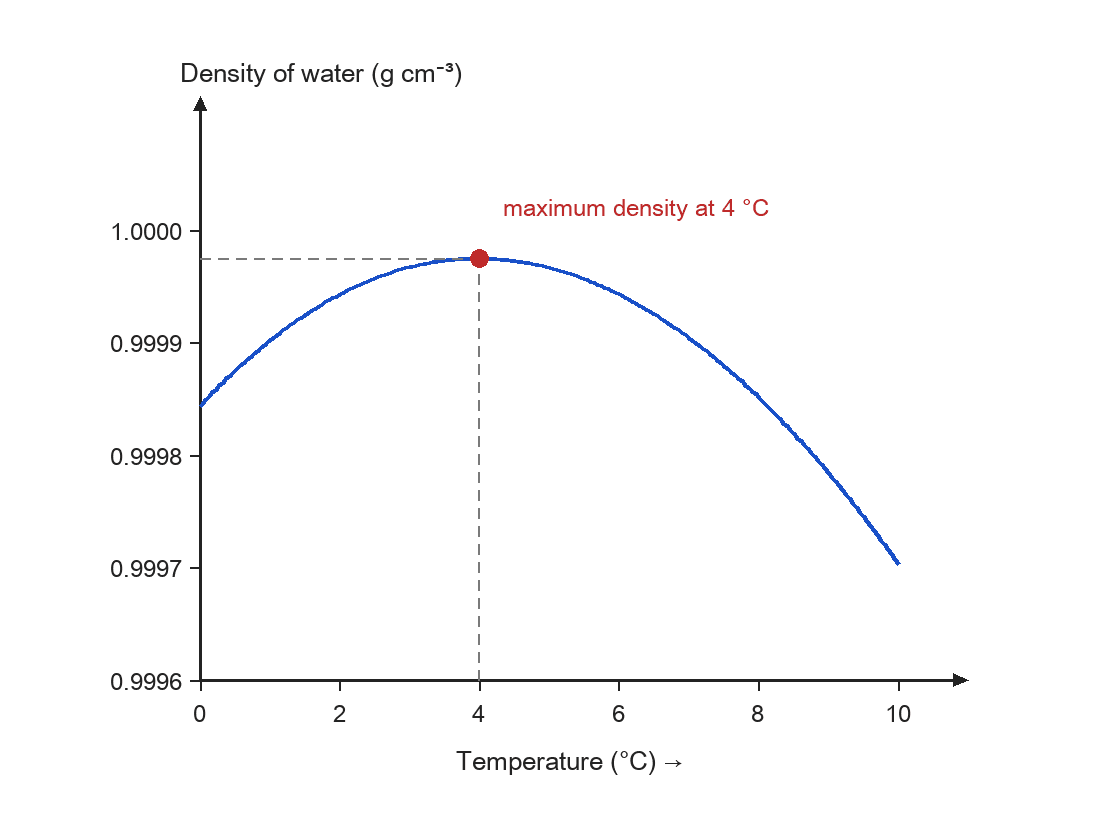
Watch out: The density graph is the volume graph turned upside down: its highest point is at 4 °C.
Therefore, the density of water rises from 0 °C to a maximum of about 1 g cm⁻³ at 4 °C and then falls up to 10 °C, so the graph is an arch with its highest point at 4 °C.
- 353 marks
Question 35
A given mass of water is cooled from 10°C to 0°C. State the volume changes observed. Represent these changes on a temperature-volume graph.
Solve with AIWritten solution
Solution:
Concept: On cooling, water contracts only down to 4 °C; below 4 °C it expands.
Step 1 — Cool from 10 °C to 4 °C.
When water is cooled from 10 °C to 4 °C, its volume decreases: it contracts normally.
Step 2 — Note the turning point.
At 4 °C the volume is the least.
Step 3 — Cool from 4 °C to 0 °C.
On further cooling from 4 °C to 0 °C, the volume increases: the water expands. This is the anomalous expansion of water.
Step 4 — Show it on a graph.
On the temperature–volume graph the arrows run from 10 °C towards 0 °C: down the right branch to the lowest point at 4 °C, then up the left branch.

Watch out: On cooling, read the graph from right to left.
Therefore, on cooling from 10 °C to 0 °C, water contracts down to its least volume at 4 °C and then expands down to 0 °C.
- 363 marks
Question 36
Explain the following :
(a) Water pipes in colder countries often burst in winter.
(b) In winter, water tank (or ocean) starts freezing from the surface and not from the bottom.
(c) Fishes survive in ponds even when the atmospheric temperature is below 0°C.
(d) A hollow glass sphere which floats with its entire volume submerged in water at 4°C, sinks when water is heated above 4°C.
(e) A glass bottle completely filled with water and tightly closed at room temperature, is likely to burst when kept in the freezer of a refrigerator.
Solve with AIWritten solution
Solution:
Concept: Water expands on cooling below 4 °C, and expands about 9 % more when it freezes; its density is greatest at 4 °C.
Step 1 — (a) Explain why water pipes burst.
On cold winter nights the temperature falls below 4 °C. The water in the pipes then expands on cooling, and it expands even more (by about 9 %) when it freezes into ice. The pipe cannot make room for this extra volume, so the water and ice push hard on its walls and the pipe bursts.
Step 2 — (b) Explain why a tank freezes from the surface.
As the surface water cools, it becomes denser and sinks, while warmer water from below rises; this goes on until all the water is at 4 °C. On further cooling, the surface water expands and becomes lighter, so it stays on top, cools to 0 °C and freezes. The water at the bottom stays at 4 °C, so the freezing starts at the surface and not at the bottom.
Step 3 — (c) Explain how fish survive.
For the reason in (b), only the top layer of a pond freezes. Ice is a poor conductor of heat, so this layer insulates the water below from the cold air. The water under the ice stays liquid (0 °C just below the ice, 4 °C at the bottom), and fish live in it.
Step 4 — (d) Explain why the glass sphere sinks.
At 4 °C the sphere floats with its whole volume just under water, so its average density equals the density of water at 4 °C, the greatest density water can have. When the water is heated above 4 °C, it expands and its density falls, while the glass hardly changes. The sphere is now denser than the water, the upthrust becomes less than its weight, and it sinks.
Step 5 — (e) Explain why the bottle bursts.
In the freezer the water cools below 4 °C and expands, and on freezing its volume increases by about 9 %. A completely filled, tightly closed bottle has no space for this extra volume, so the water and ice push on the glass and the bottle bursts.
Watch out: Ice floats because it is lighter than water; do not say water 'shrinks' when it freezes.
Therefore, all five effects follow from the anomalous expansion of water: it expands on cooling below 4 °C and on freezing, and it is densest at 4 °C.
- 375 marks
Question 37
Describe an experiment to show that water has maximum density at 4°C. What important consequences follow from this peculiar property of water ? Discuss the importance of this phenomenon in nature.
Solve with AIWritten solution
Solution:
Concept: Hope's experiment shows that water at 4 °C, being the densest, collects at the bottom of a vessel, while colder water stays on top.
Step 1 — Set up Hope's apparatus.
Take a tall metallic cylinder with two side openings, P near the top and Q near the bottom, fitted with thermometers T₁ and T₂. Round the middle of the cylinder is a trough holding a freezing mixture of ice and salt. Fill the cylinder with pure water at room temperature (say 12 °C).
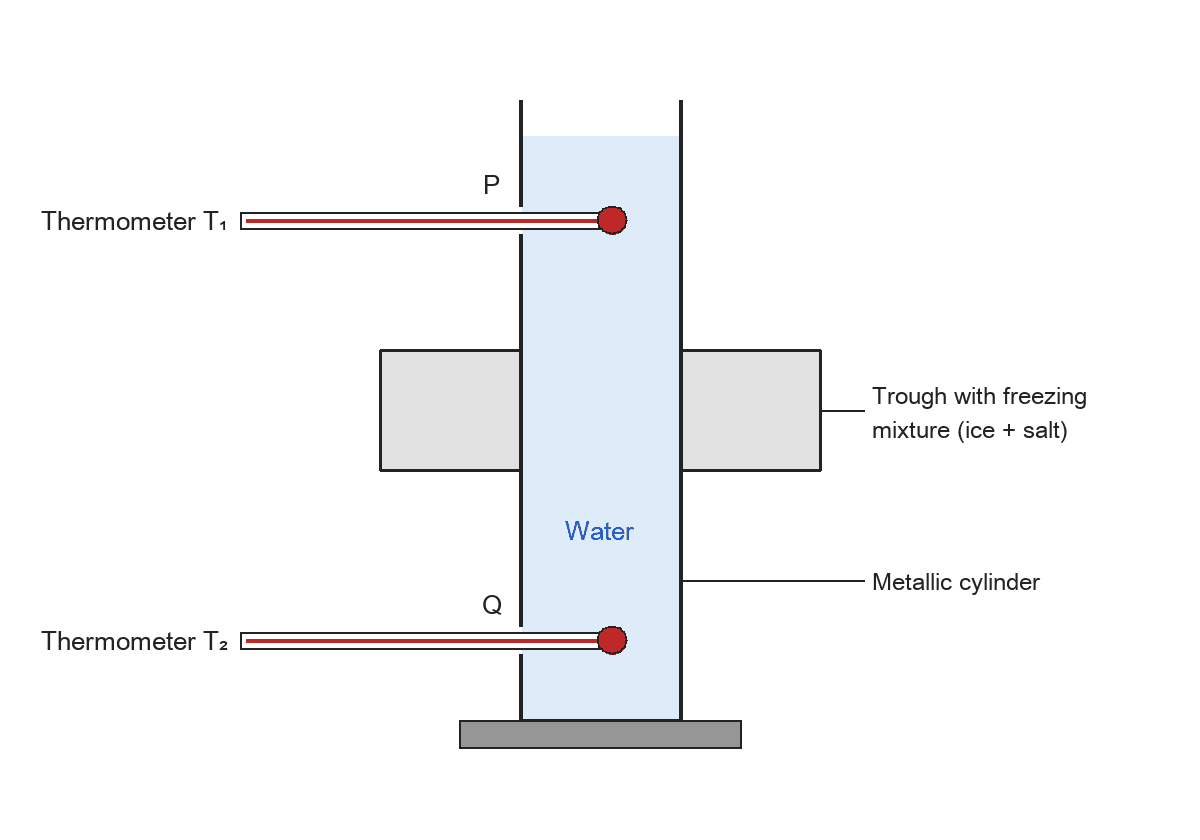
Step 2 — Take the readings.
Note the readings of both thermometers every minute or so.
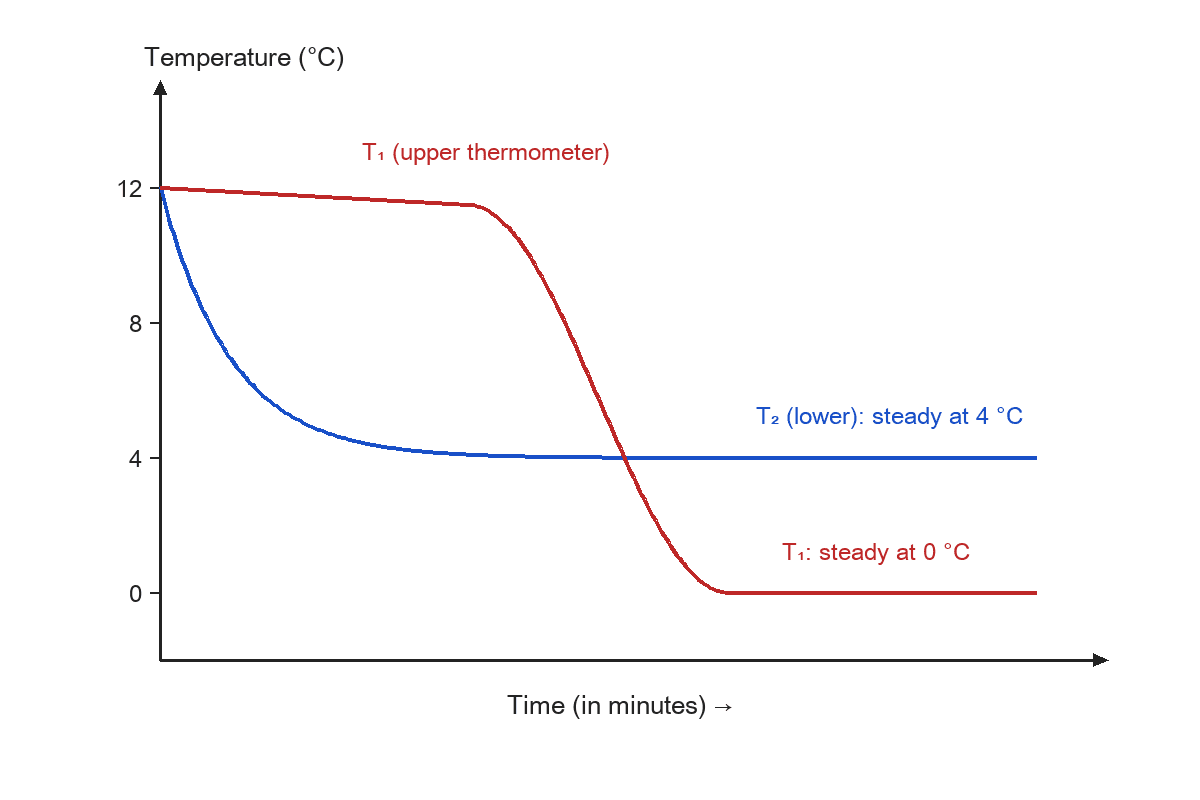
1. At first T₁ and T₂ show the same room temperature.
2. The lower thermometer T₂ falls quickly to 4 °C and then stays steady at 4 °C, while the upper thermometer T₁ changes very little.
3. After that, T₁ falls quickly to 0 °C and stays there; ice may form at the top. T₂ remains at 4 °C.
Step 3 — Explain the readings.
The freezing mixture cools the water in the middle. Down to 4 °C the cooled water contracts, becomes denser and sinks, so the lower part cools quickly to 4 °C and T₂ falls. Below 4 °C the cooled water expands, becomes lighter and rises, so now the upper part cools down to 0 °C and T₁ falls. The water at 4 °C stays at the bottom, so water at 4 °C is the densest.
Step 4 — State the consequences in nature.
This property has important effects.
1. Aquatic life survives in winter: a pond freezes only at the surface. Ice is a poor conductor, so the water below stays liquid (0 °C under the ice, 4 °C at the bottom), and fish and other animals survive.
2. Water pipes burst: water in pipes expands on cooling below 4 °C and on freezing, and the pressure bursts the pipes.
3. Crops are damaged: on very cold nights water in plant tissues expands as it cools and freezes, bursting the cells, so the plants are damaged. Farmers fill their fields with water to protect them.
4. Rocks break: water in cracks of rocks expands on freezing, widens the cracks and slowly breaks the rocks, helping to form soil.
Watch out: In Hope's experiment the LOWER thermometer reaches its steady reading (4 °C) first.
Therefore, Hope's experiment shows that water has its maximum density at 4 °C; because of this, ponds freeze only at the top and aquatic life survives, while pipes burst, crops are damaged and rocks break in very cold weather.
- 384 marks
Question 38
Draw a diagram showing the temperature of various layers of water in an ice covered pond.
Solve with AIWritten solution
Solution:
Concept: In winter the densest water (4 °C) sinks to the bottom, and the colder, lighter water stays on top and freezes at 0 °C.
Step 1 — Start from the air.
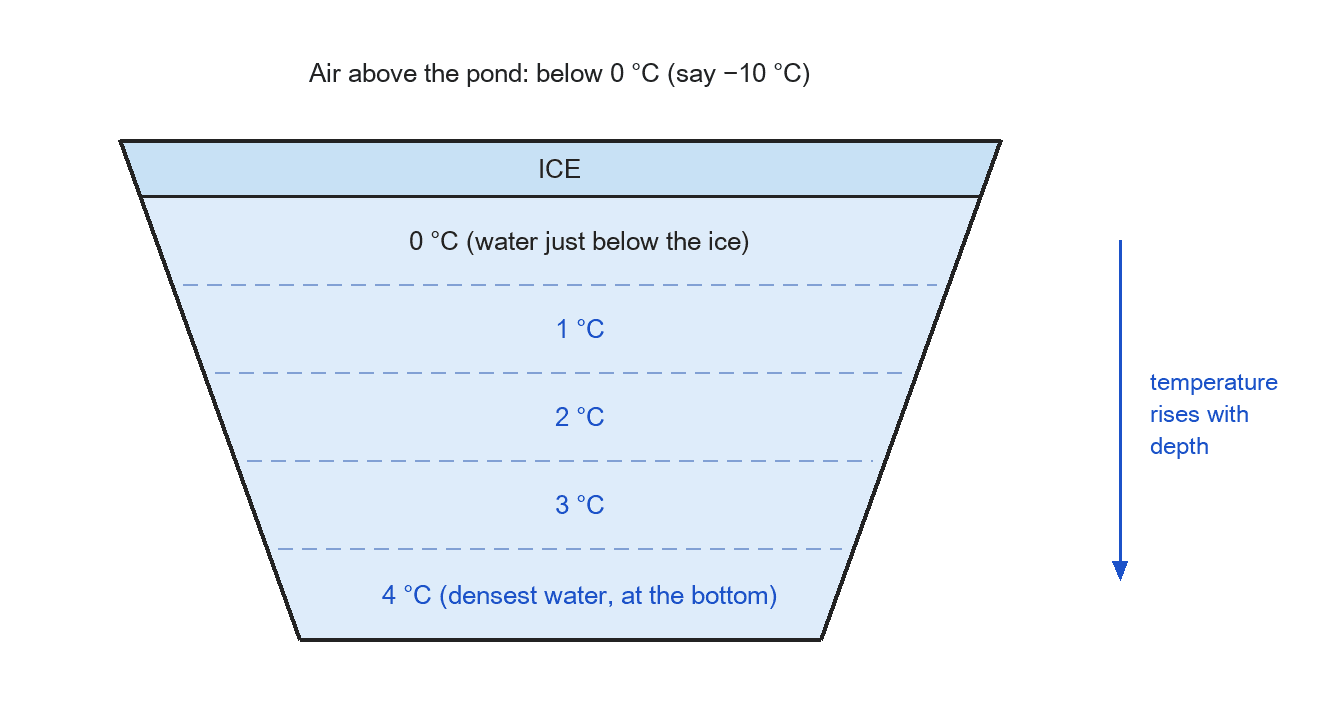
In winter the air above the pond is below 0 °C (say −10 °C), so the surface water cools first.
Step 2 — Follow the cooling.
Water cooled down to 4 °C becomes denser and sinks, so the bottom fills with water at 4 °C. Water cooled below 4 °C becomes lighter and stays on top, where it cools to 0 °C and freezes.
Step 3 — Label the layers.
The pond then has a layer of ice on top, water at 0 °C just below the ice, and water layers whose temperature rises steadily with depth (1 °C, 2 °C, 3 °C) down to 4 °C at the bottom.
Step 4 — Note why the water stays liquid.
Ice is a poor conductor of heat, so the ice layer insulates the water below and aquatic life survives.
Therefore, in an ice-covered pond the water is at 0 °C just below the ice and its temperature rises with depth to 4 °C at the bottom.
- 391 mark
Question 39
Out of the following components, which one is not abiotic ?
Solve with AIAnswer
- Correct
(A) trees
(B) light
(C) heat
(D) rain
Answer: (A) trees
Concept: Abiotic means non-living; biotic means living.
Step 1 — Recall the two kinds of components.
An ecosystem has biotic (living) components, such as plants, animals and microbes, and abiotic (non-living) components, such as light, heat, rain, humidity and minerals.
Step 2 — Sort the options.
Light, heat and rain are non-living, so they are abiotic. Trees are living producers, so they are biotic, that is, not abiotic.
Why the other options are wrong:
- (B) light: Light is non-living, so it is an abiotic component.
- (C) heat: Heat is non-living, so it is an abiotic component.
- (D) rain: Rain is non-living, so it is an abiotic component.
Therefore, trees are the component that is not abiotic, option (A).
- 401 mark
Question 40
Plants use .......... of the total energy absorbed by them in photosynthesis for producing their food.
Solve with AIAnswer
(A) 40%
(B) 50%
(C) 5%
- Correct
(D) 0.02%
Answer: (D) 0.02%
Concept: Photosynthesis turns only a tiny fraction of the sunlight reaching plants into the chemical energy of food.
Step 1 — Recall the chapter's figure.
Plants receive a lot of solar energy, but they store only a very small part of it as food by photosynthesis. The chapter gives this part as about 0.02 %.
Step 2 — See where the rest goes.
Most of the energy is reflected, passes through the leaves, is used to evaporate water from the leaves, or is lost as heat. Only a tiny fraction is turned into the chemical energy of food.
Note: we keep the printed key. Plants in nature usually store about 1 % of the light falling on their leaves; a very small figure like 0.02 % is of the order of the share of ALL the sunlight reaching the earth that ends up in food.
Why the other options are wrong:
- (A) 40%: 40 % is far more than any plant stores as food; most of the energy is lost as heat or reflected.
- (B) 50%: 50 % is far more than any plant stores as food; most of the energy is lost as heat or reflected.
- (C) 5%: 5 % is more than plants achieve in nature (usually about 1 % of the light on their leaves), and it is not the chapter's figure.
Therefore, plants use only about 0.02 % of the energy for producing their food, option (D).
- 411 mark
Question 41
Food chain begins with :
Solve with AIAnswer
(A) respiration
- Correct
(B) photosynthesis
(C) decomposition
(D) decay.
Answer: (B) photosynthesis
Concept: A food chain is a series of organisms in which each eats the one before it; it starts with green plants making food.
Step 1 — Find the first link.
Every food chain starts with the producers, the green plants.
Step 2 — See what the producers do.
The producers make food from carbon dioxide and water using sunlight, by photosynthesis. All other organisms in the chain depend on this food, so the chain begins with photosynthesis.
Why the other options are wrong:
- (A) respiration: Respiration uses up food energy in every organism; it does not start the chain.
- (C) decomposition: Decomposition breaks down dead matter; it comes at the end of the chain, not the start.
- (D) decay: Decay is the breakdown of dead bodies; it also comes at the end, not the start.
Therefore, a food chain begins with photosynthesis, option (B).
- 421 mark
Question 42
The source of energy in an ecosystem is :
Solve with AIAnswer
- Correct
(A) sun
(B) decayed bodies
(C) green plants
(D) sugar.
Answer: (A) sun
Concept: Energy enters an ecosystem as sunlight, which green plants trap by photosynthesis.
Step 1 — Trace the energy back.
Animals get energy from plants or other animals, and plants get it from sunlight. So all the energy in an ecosystem can be traced back to the sun.
Step 2 — Name the source.
The sun is therefore the source of energy for the ecosystem; green plants are only the point where this energy enters.
Watch out: Green plants are the entry point of energy, not its source.
Why the other options are wrong:
- (B) decayed bodies: Decayed bodies return materials to the soil; they are not the source of energy.
- (C) green plants: Green plants trap the energy, but they get it from the sun, so they are not its source.
- (D) sugar: Sugar is food made by plants using solar energy; it stores energy that came from the sun.
Therefore, the source of energy in an ecosystem is the sun, option (A).
- 431 mark
Question 43
Energy enters in a food chain through :
Solve with AIAnswer
(A) primary consumers
(B) secondary consumers
(C) tertiary consumers
- Correct
(D) producers.
Answer: (D) producers
Concept: In a food chain energy passes from producers to primary, secondary and tertiary consumers.
Step 1 — Find who can trap sunlight.
Only the producers (green plants) can trap solar energy and change it into the chemical energy of food by photosynthesis.
Step 2 — Conclude.
So energy enters a food chain through the producers; every consumer gets its energy from them, directly or indirectly.
Why the other options are wrong:
- (A) primary consumers: Primary consumers (herbivores) cannot use sunlight; they get energy by eating plants.
- (B) secondary consumers: Secondary consumers get energy by eating herbivores; energy does not enter there.
- (C) tertiary consumers: Tertiary consumers get energy by eating secondary consumers; energy does not enter there.
Therefore, energy enters a food chain through the producers, option (D).
- 441 mark
Question 44
The place of human being in food chain in an ecosystem is as a :
Solve with AIAnswer
(A) producer
- Correct
(B) consumer
(C) decomposer
(D) both (a) & (b).
Answer: (B) consumer
Concept: Producers make their own food; consumers eat other organisms; decomposers break down dead matter.
Step 1 — Ask whether humans make food.
Human beings cannot make their own food from sunlight; they eat plants and animals.
Step 2 — Place them in the chain.
So humans are consumers, often the last consumer in a chain, for example when they eat large fish.
Why the other options are wrong:
- (A) producer: Only green plants (and some bacteria) are producers; humans cannot make food by photosynthesis.
- (C) decomposer: Decomposers are bacteria and fungi that break down dead matter, not human beings.
- (D) both (a) & (b): Humans are not producers, so 'both' cannot be right.
Therefore, the place of a human being in a food chain is as a consumer, option (B).
- 451 mark
Question 45
Secondary consumers are :
Solve with AIAnswer
(A) Herbivores
- Correct
(B) Carnivores
(C) Krill
(D) All of the above
Answer: (B) Carnivores
Concept: Consumers are numbered by how many steps they are from the plants.
Step 1 — Find what secondary consumers eat.
Secondary consumers eat the primary consumers, which are herbivores.
Step 2 — Name them.
An animal that eats other animals is a carnivore, so secondary consumers are carnivores (for example small fish that eat krill).
Why the other options are wrong:
- (A) Herbivores: Herbivores eat plants, so they are primary consumers, not secondary.
- (C) Krill: Krill feed on tiny plants (producers), so they are primary consumers.
- (D) All of the above: Since (A) and (C) are wrong, 'all of the above' is wrong.
Therefore, secondary consumers are carnivores, option (B).
- 461 mark
Question 46
In an aquatic ecosystem, .... act as producers.
Solve with AIAnswer
(A) small fishes
- Correct
(B) plants
(C) krill
(D) large fishes
Answer: (B) plants
Concept: Producers are the organisms that make food by photosynthesis.
Step 1 — Find who makes food in water.
In a pond or the sea, the organisms that make food by photosynthesis are the green plants (including tiny floating plants called phytoplankton).
Step 2 — Name their role.
These green plants are the producers of the aquatic ecosystem.
Why the other options are wrong:
- (A) small fishes: Small fishes eat krill, so they are secondary consumers.
- (C) krill: Krill eat tiny plants, so they are primary consumers.
- (D) large fishes: Large fishes eat small fishes, so they are tertiary consumers.
Therefore, in an aquatic ecosystem, plants act as producers, option (B).
- 471 mark
Question 47
First law of themodynamics in also known as the law of :
Solve with AIAnswer
(A) conservation of mass
- Correct
(B) conservation of energy
(C) conservation of force
(D) conservation of momentum
Answer: (B) conservation of energy
Concept: The laws of thermodynamics describe how energy changes form.
Step 1 — State the first law.
The first law of thermodynamics says that energy can be changed from one form to another, but it can neither be created nor destroyed.
Step 2 — Name it.
This is exactly the law of conservation of energy.
Why the other options are wrong:
- (A) conservation of mass: Conservation of mass is a law about matter in chemical reactions, not the first law of thermodynamics.
- (C) conservation of force: There is no law of conservation of force in physics.
- (D) conservation of momentum: Conservation of momentum is a law of mechanics about colliding bodies, not the first law of thermodynamics.
Therefore, the first law of thermodynamics is the law of conservation of energy, option (B).
- 481 mark
Question 48
Choose the correct statement(s) :
A. According to the first law of thermodynamics, when energy is put to work, a part of it is always converted to non-useful form such as heat, mainly due to friction and radiation.
B. According to the second law of thermodynamics, energy can be transformed from one form to another, but it can neither be created nor destroyed.
Solve with AIAnswer
(A) Both (A) and (B)
(B) only (B)
(C) only (A)
- Correct
(D) None of these
Answer: (D) None of these
Concept: The first law is conservation of energy; the second law says some energy always becomes non-useful heat.
Step 1 — Recall the two laws.
The first law says that energy can be changed from one form to another but can neither be created nor destroyed. The second law says that whenever energy is put to work, a part of it always changes into a non-useful form, mainly heat, because of friction and radiation.
Step 2 — Judge statement A.
Statement A gives the second law's idea (energy partly becomes non-useful heat) but calls it the first law, so statement A is wrong.
Step 3 — Judge statement B.
Statement B gives the first law's idea (conservation of energy) but calls it the second law, so statement B is wrong.
Watch out: Here each statement describes a real law but gives it the wrong name.
Why the other options are wrong:
- (A) Both (A) and (B): Neither statement is correct, so 'both' is wrong.
- (B) only (B): Statement B names the wrong law, so it is not correct.
- (C) only (A): Statement A names the wrong law, so it is not correct.
Therefore, neither statement is correct, option (D).
- 492 marks
Question 49
What is an ecosystem ? Name its two components.
Solve with AIWritten solution
Solution:
Concept: An ecosystem is living things together with their non-living surroundings.
Step 1 — Define an ecosystem.
An ecosystem is a unit of nature made up of living things together with their non-living surroundings, working together, for example a pond or a forest.
Step 2 — Name its two components.
It has two components.
1. Biotic (living) components: producers, consumers and decomposers.
2. Abiotic (non-living) components: light, heat, rain, humidity, and inorganic and organic substances.
Therefore, an ecosystem is a unit of living (biotic) and non-living (abiotic) components, and these are its two components.
- 501 mark
Question 50
What is a food chain ?
Solve with AIWritten solution
Solution:
Concept: A food chain shows who eats whom, and so the path along which energy flows.
Step 1 — Define a food chain.
A food chain is the sequence of organisms through which energy passes in an ecosystem by eating and being eaten.
Step 2 — Give an example.
It starts with the producers and passes through the consumers, for example: plants → krill → small fish → large fish → human.
Therefore, a food chain is the sequence of organisms through which energy is passed on by eating and being eaten, starting with the producers.
- 511 mark
Question 51
State the law which governs the energy flow in an ecosystem.
Solve with AIWritten solution
Solution:
Concept: Energy flow in living systems follows the same laws as in machines.
Step 1 — Name the laws.
The energy flow in an ecosystem obeys the laws of thermodynamics.
Step 2 — State the first law.
Energy can be changed from one form to another, but it can neither be created nor destroyed (law of conservation of energy).
Step 3 — State the second law.
Whenever energy changes form, a part of it always becomes a non-useful form, mainly heat, so no transfer is 100 % efficient.
Therefore, the energy flow in an ecosystem is governed by the laws of thermodynamics: energy is conserved (first law) and at each transfer some of it becomes non-useful heat (second law).
- 522 marks
Question 52
Give two examples each of biotic and abiotic components.
Solve with AIWritten solution
Solution:
Concept: Biotic means living; abiotic means non-living.
Step 1 — Give two biotic components.
Biotic means living. Green plants (producers) and animals such as deer or fish (consumers) are biotic; bacteria and fungi (decomposers) are biotic too.
Step 2 — Give two abiotic components.
Abiotic means non-living. Light and heat are abiotic; rain, humidity, water and air are other examples.
Therefore, biotic components: green plants and animals; abiotic components: light and heat.
- 531 mark
Question 53
From where do the tertiary consumers obtain their energy ?
Solve with AIWritten solution
Solution:
Concept: Each consumer gets its energy from the level just below it.
Step 1 — Place the tertiary consumers.
Tertiary consumers are the third level of consumers, carnivores such as large fish.
Step 2 — Find their food.
They eat the secondary consumers (for example small fish), and get their energy from this food.
Therefore, the tertiary consumers obtain their energy by eating the secondary consumers.
- 542 marks
Question 54
What is the source of energy for all ecosystems?
Solve with AIWritten solution
Solution:
Concept: All food energy can be traced back to sunlight.
Step 1 — Name the source.
The sun is the source of energy for all ecosystems.
Step 2 — Explain how the energy enters.
Green plants absorb sunlight and change it into the chemical energy of food by photosynthesis.
Step 3 — Explain how it spreads.
This energy then passes to the consumers along the food chain, so every organism's energy comes from the sun in the end.
Therefore, the sun is the source of energy for all ecosystems.
- 552 marks
Question 55
State the importance of green plants in an ecosystem.
Solve with AIWritten solution
Solution:
Concept: Green plants (with algae) are the link between the sun's energy and the rest of the living world.
Step 1 — Say what green plants make.
Green plants are the producers: they make food (organic substances) from simple compounds using solar energy by photosynthesis.
Step 2 — Say how energy enters.
Energy enters the food chain mainly through green plants (with algae, the other producers); the chemical energy stored in them supports all the consumers.
Step 3 — Say who depends on them.
Herbivores eat plants directly and carnivores depend on them indirectly, so without green plants no animal, including humans, could survive.
Step 4 — Add the oxygen they give.
During photosynthesis plants also give out oxygen, which living beings need for respiration.
Therefore, green plants are important because they make food, bring the sun's energy into the food chain for all consumers, and give out oxygen.
- 563 marks
Question 56
Differentiate between the producers and consumers.
Solve with AIWritten solution
Solution:
Concept: Producers make their own food; consumers depend on others for food.
Step 1 — Compare the two groups.
Producers make their own food, while consumers depend on others for food. The table compares them.
Producers Consumers They make their own food from simple compounds using solar energy by photosynthesis. They cannot make their own food; they eat producers or other consumers. They trap solar energy, so energy enters the food chain through them. They get energy from the food they eat. They form the first level of a food chain. They form the second and higher levels of a food chain. Examples: green plants, photosynthetic bacteria. Examples: krill and deer (herbivores), small fish and large fish (carnivores), human beings. Therefore, producers make their own food using sunlight and form the first level of a food chain, while consumers eat other organisms and form the higher levels.
- 572 marks
Question 57
State the functions of decomposers in an ecosystem.
Solve with AIWritten solution
Solution:
Concept: Decomposers are nature's cleaners and recyclers.
Step 1 — Name the decomposers.
Decomposers are bacteria and fungi that feed on dead matter.
Step 2 — List their functions.
They do four jobs in an ecosystem.
1. They break down the dead bodies and wastes of plants and animals into simpler substances.
2. They return minerals to the soil and water, so that producers can use them again.
3. They clean the environment by removing dead matter.
4. In the process the energy left in dead matter is finally released as heat, a degraded (non-useful) form of energy.
Therefore, decomposers break down dead matter, return minerals for reuse by plants and keep the environment clean.
- 583 marks
Question 58
What are primary, secondary and tertiary consumers ? Explain briefly by giving examples.
Solve with AIWritten solution
Solution:
Concept: Consumers are numbered by how many steps they are away from the producers.
Step 1 — Explain primary consumers.
Primary consumers are the herbivores that eat the producers directly, for example krill in the sea, or deer, cows and rabbits on land.
Step 2 — Explain secondary consumers.
Secondary consumers are carnivores that eat the primary consumers, for example small fish that eat krill, or a frog that eats insects.
Step 3 — Explain tertiary consumers.
Tertiary consumers are carnivores that eat the secondary consumers, for example large fish that eat small fish, or a snake that eats frogs.
Step 4 — Put them in a chain.
Humans may then eat the large fish as the last consumer: plants → krill → small fish → large fish → human.
Therefore, primary consumers are herbivores (krill), secondary consumers eat them (small fish) and tertiary consumers eat the secondary consumers (large fish).
- 593 marks
Question 59
The energy transfer in an ecosystem is not 100% efficient. Why ?
Solve with AIWritten solution
Solution:
Concept: Second law of thermodynamics: at every transfer, part of the energy becomes non-useful heat.
Step 1 — Follow the energy at one level.
Each organism uses a large part of the energy it gets in respiration, to carry out its life processes, and this energy finally escapes as heat.
Step 2 — Count the other losses.
A further part is lost in excretion and in the decay of dead organisms; this energy never reaches the next consumer.
Step 3 — Use the chapter's example.
In the chapter's example the producers fix 20,810 cal, but the primary consumers get only 3,368 cal of it.
Step 4 — Apply the second law.
By the second law of thermodynamics, whenever energy changes form, a part of it always becomes a non-useful form, mainly heat. So, just as in a machine, the transfer cannot be 100 % efficient.
Watch out: The energy is not destroyed; it changes into heat that living things cannot use.
Therefore, energy transfer in an ecosystem is not 100 % efficient because at every level most of the energy is used in respiration and lost as heat or in decay, as the second law of thermodynamics says.
- 604 marks
Question 60
Draw a simple diagram showing a food chain.
Solve with AIWritten solution
Solution:
Concept: A food chain starts with the producers and passes energy from one consumer to the next by eating and being eaten.
Step 1 — Start with the sun.
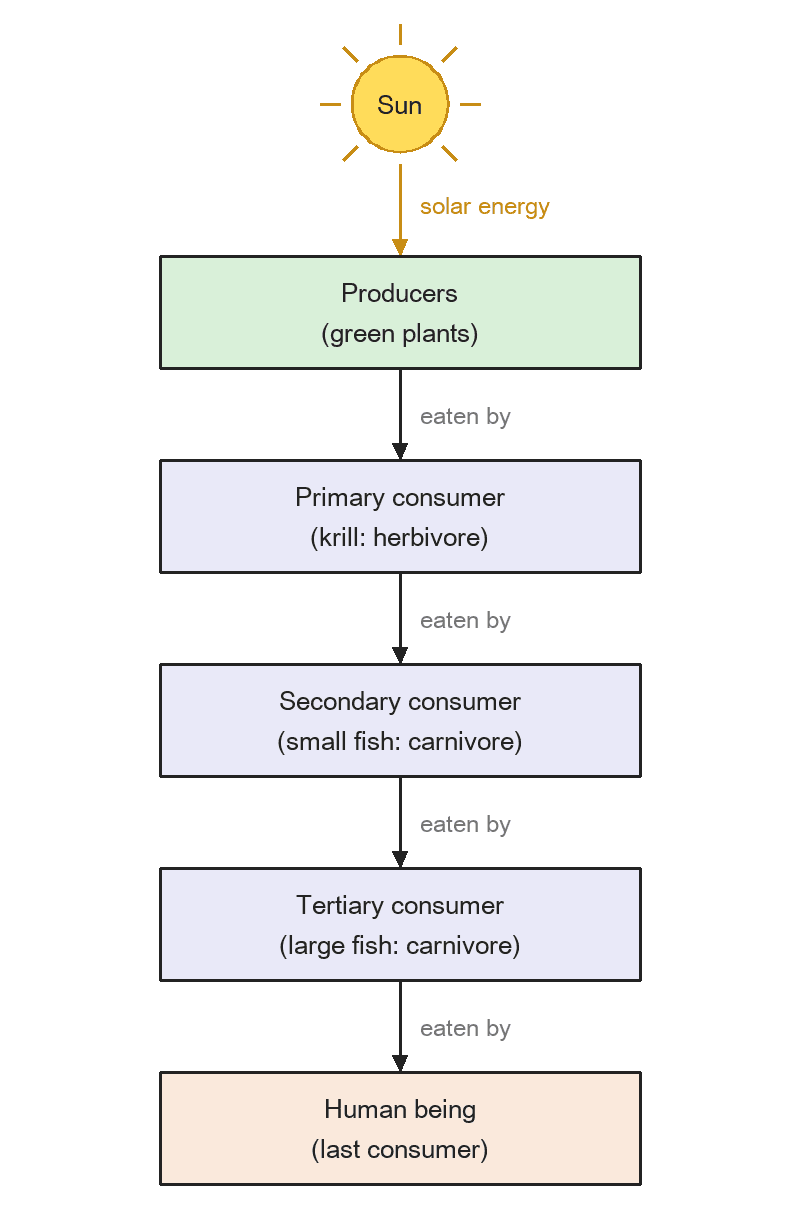
The sun supplies energy to the producers, the green plants, which make food by photosynthesis.
Step 2 — Add the consumers.
Each consumer eats the one before it.
1. Primary consumers (krill, herbivores) eat the producers.
2. Secondary consumers (small fish, carnivores) eat the krill.
3. Tertiary consumers (large fish, carnivores) eat the small fish.
4. Humans may be the last consumer when they eat the large fish.
Step 3 — Draw the chain.
The arrows point in the direction in which food, and so energy, passes.
Watch out: Arrows in a food chain point from the eaten to the eater, the way energy moves.
Therefore, a simple food chain is: sun → green plants → krill → small fish → large fish → human.
- 615 marks
Question 61
Describe the energy flow in an ecosystem.
Solve with AIWritten solution
Solution:
Concept: Energy enters through the producers and passes step by step to the consumers; at every step most of it is used in respiration or lost in decay.
Step 1 — Producers.
The producers (green plants) build complex food from simple compounds using solar energy. The chemical energy so stored is the gross primary production, 20,810 cal in the chapter's example. The plants use 11,977 cal in their own respiration, and the rest, the net primary production, is stored.
Step 2 — Primary consumers (herbivores).
The herbivores obtain only 3,368 cal of the plants' stored energy; the rest is lost when the uneaten plant matter decays.
They use 1,890 cal in respiration and store the rest.
Step 3 — Secondary consumers (carnivores).
They obtain only 383 cal from the herbivores; the rest of the herbivores' store is lost in decay.
They use 316 cal in respiration and store the rest.
Step 4 — Tertiary consumers (carnivores).
They obtain only 21 cal; the rest is lost in decay.
They use 15 cal in respiration, and the 6 cal left is lost when they die and decay.
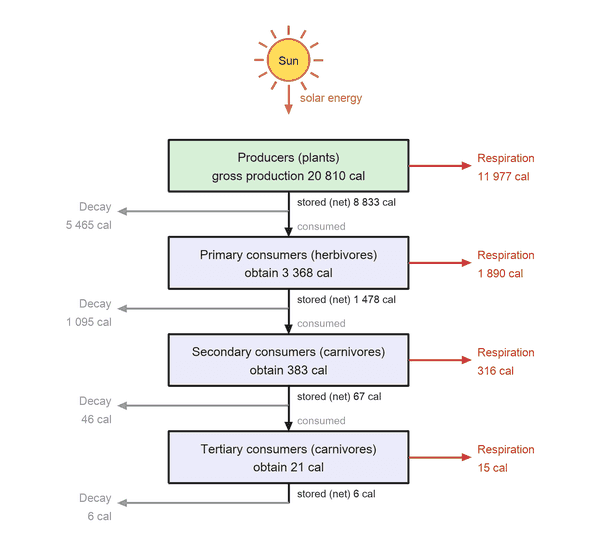
Step 5 — Draw the conclusion.
At every level only a small part of the energy passes on, and the rest ends as heat. The energy flows in one direction only (sun → producers → consumers) and does not come back, so the flow is linear, not cyclic.
Note: these are the chapter's example figures. In the real field study they come from, the values are kilocalories per square metre per year; the chapter writes them simply as cal.
Therefore, energy flows in one direction from the sun through the producers to the primary, secondary and tertiary consumers, becoming less at every step (20,810 → 3,368 → 383 → 21 cal), and it ends as non-useful heat.
- 624 marks
Question 62
Show that the energy flow in an ecosystem is linear.
Solve with AIWritten solution
Solution:
Concept: Linear means the energy moves in one fixed direction and never comes back to where it started.
Step 1 — Say where energy enters.
Energy enters the ecosystem from the sun through the producers (green plants), which store it as chemical energy by photosynthesis.
Step 2 — Follow its path.
From the producers it passes to the primary consumers, then the secondary consumers, then the tertiary consumers, by eating and being eaten: sun → producers → primary → secondary → tertiary consumers.
Step 3 — Show where it ends.
At each step a large part of the energy is used in respiration or lost in decay, and it escapes as heat to the surroundings. Plants cannot use this heat again.
Step 4 — Check that it never goes back.
Energy is never passed backwards: a herbivore's energy does not go back to the plant, and the heat given out does not go back to the sun.
Watch out: Materials such as carbon and minerals are recycled by decomposers, but energy is not.
Therefore, the energy flow is linear: it moves in one direction from the sun to the producers and consumers, ends as heat, and never returns to the sun.
- 635 marks
Question 63
Draw a simple diagram showing the energy flow in a food chain.
Solve with AIWritten solution
Solution:
Concept: At each level energy is received, part is used in respiration, part is lost in decay, and only a little passes to the next level.
Step 1 — Draw the levels.
Draw the sun, then the producers, primary, secondary and tertiary consumers one below the other. At each level, show the energy taken in, the part used in respiration (arrow to the right) and the part lost in decay (arrow to the left).
Step 2 — Read the producers' level.
The producers fix 20,810 cal (gross production); 11,977 cal is used in respiration and 8,833 cal is stored.
Step 3 — Read the consumers' levels.
The primary consumers obtain 3,368 cal (5,465 cal lost in decay), use 1,890 cal in respiration and store 1,478 cal. The secondary consumers obtain 383 cal (1,095 cal lost in decay), use 316 cal and store 67 cal. The tertiary consumers obtain 21 cal (46 cal lost in decay), use 15 cal, and 6 cal is lost in decay.
Step 4 — See the trend.
The energy passed on becomes smaller and smaller at each step: 20,810 → 3,368 → 383 → 21 cal.
Note: these are the chapter's example figures. In the real field study they come from, the values are kilocalories per square metre per year; the chapter writes them simply as cal.
Therefore, the diagram shows energy entering the producers and passing to each level of consumers, getting much smaller at every step.
- 645 marks
Question 64
Draw a diagram to show that the energy flow in an ecosystem is governed by the law of conservation of energy.
Solve with AIWritten solution
Solution:
Concept: The energy 'lost' at each stage is not destroyed; it changes into heat. Adding all the parts gives back the energy that entered.
Step 1 — Show the energy that enters.
The producers fix 20,810 cal of solar energy; this is all the energy that enters the food chain.

Step 2 — Add the energy used in respiration.
At every level a part of the energy is used in respiration and given out as heat.
Step 3 — Add the energy lost in decay.
At every level another part is lost in decay.
Step 4 — Compare the total with the input.
The two parts together should account for all the energy that entered.
Step 5 — Draw the conclusion.
The sum is exactly the 20,810 cal fixed by the producers. No energy has been created or destroyed; it has only changed form, from chemical energy to heat. This is the law of conservation of energy (first law of thermodynamics). At the same time the energy ends as non-useful heat, showing the second law.
Note: these are the chapter's example figures. In the real field study they come from, the values are kilocalories per square metre per year; the chapter writes them simply as cal.
Therefore, respiration (14,198 cal) and decay (6,612 cal) together equal the 20,810 cal fixed by the producers, so the energy flow obeys the law of conservation of energy.
- 651 mark
Question 65
The ultimate source of energy is :
Solve with AIAnswer
(A) wood
(B) wind
(C) water
- Correct
(D) sun.
Answer: (D) sun
Concept: Almost all the energy we use on the earth comes, directly or indirectly, from the sun.
Step 1 — Trace each source back.
Wood stores energy that trees trapped from sunlight; wind blows because the sun heats the earth unevenly; rivers flow because the sun drives evaporation and rain.
Step 2 — Name the ultimate source.
So the energy of wood, wind and water all comes, directly or indirectly, from the sun. The sun is the ultimate source.
Why the other options are wrong:
- (A) wood: Wood stores solar energy trapped by trees in photosynthesis, so it is not the ultimate source.
- (B) wind: Winds are caused by unequal heating of the earth by the sun, so wind energy also comes from the sun.
- (C) water: The water cycle (evaporation and rain) is driven by the sun, so the energy of flowing water comes from the sun.
Therefore, the ultimate source of energy is the sun, option (D).
- 661 mark
Question 66
Renewable source of energy is :
Solve with AIAnswer
(A) coal
(B) fossil fuels
(C) natural gas
- Correct
(D) sun.
Answer: (D) sun
Concept: Renewable sources are replenished by nature; fossil fuels are not.
Step 1 — Recall the meaning of renewable.
A renewable source keeps giving energy continuously and is not used up.
Step 2 — Check the options.
Coal, petroleum and natural gas are fossil fuels: they took millions of years to form and cannot be replaced once used. The sun will keep shining for billions of years, so it is renewable.
Why the other options are wrong:
- (A) coal: Coal is a fossil fuel that took millions of years to form, so it is non-renewable.
- (B) fossil fuels: Fossil fuels cannot be replaced quickly once used, so they are non-renewable.
- (C) natural gas: Natural gas is a fossil fuel, so it is non-renewable.
Therefore, the renewable source of energy is the sun, option (D).
- 671 mark
Question 67
A natural source providing us energy continuously is called :
Solve with AIAnswer
(A) non-renewable
(B) conventional
- Correct
(C) renewable
(D) none of the above
Answer: (C) renewable
Concept: Sources of energy are grouped as renewable or non-renewable by whether they will run out.
Step 1 — Match the description.
A natural source that gives us energy continuously, and is not used up, is called a renewable (or non-conventional) source of energy.
Step 2 — Give examples.
The sun, wind and flowing water are renewable sources.
Why the other options are wrong:
- (A) non-renewable: Non-renewable sources, such as coal, will get used up; they do not give energy continuously.
- (B) conventional: Conventional sources are the non-renewable ones, such as coal and petroleum, so this is wrong.
- (D) none of the above: This is wrong because option (C), renewable, is the right name.
Therefore, a natural source providing energy continuously is called renewable, option (C).
- 681 mark
Question 68
The ......... energy of wind is called wind energy.
Solve with AIAnswer
(A) potential
(B) chemical
(C) electric
- Correct
(D) kinetic
Answer: (D) kinetic
Concept: Kinetic energy is the energy of motion; potential energy is the energy of position.
Step 1 — See what wind is.
Wind is a large mass of air in motion.
Step 2 — Name its energy.
The energy a body has because of its motion is kinetic energy. So wind energy is the kinetic energy of the moving air.
Why the other options are wrong:
- (A) potential: Potential energy is due to position or shape, not motion, so it is not wind energy.
- (B) chemical: Chemical energy is stored in fuels and food, not in moving air.
- (C) electric: Electrical energy is produced only after a wind generator changes the wind's kinetic energy.
Therefore, the kinetic energy of wind is called wind energy, option (D).
- 691 mark
Question 69
The energy obtained from the sun is called :
Solve with AIAnswer
(A) solar
(B) renewable
(C) non-renewable
- Correct
(D) both (a) and (b)
Answer: (D) both solar and renewable
Concept: Solar energy is the energy of the sun, a source that will not run out.
Step 1 — Name it.
Energy obtained from the sun is called solar energy.
Step 2 — Classify it.
The sun will go on giving energy for billions of years, so solar energy is also a renewable source. Both words describe it.
Why the other options are wrong:
- (A) solar: 'Solar' is right, but it is also renewable, so this is only half the answer.
- (B) renewable: 'Renewable' is right, but it is also called solar energy, so this is only half the answer.
- (C) non-renewable: The sun's energy will not get used up, so it is not non-renewable.
Therefore, the energy obtained from the sun is called solar energy and it is renewable, option (D).
- 701 mark
Question 70
The value of solar constant is :
Solve with AIAnswer
(A) 1.34 kW km
- Correct
(B) 1.34 kW m
(C) 1.34 kW m
(D) none of the above
Answer: (B) 1.34 kW m⁻²
Concept: The solar constant is the power of sunlight per unit area just outside the atmosphere.
Step 1 — Recall the definition.
The solar constant is the solar energy reaching the earth's upper atmosphere each second on an area of 1 m² held at right angles to the sun's rays.
Step 2 — Find its unit.
Energy per second is power (watt), and per square metre means dividing by m², so the unit is W m⁻² (or kW m⁻²).
Step 3 — Recall its value.
The chapter gives the value as about 1.34 kW m⁻², which matches option (B) in both number and unit.
Watch out: The unit must be power DIVIDED by area: kW m⁻², not kW m².
Note: present-day satellite measurements give the solar constant as about 1.36 kW m⁻²; the chapter's 1.34 kW m⁻² is close to it.
Why the other options are wrong:
- (A) The number is right, but the area unit should be square metre, not square kilometre.
- (C) kW m² means power multiplied by area, which is not power per unit area.
- (D) none of the above: This is wrong because option (B) gives the right value and unit.
Therefore, the solar constant is about 1.34 kW m⁻², option (B).
- 711 mark
Question 71
The correct renewable sources of energy are :
(i) Biomass
(ii) Nuclear fuel
(iii) Coal
(iv) Petroleum
Solve with AIAnswer
(A) (i)
(B) (iii)
(C) (ii) and (iv)
- Correct
(D) (i) and (ii)
Answer: (D) biomass and nuclear fuel
Concept: A renewable source can give energy over a long time without running out; fossil fuels are non-renewable.
Step 1 — Recall the chapter's list.
The chapter lists the renewable sources as the sun, wind, flowing water, biomass, tides, oceans, geothermal hot spots and nuclear fuel, because they can provide energy over a long period of time.
Step 2 — Check each item.
Biomass (item i) and nuclear fuel (item ii) are in that list. Coal (item iii) and petroleum (item iv) are fossil fuels, which are non-renewable.
Note: we keep the printed key, which follows the chapter's own list. Most books call nuclear fuel (uranium) non-renewable, because it is a mineral found in limited amounts; on that view the answer would be (A), biomass only.
Why the other options are wrong:
- (A) This leaves out nuclear fuel, which the chapter also counts as renewable.
- (B) Coal is a fossil fuel and is non-renewable.
- (C) Petroleum is a fossil fuel and is non-renewable, so this pair is wrong.
Therefore, by the chapter's list, the renewable sources are biomass and nuclear fuel, option (D).
- 721 mark
Question 72
Geothermal energy is the energy possessed by the:
Solve with AIAnswer
(A) Sun
(B) Wind
(C) Biomass
- Correct
(D) Rocks
Answer: (D) Rocks
Concept: Geothermal energy is the heat stored in hot rocks inside the earth.
Step 1 — Break up the word.
The word comes from 'geo', meaning earth, and 'thermal', meaning heat, so geothermal energy is heat from inside the earth.
Step 2 — Name what holds it.
At some places (hot spots) the rocks below the surface are very hot. The heat energy possessed by these rocks is geothermal energy.
Why the other options are wrong:
- (A) Sun: The energy of the sun is solar energy, not geothermal energy.
- (B) Wind: The energy of the wind is wind energy, not geothermal energy.
- (C) Biomass: The energy stored in biomass is bio-energy, not geothermal energy.
Therefore, geothermal energy is the energy possessed by hot rocks, option (D).
- 731 mark
Question 73
The main constituent of biogas is :
Solve with AIAnswer
(A) oxygen
(B) carbon dioxide
(C) nitrogen
- Correct
(D) methane
Answer: (D) methane
Concept: Biogas is a fuel gas made from wastes by bacteria working without air; its burning part is methane.
Step 1 — Recall how biogas forms.
Biogas is made when animal dung and plant wastes rot in the absence of air, helped by bacteria.
Step 2 — Name its main gas.
The main gas formed is methane, usually about 55 % to 75 % of biogas; most of the rest is carbon dioxide, with traces of hydrogen and hydrogen sulphide.
Why the other options are wrong:
- (A) oxygen: Biogas is formed in the absence of oxygen, and oxygen is not one of its gases.
- (B) carbon dioxide: Carbon dioxide is present, but in a smaller amount than methane, and it does not burn.
- (C) nitrogen: Nitrogen is present at most as a trace, so it is not the main constituent.
Therefore, the main constituent of biogas is methane, option (D).
- 741 mark
Question 74
The chemical formula of the strong-smelling substance that is mixed in LPG is :
Solve with AIAnswer
(A)
- Correct
(B)
(C)
(D)
Answer: (B) C₂H₅SH (ethyl mercaptan)
Concept: Ethyl mercaptan is the strong-smelling compound added to LPG; 'ethyl' means the group C₂H₅.
Step 1 — Recall why a smell is added.
LPG has no smell of its own, so a leak would go unnoticed. A strong-smelling substance is mixed with it so that a leak can be detected at once.
Step 2 — Name the substance and its formula.
The substance is ethyl mercaptan (ethanethiol). It is an ethyl group, C₂H₅, joined to an –SH group, so its formula is C₂H₅SH.
Why the other options are wrong:
- (A) C₂H₂SH does not contain an ethyl group (C₂H₅), so it is not ethyl mercaptan.
- (C) CH₅SH is not a possible formula: one carbon atom cannot hold five hydrogen atoms and an –SH group.
- (D) C₂SH₃ has the atoms in the wrong numbers and is not ethyl mercaptan.
Therefore, the strong-smelling substance mixed in LPG is ethyl mercaptan, C₂H₅SH, option (B).
- 751 mark
Question 75
The process used for refining of petroleum is known as :
Solve with AIAnswer
(A) evaporation
(B) filteration
(C) distillation
- Correct
(D) fractional distillation
Answer: (D) fractional distillation
Concept: Liquids with different boiling points can be separated by fractional distillation.
Step 1 — See what refining means.
Crude petroleum is a mixture of many substances (petrol, kerosene, diesel and so on) that boil at different temperatures. Refining separates them.
Step 2 — Name the process.
The mixture is heated and its parts are collected at different heights of a tall column, according to their boiling points. This is fractional distillation.
Why the other options are wrong:
- (A) evaporation: Evaporation would only drive off the volatile parts; it does not collect the parts separately.
- (B) filteration: Filtration separates solids from liquids, not one liquid from another.
- (C) distillation: Simple distillation cannot separate the many parts of petroleum, whose boiling points are close.
Therefore, petroleum is refined by fractional distillation, option (D).
- 761 mark
Question 76
Identify the incorrect statement(s) about solar panels.
(i) The running costs of solar panels is very high.
(ii) They do not cause any pollution.
(iii) They last over a long period of time.
Solve with AIAnswer
- Correct
(A) (i)
(B) (ii)
(C) (iii)
(D) (i) and (iii)
Answer: (A) only statement i
Concept: Solar panels are costly to set up but almost free to run, clean and long-lasting.
Step 1 — Judge statement i.
Sunlight is free and solar panels need hardly any maintenance, so their running cost is almost nil. Statement i, which says the running cost is very high, is incorrect. (It is the setting-up cost that is high.)
Step 2 — Judge statement ii.
Solar panels give out no smoke or gases while working, so statement ii is correct.
Step 3 — Judge statement iii.
Solar panels last a long time (usually 20 years or more), so statement iii is correct.
Watch out: The question asks for the INCORRECT statement.
Why the other options are wrong:
- (B) Statement ii is correct: solar panels do not cause pollution while working.
- (C) Statement iii is correct: solar panels last over a long period of time.
- (D) Statement iii is correct, so this pair cannot be the incorrect statements.
Therefore, only statement i is incorrect, option (A).
- 771 mark
Question 77
The non-renewable sources of energy are :
Solve with AIAnswer
(A) Coal
(B) Petroleum
(C) Natural gas
- Correct
(D) All of the above
Answer: (D) All of the above
Concept: Fossil fuels are non-renewable sources of energy.
Step 1 — Recall what fossil fuels are.
Coal, petroleum and natural gas were formed over millions of years from the remains of plants and animals buried under the earth.
Step 2 — Classify them.
Once used, they cannot be replaced in a human lifetime, so all three are non-renewable.
Why the other options are wrong:
- (A) Coal: Coal is non-renewable, but so are petroleum and natural gas, so this is incomplete.
- (B) Petroleum: Petroleum is non-renewable, but so are coal and natural gas, so this is incomplete.
- (C) Natural gas: Natural gas is non-renewable, but so are coal and petroleum, so this is incomplete.
Therefore, coal, petroleum and natural gas are all non-renewable, option (D).
- 782 marks
Question 78
State two characteristics which a source of energy must have.
Solve with AIWritten solution
Solution:
Concept: A good source of energy must be adequate, steady, safe and economical.
Step 1 — Think about the amount and rate.
A source of energy should give an adequate amount of useful energy at a steady rate over a long period of time.
Step 2 — Think about use.
It should be safe and convenient to use, economical, and easy to store and transport.
Therefore, a source of energy must (1) give enough useful energy at a steady rate over a long time, and (2) be safe, convenient, economical and easy to store and transport.
- 792 marks
Question 79
Select the renewable and non-renewable sources of energy from the following :
(a) Coal (b) Wood (c) Water (d) Diesel (e) Wind (f) Oil
Solve with AIWritten solution
Solution:
Concept: Sources that nature keeps renewing are renewable; fossil fuels are non-renewable.
Step 1 — Pick out the renewable sources.
Wood (trees can be grown again), water (kept flowing by the water cycle) and wind (kept blowing by the sun) can be renewed.
Step 2 — Pick out the non-renewable sources.
Coal, diesel and oil are fossil fuels or are made from them, so they cannot be renewed.
Therefore, renewable: (b) wood, (c) water, (e) wind; non-renewable: (a) coal, (d) diesel, (f) oil.
- 801 mark
Question 80
What is the main source of energy for the earth ?
Solve with AIWritten solution
Solution:
Concept: Almost all forms of energy on the earth come from sunlight.
Step 1 — Trace the energy we use.
Food, fuels, wind and flowing water all get their energy, directly or indirectly, from sunlight.
Step 2 — Name the main source.
So the main source of energy for the earth is the sun.
Therefore, the main source of energy for the earth is the sun.
- 812 marks
Question 81
State the energy transformation in the following:
(i) electricity is obtained from solar energy.
(ii) electricity is obtained from wind energy.
(iii) electricity is obtained from hydro energy.
(iv) electricity is obtained from nuclear energy.
Solve with AIWritten solution
Solution:
Concept: Follow the energy from its source, step by step, to the generator's output.
Step 1 — (i) Solar energy.
In a solar cell, light energy changes directly into electrical energy. In a solar power plant, solar energy → heat energy of steam → kinetic energy of the turbine → electrical energy.
Step 2 — (ii) Wind energy.
Kinetic energy of the wind → rotational kinetic energy of the blades and turbine → electrical energy.
Step 3 — (iii) Hydro energy.
Potential energy of water stored in a dam → kinetic energy of the falling water → rotational kinetic energy of the turbine → electrical energy.
Step 4 — (iv) Nuclear energy.
Nuclear energy → heat energy → kinetic energy of steam and turbine → electrical energy.
Therefore, in each case the source energy is changed (through heat or motion) into the rotation of a turbine, or directly in a solar cell, and finally into electrical energy.
- 821 mark
Question 82
The conversion of part of energy into an unuseful form of energy is called ............ .
Solve with AIWritten solution
Solution:
Concept: Energy that changes into a form we cannot use is said to be degraded.
Step 1 — See what is described.
When energy changes form, part of it changes into a form we cannot use, mostly heat.
Step 2 — Name it.
This is called degradation (or dissipation) of energy.
Therefore, the conversion of part of energy into an unuseful form is called degradation of energy.
- 832 marks
Question 83
Name the two groups in which various sources of energy are classified. State on what basis are they classified.
Solve with AIWritten solution
Solution:
Concept: Sources are grouped by whether nature replaces them as fast as we use them.
Step 1 — Name the two groups.
Sources of energy are grouped into two kinds.
1. Renewable (non-conventional) sources: for example the sun, wind and flowing water.
2. Non-renewable (conventional) sources: for example coal, petroleum and natural gas.
Step 2 — State the basis.
They are classified by availability: whether the source can give energy continuously and be renewed, or whether it will be used up once consumed.
Therefore, sources of energy are classified as renewable and non-renewable, on the basis of their availability.
- 843 marks
Question 84
What is meant by renewable and non-renewable sources of energy ? State two differences between them, giving two examples of each.
Solve with AIWritten solution
Solution:
Concept: Renewable sources are replenished by nature; non-renewable sources took millions of years to form and will run out.
Step 1 — Define renewable sources.
A renewable (non-conventional) source gives us energy continuously; it can be used again and again and will not get used up.
Step 2 — Define non-renewable sources.
A non-renewable (conventional) source has collected in nature over a very long time and cannot be replaced quickly once it is used up.
Step 3 — Write two differences.
The table compares the two kinds.
Renewable sources Non-renewable sources Energy can be obtained from them continuously over a long period of time. Energy cannot be obtained from them continuously over a long period of time. They will not get used up and can be regenerated. They will get used up and cannot be regenerated. Step 4 — Give examples.
Renewable: the sun (solar energy) and wind. Non-renewable: coal and petroleum.
Therefore, renewable sources (sun, wind) give energy continuously and are regenerated, while non-renewable sources (coal, petroleum) will be used up and cannot be regenerated.
- 852 marks
Question 85
Why is the use of wood as a fuel not advisable although wood is a renewable source of energy ?
Solve with AIWritten solution
Solution:
Concept: Wood is renewable only in principle; trees grow slowly and cutting them harms the environment.
Step 1 — Compare growth with use.
Trees take many years (often more than 15) to grow fully, so wood is renewed very slowly. We would use it up much faster than it could be replaced.
Step 2 — Think of the environment.
Cutting trees on a large scale destroys forests, which adds to global warming and upsets the balance of nature (loss of habitat, soil erosion, less rainfall).
Step 3 — Think of the air.
Burning wood gives out a lot of smoke and carbon dioxide, which pollute the air.
Therefore, wood should not be used as a fuel because trees take many years to grow again, cutting them destroys forests, and burning wood pollutes the air.
- 862 marks
Question 86
Name five renewable and three non-renewable sources of energy.
Solve with AIWritten solution
Solution:
Concept: Renewable sources mostly come from the sun; the fossil fuels are non-renewable.
Step 1 — List five renewable sources.
The sun, wind, flowing water (hydro), biomass and tides are renewable; ocean and geothermal energy are other examples.
Step 2 — List three non-renewable sources.
Coal, petroleum and natural gas are the fossil fuels, which are non-renewable.
Therefore, renewable: sun, wind, flowing water, biomass, tides; non-renewable: coal, petroleum, natural gas.
- 873 marks
Question 87
What is (i) tidal, (ii) ocean and (iii) geo thermal energy ? Explain in brief.
Solve with AIWritten solution
Solution:
Concept: These are energies from the motion and heat of the sea and from the heat inside the earth.
Step 1 — (i) Tidal energy.
The sea rises (high tide) and falls (low tide) twice a day. The energy of this rising and falling water is tidal energy. It is used by building a dam across a narrow opening to the sea and running turbines as water flows in and out. It is not a major source, because the rise and fall is small at most places and very few sites are suitable.
Step 2 — (ii) Ocean energy.
Ocean water has energy in two forms.
(a) Ocean thermal energy: the sun heats the surface water while deep water stays cold. Where the difference is about 20 °C or more, the energy available from it can run an ocean thermal energy conversion (OTEC) plant.
(b) Sea-wave energy: winds make the surface waves move fast, and the kinetic energy of these waves is sea-wave energy.
Step 3 — (iii) Geothermal energy.
At some places (hot spots) the rocks below the surface are very hot. Their heat is geothermal energy. These rocks turn underground water into steam, which is brought up through pipes to turn turbines and produce electricity.
Therefore, tidal energy is the energy of the rising and falling tides, ocean energy is the energy of the ocean's temperature difference and waves, and geothermal energy is the heat of hot rocks inside the earth.
- 883 marks
Question 88
State two advantages and two limitations of producing electricity from solar energy.
Solve with AIWritten solution
Solution:
Concept: Solar electricity is clean and cheap to run, but costly to set up and available only in sunlight.
Step 1 — State two advantages.
Producing electricity from sunlight has clear benefits.
1. It causes no pollution while working, so it is one of the cleanest sources of electricity.
2. Its running cost is almost nil and it needs little maintenance; it also suits remote places where power lines cannot reach.
Step 2 — State two limitations.
It also has drawbacks.
1. The initial cost of solar panels is high.
2. Only a small part of the sunlight is turned into electricity (low efficiency), and no electricity is made at night or when it is cloudy.
Therefore, solar electricity is pollution-free and almost free to run, but its setting-up cost is high and its efficiency is low.
- 893 marks
Question 89
State two advantages and two limitations of using wind energy for generating electricity.
Solve with AIWritten solution
Solution:
Concept: Wind energy is clean and never runs out, but it needs steady winds and much land.
Step 1 — State two advantages.
Wind power has these benefits.
1. It causes no pollution.
2. It is a renewable source that will not run out.
Step 2 — State two limitations.
It also has these drawbacks.
1. A wind farm can be set up only where the wind blows steadily for most of the year, with a speed of at least about 15 km h⁻¹.
2. A wind farm needs a large area of land, and setting it up is costly.
Therefore, wind energy is pollution-free and renewable, but it needs sites with steady strong winds and a large area of land.
- 903 marks
Question 90
What is nuclear energy ? Name the process used for producing electricity using the nuclear energy.
Solve with AIWritten solution
Solution:
Concept: In a nuclear reaction a little mass disappears and appears as a large amount of energy.
Step 1 — Explain where the energy comes from.
When a heavy nucleus such as uranium-235 splits (fission), or light nuclei join (fusion), the products have slightly less mass than the starting nuclei. This lost mass m appears as energy E, given by Einstein's relation, where c is the speed of light (3 × 10⁸ m s⁻¹).
Step 2 — Define nuclear energy.
The energy released in this way, in nuclear fission or fusion, is called nuclear energy.
Step 3 — Name the process for electricity.
Electricity is produced by the controlled chain reaction of nuclear fission of uranium-235 (or plutonium-239) in a nuclear reactor. Control rods (of cadmium or boron) absorb some of the neutrons to keep the reaction steady.
Watch out: Power plants use FISSION; controlled fusion is still being developed.
Therefore, nuclear energy is the energy released when a small mass disappears in a nuclear reaction (E = mc²), and electricity is produced by the controlled chain reaction of nuclear fission in a reactor.
- 915 marks
Question 91
What is solar energy ? How is solar energy used to generate electricity in a solar power plant ?
Solve with AIWritten solution
Solution:
Concept: A solar power plant concentrates sunlight to boil water, and the steam drives a turbine and generator.
Step 1 — Define solar energy.
Solar energy is the energy obtained from the sun. Nuclear fusion inside the sun releases a huge amount of energy, which spreads out in all directions; the earth receives a tiny part of it.
Step 2 — State the principle of the plant.
In a solar power plant the sun's heat is used to make electricity. Sun rays reflected from a large concave reflector are concentrated at its focus, where they can boil water.
Step 3 — Describe the construction.
The plant has many large concave reflectors. At the focus of each there are black-painted water pipes (black absorbs heat well).
Step 4 — Describe the working.
The reflectors concentrate sunlight on the pipes, so the water inside boils into steam. The steam turns a turbine, which drives a generator that produces electricity.
Step 5 — Write the energy changes.
Solar energy → heat energy of steam → kinetic energy of the turbine → electrical energy.
Therefore, solar energy is the energy of the sun, and in a solar power plant concentrated sunlight boils water into steam that turns a turbine to generate electricity.
- 925 marks
Question 92
What is a solar cell ? State two uses of solar cells. State whether a solar cell produces a.c. or d.c. Give one disadvantage of using a solar cell.
Solve with AIWritten solution
Solution:
Concept: A solar cell turns light directly into electricity using a semiconductor.
Step 1 — Define a solar cell.
A solar cell is a device that changes solar (light) energy directly into electrical energy. It is made of a semiconductor such as silicon (or gallium arsenide) with suitable impurities. In sunlight a potential difference of about 0.5 V appears across it; many cells joined over a large area form a solar panel.
Step 2 — Give two uses.
Solar cells have many uses.
1. They supply electricity to artificial satellites.
2. They run watches and calculators (and water pumps, street lights, radio and TV in remote areas).
Step 3 — Say a.c. or d.c.
A solar cell gives a steady current in one direction, so it produces d.c.
Step 4 — Give one disadvantage.
Its efficiency is low: only a small part of the light falling on it becomes electricity (it is also costly to set up and does not work at night).
Therefore, a solar cell converts sunlight directly into electricity; it is used in satellites and calculators, it produces d.c., and its low efficiency is a disadvantage.
- 934 marks
Question 93
State two advantages and two disadvantages of producing hydro electricity.
Solve with AIWritten solution
Solution:
Concept: Hydroelectricity is clean and renewable, but dams disturb the environment.
Step 1 — State two advantages.
Hydroelectricity has these benefits.
1. It does not pollute the environment.
2. It is renewable; dams also help with irrigation and flood control.
Step 2 — State two disadvantages.
It also has these drawbacks.
1. Fast-flowing water is not available everywhere, so hydro plants can be built only at suitable places.
2. Building dams floods land, destroying plants and animals there, and disturbs the ecological balance downstream.
Therefore, hydroelectricity is pollution-free and renewable, but it is possible only at suitable sites and dams harm the local ecology.
- 944 marks
Question 94
What percentage of total electrical power generated in India is obtained from nuclear power plants ? Name two places in India where electricity is generated from nuclear power plants.
Solve with AIWritten solution
Solution:
Concept: Nuclear energy is still a small part of India's electricity supply.
Step 1 — Give the percentage.
Nuclear power plants supply only a small part of India's electricity, about 3 % of the total generated.
Step 2 — Name two places.
Two nuclear power plants are at Tarapur (Maharashtra) and Kalpakkam (Tamil Nadu). Others are at Rawatbhata (Rana Pratap Sagar, Rajasthan), Narora (Uttar Pradesh), Kaiga (Karnataka), Kakrapar (Gujarat) and Kudankulam (Tamil Nadu).
Therefore, about 3 % of India's electricity comes from nuclear power plants, for example at Tarapur and Kalpakkam.
- 954 marks
Question 95
State two advantages and two disadvantages of using nuclear energy for producing electricity.
Solve with AIWritten solution
Solution:
Concept: A little nuclear fuel gives a huge amount of energy, but radiation and waste are dangerous.
Step 1 — State two advantages.
Nuclear power has these benefits.
1. A very small amount of nuclear fuel (such as uranium-235) gives a huge amount of energy.
2. Once loaded, the fuel keeps giving energy for a long time, and the plant gives out no carbon dioxide while working.
Step 2 — State two disadvantages.
It also has these drawbacks.
1. The radiations produced are highly penetrating and harmful to living things, so very strict safety measures are needed to protect workers and the public.
2. The radioactive waste stays dangerous for a very long time and must be stored safely; it can pollute the environment if it leaks.
Therefore, nuclear energy gives a lot of energy from little fuel over a long time, but its radiations and radioactive waste are harmful and need strict safety.
- 964 marks
Question 96
State four ways for the judicious use of energy.
Solve with AIWritten solution
Solution:
Concept: Fossil fuels are limited, so energy must be used wisely and renewable sources used more.
Step 1 — Save fossil fuels.
Coal and petroleum should be used only where no other source can be used, because they are limited.
Step 2 — Avoid waste.
Energy should not be wasted: switch off lights and fans when not needed and use public transport.
Step 3 — Protect trees.
Cutting of trees should be stopped and more trees planted.
Step 4 — Use renewable sources.
Ways should be developed to use renewable sources, such as solar, wind, hydro, bio- and ocean energy, as much as possible.
Therefore, four ways are: use fossil fuels only when needed, avoid wasting energy, stop cutting trees, and use renewable sources as much as possible.
- 975 marks
Question 97
What do you mean by degradation of energy ? Explain it by taking two examples of your daily life.
Solve with AIWritten solution
Solution:
Concept: In every energy change, part of the energy turns into a form (mostly heat) that is of no use to us.
Step 1 — Define degradation of energy.
When energy is changed into a form we want, not all of it changes into that form. A part becomes an unwanted form, usually heat (because of friction), or is lost to the surroundings by radiation. This gradual loss of useful energy is called degradation of energy. The total energy stays the same, but less of it is available for useful work.
Step 2 — Example 1: an electric bulb.
In an ordinary filament bulb only about 5 % to 10 % of the electrical energy becomes light; the rest becomes heat, which only warms the air around it.
Step 3 — Example 2: a vehicle.
Only a part of the energy of the fuel moves a car. Much of it is wasted in heating the engine, in working against friction between the tyres and the road, and as sound.
Watch out: Degraded energy is not destroyed; it is still there as heat, but we cannot use it.
Therefore, degradation of energy is the gradual loss of useful energy into unwanted forms (mainly heat), as in an electric bulb or a running vehicle.
- 985 marks
Question 98
What is wind energy ? How is wind energy used to produce electricity ? How much electric power is generated in India using wind energy ?
Solve with AIWritten solution
Solution:
Concept: A wind turbine turns the kinetic energy of the wind into rotation, which a generator turns into electricity.
Step 1 — Define wind energy.
Wind is a large mass of moving air, so it has kinetic energy. The kinetic energy of the wind is called wind energy.
Step 2 — Describe the wind generator.
A small electric generator is placed at the top of a tall tower. Its armature is joined to the shaft that carries the blades of the wind turbine.
Step 3 — Explain how it works.
The wind turns the blades, so the kinetic energy of the wind becomes the rotational kinetic energy of the blades. The blades turn the armature in a magnetic field, so an alternating e.m.f. is produced.
Step 4 — Combine many generators.
One wind generator gives only a small power, so many are set up over a large area (a wind farm) and their power is combined and supplied to consumers.
Step 5 — State India's wind power.
The chapter gives India's wind power as more than 10,000 MW, mainly from Gujarat and Tamil Nadu. India's installed wind capacity has grown a great deal since then: by 2025 it had reached about 50,000 MW.
Therefore, wind energy is the kinetic energy of moving air; a wind turbine turns a generator to make electricity, and India's wind power, given in the chapter as over 10,000 MW, was about 50,000 MW by 2025.
- 991 mark
Question 99
The gases which are good ......... of long wavelength infrared radiations are called greenhouse gases.
Solve with AIAnswer
(A) emitters
(B) reflectors
- Correct
(C) absorbers
(D) none of the above
Answer: (C) absorbers
Concept: Greenhouse gases let sunlight in but absorb the infrared radiation given out by the warm earth.
Step 1 — Follow the radiation.
Sunlight warms the earth's surface, and the warm surface gives out long-wavelength infrared radiation.
Step 2 — See what greenhouse gases do.
Gases such as carbon dioxide, water vapour, methane and nitrous oxide absorb this infrared radiation and so trap heat in the lower atmosphere. Being good absorbers of it is what makes them greenhouse gases.
Why the other options are wrong:
- (A) emitters: They do give out infrared radiation, but it is their absorbing it that traps heat and defines them.
- (B) reflectors: They trap heat by absorbing the radiation, not by reflecting it.
- (D) none of the above: This is wrong because option (C), absorbers, is the right word.
Therefore, greenhouse gases are good absorbers of long-wavelength infrared radiation, option (C).
- 1001 mark
Question 100
The green house gas is :
Solve with AIAnswer
(A) oxygen
(B) nitrogen
(C) chlorine
- Correct
(D) carbon dioxide.
Answer: (D) carbon dioxide
Concept: Gases whose molecules absorb infrared radiation (carbon dioxide, methane, water vapour) are greenhouse gases.
Step 1 — Recall what a greenhouse gas does.
A greenhouse gas absorbs the long-wavelength infrared radiation given out by the earth.
Step 2 — Check the options.
Carbon dioxide absorbs infrared radiation strongly, so it is a greenhouse gas; it is the main one added by human activity.
Why the other options are wrong:
- (A) oxygen: Oxygen, a main gas of air, hardly absorbs infrared radiation, so it is not a greenhouse gas.
- (B) nitrogen: Nitrogen, the main gas of air, hardly absorbs infrared radiation, so it is not a greenhouse gas.
- (C) chlorine: Chlorine is not a greenhouse gas (though chlorofluorocarbons, which contain chlorine, are).
Therefore, the greenhouse gas is carbon dioxide, option (D).
- 1011 mark
Question 101
The increase of carbon dioxide gas in atmosphere will cause :
Solve with AIAnswer
(A) decrease in temperature
- Correct
(B) increase in temperature
(C) decrease in humidity
(D) increase in humidity.
Answer: (B) increase in temperature
Concept: Carbon dioxide is a greenhouse gas: the more of it there is, the more heat is trapped.
Step 1 — See what extra carbon dioxide does.
More carbon dioxide absorbs more of the infrared radiation given out by the earth, so more heat is trapped in the atmosphere.
Step 2 — Find the effect.
With more heat trapped, the average temperature of the earth rises. This is global warming.
Why the other options are wrong:
- (A) decrease in temperature: Trapping more heat raises the temperature; it cannot lower it.
- (C) decrease in humidity: Humidity (water vapour in the air) is not the direct effect of more carbon dioxide.
- (D) increase in humidity: A change in humidity is not the direct effect asked about; the direct effect is warming.
Therefore, an increase of carbon dioxide in the atmosphere causes an increase in temperature, option (B).
- 1021 mark
Question 102
Without green house effect, the average temperature of earth's surface would have been :
Solve with AIAnswer
- Correct
(A) –18°C
(B) 33°C
(C) 0°C
(D) 15°C
Answer: (A) about −18 °C
Concept: The natural greenhouse effect keeps the earth about 33 °C warmer than it would otherwise be.
Step 1 — Recall the present average temperature.
With its greenhouse gases, the earth's average surface temperature is about 15 °C.
Step 2 — Recall the greenhouse warming.
The natural greenhouse gases warm the surface by about 33 °C.
Step 3 — Take the warming away.
Without the greenhouse effect, the average temperature would be this much lower.
Watch out: 33 °C is the warming, not the temperature.
Why the other options are wrong:
- (B) 33°C: 33 °C is the size of the greenhouse warming, not the temperature without it.
- (C) 0°C: 0 °C does not follow from the 33 °C warming; the earth would be much colder, about −18 °C.
- (D) 15°C: About 15 °C is the present average temperature WITH the greenhouse effect.
Therefore, without the greenhouse effect the earth's average temperature would be about −18 °C, option (A).
- 1031 mark
Question 103
Global warming means a ............ in average effective temperature near the earth's surface due to an ....... in the amount of greenhouse gases in its atmosphere.
Solve with AIAnswer
(A) decrease, increase
(B) decrease, decrease
(C) increase, decrease
- Correct
(D) increase, increase
Answer: (D) increase, increase
Concept: Global warming is the rise in the earth's average temperature caused by extra greenhouse gases.
Step 1 — Fill the first blank.
The word warming means a rise, so global warming is an increase in the average temperature near the earth's surface.
Step 2 — Fill the second blank.
The rise is caused by more heat being trapped, which happens when the amount of greenhouse gases increases.
Why the other options are wrong:
- (A) decrease, increase: Warming is a rise in temperature, not a decrease.
- (B) decrease, decrease: Both words are wrong: warming is a rise, and it is caused by more greenhouse gases, not less.
- (C) increase, decrease: Fewer greenhouse gases would trap less heat and cause cooling, not warming.
Therefore, global warming is an increase in temperature due to an increase in greenhouse gases, option (D).
- 1041 mark
Question 104
The global warming has resulted in :
Solve with AIAnswer
(A) the increase in yield of crops
(B) the decrease in sea levels
(C) the decrease in human deaths
- Correct
(D) the increase in sea levels.
Answer: (D) the increase in sea levels
Concept: Global warming melts land ice and warms the oceans.
Step 1 — See what warming does to ice and water.
Global warming is melting glaciers and the ice sheets on land, and this water flows into the oceans. Warmer sea water also expands.
Step 2 — Find the result.
Both effects make the sea level rise.
Why the other options are wrong:
- (A) the increase in yield of crops: Warming has not raised crop yields overall; heat waves and droughts lower yields in many hot regions.
- (B) the decrease in sea levels: Melting land ice and expanding sea water raise the sea level; they do not lower it.
- (C) the decrease in human deaths: Deaths from heat strokes and from diseases that spread in warmer weather have increased, not decreased.
Therefore, global warming has resulted in an increase in sea levels, option (D).
- 1052 marks
Question 105
What do you mean by greenhouse effect ?
Solve with AIWritten solution
Solution:
Concept: Greenhouse gases let sunlight in but trap the heat radiated by the earth, like the glass of a greenhouse.
Step 1 — Follow the energy.
Sunlight passes through the air and warms the earth's surface. The warm surface gives out long-wavelength infrared radiation.
Step 2 — See what the gases do.
Greenhouse gases such as carbon dioxide, water vapour, methane, nitrous oxide, ozone and chlorofluorocarbons (CFCs) absorb this infrared radiation and keep the heat in the lower atmosphere.
Step 3 — Define the effect.
This warming of the earth's surface and lower atmosphere by the greenhouse gases is the greenhouse effect.
Therefore, the greenhouse effect is the warming of the earth's surface and lower atmosphere because greenhouse gases absorb the infrared radiation given out by the earth.
- 1061 mark
Question 106
Name three greenhouse gases.
Solve with AIWritten solution
Solution:
Concept: Greenhouse gases are good absorbers of long-wavelength infrared radiation.
Step 1 — Recall what makes a greenhouse gas.
A greenhouse gas absorbs the long-wavelength infrared radiation given out by the earth.
Step 2 — Name three.
Three such gases are carbon dioxide, methane and nitrous oxide.
Therefore, three greenhouse gases are carbon dioxide, methane and nitrous oxide (water vapour, ozone and CFCs are others).
- 1071 mark
Question 107
Which of the following solar radiations pass through the atmosphere of the earth ?
X-rays, ultraviolet rays, visible light rays, infrared radiation.
Solve with AIWritten solution
Solution:
Concept: The atmosphere is transparent mainly to visible light and short-wavelength infrared.
Step 1 — Check the short-wavelength radiations.
X-rays are absorbed high up in the atmosphere, and most of the ultraviolet rays are absorbed by the ozone layer, so these do not reach the ground (only a little near-ultraviolet gets through).
Step 2 — Check the rest.
Visible light passes through the atmosphere, and so does the short-wavelength infrared radiation from the sun.
Therefore, visible light rays and infrared radiation pass through the earth's atmosphere.
- 1081 mark
Question 108
Name the radiations which are absorbed by the greenhouse gases.
Solve with AIWritten solution
Solution:
Concept: A cool body like the earth radiates long-wavelength infrared, which greenhouse gases absorb.
Step 1 — Find the radiation given out by the earth.
The earth's surface is much cooler than the sun, so it gives out radiation of long wavelength, in the infrared.
Step 2 — Name what the gases absorb.
Greenhouse gases absorb this long-wavelength infrared radiation.
Therefore, greenhouse gases absorb the long-wavelength infrared radiation emitted by the earth's surface.
- 1091 mark
Question 109
What would have been the temperature of earth's atmosphere in absence of greenhouse gases in it ?
Solve with AIWritten solution
Solution:
Concept: Greenhouse gases warm the earth by about 33 °C.
Step 1 — Recall the present temperature and the warming.
The earth's average surface temperature is about 15 °C, and the natural greenhouse gases keep it about 33 °C warmer than it would otherwise be.
Step 2 — Take the warming away.
Without greenhouse gases the average temperature would be lower by this amount.
Therefore, in the absence of greenhouse gases the earth's average temperature would be about −18 °C (about 0 °F).
- 1102 marks
Question 110
What results in the increase of carbon dioxide contents of earth's atmosphere ?
Solve with AIWritten solution
Solution:
Concept: Human activities add carbon dioxide faster than nature can remove it.
Step 1 — Burning of fossil fuels.
Coal, petroleum and natural gas burnt in power plants, factories and vehicles add carbon dioxide to the air; cement making adds more. People now release about 37 billion tonnes of carbon dioxide a year from fossil fuels.
Step 2 — Deforestation.
Clearing forests leaves fewer trees to take in carbon dioxide, and burning the cut trees adds more of it.
Step 3 — Growing population.
More people use more fuel and energy, so more carbon dioxide is released.
Step 4 — An unbalanced carbon cycle.
The oceans and plants cannot take up all the extra carbon dioxide, so it builds up in the air.
Therefore, the carbon dioxide content of the air is increasing mainly because of burning fossil fuels and cutting down forests, along with a growing population.
- 1112 marks
Question 111
State the effect of greenhouse gases on the temperature of earth's atmosphere.
Solve with AIWritten solution
Solution:
Concept: Greenhouse gases trap heat: the right amount keeps the earth warm; too much overheats it.
Step 1 — See what the gases do.
Greenhouse gases absorb the long-wavelength infrared radiation given out by the earth and do not let it escape into space, so they keep the surface and lower atmosphere warm.
Step 2 — The right amount is useful.
The natural amount of these gases keeps the earth's average temperature at about 15 °C instead of about −18 °C, which makes life possible.
Step 3 — Too much is harmful.
If the amount of greenhouse gases increases, more heat is trapped and the average temperature rises further. This is global warming.
Therefore, greenhouse gases raise the temperature of the earth's atmosphere by trapping heat; more of them means a higher temperature.
- 1122 marks
Question 112
What do you mean by global warming ?
Solve with AIWritten solution
Solution:
Concept: Global warming is the rise in the earth's average temperature caused by extra greenhouse gases.
Step 1 — Define global warming.
Global warming is the increase in the average temperature near the earth's surface caused by an increase in the amount of greenhouse gases in the atmosphere.
Step 2 — Give the scale of it.
The earth's average surface temperature is now about 1.2 °C higher than in the late 1800s, mainly because human activities have added carbon dioxide and other greenhouse gases.
Therefore, global warming means the rise in the average temperature near the earth's surface due to an increase in greenhouse gases.
- 1132 marks
Question 113
What causes the rise in atmospheric temperature?
Solve with AIWritten solution
Solution:
Concept: More greenhouse gases trap more heat.
Step 1 — Name the cause.
The atmosphere is getting warmer because the proportion of greenhouse gases (carbon dioxide, methane, nitrous oxide and others) in it has increased.
Step 2 — Explain how it warms.
These gases absorb the long-wavelength infrared radiation from the earth's surface, so more heat is trapped in the atmosphere instead of escaping into space.
Step 3 — Say where the extra gases come from.
They come from human activities: burning fossil fuels, industry, cutting forests and the use of motor vehicles.
Therefore, the rise in atmospheric temperature is caused by the increase of greenhouse gases, which trap more of the heat radiated by the earth.
- 1142 marks
Question 114
State the cause of increase of greenhouse effect.
Solve with AIWritten solution
Solution:
Concept: Human activities have increased the amounts of greenhouse gases in the atmosphere.
Step 1 — Carbon dioxide.
Burning fossil fuels, industry and the clearing of forests have raised the carbon dioxide in the air from about 280 ppm (parts per million) before 1750 to about 425 ppm today, about 50 % more. Carbon dioxide causes about two-thirds of the extra greenhouse warming.
Step 2 — Methane.
Rice fields, cattle, natural gas production and leaks, and burning of biomass have raised methane to more than two and a half times its old level.
Step 3 — Other gases.
Nitrous oxide from fertilisers has also increased. CFCs from old refrigerators and sprays added to the effect; they are now banned and slowly decreasing, but some gases that replaced them are also greenhouse gases.
Note: the chapter's older figures (carbon dioxide up by 25 %, methane doubled, CFCs rising by 5 % a year) are out of date; the values above are current.
Therefore, the greenhouse effect is increasing because human activities have raised the amounts of greenhouse gases, mainly carbon dioxide and methane.
- 1152 marks
Question 115
What will be the effect of global warming at the poles ?
Solve with AIWritten solution
Solution:
Concept: Warming melts polar ice.
Step 1 — Sea ice.
Warming is melting the floating sea ice around the poles; the Arctic sea ice is shrinking fast and may almost vanish in some summers within a few decades.
Step 2 — Land ice.
The great ice sheets on land, in Greenland and Antarctica, are losing ice, and this water flows into the oceans and raises the sea level.
Step 3 — Polar animals.
Animals such as polar bears and seals lose the icy habitat they depend on.
Watch out: Melting of floating sea ice hardly changes the sea level; it is the melting of ice on land that raises it.
Therefore, global warming is melting the ice at the poles, which shrinks the sea ice, raises the sea level (from land ice) and destroys the habitat of polar animals.
- 1162 marks
Question 116
State the effect of global warming in coastal regions.
Solve with AIWritten solution
Solution:
Concept: A rising sea floods low coastal land.
Step 1 — Find the main effect.
Melting land ice and the expansion of warming sea water raise the sea level.
Step 2 — Say what this does to the coast.
Low-lying coastal land, with its buildings and roads, gets flooded, and sea water gets into wells and farmland.
Step 3 — Add the effect of storms.
Warmer seas make tropical storms and hurricanes stronger, so coastal areas suffer more damage.
Therefore, in coastal regions global warming raises the sea level, so low-lying buildings and roads get flooded and stronger storms cause damage.
- 1172 marks
Question 117
How will global warming affect the sea level ?
Solve with AIWritten solution
Solution:
Concept: Melting land ice and expanding warm water both add to the oceans' volume.
Step 1 — Give the two causes.
Glaciers and the ice sheets on land melt and their water flows into the oceans; and warmer sea water expands.
Step 2 — Give the rate.
Both raise the sea level. The global sea level has risen by about 3.3 mm a year on average since 1993, and by more than 4 mm a year in the last decade, and the rate is expected to grow.
Therefore, global warming raises the sea level, which floods low-lying coastal areas.
- 1182 marks
Question 118
How will global warming affect agriculture ?
Solve with AIWritten solution
Solution:
Concept: Warming shifts the regions where crops grow well.
Step 1 — Hot regions.
A warming of about 3 °C would give poorer crop yields in the low-latitude (hot) regions and increase malnutrition there.
Step 2 — Cooler regions.
Crop yields are expected to increase in some middle- and high-latitude regions.
Step 3 — Effect on farmers.
So farming regions would have to shift from low latitudes towards higher latitudes. Changes in rainfall, more droughts and floods, and changes in the flowering season of plants would also affect farming.
Therefore, global warming would lower crop yields in hot low-latitude regions, raise them in some cooler regions, and make farming shift towards higher latitudes.
- 1192 marks
Question 119
State two ways to minimise the impact of global warming.
Solve with AIWritten solution
Solution:
Concept: Cut down the emission of greenhouse gases and increase their absorption.
Step 1 — Cut the emissions.
Generate electricity from renewable sources (solar, wind, tidal, geothermal) instead of fossil-fuel power plants.
Step 2 — Increase the absorption.
Plant more trees (reforestation) and stop deforestation, so that more carbon dioxide is taken up.
Therefore, two ways are using renewable sources of energy instead of fossil fuels, and planting more trees.
- 1202 marks
Question 120
What is carbon tax ? Who will pay it ?
Solve with AIWritten solution
Solution:
Concept: A carbon tax makes polluters pay for the carbon dioxide they release.
Step 1 — Define carbon tax.
A carbon tax is a tax charged on the carbon dioxide released, usually so much per tonne of carbon dioxide emitted (or on the carbon in the fuel burnt).
Step 2 — Say who pays it.
It is paid by the industries and companies that burn fossil fuels and release carbon dioxide.
Step 3 — Say why it helps.
Since more emission means more tax, it pushes industries to save energy and switch to cleaner sources, which reduces emissions.
Therefore, carbon tax is a tax on carbon dioxide emission, and it is paid by the industries that release it.
- 1215 marks
Question 121
State, in detail, the causes of global warming.
Solve with AIWritten solution
Solution:
Concept: Global warming is caused by the increase in greenhouse gases due to human activities.
Step 1 — State the main cause.
Global warming is caused by the increase of greenhouse gases in the atmosphere due to human activities. These gases absorb more of the infrared radiation from the earth's surface and trap more heat, which strengthens the greenhouse effect.
Step 2 — More carbon dioxide.
Carbon dioxide has risen from about 280 ppm before 1750 to about 425 ppm today, about 50 % more, and causes about two-thirds of the extra warming. Its causes are:
(a) burning fossil fuels in power plants, transport and industry (cement factories in particular);
(b) deforestation, which leaves fewer trees to absorb carbon dioxide;
(c) a growing population using more energy (about 37 billion tonnes of carbon dioxide a year come from fossil fuels);
(d) an unbalanced carbon cycle: the oceans and plants cannot take up all the extra carbon dioxide.
Step 3 — More methane.
Methane has risen to more than two and a half times its old level, because of rice cultivation, cattle rearing, natural gas production and leaks, and burning of biomass.
Step 4 — Other gases.
Nitrous oxide from fertilisers has increased. CFCs from refrigerators, air conditioners and sprays added to the warming; they are now banned and slowly decreasing, but some of the gases that replaced them are also strong greenhouse gases.
Note: the chapter's older figures (carbon dioxide up by 25 %, methane doubled, CFCs rising by 5 % a year) are out of date; the values above are current.
Therefore, global warming is caused by the increase of greenhouse gases, mainly carbon dioxide (from fossil fuels and deforestation) and methane, which enhances the greenhouse effect.
- 1225 marks
Question 122
What technological measures are necessary to minimise the impact of global warming ?
Solve with AIWritten solution
Solution:
Concept: Use technology that releases less carbon dioxide.
Step 1 — Use renewable sources for electricity.
Power plants burning fossil fuels are the largest single source of greenhouse gases (roughly a third of all emissions). Electricity should be generated more and more from wind, solar, tidal and geothermal energy, and fossil-fuel power plants phased out.
Step 2 — Use battery-operated vehicles.
Transport, mostly vehicles with petrol and diesel engines, gives about 15 % of greenhouse gas emission. Electric cars, bikes and scooters, charged from renewable sources, would cut this; vehicles should also be used at full capacity and made smaller.
Step 3 — Use bio-char stoves.
In developing countries much cooking is done by burning biomass, which gives smoke and greenhouse gases. In a bio-char stove the biomass is heated with very little air: it gives combustible gases that burn cleanly and leaves charcoal (biochar), which can be buried in the soil so that its carbon stays out of the air.
Therefore, the technological measures are generating electricity from renewable sources, using battery-operated vehicles, and using bio-char stoves for cooking.
- 1235 marks
Question 123
What policy measures should the government enforce in order to minimise global warming ?
Solve with AIWritten solution
Solution:
Concept: Policies should change people's lifestyle and slow the growth of population.
Step 1 — Educate for a sustainable lifestyle.
Children should be taught to live sustainably: that happiness lies in a cooperative rather than a competitive society, that buying more and more is not the aim of life, and that we should make full use of what we have.
Step 2 — Control population growth.
The world population, about 8.2 billion in 2025, is expected to reach about 9.7 billion by 2050, mostly in developing countries. Growth can be slowed by:
1. free and easy access to family planning;
2. welfare measures that encourage smaller families;
3. empowering women through education and freedom to choose a career (educated women tend to plan their families).
Step 3 — Use economic measures.
The government can also support reforestation and make industries pay a carbon tax.
Therefore, the government should promote a sustainable lifestyle through education and control population growth through family planning, welfare measures and the empowerment of women.
What Class 9 Physics Ch 6 covers
The sections of the chapter, in the order the book takes them. Every question above comes from one of these.
- 01Concept of Heat
- 02Concept of Temperature
- 03Thermal Expansion
- 04Anomalous Expansion of Water
- 05Energy Flow in an Ecosystem
- 06Sources of Energy
More ways to study this chapter
The same chapter asked three other ways. Practise it, revise it, and see what the board has set on Ch 6 before.
Class 9 Physics Ch 6 questions students ask
How many questions are there in Class 9 Physics Ch 6?
123 questions. Every one is solved step by step on this page.
Are these Class 9 Physics solutions free?
Yes. Every question and its full working is free to read, with no account needed.
Can I download the Class 9 Physics Ch 6 solutions as a PDF?
There is no PDF to download. Every solution is on this page instead, which means it is searchable, always the current syllabus, and readable on a phone. Use your browser's print option if you want it on paper.