
Question 615 marksMedium
Describe the energy flow in an ecosystem.
Confirming your payment
Sign up now and get 250 free tokens.
Heat and Energy · Question 61 of 123
Describe the energy flow in an ecosystem.
Solution:
Concept: Energy enters through the producers and passes step by step to the consumers; at every step most of it is used in respiration or lost in decay.
Step 1 — Producers.
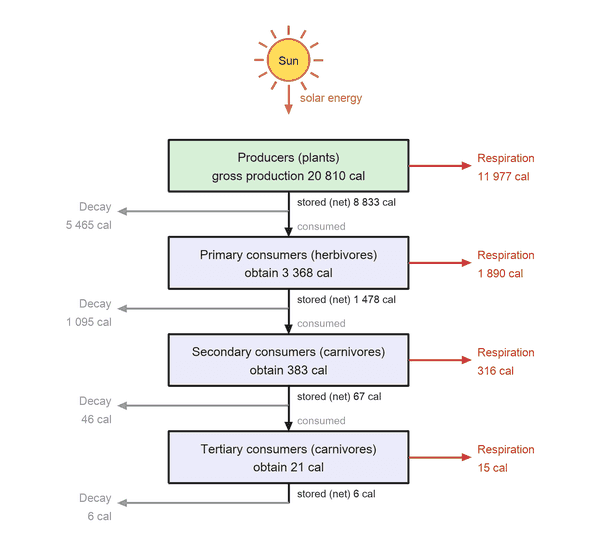
The producers (green plants) build complex food from simple compounds using solar energy. The chemical energy so stored is the gross primary production, 20,810 cal in the chapter's example. The plants use 11,977 cal in their own respiration, and the rest, the net primary production, is stored.
Step 2 — Primary consumers (herbivores).
The herbivores obtain only 3,368 cal of the plants' stored energy; the rest is lost when the uneaten plant matter decays.
They use 1,890 cal in respiration and store the rest.
Step 3 — Secondary consumers (carnivores).
They obtain only 383 cal from the herbivores; the rest of the herbivores' store is lost in decay.
They use 316 cal in respiration and store the rest.
Step 4 — Tertiary consumers (carnivores).
They obtain only 21 cal; the rest is lost in decay.
They use 15 cal in respiration, and the 6 cal left is lost when they die and decay.
Step 5 — Draw the conclusion.
At every level only a small part of the energy passes on, and the rest ends as heat. The energy flows in one direction only (sun → producers → consumers) and does not come back, so the flow is linear, not cyclic.
Note: these are the chapter's example figures. In the real field study they come from, the values are kilocalories per square metre per year; the chapter writes them simply as cal.
Therefore, energy flows in one direction from the sun through the producers to the primary, secondary and tertiary consumers, becoming less at every step (20,810 → 3,368 → 383 → 21 cal), and it ends as non-useful heat.