
Opening your dashboard
Class 9 Physics Chapter 6 Heat and Energy: Competency-Based Questions (CBQ)
40 questions on Chapter 6, each worked through on its own page with the AI tutor. Class 9 Physics, ICSE 2026-27.
40 questions
1–5 marks · Mixed difficulty
- 11 mark
Question 1
Competency: Application
Three water baths in a laboratory were set by three students, each using a thermometer with a different scale. Their labels read :
Bath P : 310 K
Bath Q : 40°C
Bath R : 100°F
Which list gives the baths in order from the hottest to the coldest ?
- 21 mark
Question 2
Competency: Analysis
A glass flask is filled with coloured water at 25°C and closed with a cork that carries a long narrow glass tube. The water stands part of the way up the tube and its level is marked. The flask is then lowered quickly into a trough of water at 70°C.
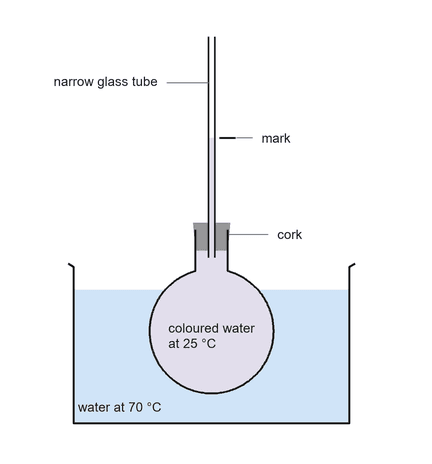
The level in the tube first falls a little below the mark, and then rises steadily well above it. Which explanation fits both observations ?
- 31 mark
Question 3
Competency: Application & Analysis
A beaker is filled with water at 4°C exactly up to its brim. In trial 1 the beaker is slowly warmed until the water is at 8°C. In trial 2 an identical brim-full beaker at 4°C is slowly cooled until the water is at 1°C. Neglecting any change in the size of the beaker, in which trial does water spill over the brim ?
- 41 mark
Question 4
Competency: Understanding & Analysis
A visitor to a power plant notices that it has no boiler and uses no steam anywhere, yet its generator is driven by a turbine. Which pair of power plants could the visitor be describing ?
- 51 mark
Question 5
Competency: Understanding
Assertion (A): A tiny spark from a sparkler, at about 1000°C, landing on the hand does much less harm than a cupful of boiling water at 100°C spilt on it.
Reason (R): The heat energy contained in a body depends on its mass as well as on its temperature.
- 61 mark
Question 6
Competency: Understanding
Assertion (A): If the earth's atmosphere had no greenhouse gases at all, the earth would be a more comfortable place for living things.
Reason (R): Greenhouse gases absorb the long wavelength infrared radiations given out by the earth's surface.
- 72 marks
Question 7
Competency: Application
The label on a packet of biscuits of brand X says that one serving supplies 105 kcal of energy. The label of brand Y gives the energy of one serving as 420 kJ.
(a) Express the energy of one serving of brand X in joule. (Take 1 cal = 4.2 J.)
(b) Which brand supplies more energy in one serving, and by how many kilojoule ?
- 82 marks
Question 8
Competency: Analysis
Rods of three metals, each exactly 1 m long at 20°C, are heated to 120°C. The increase in length of each rod is given in the table.
Metal Increase in length Aluminium 2.4 mm Brass 1.9 mm Iron 1.2 mm (a) Wires of these three metals, equal in length, are stretched equally tight between the same pair of poles on a winter morning. Which wire will sag the most on a hot summer afternoon ? Give a reason from the table.
(b) An iron rod is stuck tightly in a hole in an aluminium plate. To pull the rod out easily, should the plate and the rod be heated together or cooled together ? Explain.
- 92 marks
Question 9
Competency: Analysis & Evaluation
A company wants to set up a wind farm and has collected the following data for three sites.
Site Average speed of wind How the wind blows P 12 km h steadily throughout the year Q 20 km h steadily throughout the year R 40 km h for about two months of the year; almost still in the other months (a) Which site should the company choose ? Give the reason for rejecting each of the other two.
(b) State one more thing about the chosen site that the company must check before building the wind farm.
- 102 marks
Question 10
Competency: Application & Analysis
The grain harvested from a field stores 50 000 kJ of energy as food. The grain can be used in two ways.
Way 1 : people eat the grain.
Way 2 : the grain is fed to hens and people eat the hens. The hens store as food in their bodies only 10% of the energy of the grain they eat.
(a) How much energy is available to people as food in way 2 ? How many times as much is available in way 1 ?
(b) What happens to the rest of the energy of the grain in way 2 ? Is it destroyed ?
- 114 marks
Question 11
Competency: Analysis
Case study: Meera fills a tall metal jar with water at 12°C. She fixes one thermometer A in the water near the top of the jar and another thermometer B near the bottom. She then packs a freezing mixture of ice and salt round the middle of the jar only, and notes both readings every 10 minutes.
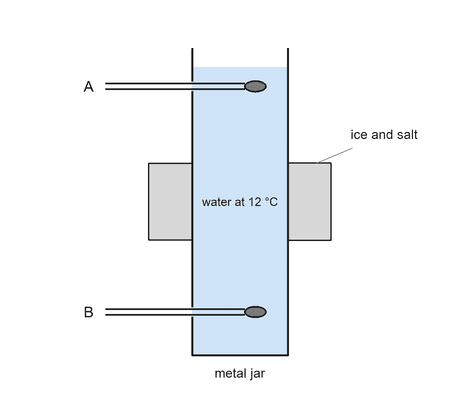
Her graph is shown below, but she forgot to write which curve belongs to which thermometer.

(a) Which curve, X or Y, shows the readings of thermometer B at the bottom ? Give a reason.
(b) From 30 minutes onwards, curve X stays level while curve Y keeps falling. Explain both facts.
(c) Meera's friend says, "If the jar is left for a few more minutes, the thermometer at the bottom will also drop quickly to 0°C." Do you agree ? Give a reason, and state where ice will form first in the jar.
- 124 marks
Question 12
Competency: Application & Evaluation
Case study: A school wants to run its lights, fans and computers in the daytime with solar panels fixed on its roof. The school needs 3000 W of electric power. The supplier gives the following data. (1 W = 1 J s)
Quantity Value Solar energy falling on 1 m of a panel each second on a clear day 800 J Area of one panel 1.5 m Part of the solar energy that a panel changes into electrical energy 15% Number of panels offered 20 (a) Calculate the solar energy falling on one panel each second on a clear day.
(b) Calculate the total electric power given by the 20 panels on a clear day. Is it enough for the school ?
(c) On a cloudy day the solar energy falling on 1 m each second drops to 300 J. The principal says, "If we buy 40 panels instead of 20, we shall have enough power even on a cloudy day." Check this claim by calculation and suggest a better arrangement for cloudy days.
- 134 marks
Question 13
Competency: Analysis & Evaluation
Case study: The port office of a harbour town has recorded the average level of the sea every ten years. The graph shows how much the average sea level has risen above its level in 1990.

(a) From the graph, find the rise in sea level in each of the three ten-year periods. What do these values show about the rate at which the sea is rising ?
(b) Explain two ways in which global warming makes the sea level rise.
(c) The landing platform of the harbour was 16 cm above the average sea level in 2020. An officer says, "The sea rose 4 cm in the last ten years, so the platform is safe until the year 2060." Judge this statement, using your answer to part (a).
- 144 marks
Question 14
Competency: Creation & Application
A laboratory has a mercury thermometer whose scale has been rubbed off. You are given a metre rule, a beaker of crushed melting ice, a flask in which water is boiling (at normal atmospheric pressure) and a marker pen.
(a) Plan how you will use these to put a Celsius scale on the thermometer. State one precaution.
(b) In a trial, the mercury thread was 2.0 cm long (measured from the bulb) in melting ice and 22.0 cm long in the steam above boiling water. When the bulb was dipped in warm oil, the thread was 9.0 cm long. Find the temperature of the oil in degree Celsius.
(c) Express this temperature in kelvin.
- 154 marks
Question 15
Competency: Analysis & Evaluation
Case study: Arjun boils the same amount of water in three ways and finds out, for each, the energy supplied and the energy that actually goes into the water.
Way of heating Energy supplied Energy taken by the water Open wood fire 5000 kJ (from the wood) 500 kJ LPG stove 1250 kJ (from the gas) 750 kJ Electric kettle 900 kJ (electrical energy) 720 kJ (a) For each way, calculate the energy that is degraded and the percentage of the supplied energy that is usefully used.
(b) Where does the degraded energy go ? Does this loss go against the law of conservation of energy ?
(c) Arjun concludes, "The electric kettle wastes the least energy, so it uses the least fuel." The electricity for his house comes from a coal-fired power station, and only 30% of the energy of the coal reaches the house as electrical energy. Judge his conclusion by calculation.
- 161 mark
Question 16
Competency: Application
A school nurse records a student's body temperature as 98.6 °F in the morning and 102.2 °F at noon, using a Fahrenheit thermometer. The doctor wants the rise in temperature expressed in kelvin. What is the rise?
- 171 mark
Question 17
Competency: Application
An old laboratory notebook records that a spirit lamp gave out erg of heat in a small experiment. Using 1 J = erg and 1 cal = 4.2 J, the heat in calorie is :
- 181 mark
Question 18
Competency: Analysis
Equal volumes, 1000 cm each, of air, ethyl alcohol (a liquid) and iron (a solid) are heated through the same rise in temperature of 50 K. The increase in volume of each sample is given below (approximate values).
Substance Increase in volume (cm) Air 170 Ethyl alcohol 55 Iron 1.8 Which conclusion is correctly supported by the table?
- 191 mark
Question 19
Competency: Understanding & Analysis
Read the Assertion (A) and the Reason (R) and choose the correct option.
Assertion (A): In general, on heating through the same rise in temperature, a liquid expands more than a solid of the same volume.
Reason (R): Water contracts when it is heated from 0 °C to 4 °C.
- 201 mark
Question 20
Competency: Understanding & Analysis
Read the Assertion (A) and the Reason (R) and choose the correct option.
Assertion (A): Whenever energy is degraded, the total energy of the universe decreases.
Reason (R): The degraded energy is no longer available to us for useful work.
- 211 mark
Question 21
Competency: Analysis
The figure shows the energy stored as food at each level of a grassland food chain, in kJ per square metre per year. (Hypothetical data.)

Which conclusion is correct?
- 221 mark
Question 22
Competency: Understanding
Kavita's family uses an LPG cylinder for cooking. One morning she notices a strong, unpleasant smell near the stove although the burner is off. Her mother says the smell is a warning that the gas is leaking. Why does LPG, which is made of butane, propane and ethane, have such a smell?
- 231 mark
Question 23
Competency: Analysis
In a nuclear reactor, rods of cadmium are lowered between the rods of uranium. During a safety drill, the engineers imagine that all the cadmium rods are pulled completely out of the reactor while the uranium stays in place. What would happen?
- 241 mark
Question 24
Competency: Analysis
In winter, people notice that a cloudy night is usually warmer than a clear night, when the sky is clear and stars are visible. Which statement gives the correct reason?
- 251 mark
Question 25
Competency: Analysis
A weather observatory measures the amount of carbon dioxide in the air every year. The table gives the yearly averages, rounded, in parts per million (ppm) by volume.
Year 1960 1980 2000 2020 Carbon dioxide (ppm) 317 339 370 414 Which conclusion is correctly supported by the table?
- 262 marks
Question 26
Competency: Understanding & Application
The water at the foot of a very high waterfall is found to be very slightly warmer than the water at the top. The rise is only a fraction of a degree.
(a) Name the form of energy that the water has at the top of the fall, and the form of energy into which it finally changes.
(b) What happens to this heat afterwards, and can we use it to do useful work?
- 272 marks
Question 27
Competency: Application
A scientist cools a sample of nitrogen gas until it becomes a liquid at 77 K. Her student asks whether a body could be cooled to °C.
(a) Express 77 K in degree Celsius and in degree Fahrenheit.
(b) Can a body be at °C? Give a reason.
- 282 marks
Question 28
Competency: Application
To fit an iron tyre on a wooden cart wheel, a village blacksmith makes the ring of iron slightly smaller than the wheel. He heats the ring in a fire and slips it over the wheel. He then pours water on the ring, and the ring grips the wheel very tightly.
(a) Why must he heat the ring before it can be slipped over the wheel?
(b) Why does the ring grip the wheel tightly afterwards?
- 292 marks
Question 29
Competency: Evaluation & Analysis
Two beakers hold water at the same temperature of 40 °C. Beaker P has 100 g of water and beaker Q has 300 g. Both are emptied into one insulated flask. Anil says, "The temperature of the mixture will be °C, because the two lots of water are added."
(a) What will be the temperature of the 400 g of water in the flask? Give a reason.
(b) Is Anil right to add the temperatures? Say what can be added.
- 302 marks
Question 30
Competency: Application
A village fish farmer wants to know how much energy the plants of his pond must store as food so that his big fish can be fed. In his pond the chain is
plants → small fish → big fish
Suppose that each level obtains 10 % of the energy stored as food by the level below it. The big fish need 45 000 cal of stored food energy. (Hypothetical data.)
(a) How much energy must the plants store?
(b) A third consumer, medium fish, is now put between the small fish and the big fish, and the big fish still need 45 000 cal. How many times as much energy must the plants now store?
- 312 marks
Question 31
Competency: Evaluation
A newspaper writes, "India has large coal mines, so there is no need to save energy or to develop other sources of energy."
(a) Give two reasons why this conclusion is not sound.
(b) State one measure for the judicious use of energy that a family can take at home.
- 323 marks
Question 32
Competency: Analysis
The graph shows how the reading on a Fahrenheit thermometer is related to the reading on a Celsius thermometer for the same body. The dashed line is drawn where the two readings would be equal.

(a) Read from the graph the Fahrenheit reading when the Celsius reading is 30 °C.
(b) Find the slope of the straight line and say what it tells you about the two scales.
(c) At what temperature do the two scales show the same reading? Check your answer by calculation.
- 333 marks
Question 33
Competency: Application
A power station feeds 500 MW of electrical power into the transmission lines that carry electricity to a city. Because of the resistance of the lines, 4 % of this power is changed into heat in the wires. The power company plans to change the cables so that only 2.5 % is lost. (Hypothetical data; 1 MW = J s, and 1 kWh is the energy used by 1 kW in 1 hour.)
(a) How much electrical energy is changed into heat in the lines every second at present? Is this energy destroyed?
(b) What power reaches the city at present?
(c) How many kWh of energy does the change of cables save in 1 hour?
- 343 marks
Question 34
Competency: Creativity
You want to show that carbon dioxide helps to keep a space warm by the greenhouse effect. You have two identical clear plastic bottles, two thermometers, a 100 W table lamp, a clock, and the material to make a little carbon dioxide (an effervescent tablet and some water).
(a) Describe how you will set up the two bottles and what you will measure.
(b) State three things that you will keep the same, so that the test is fair.
(c) What result do you expect, and why may the difference be small?
- 353 marks
Question 35
Competency: Evaluation & Analysis
A town gives out 1000 thousand tonnes of carbon dioxide every year: 400 from coal-based power stations, 250 from transport, 200 from industries and 150 from homes. The town council wants to cut its yearly emission by 200 thousand tonnes. It has three measures to choose from. (Hypothetical data.)
Measure What it does Cost per year (₹ crore) P A solar plant replaces one-fourth of the coal-based electricity 50 Q Forty per cent of the travel by petrol and diesel vehicles is moved to an electric metro that runs on solar electricity 120 R Trees planted on waste land take in 30 thousand tonnes of carbon dioxide a year 3 (a) Calculate the reduction in the yearly emission by measure P and by measure Q.
(b) Find the cost per thousand tonnes of carbon dioxide removed for each of P, Q and R.
(c) Which two measures together give the cut of 200 thousand tonnes, and what is their cost? Why is measure R not enough on its own?
- 363 marks
Question 36
Competency: Application
A hill village builds a small hydroelectric plant below a small dam. Every second 2000 kg of water falls through a height of 10 m on to the turbine. Of the energy of the falling water, 60 % is changed into electrical energy. The village has 150 houses, and each house needs 600 W at the busiest time. Take m s. (Hypothetical data.)
(a) Calculate the power of the falling water.
(b) Calculate the electrical power produced.
(c) Can the plant supply all the houses at the busiest time? Show your working.
- 374 marks
Question 37
Competency: Analysis & Evaluation
Case study: Radha pours hot tea into a steel tumbler, covers it with a lid that has a small hole for a thermometer, and puts it on a table in a room whose air stays at 30 °C all through the evening. With a thermometer she notes the temperature of the tea every 10 minutes for one hour. Her friend Imran watches the tea cool and says, "Heat keeps flowing out of the tea all the time, so if we wait long enough the tea will become colder than the room, like chilled water from the refrigerator." The graph shows Radha's readings. (Hypothetical data.)

(a) From the graph, read the temperature of the tea after 10 minutes and the temperature towards which it is settling. Why does it settle at this value?
(b) Find the fall in temperature of the tea in each of the first three intervals of 10 minutes. How does the fall change, and why do you think so?
(c) Evaluate what Imran says.
- 385 marks
Question 38
Competency: Analysis & Evaluation
Case study: The electricity board of a state supplies 20 000 MW of power. The table shows how this power is shared between the sources at present. The board plans to raise the share of solar power from 8 % to 20 % by cutting down only the share of coal. The chief engineer says, "After this plan, solar panels alone will meet the state's demand even at night." (Hypothetical data.)
Source Share of power (%) Coal 60 Natural gas 5 Flowing water (hydro) 15 Wind 12 Solar 8 (a) Which of these sources are non-renewable? What percentage of the state's power comes from them?
(b) After the plan, what will be the share of coal, and the total share of the renewable sources? By how many MW will the solar power increase?
(c) Evaluate the chief engineer's statement.
- 394 marks
Question 39
Competency: Analysis & Evaluation
Case study: A steel flyover is built in sections called girders. There is a small gap between two neighbouring girders, which is covered by a metal plate that can slide. The flyover carries heavy traffic every day, and an engineer checks the gaps every year. The engineer measures the gap when the steel is at different temperatures. On a summer afternoon in Rajasthan the steel may reach about 65 °C. (Hypothetical data.)
Temperature of the steel (°C) 10 20 30 40 50 Gap (mm) 12.0 9.6 7.2 4.8 2.4 (a) What does the table show about the gap when the temperature rises, and why?
(b) At what temperature will the gap close completely? Assume that the gap keeps changing at the same rate.
(c) The gap of 12.0 mm was set when the steel was at 10 °C. Show that this gap is not enough for a temperature of 65 °C, and find the least gap that should be left at 10 °C. Why should the gap not be made much larger than that?
- 405 marks
Question 40
Competency: Application & Creativity
Case study: The eco-club of a school audits the electricity used in one day. The table shows the electrical appliances, the number of each, the power of each and the time for which they work. The school runs on six days a week, and the headmaster has asked the club to find out where electricity can be saved without making classrooms darker or hotter. The school gets its electricity from a power station that burns coal. (Hypothetical data; 1 kWh is the energy used by 1 kW in 1 hour.)
Appliance Number Power of each (W) Hours of use in a day Filament bulb 30 60 6 Tube light 20 40 6 Fan 25 75 6 Computer 10 150 4 (a) Find the energy used in a day by each kind of appliance, and the total energy, in kWh.
(b) All the filament bulbs are replaced by 9 W LED lamps that give the same light. Find the energy saved in a day and the percentage of the total energy that it is.
(c) Plan two more measures that together save at least 3 kWh a day, and show by calculation that they do. Explain how saving electricity helps to reduce global warming.