
Question 375 marksMedium
Describe an experiment to show that water has maximum density at 4°C. What important consequences follow from this peculiar property of water ? Discuss the importance of this phenomenon in nature.
Confirming your payment
Sign up now and get 250 free tokens.
Heat and Energy · Question 37 of 123
Describe an experiment to show that water has maximum density at 4°C. What important consequences follow from this peculiar property of water ? Discuss the importance of this phenomenon in nature.
Solution:
Concept: Hope's experiment shows that water at 4 °C, being the densest, collects at the bottom of a vessel, while colder water stays on top.
Step 1 — Set up Hope's apparatus.
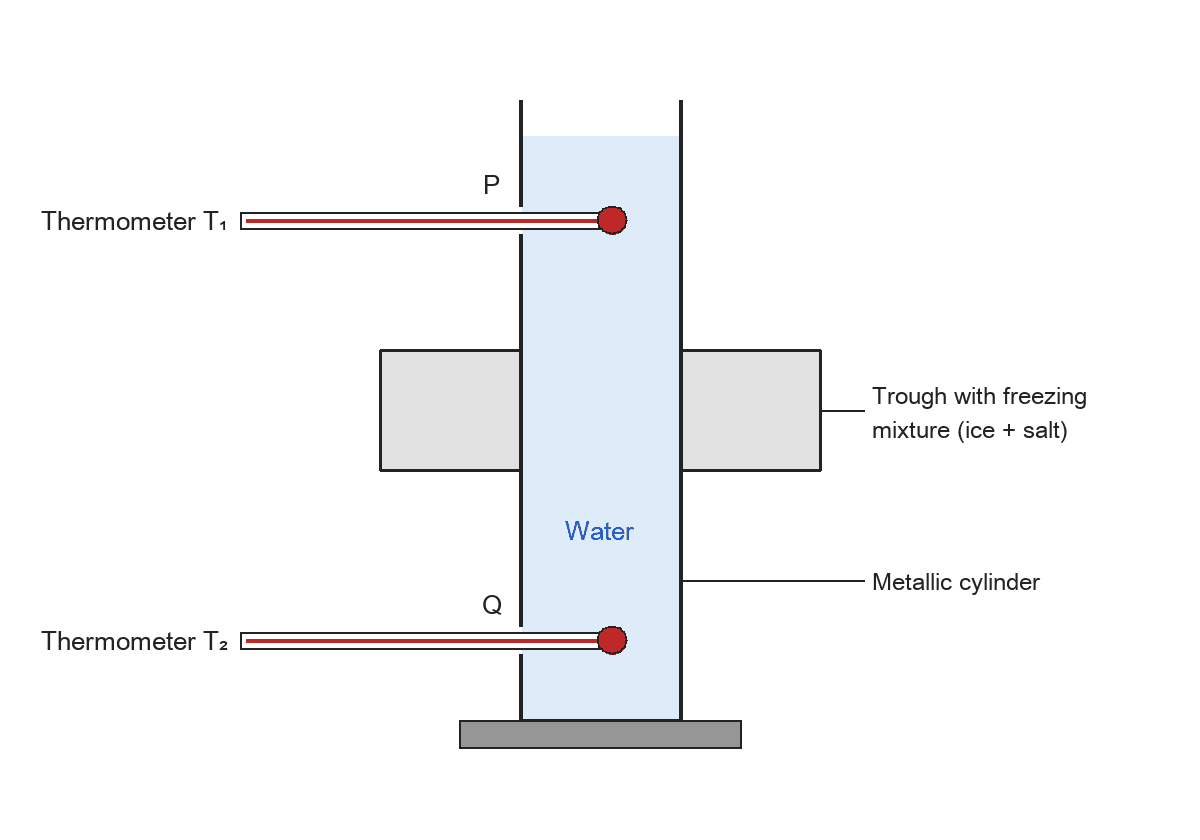
Take a tall metallic cylinder with two side openings, P near the top and Q near the bottom, fitted with thermometers T₁ and T₂. Round the middle of the cylinder is a trough holding a freezing mixture of ice and salt. Fill the cylinder with pure water at room temperature (say 12 °C).
Step 2 — Take the readings.
Note the readings of both thermometers every minute or so.
1. At first T₁ and T₂ show the same room temperature.
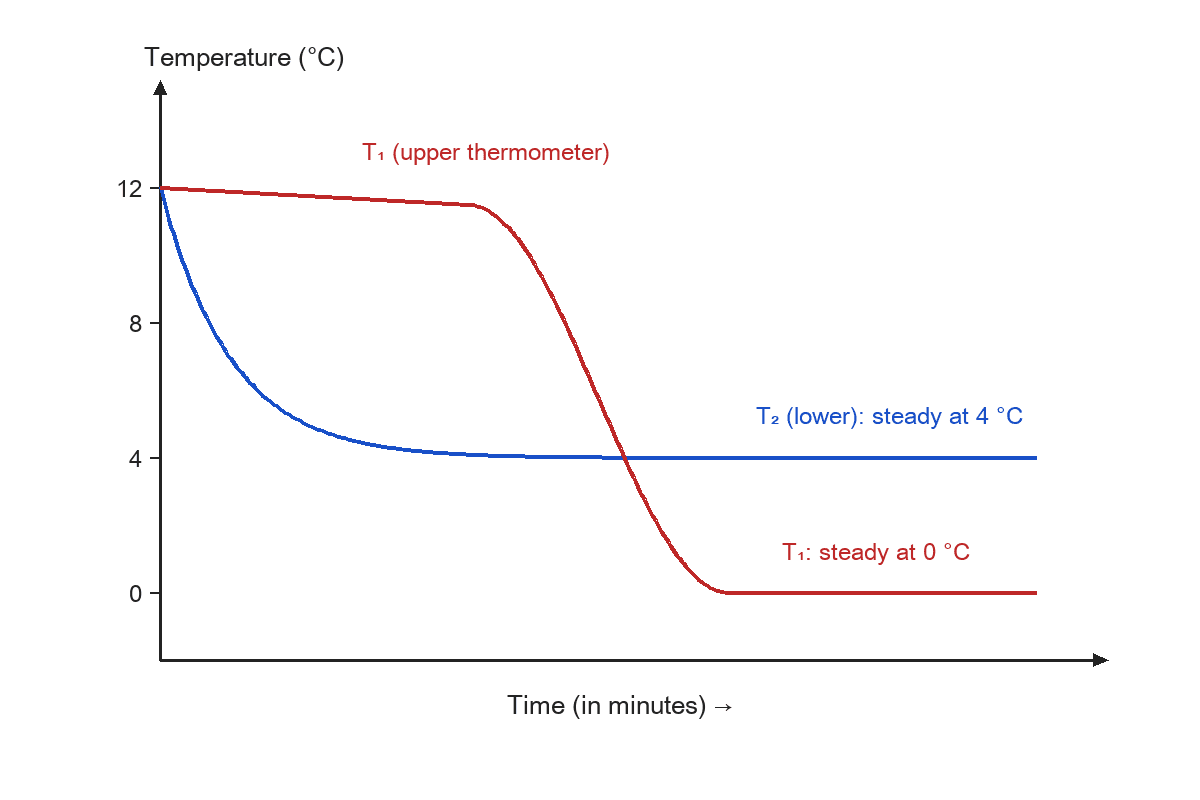
2. The lower thermometer T₂ falls quickly to 4 °C and then stays steady at 4 °C, while the upper thermometer T₁ changes very little.
3. After that, T₁ falls quickly to 0 °C and stays there; ice may form at the top. T₂ remains at 4 °C.
Step 3 — Explain the readings.
The freezing mixture cools the water in the middle. Down to 4 °C the cooled water contracts, becomes denser and sinks, so the lower part cools quickly to 4 °C and T₂ falls. Below 4 °C the cooled water expands, becomes lighter and rises, so now the upper part cools down to 0 °C and T₁ falls. The water at 4 °C stays at the bottom, so water at 4 °C is the densest.
Step 4 — State the consequences in nature.
This property has important effects.
1. Aquatic life survives in winter: a pond freezes only at the surface. Ice is a poor conductor, so the water below stays liquid (0 °C under the ice, 4 °C at the bottom), and fish and other animals survive.
2. Water pipes burst: water in pipes expands on cooling below 4 °C and on freezing, and the pressure bursts the pipes.
3. Crops are damaged: on very cold nights water in plant tissues expands as it cools and freezes, bursting the cells, so the plants are damaged. Farmers fill their fields with water to protect them.
4. Rocks break: water in cracks of rocks expands on freezing, widens the cracks and slowly breaks the rocks, helping to form soil.
Watch out: In Hope's experiment the LOWER thermometer reaches its steady reading (4 °C) first.
Therefore, Hope's experiment shows that water has its maximum density at 4 °C; because of this, ponds freeze only at the top and aquatic life survives, while pipes burst, crops are damaged and rocks break in very cold weather.