
Opening your dashboard
Class 9 Physics Chapter 6 Heat and Energy: Practice Questions
43 questions on Chapter 6, each worked through on its own page with the AI tutor. Class 9 Physics, ICSE 2026-27.
43 questions
1–5 marks · Mixed difficulty
- 11 mark
Question 1
Bloom's level: Remember
On the Kelvin scale, the ice point and the steam point of pure water are :
- 21 mark
Question 2
Bloom's level: Remember
Biogas is produced when biomass such as cattle dung decomposes in the absence of :
- 31 mark
Question 3
Bloom's level: Understand
A small cup of water at 80°C is placed inside a large bucket of water at 40°C. The bucket contains much more heat energy than the cup. Which statement is correct ?
- 41 mark
Question 4
Bloom's level: Apply
A carpenter hammers a nail repeatedly into hard wood and finds that the nail becomes warm. In this case :
- 51 mark
Question 5
Bloom's level: Apply
A hollow glass sphere just floats with its entire volume submerged in water at 4°C. The water is now slowly cooled to 1°C. The sphere will :
- 61 mark
Question 6
Bloom's level: Analyse
The table shows the average amount of carbon dioxide in the air and the rise in the average temperature of the earth's surface (compared with the average for 1951-1980), in four years :
Year 1960 1980 2000 2020 Carbon dioxide (parts per million) 317 339 370 414 Temperature rise (in °C) -0.03 0.26 0.40 1.01 Which conclusion is best supported by the data ?
- 71 mark
Question 7
Bloom's level: Apply
A remote hilly village has no electric power line. A fast stream falls about 10 m down a hillside next to it, and the wind there blows at only about 8 km h on most days. The most suitable way to produce electricity for the village is :
- 81 mark
Question 8
Bloom's level: Evaluate
Ravi says, "If a machine is oiled perfectly, all the energy supplied to it can be turned into useful work, so its efficiency can be made equal to 1." Which is the best judgement of Ravi's statement ?
- 91 mark
Question 9
Bloom's level: Understand
The greenhouse effect keeps the earth warm because the atmosphere :
- 101 mark
Question 10
Bloom's level: Understand
Read the Assertion (A) and the Reason (R) and choose the correct option.
Assertion (A): Small gaps are left between the steel rails of a railway track.
Reason (R): Solids expand on heating.
- 111 mark
Question 11
Bloom's level: Understand
Read the Assertion (A) and the Reason (R) and choose the correct option.
Assertion (A): Global warming may lead to the flooding of low-lying coastal areas.
Reason (R): Global warming is caused mainly by an increase in the amount of oxygen in the atmosphere.
- 121 mark
Question 12
Bloom's level: Analyse
Read the Assertion (A) and the Reason (R) and choose the correct option.
Assertion (A): The transfer of energy from one level of a food chain to the next is never 100% efficient.
Reason (R): According to the first law of thermodynamics, energy can neither be created nor destroyed.
- 132 marks
Question 13
Bloom's level: Remember
Name the form of energy that changes into heat in each case :
(a) we rub our palms together,
(b) an electric current passes through a metallic wire,
(c) coal is burnt,
(d) air is pumped into a bicycle tube.
- 142 marks
Question 14
Bloom's level: Apply
An immersion heater gives 20 930 J of heat energy to some water. Express this heat in (a) calorie, (b) kilocalorie. (1 cal = 4.186 J)
- 152 marks
Question 15
Bloom's level: Understand
A small iron nail and a large iron block are both taken out of boiling water at 100°C.
(a) Do they have the same temperature ? Do they contain the same amount of heat energy ?
(b) Each is dropped into a separate identical bucket of water at 30°C. Which one will warm its bucket more ? Why ?
- 162 marks
Question 16
Bloom's level: Analyse
The volume of 1 g of water at different temperatures is :
Temperature (in °C) 0 2 4 6 8 Volume (in cm) 1.00013 1.00003 1.00000 1.00003 1.00012 (a) At which temperature is the density of water the greatest ? Give a reason from the table.
(b) Describe how the volume and the density of this water change when it is heated from 0°C to 8°C.
- 172 marks
Question 17
Bloom's level: Apply
The metal lid of a glass jar is stuck tight. Pouring hot water over the lid for a short time makes it easy to open. Explain why.
- 181 mark
Question 18
Bloom's level: Remember
Name the power plant that produces electricity by using the difference in temperature between the surface water and the deeper water of an ocean.
- 192 marks
Question 19
Bloom's level: Understand
A food chain usually has only three or four steps (for example, grass → grasshopper → frog → snake). Explain why it rarely has many more steps.
- 202 marks
Question 20
Bloom's level: Apply
An electric bulb takes 100 J of electrical energy every second and gives out 20 J of light energy every second.
(a) How much energy is degraded every second, and into which form mainly ?
(b) What percentage of the electrical energy becomes useful light ?
- 212 marks
Question 21
Bloom's level: Understand
Distinguish between a solar cell and a solar power plant with respect to (a) how they change solar energy into electricity, (b) the kind of current they give.
- 222 marks
Question 22
Bloom's level: Evaluate
A student writes, "Global warming is good for India because our winters will become warmer and our crops will grow better." Do you agree ? Justify your answer with any two effects of global warming.
- 234 marks
Question 23
Bloom's level: Apply
Case study: In winter, Tsering visits a lake in Ladakh whose surface has frozen. Through a hole in the ice he lowers a thermometer and notes the temperature at different depths :
Depth below the ice (in m) 0.0 0.5 1.0 2.0 3.0 (bottom) Temperature (in °C) 0 1 2.5 4 4 (a) Which layer of water is the densest ? Why is it found at the bottom ?
(b) Why do the layers between 0°C and 4°C stay on top instead of sinking ?
(c) Suppose water contracted on cooling all the way down to 0°C, like most liquids. What would happen to the lake and its fish in a very cold winter ?
- 244 marks
Question 24
Bloom's level: Analyse
The flow of energy in a food chain in a grassland is recorded (all values in calorie) :
Level Energy obtained Used in respiration Stored as food Producers (grass) 20 000 (gross production) 11 500 8 500 Primary consumers 3 400 1 900 1 500 Secondary consumers 400 320 80 (a) How much of the producers' net production is lost in decay ?
(b) What percentage of the energy obtained by the primary consumers reaches the secondary consumers ?
(c) Show that the energy at the primary consumer level is fully accounted for. Which law does this illustrate ?
(d) Why is the flow of energy in this food chain called linear ?
- 255 marks
Question 25
Bloom's level: Create
Case study: A school in a remote village has no electricity supply. The village has plenty of sunshine for most of the year and keeps many cattle. The school needs electricity for lights, fans and two computers in the daytime and a little at night, and fuel for cooking the mid-day meal. At present wood is burnt for cooking.
(a) Propose a source of energy for the school's electricity. Say how it works and how electricity will be made available at night.
(b) Propose a better fuel than wood for the kitchen and say how it will be produced. Why should wood be avoided ?
(c) Point out one limitation of each of your choices and suggest two ways in which the school can use energy judiciously.
- 264 marks
Question 26
Bloom's level: Create
Plan an experiment to show that, on heating, gases expand much more than liquids. You have a round-bottomed flask, a cork with a narrow glass tube passing through it, coloured water, a trough of water and a basin of hot water.
(a) Describe the two set-ups and the steps you will follow.
(b) What will you keep the same so that the comparison is fair ?
(c) State what you expect to observe and your conclusion.
- 274 marks
Question 27
Bloom's level: Evaluate
A state is deciding between two projects for new electricity: (1) a large dam with a hydroelectric plant in a forested river valley, (2) a nuclear power plant near the coast. Two students give their views :
Anil: "The dam is completely harmless because water power causes no pollution."
Bina: "The nuclear plant is the best because a small amount of fuel gives a huge amount of energy, so it has no drawbacks."
(a) Judge Anil's statement, giving one point in its favour and two against it.
(b) Judge Bina's statement, giving one point in its favour and two against it.
(c) Which points must be checked before the state chooses either project ?
- 284 marks
Question 28
Bloom's level: Apply
Use the ideas of this chapter to answer the following :
(a) The water at the bottom of a frozen pond is at 4°C. Express this temperature in kelvin.
(b) Water in a geyser is heated from 20°C to 60°C. Find the rise in temperature in kelvin and in degree Fahrenheit.
(c) In a coal-fired power station, 1000 MJ of chemical energy of coal gives 350 MJ of electrical energy. How much energy is degraded, and what is the percentage of useful output ?
(d) Name one renewable source that could replace the coal, and one greenhouse gas whose release would then decrease.
- 294 marks
Question 29
Bloom's level: Apply
Case study: Neha's family parks their car in the sun with all the windows closed. After two hours, the air inside is much hotter than the air outside.
(a) Which radiations of the sun pass through the window glass and heat the seats ?
(b) Explain why the heat cannot escape easily, so that the car keeps getting hotter.
(c) How is this similar to the greenhouse effect of the earth's atmosphere ? What would the average temperature of the earth's surface be without the greenhouse gases, and what is it now ?
- 304 marks
Question 30
Bloom's level: Analyse
Examine the following sources of energy : coal, petroleum, wind, flowing water (hydro), biogas, geothermal energy, tides.
(a) Sort them into two groups: those whose energy came from the sun, and those whose energy did not.
(b) Trace the chain of energy from the sun for coal and for wind.
(c) Which of these sources are renewable ? On what basis are sources classified as renewable or non-renewable ?
- 312 marks
Question 31
Explain what is meant by the internal energy of a body.
- 322 marks
Question 32
The difference between two temperatures is 25°C. Find this temperature difference on the Fahrenheit scale.
- 332 marks
Question 33
At what temperature is the reading on the Celsius scale half the reading on the Fahrenheit scale ?
- 341 mark
Question 34
A temperature of 50°C, when expressed on the Fahrenheit scale, is :
- 351 mark
Question 35
In which of the following is electricity produced directly, without rotating a turbine ?
- 361 mark
Question 36
Assertion (A): Coal and petroleum are non-renewable sources of energy.
Reason (R): Coal and petroleum were formed from the remains of plants and animals buried under the earth over millions of years, so they cannot be replaced once they are used up.
- 372 marks
Question 37
A small iron ball at 150°C is dropped into a large tub of water at 30°C.
(i) In which direction does heat energy flow, and when does this flow stop ?
(ii) The water in the tub contains far more heat energy than the ball. Explain why heat does not flow from the water to the ball.
- 382 marks
Question 38
An iron ball just passes through an iron ring when both are at room temperature.
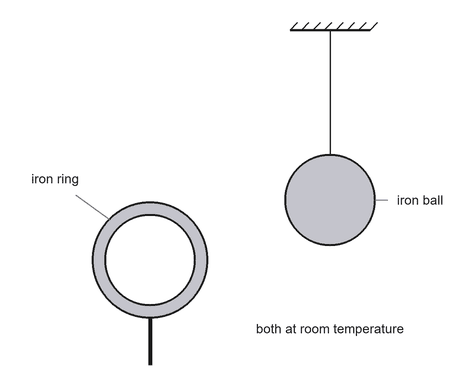
(i) The ball alone is heated strongly and placed on the ring. State and explain what is observed.
(ii) The ring is now also heated to the same temperature as the ball. State and explain what is observed.
- 392 marks
Question 39
In a pond, the food chain is : small water plants → small fish → large fish. In a certain time the plants store 9000 cal of energy as food. The small fish obtain 2700 cal of this energy and store 900 cal of it as food in their bodies.
(i) What percentage of the energy stored by the plants is obtained by the small fish ?
(ii) How much energy do the small fish use in respiration ? In what form is this energy finally lost ?
- 402 marks
Question 40
In a diesel generator set, the fuel supplies 8000 J of energy every second and the set gives out 2800 J of electrical energy every second.
(i) Calculate the energy degraded every second, and the percentage of the energy of the fuel that is changed into electrical energy.
(ii) In what form does most of the degraded energy appear ? Is this energy destroyed ?
- 414 marks
Question 41
The water of a deep lake is at 10°C when winter sets in. The temperature of the air above the lake then falls slowly and finally stays at −5°C.
(i) Explain why the water cooled at the surface keeps sinking until all the water of the lake is at 4°C.
(ii) What happens to the surface water when it is cooled further, below 4°C ? Where does ice form first ?
(iii) After a thick layer of ice has formed, state the temperature of the water just below the ice and of the water at the bottom of the lake. How does this help the fish in the lake ?
- 424 marks
Question 42
The greenhouse effect keeps the average temperature of the earth's surface at about 15°C. Without it, the average temperature would be about −18°C.
(i) Name two greenhouse gases present in the earth's atmosphere.
(ii) Explain how these gases keep the earth's surface warm.
(iii) Calculate the rise in the average temperature of the earth's surface that is due to the greenhouse effect, and express the temperature −18°C in kelvin.
- 433 marks
Question 43
Electricity is generated by wind generators in a wind farm and by the generators of a hydroelectric power plant.
(i) Name the form of energy of the wind, and of the water stored in the dam, that is used to generate electricity.
(ii) Write, in order, the energy changes that take place in a wind generator and in a hydroelectric power plant.
(iii) State one limitation of each of these two ways of generating electricity.