
Opening your dashboard
Class 9 Physics Chapter 1: Measurements and Experimentation Solutions
151 textbook questions with step-by-step answers, free to read, for ICSE 2026-27.
Get talked through Ch 1, not just shown the answer
Reading a finished solution is not the same as being able to do it. The AI tutor takes one question at a time and works it with you, in your own words, until you can.
- Ask it out loud, in your own words
- It gives you the next step, not the answer
- Stuck on part (ii)? Start there
151 questions with solutions
1–5 marks · Mixed difficulty
The first 45 solutions are on this page. This chapter is a long one, so the rest open on their own page to keep this one quick to load.
- 11 mark
Question 1
The condition(s) essential for a unit to be accepted internationally :
Solve with AIAnswer
(A) The unit should be of convenient size and without any ambiguity.
(B) The unit should be reproducible.
(C) The value of the unit should not change with space and time.
- Correct
(D) All of the above.
Answer: (D) All of the above
Concept: A unit that is used all over the world must be of a convenient size, must be defined without any ambiguity, must be reproducible (any laboratory can make the same standard), and its value must not change with space and time.
Step 1 — See what the question asks.
The question asks which conditions a unit must satisfy before every country can accept and use it. A unit used all over the world must give the same result for everyone, everywhere, at every time.
Step 2 — Test each statement.
Statement (A) is needed, because a unit of awkward size or an unclear definition would give confusing values. Statement (B) is needed, because laboratories in every country must be able to make an exact copy of the standard. Statement (C) is needed, because a unit whose value drifted with place or time could not be trusted.
Step 3 — Combine the results.
All three statements are essential conditions, so the option that includes all of them is the answer.
Why the other options are wrong:
- (A) The unit should be of convenient size and without any ambiguity: This is one essential condition, but reproducibility and constancy with space and time are needed as well, so (A) alone is incomplete.
- (B) The unit should be reproducible: Reproducibility is essential, but a unit must also be of convenient size, unambiguous and unchanging, so (B) alone is incomplete.
- (C) The value of the unit should not change with space and time: Constancy is essential, but the other two conditions are also required, so (C) alone is incomplete.
Therefore, all three conditions are essential, option (D).
- 21 mark
Question 2
In mechanics, the three fundamental quantities are:
Solve with AIAnswer
(A) Length, mass, velocity
(B) Mass, time, density
(C) Mass, time, pressure
- Correct
(D) Length, mass, time
Answer: (D) Length, mass, time
Concept: Fundamental (basic) quantities are those that do not depend on any other quantity. In mechanics these are length, mass and time, measured in metre, kilogram and second. All other quantities, such as speed, force and pressure, are derived from them, and their units are derived units.
Step 1 — Recall the fundamental quantities of mechanics.
Mechanics deals with motion and forces. Every quantity in it can be built from just three basic quantities that do not depend on each other: length, mass and time.
Step 2 — Check the options.
Only option (D) lists these three. Every other option contains a quantity that is itself built from length, mass and time.
Watch out: A quantity such as velocity or density is common, but it is not fundamental, because it can be written in terms of other quantities.
Why the other options are wrong:
- (A) Length, mass, velocity: Velocity is displacement ÷ time, so it is a derived quantity, not a fundamental one.
- (B) Mass, time, density: Density is mass ÷ volume, and volume comes from length, so density is a derived quantity.
- (C) Mass, time, pressure: Pressure is force ÷ area, so it is a derived quantity.
Therefore, the three fundamental quantities of mechanics are length, mass and time, option (D).
- 31 mark
Question 3
How many units are fundamental and complementary ?
Solve with AIAnswer
(A) 2 fundamental, 7 complementary
(B) 3 fundamental, 6 complementary
- Correct
(C) 7 fundamental, 2 complementary
(D) 4 fundamental, 5 complementary
Answer: (C) 7 fundamental, 2 complementary
Concept: The S.I. system has seven fundamental units: metre (length), kilogram (mass), second (time), kelvin (temperature), candela (luminous intensity), ampere (electric current) and mole (amount of substance). The book also lists two complementary (supplementary) units: the radian (plane angle) and the steradian (solid angle).
Step 1 — Count the fundamental units.
The S.I. system names seven fundamental units: metre, kilogram, second, kelvin, candela, ampere and mole. So there are 7 fundamental units.
Step 2 — Count the complementary units.
The book adds two complementary (supplementary) units for angles: the radian for a plane angle and the steradian for a solid angle. So there are 2 complementary units.
Watch out: Do not swap the two numbers; there are more fundamental units (7) than complementary ones (2).
Note: since 1995 the S.I. treats the radian and the steradian as dimensionless derived units, so the class of "supplementary units" no longer exists; the count 7 + 2 follows the book.
Why the other options are wrong:
- (A) 2 fundamental, 7 complementary: This swaps the two counts: there are 2 complementary units, not 7, and 7 fundamental units, not 2.
- (B) 3 fundamental, 6 complementary: Three is the number of fundamental quantities of mechanics only (length, mass, time), not of the whole S.I. system, and there are not 6 complementary units.
- (D) 4 fundamental, 5 complementary: Neither number is right: the S.I. system has 7 fundamental units and the book lists 2 complementary units.
Therefore, there are 7 fundamental and 2 complementary units, option (C).
- 41 mark
Question 4
The fundamental unit is :
Solve with AIAnswer
(A) Newton
(B) Pascal
(C) Hertz
- Correct
(D) Second
Answer: (D) Second
Concept: Fundamental (basic) quantities are those that do not depend on any other quantity. In mechanics these are length, mass and time, measured in metre, kilogram and second. All other quantities, such as speed, force and pressure, are derived from them, and their units are derived units.
Step 1 — Recall the seven fundamental units.
The fundamental S.I. units are the metre, kilogram, second, kelvin, candela, ampere and mole. They are defined on their own and do not depend on other units.
Step 2 — Find which option is in the list.
Of the four options, only the second, the unit of time, is in this list. The other three units are combinations of kg, m and s.
Why the other options are wrong:
- (A) Newton: The newton is the unit of force, and 1 N is 1 kg m s, so it is a derived unit.
- (B) Pascal: The pascal is the unit of pressure, and 1 Pa is 1 N m, so it is a derived unit.
- (C) Hertz: The hertz is the unit of frequency, and 1 Hz is 1 s, so it is a derived unit.
Therefore, the fundamental unit is the second, option (D).
- 51 mark
Question 5
Which of the following unit is not a fundamental unit ?
Solve with AIAnswer
(A) Metre
- Correct
(B) Litre
(C) Second
(D) Kilogram
Answer: (B) Litre
Concept: Fundamental (basic) quantities are those that do not depend on any other quantity. In mechanics these are length, mass and time, measured in metre, kilogram and second. All other quantities, such as speed, force and pressure, are derived from them, and their units are derived units.
Step 1 — See what each unit measures.
The metre measures length, the second measures time and the kilogram measures mass; these are three of the fundamental units. The litre measures volume.
Step 2 — Decide whether the litre is fundamental.
Volume is length × length × length, so a unit of volume is built from the unit of length. The litre is therefore a derived unit.
Watch out: The litre is a common everyday unit, but being common does not make a unit fundamental.
Why the other options are wrong:
- (A) Metre: The metre is the fundamental unit of length.
- (C) Second: The second is the fundamental unit of time.
- (D) Kilogram: The kilogram is the fundamental unit of mass.
Therefore, the litre is not a fundamental unit, option (B).
- 61 mark
Question 6
One millimetre is ....... part of metre :
Solve with AIAnswer
(A) One hundredth
- Correct
(B) One thousandth
(C) One billionth
(D) One millionth
Answer: (B) One thousandth
Concept: The prefix milli means one-thousandth (), centi means one-hundredth (), micro means one-millionth () and nano means one-billionth ().
Step 1 — Use the meaning of the prefix.
A millimetre is a metre with the prefix milli, and milli means one-thousandth. So 1 mm is one-thousandth part of a metre.
Watch out: Do not mix up milli (one-thousandth) with centi (one-hundredth).
Why the other options are wrong:
- (A) One hundredth: One-hundredth of a metre is a centimetre, not a millimetre.
- (C) One billionth: One-billionth of a metre ( m) is a nanometre.
- (D) One millionth: One-millionth of a metre ( m) is a micron (micrometre).
Therefore, one millimetre is one-thousandth part of a metre, option (B).
- 71 mark
Question 7
One astronomical unit is equal to :
Solve with AIAnswer
- Correct
(A) metre
(B) metre
(C) metre
(D) metre
Answer: (A) metre
Concept: Large units of length: 1 astronomical unit (A.U.), the mean distance of the earth from the sun, is m. 1 light year (ly), the distance travelled by light in vacuum in one year, is m. 1 parsec is m, about 3.26 ly.
Step 1 — Recall what an astronomical unit is.
One astronomical unit (A.U.) is the mean distance between the earth and the sun. It is used for distances inside the solar system.
Step 2 — Recall its value.
This mean distance is about 150 million kilometres. In metres it is
Watch out: Check both the number and the power of ten; options (A) and (D) have the same power but different numbers.
Why the other options are wrong:
- (B) metre: m is about ten times too large.
- (C) metre: m is about ten times too small.
- (D) metre: m has the right power of ten, but the number 1.398 is not the earth–sun distance (1.496).
Therefore, 1 astronomical unit is metre, option (A).
- 81 mark
Question 8
The distance of stars from earth is generally measured in :
Solve with AIAnswer
(A) Kilometre
- Correct
(B) Light year
(C) Angstrom
(D) Fermi
Answer: (B) Light year
Concept: Large units of length: 1 astronomical unit (A.U.), the mean distance of the earth from the sun, is m. 1 light year (ly), the distance travelled by light in vacuum in one year, is m. 1 parsec is m, about 3.26 ly.
Step 1 — Think about the size of the distance.
Even the nearest star is about m away. Such a huge distance needs a very large unit, so that the numbers stay small and easy to use.
Step 2 — Pick the large unit.
Of the options, only the light year (about m) is large enough. The nearest star is then only about 4 light years away.
Watch out: The light year sounds like a unit of time, but it is a distance.
Why the other options are wrong:
- (A) Kilometre: The kilometre is far too small; star distances would need numbers like km.
- (C) Angstrom: The angstrom ( m) is used for the size of atoms and the wavelength of light.
- (D) Fermi: The fermi ( m) is used for the size of a nucleus.
Therefore, the distance of stars is generally measured in light years, option (B).
- 91 mark
Question 9
1 Fermi is equal to :
Solve with AIAnswer
(A) m
(B) m
(C) m
- Correct
(D) m
Answer: (D) m
Concept: Lengths are compared with the metre (m). Very small lengths use small units such as the micron (1 μ is m), the nanometre (1 nm is m), the angstrom (1 Å is m) and the fermi (1 fermi is m). Very large distances use the astronomical unit, the light year and the parsec.
Step 1 — Recall what the fermi measures.
The fermi is a tiny unit used for the size of an atomic nucleus. A nucleus is about 100 000 times smaller than an atom, which is about m across.
Step 2 — Write its value.
The fermi is defined as
Watch out: Watch the sign of the power: a fermi is very small, so the power of ten must be negative.
Why the other options are wrong:
- (A) m: m is ten times larger than a fermi.
- (B) m: m is one angstrom, the size scale of an atom.
- (C) m: m has a positive power, so it is a huge length (about a tenth of a light year), not a tiny one.
Therefore, 1 fermi is m, option (D).
- 101 mark
Question 10
The unit of time is :
Solve with AIAnswer
(A) light year
(B) parsec
- Correct
(C) leap year
(D) angstrom.
Answer: (C) leap year
Concept: Time is measured in seconds (s). 1 min is 60 s, 1 h is 3600 s and 1 mean solar day is 86 400 s. Very short times use the millisecond, the microsecond (1 μs is s), the nanosecond (1 ns is s) and the shake ( s). Long times use the year, the leap year (366 days) and the lunar month (about 29.5 days).
Step 1 — See what each option measures.
A light year, a parsec and an angstrom are all lengths. A leap year is a span of time.
Step 2 — Recall the leap year.
A leap year is a year of 366 days (February has 29 days). It is a unit of time.
Watch out: The word "year" appears in both "light year" and "leap year", but only the leap year measures time.
Why the other options are wrong:
- (A) light year: The light year is the distance light travels in one year, so it is a unit of length.
- (B) parsec: The parsec (about 3.26 light years) is a unit of length used in astronomy.
- (D) angstrom: The angstrom ( m) is a unit of very small lengths.
Therefore, the unit of time is the leap year, option (C).
- 111 mark
Question 11
1 Å is equal to :
Solve with AIAnswer
- Correct
(A) 0.1 nm
(B) nm
(C) m
(D) μ
Answer: (A) 0.1 nm
Concept: Lengths are compared with the metre (m). Very small lengths use small units such as the micron (1 μ is m), the nanometre (1 nm is m), the angstrom (1 Å is m) and the fermi (1 fermi is m). Very large distances use the astronomical unit, the light year and the parsec.
Step 1 — Write both units in metres.
We compare the angstrom with the nanometre by writing each in metres.
Step 2 — Divide to compare them.
The number of nanometres in one angstrom is found by dividing the two values.
Watch out: 1 Å is cm, not m; keep track of the unit as well as the power of ten.
Why the other options are wrong:
- (B) nm: 1 Å is nm; nm would be m, far too small.
- (C) m: m is 100 Å; 1 Å is cm, so this option confuses metres with centimetres.
- (D) μ: 1 micron is Å, so 1 Å is μ, not μ.
Therefore, 1 Å is equal to 0.1 nm, option (A).
- 121 mark
Question 12
One metric tonne is equal to :
Solve with AIAnswer
- Correct
(A) 10 quintal
(B) 100 quintal
(C) 1000 quintal
(D) 25 quintal
Answer: (A) 10 quintal
Concept: Mass is measured in kilograms (kg). Smaller units: 1 g is kg and 1 mg is kg. Larger units: 1 quintal is 100 kg and 1 metric tonne is 1000 kg. Atomic masses use the atomic mass unit (1 u is about kg), and the masses of stars use the solar mass (about kg).
Step 1 — Write both units in kilograms.
One metric tonne is 1000 kg, and one quintal is 100 kg.
Step 2 — Find how many quintals make a tonne.
Divide the mass of one tonne by the mass of one quintal.
Why the other options are wrong:
- (B) 100 quintal: 100 quintals would be 10 000 kg, which is 10 tonnes.
- (C) 1000 quintal: 1000 quintals would be 100 000 kg, which is 100 tonnes.
- (D) 25 quintal: 25 quintals is 2500 kg, which is 2.5 tonnes.
Therefore, one metric tonne is equal to 10 quintal, option (A).
- 131 mark
Question 13
Light-year is the unit of :
Solve with AIAnswer
(A) Time
- Correct
(B) Length
(C) Mass
(D) None of these
Answer: (B) Length
Concept: Large units of length: 1 astronomical unit (A.U.), the mean distance of the earth from the sun, is m. 1 light year (ly), the distance travelled by light in vacuum in one year, is m. 1 parsec is m, about 3.26 ly.
Step 1 — Recall the definition.
A light year is the distance travelled by light in vacuum in one year. Since it is a distance, it is a unit of length.
Step 2 — Find its size.
Light travels about m every second, and a year has about s, so one light year is about m.
Watch out: The word "year" in its name does not make it a unit of time.
Why the other options are wrong:
- (A) Time: A light year is a distance, not a time; the year only tells how long the light travels.
- (C) Mass: A light year has nothing to do with mass.
- (D) None of these: This is wrong because option (B), length, is correct.
Therefore, the light year is a unit of length, option (B).
- 141 mark
Question 14
One solar mass is equal to :
Solve with AIAnswer
(A) kg
(B) kg
- Correct
(C) kg
(D) kg
Answer: (C) kg
Concept: Mass is measured in kilograms (kg). Smaller units: 1 g is kg and 1 mg is kg. Larger units: 1 quintal is 100 kg and 1 metric tonne is 1000 kg. Atomic masses use the atomic mass unit (1 u is about kg), and the masses of stars use the solar mass (about kg).
Step 1 — Recall what a solar mass is.
One solar mass is the mass of the sun. It is used as a unit for the masses of stars and galaxies.
Step 2 — Recall its value.
The mass of the sun is about kg, so
Why the other options are wrong:
- (A) kg: kg is ten billion times too small; it is less than the mass of the moon.
- (B) kg: kg is about the mass of Jupiter, a thousand times less than the sun.
- (D) kg: kg has the right power of ten, but the sun's mass is about 2, not 3, times kg.
Therefore, one solar mass is kg, option (C).
- 151 mark
Question 15
One lunar cycle is nearly equal to :
Solve with AIAnswer
(A) 28.5 days
- Correct
(B) 29.5 days
(C) 30 days
(D) 30.5 days
Answer: (B) 29.5 days
Concept: Time is measured in seconds (s). 1 min is 60 s, 1 h is 3600 s and 1 mean solar day is 86 400 s. Very short times use the millisecond, the microsecond (1 μs is s), the nanosecond (1 ns is s) and the shake ( s). Long times use the year, the leap year (366 days) and the lunar month (about 29.5 days).
Step 1 — Recall what a lunar cycle is.
A lunar cycle (lunar month) is the time from one new moon to the next, that is one complete cycle of the moon's phases as seen from the earth.
Step 2 — Recall its length.
This time is about 29.53 days, so it is nearly 29.5 days. Twelve such months make about 354 days, which is why a lunar year is shorter than a solar year.
Watch out: The moon goes round the earth once in about 27.3 days relative to the stars, but its phases repeat every 29.5 days, because the earth also moves round the sun.
Why the other options are wrong:
- (A) 28.5 days: 28.5 days is one day too short.
- (C) 30 days: 30 days is the length of some calendar months, not of the lunar cycle.
- (D) 30.5 days: 30.5 days is a full day too long.
Therefore, one lunar cycle is nearly 29.5 days, option (B).
- 161 mark
Question 16
One shake is equal to :
Solve with AIAnswer
(A) s
- Correct
(B) s
(C) s
(D) s
Answer: (B) s
Concept: Time is measured in seconds (s). 1 min is 60 s, 1 h is 3600 s and 1 mean solar day is 86 400 s. Very short times use the millisecond, the microsecond (1 μs is s), the nanosecond (1 ns is s) and the shake ( s). Long times use the year, the leap year (366 days) and the lunar month (about 29.5 days).
Step 1 — Recall the shake.
The shake is a very small unit of time used in nuclear physics, for events that happen extremely fast. It is defined as
Why the other options are wrong:
- (A) s: s is one nanosecond, ten times shorter than a shake.
- (C) s: s is a hundred times shorter than a shake.
- (D) s: s is a very long time, about 3 years, not a tiny unit.
Therefore, one shake is s, option (B).
- 171 mark
Question 17
Which of the following unit is equivalent to watt ?
Solve with AIAnswer
- Correct
(A) Volt × Ampere
(B) Volt/Ampere
(C) Ampere/Volt
(D) Ohm
Answer: (A) Volt × Ampere
Concept: Electric power is the rate at which electrical energy is used. It equals the potential difference (in volts) times the current (in amperes), and its unit is the watt (W).
Step 1 — Write the formula for electric power.
Power is the potential difference across a device times the current through it.
Step 2 — Put in the units.
Putting the units of V and I into this formula gives the unit of power.
Watch out: Volt ÷ ampere is resistance (Ohm's law), not power.
Why the other options are wrong:
- (B) Volt/Ampere: Volt ÷ ampere is the ohm, the unit of resistance (from R = V ÷ I).
- (C) Ampere/Volt: Ampere ÷ volt is the reciprocal of the ohm (the unit of conductance), not a unit of power.
- (D) Ohm: The ohm is the unit of resistance, not of power.
Therefore, the watt is equivalent to volt × ampere, option (A).
- 181 mark
Question 18
Which one of the following is a derived unit ?
Solve with AIAnswer
(A) Metre
(B) Kelvin
- Correct
(C) Metre
(D) Mole
Answer: (C) Metre
Concept: Fundamental (basic) quantities are those that do not depend on any other quantity. In mechanics these are length, mass and time, measured in metre, kilogram and second. All other quantities, such as speed, force and pressure, are derived from them, and their units are derived units.
Step 1 — Check each unit.
The metre (length), kelvin (temperature) and mole (amount of substance) are all in the list of seven fundamental S.I. units.
Step 2 — Identify the derived unit.
Metre (m) is the unit of volume. Volume is length × length × length, so its unit is built from the metre and is a derived unit.
Watch out: A unit made by multiplying or raising a fundamental unit to a power is a derived unit, even though it uses only one fundamental unit.
Why the other options are wrong:
- (A) Metre: The metre is the fundamental unit of length.
- (B) Kelvin: The kelvin is the fundamental unit of temperature.
- (D) Mole: The mole is the fundamental unit of amount of substance.
Therefore, metre is a derived unit, option (C).
- 191 mark
Question 19
The S.I. unit of energy is :
Solve with AIAnswer
- Correct
(A) Joule
(B) Kg m
(C) Kg ms
(D) Kg ms
Answer: (A) Joule
Concept: A derived unit is found by writing the quantity in terms of length, mass and time and then putting in the units m, kg and s. Force is mass × acceleration, so 1 N is 1 kg m s; work is force × displacement, so 1 J is 1 kg m s.
Step 1 — Write energy in terms of force.
Energy is measured by the work done, and work is force × displacement. Its S.I. unit is named the joule.
Step 2 — Express the joule in kg, m and s.
A newton is 1 kg m s, and multiplying by one metre gives the joule.
Watch out: None of the options (B)–(D) equals kg m s, so only the joule is right.
Why the other options are wrong:
- (B) Kg m: kg m has no s, so it is not a unit of energy (it is the unit of moment of inertia).
- (C) Kg ms: kg m s is joule per second, the watt, the unit of power.
- (D) Kg ms: kg m s is joule × second, the unit of angular momentum, not of energy.
Therefore, the S.I. unit of energy is the joule, option (A).
- 201 mark
Question 20
The S.I. unit of pressure is :
Solve with AIAnswer
(A) Kg ms
- Correct
(B) Kg ms
(C) Kg ms
(D) Kg ms
Answer: (B) Kg ms
Concept: A derived unit is found by writing the quantity in terms of length, mass and time and then putting in the units m, kg and s. Force is mass × acceleration, so 1 N is 1 kg m s; work is force × displacement, so 1 J is 1 kg m s.
Step 1 — Write pressure as force per area.
Pressure is the force acting on unit area, so its unit is the unit of force divided by the unit of area.
Step 2 — Put in the units and simplify.
We divide kg m s by m; dividing by m lowers the power of the metre by 2.
This unit is called the pascal (Pa).
Watch out: When you divide m by m, subtract the powers of m: 1 minus 2 gives a power of −1, not −2.
Why the other options are wrong:
- (A) Kg ms: kg m s has the wrong power of the metre; it would come from dividing by m.
- (C) Kg ms: kg m s has a positive power of the second, which does not come from force ÷ area.
- (D) Kg ms: kg m s is the newton, the unit of force, not of pressure.
Therefore, the S.I. unit of pressure is kg m s, option (B).
- 211 mark
Question 21
Which of the following is the smallest unit ?
Solve with AIAnswer
(A) Millimetre
(B) Angstrom
- Correct
(C) Fermi
(D) Metre
Answer: (C) Fermi
Concept: Lengths are compared with the metre (m). Very small lengths use small units such as the micron (1 μ is m), the nanometre (1 nm is m), the angstrom (1 Å is m) and the fermi (1 fermi is m). Very large distances use the astronomical unit, the light year and the parsec.
Step 1 — Write each unit in metres.
To compare the units, we write each one in metres.
Unit Value in metres metre 1 m millimetre m angstrom m fermi m Step 2 — Compare the powers of ten.
The more negative the power of ten, the smaller the unit. The fermi has the most negative power, , so it is the smallest.
Why the other options are wrong:
- (A) Millimetre: The millimetre is m, a million million times larger than a fermi.
- (B) Angstrom: The angstrom is m, a hundred thousand times larger than a fermi.
- (D) Metre: The metre is the largest of the four units.
Therefore, the smallest unit is the fermi, option (C).
- 221 mark
Question 22
What is meant by measurement ?
Solve with AIWritten solution
Solution:
Concept: A unit is a standard quantity of the same kind, of fixed size, with which a physical quantity is compared. A measured value is always written as a number times a unit, for example 5 kg.
Step 1 — State the meaning.
Measurement is the process of comparing a given physical quantity with a known standard quantity of the same nature.
Step 2 — Give an example.
When we say that a rod is 2 m long, we mean that the standard length of 1 metre fits into the length of the rod 2 times.
Therefore, measurement is the comparison of a given physical quantity with a known standard of the same nature.
- 231 mark
Question 23
What do you understand by the term unit ?
Solve with AIWritten solution
Solution:
Concept: A unit is a standard quantity of the same kind, of fixed size, with which a physical quantity is compared. A measured value is always written as a number times a unit, for example 5 kg.
Step 1 — State the meaning.
A unit is a quantity of constant magnitude which is used to measure the magnitudes of other quantities of the same nature.
Step 2 — Give examples.
The metre is the unit of length and the kilogram is the unit of mass. A length of 5 m is 5 times the unit length of 1 m.
Therefore, a unit is a standard quantity of constant magnitude used to measure other quantities of the same kind.
- 241 mark
Question 24
How is a physical quantity expressed ?
Solve with AIWritten solution
Solution:
Concept: A unit is a standard quantity of the same kind, of fixed size, with which a physical quantity is compared. A measured value is always written as a number times a unit, for example 5 kg.
Step 1 — State the rule.
A physical quantity is written as the product of its numerical value and its unit.
Step 2 — Give an example.
In "mass of sugar = 5 kg", the number 5 is the numerical value and kg is the unit. It means that the unit kilogram is contained 5 times in the mass of the sugar.
Watch out: A number without its unit (just "5") does not describe a physical quantity.
Therefore, a physical quantity is expressed as its numerical value multiplied by its unit.
- 251 mark
Question 25
Name the three fundamental quantities.
Solve with AIWritten solution
Solution:
Concept: Fundamental (basic) quantities are those that do not depend on any other quantity. In mechanics these are length, mass and time, measured in metre, kilogram and second. All other quantities, such as speed, force and pressure, are derived from them, and their units are derived units.
Step 1 — Name the quantities.
The three fundamental quantities are length, mass and time.
Step 2 — Give their S.I. units.
Their S.I. units are the metre (m), the kilogram (kg) and the second (s).
Therefore, the three fundamental quantities are length, mass and time.
- 261 mark
Question 26
What is the S.I. unit of Luminous intensity ?
Solve with AIWritten solution
Solution:
Concept: The S.I. system has seven fundamental units: metre (length), kilogram (mass), second (time), kelvin (temperature), candela (luminous intensity), ampere (electric current) and mole (amount of substance). The book also lists two complementary (supplementary) units: the radian (plane angle) and the steradian (solid angle).
Step 1 — Recall the unit.
Luminous intensity, the brightness of a light source in a given direction, is one of the seven fundamental quantities. Its S.I. unit is the candela, with the symbol cd.
Therefore, the S.I. unit of luminous intensity is the candela (cd).
- 271 mark
Question 27
Define one parsec.
Solve with AIWritten solution
Solution:
Concept: Large units of length: 1 astronomical unit (A.U.), the mean distance of the earth from the sun, is m. 1 light year (ly), the distance travelled by light in vacuum in one year, is m. 1 parsec is m, about 3.26 ly.
Step 1 — State the definition.
One parsec is the distance from which the mean radius of the earth's orbit round the sun (1 A.U.) would subtend an angle of one second of arc (1″).
Step 2 — Give its value.
The parsec is used for distances of stars and galaxies. Its value is
Watch out: One second of arc is of a degree, not a second of time.
Therefore, one parsec is the distance at which 1 A.U. subtends an angle of 1″; it is about m.
- 281 mark
Question 28
Define a fundamental unit.
Solve with AIWritten solution
Solution:
Concept: Fundamental (basic) quantities are those that do not depend on any other quantity. In mechanics these are length, mass and time, measured in metre, kilogram and second. All other quantities, such as speed, force and pressure, are derived from them, and their units are derived units.
Step 1 — State the definition.
A fundamental (basic) unit is a unit which is independent of every other unit; it can neither be changed nor be expressed in terms of any other fundamental unit.
Step 2 — Give examples.
The metre (length), kilogram (mass) and second (time) are fundamental units, as are the kelvin, ampere, candela and mole.
Therefore, a fundamental unit is one that does not depend on any other unit, such as the metre, kilogram or second.
- 291 mark
Question 29
Define a derived unit.
Solve with AIWritten solution
Solution:
Concept: Fundamental (basic) quantities are those that do not depend on any other quantity. In mechanics these are length, mass and time, measured in metre, kilogram and second. All other quantities, such as speed, force and pressure, are derived from them, and their units are derived units.
Step 1 — State the definition.
Derived units are units which depend on the fundamental units, that is they can be expressed in terms of the fundamental units.
Step 2 — Give an example.
Speed is distance ÷ time, so its unit is the unit of length divided by the unit of time, metre per second (m s).
Therefore, a derived unit is one that is expressed in terms of fundamental units, for example m s.
- 301 mark
Question 30
Define standard metre.
Solve with AIWritten solution
Solution:
Concept: The metre is now defined from the speed of light in vacuum, which is a fundamental constant and is the same everywhere and at every time.
Step 1 — State the definition.
One metre is the distance travelled by light in vacuum in of a second. This definition was adopted in 1983.
Step 2 — Note the old standard.
Earlier (1889), the standard metre was the distance between two fine lines on a platinum–iridium bar kept at 0 °C at the International Bureau of Weights and Measures at Sèvres, near Paris.
Note: the definition uses light in vacuum; the speed of light in air is very slightly smaller.
Therefore, one metre is the distance travelled by light in vacuum in s.
- 311 mark
Question 31
How is nanometre related to Angstrom ?
Solve with AIWritten solution
Solution:
Concept: Lengths are compared with the metre (m). Very small lengths use small units such as the micron (1 μ is m), the nanometre (1 nm is m), the angstrom (1 Å is m) and the fermi (1 fermi is m). Very large distances use the astronomical unit, the light year and the parsec.
Step 1 — Write both units in metres.
We write each unit in metres so that they can be compared.
Step 2 — Divide to compare.
Dividing the nanometre by the angstrom tells how many angstroms make one nanometre.
Therefore, 1 nm is 10 Å (and 1 Å is 0.1 nm).
- 322 marks
Question 32
Complete the following ;
(a) 1 light year = .............. m
(b) 1 m = .............. Å
(c) 1 m = .............. μ
(d) 1 micron = .............. Å
(e) 1 Fermi = .............. m
Solve with AIWritten solution
Solution:
Concept: Lengths are compared with the metre (m). Very small lengths use small units such as the micron (1 μ is m), the nanometre (1 nm is m), the angstrom (1 Å is m) and the fermi (1 fermi is m). Very large distances use the astronomical unit, the light year and the parsec. Large units of length: 1 astronomical unit (A.U.), the mean distance of the earth from the sun, is m. 1 light year (ly), the distance travelled by light in vacuum in one year, is m. 1 parsec is m, about 3.26 ly.
Step 1 — Part (a): light year.
A light year is the distance light travels in one year, so we multiply the speed of light by the number of seconds in a year (365 days).
Step 2 — Part (b): metre to angstrom.
Since 1 Å is m, the number of angstroms in 1 m is the reciprocal of .
Step 3 — Part (c): metre to micron.
Since 1 μ is m, we divide in the same way.
Step 4 — Part (d): micron to angstrom.
We divide the size of a micron by the size of an angstrom, both in metres.
Step 5 — Part (e): fermi.
The fermi is defined for nuclear sizes as m.
Therefore, (a) 1 ly is m, (b) 1 m is Å, (c) 1 m is μ, (d) 1 micron is Å and (e) 1 fermi is m.
- 332 marks
Question 33
Complete the following :
(a) 1 g = .............. kg
(b) 1 mg = .............. kg
(c) 1 quintal = .............. kg
(d) 1 a.m.u (or u) = .............. kg
Solve with AIWritten solution
Solution:
Concept: Mass is measured in kilograms (kg). Smaller units: 1 g is kg and 1 mg is kg. Larger units: 1 quintal is 100 kg and 1 metric tonne is 1000 kg. Atomic masses use the atomic mass unit (1 u is about kg), and the masses of stars use the solar mass (about kg).
Step 1 — Part (a): gram.
A kilogram is 1000 g, so one gram is one-thousandth of a kilogram, kg.
Step 2 — Part (b): milligram.
A milligram is one-thousandth of a gram, and a gram is one-thousandth of a kilogram.
Step 3 — Part (c): quintal.
A quintal is a large unit of mass used for grain; 1 quintal is 100 kg.
Step 4 — Part (d): atomic mass unit.
The atomic mass unit is one-twelfth of the mass of one carbon-12 atom. Its value is about kg.
Therefore, (a) 1 g is kg, (b) 1 mg is kg, (c) 1 quintal is 100 kg and (d) 1 u is kg.
- 341 mark
Question 34
What is a leap year ?
Solve with AIWritten solution
Solution:
Concept: Time is measured in seconds (s). 1 min is 60 s, 1 h is 3600 s and 1 mean solar day is 86 400 s. Very short times use the millisecond, the microsecond (1 μs is s), the nanosecond (1 ns is s) and the shake ( s). Long times use the year, the leap year (366 days) and the lunar month (about 29.5 days).
Step 1 — State the meaning.
A leap year is a year in which February has 29 days, so the year has 366 days instead of 365.
Step 2 — Say why it is needed.
The earth takes about 365¼ days to go round the sun. The extra quarter day each year adds up to one whole day in four years, and this day is added to February.
Step 3 — State the rule.
A year divisible by 4 is a leap year, except a century year (such as 1900), which must be divisible by 400 (such as 2000).
Therefore, a leap year is a year of 366 days, in which February has 29 days.
- 351 mark
Question 35
'The year 2024 will have February of 29 days'. Is this statement true ?
Solve with AIWritten solution
Solution:
Concept: A year is a leap year (February of 29 days) if it is divisible by 4; a century year is a leap year only if it is divisible by 400.
Step 1 — Test the year 2024.
We divide 2024 by 4 to see whether it is a leap year.
Step 2 — Apply the rule.
The division is exact, and 2024 is not a century year, so the century rule does not apply. Hence 2024 is a leap year, and its February has 29 days.
Therefore, yes, the statement is true: 2024 is a leap year, so its February has 29 days.
- 361 mark
Question 36
What is a lunar month ?
Solve with AIWritten solution
Solution:
Concept: Time is measured in seconds (s). 1 min is 60 s, 1 h is 3600 s and 1 mean solar day is 86 400 s. Very short times use the millisecond, the microsecond (1 μs is s), the nanosecond (1 ns is s) and the shake ( s). Long times use the year, the leap year (366 days) and the lunar month (about 29.5 days).
Step 1 — State the meaning.
A lunar month is the time of one lunar cycle, that is one complete cycle of the phases of the moon (from one new moon to the next) as seen from the earth.
Step 2 — Give its length and use.
It is nearly 29.5 days long. The Islamic (Hijri) calendar is made of lunar months, and Indian (Hindu) calendars also use lunar months, adding an extra month now and then to keep in step with the seasons.
Therefore, a lunar month is the time of one cycle of the moon's phases, nearly 29.5 days.
- 372 marks
Question 37
Complete the following :
(a) 1 nano second = .............s
(b) 1 μs = .............s
(c) 1 mean solar day = .............s
(d) 1 year = .............s
Solve with AIWritten solution
Solution:
Concept: Time is measured in seconds (s). 1 min is 60 s, 1 h is 3600 s and 1 mean solar day is 86 400 s. Very short times use the millisecond, the microsecond (1 μs is s), the nanosecond (1 ns is s) and the shake ( s). Long times use the year, the leap year (366 days) and the lunar month (about 29.5 days).
Step 1 — Parts (a) and (b): use the prefixes.
Nano means and micro means , so 1 ns is s and 1 μs is s.
Step 2 — Part (c): one mean solar day.
A mean solar day has 24 hours, each of 60 minutes of 60 seconds.
Step 3 — Part (d): one year.
A year has 365 days, so we multiply the seconds in one day by 365.
Therefore, (a) 1 ns is s, (b) 1 μs is s, (c) 1 mean solar day is 86 400 s and (d) 1 year is about s.
- 382 marks
Question 38
Name the physical quantities which are measured in the following units :
(a) u (b) ly (c) ns (d) nm
Solve with AIWritten solution
Solution:
Concept: Each unit tells us the kind of quantity it measures: u is the atomic mass unit, ly the light year, ns the nanosecond and nm the nanometre.
Step 1 — Match each unit with its quantity.
The atomic mass unit measures tiny masses, the light year measures huge distances, the nanosecond measures very short times and the nanometre measures very small lengths.
Step 2 — Write the answers.
(a) u measures mass; (b) ly measures distance (length); (c) ns measures time; (d) nm measures length.
Watch out: Ly is a distance even though its name contains "year".
Therefore, (a) u: mass, (b) ly: length, (c) ns: time, (d) nm: length.
- 392 marks
Question 39
Write the derived units of the following :
(a) speed (b) force (c) work (d) pressure
Solve with AIWritten solution
Solution:
Concept: A derived unit is found by writing the quantity in terms of length, mass and time and then putting in the units m, kg and s. Force is mass × acceleration, so 1 N is 1 kg m s; work is force × displacement, so 1 J is 1 kg m s.
Step 1 — Part (a): speed.
Speed is distance ÷ time, so its unit is metre ÷ second, m s.
Step 2 — Part (b): force.
Force is mass × acceleration, and acceleration is in m s, so the unit of force is kg m s, called the newton (N).
Step 3 — Part (c): work.
Work is force × displacement, so its unit is kg m s × m, that is kg m s, called the joule (J).
Step 4 — Part (d): pressure.
Pressure is force ÷ area, so its unit is kg m s ÷ m, that is kg m s, called the pascal (Pa).
Therefore, the units are (a) m s, (b) kg m s, (c) kg m s and (d) kg m s.
- 402 marks
Question 40
How are the following derived units related to the fundamental units ?
(a) Newton (b) Watt (c) Joule (d) Pascal.
Solve with AIWritten solution
Solution:
Concept: A derived unit is found by writing the quantity in terms of length, mass and time and then putting in the units m, kg and s. Force is mass × acceleration, so 1 N is 1 kg m s; work is force × displacement, so 1 J is 1 kg m s.
Step 1 — Part (a): newton.
The newton is the unit of force (mass × acceleration), so 1 N is 1 kg m s.
Step 2 — Part (b): watt.
The watt is the unit of power (work ÷ time), so 1 W is 1 J s, that is 1 kg m s.
Step 3 — Part (c): joule.
The joule is the unit of work (force × displacement), so 1 J is 1 N m, that is 1 kg m s.
Step 4 — Part (d): pascal.
The pascal is the unit of pressure (force ÷ area), so 1 Pa is 1 N m, that is 1 kg m s.
Watch out: Dividing by time (for the watt) adds one more power of s to the joule.
Therefore, 1 N is 1 kg m s, 1 W is 1 kg m s, 1 J is 1 kg m s and 1 Pa is 1 kg m s.
- 412 marks
Question 41
Name the physical quantities related to the following units :
(a) km (b) Newton (c) Joule (d) Pascal (e) Watt
Solve with AIWritten solution
Solution:
Concept: A derived unit is found by writing the quantity in terms of length, mass and time and then putting in the units m, kg and s. Force is mass × acceleration, so 1 N is 1 kg m s; work is force × displacement, so 1 J is 1 kg m s.
Step 1 — Match each unit with its quantity.
A square unit of length measures area, and each named unit belongs to one quantity: the newton to force, the joule to work and energy, the pascal to pressure and the watt to power.
Step 2 — Write the answers.
(a) km: area; (b) newton: force; (c) joule: work (energy); (d) pascal: pressure; (e) watt: power.
Therefore, the quantities are (a) area, (b) force, (c) work or energy, (d) pressure and (e) power.
- 422 marks
Question 42
What are the three requirements for selecting a unit of a physical quantity ?
Solve with AIWritten solution
Solution:
Concept: A unit is the standard with which every measurement is compared, so it must be reliable everywhere and easy to use.
Step 1 — Convenient size.
The unit should be of convenient size, neither too large nor too small for the quantities usually measured with it.
Step 2 — No ambiguity.
It should be possible to define it without ambiguity, so that everyone means exactly the same thing by it.
Step 3 — Reproducible.
It should be reproducible, so that an exact copy of the standard can be made in any laboratory.
Step 4 — Constant.
Also, its value should not change with space and time; it must be the same everywhere and always.
Therefore, a unit should be of convenient size, unambiguously defined and reproducible (and unchanging with space and time).
- 433 marks
Question 43
What are the fundamental units in S.I. system ? Name them along with their symbols.
Solve with AIWritten solution
Solution:
Concept: The S.I. system has seven fundamental units: metre (length), kilogram (mass), second (time), kelvin (temperature), candela (luminous intensity), ampere (electric current) and mole (amount of substance). The book also lists two complementary (supplementary) units: the radian (plane angle) and the steradian (solid angle).
Step 1 — List the fundamental units.
The seven fundamental quantities, their S.I. units and symbols are:
Quantity Unit Symbol Length metre m Mass kilogram kg Time second s Temperature kelvin K Luminous intensity candela cd Electric current ampere A Amount of substance mole mol Step 2 — Add the complementary units.
The book also lists two complementary units: the radian (rad) for a plane angle and the steradian (sr) for a solid angle.
Watch out: Unit symbols are written in small letters (m, kg, s), except those named after people (K, A).
Note: some books write the radian and steradian as rd and st-rd; the S.I. symbols are rad and sr. Since 1995 the S.I. treats both as dimensionless derived units.
Therefore, the S.I. fundamental units are the metre (m), kilogram (kg), second (s), kelvin (K), candela (cd), ampere (A) and mole (mol).
- 442 marks
Question 44
Explain the meaning of derived unit with the help of one example.
Solve with AIWritten solution
Solution:
Concept: Fundamental (basic) quantities are those that do not depend on any other quantity. In mechanics these are length, mass and time, measured in metre, kilogram and second. All other quantities, such as speed, force and pressure, are derived from them, and their units are derived units.
Step 1 — State the meaning.
Derived units are units which depend on the fundamental units, that is they are obtained by multiplying or dividing fundamental units.
Step 2 — Example: the unit of speed.
Speed is distance ÷ time. To get its unit we divide the unit of length (metre) by the unit of time (second).
Step 3 — Note other examples.
In the same way, area is measured in m (length × length) and volume in m.
Therefore, a derived unit, such as m s for speed, is obtained by combining fundamental units.
- 452 marks
Question 45
Name two units of length which are bigger than a metre. How are they related to the metre ?
Solve with AIWritten solution
Solution:
Concept: Large units of length: 1 astronomical unit (A.U.), the mean distance of the earth from the sun, is m. 1 light year (ly), the distance travelled by light in vacuum in one year, is m. 1 parsec is m, about 3.26 ly.
Step 1 — First unit: the kilometre.
The kilometre is used for distances between places. One kilometre is one thousand metres.
Step 2 — Second unit: the light year.
The light year is the distance light travels in vacuum in one year; it is used for distances of stars.
Step 3 — Other bigger units.
The astronomical unit ( m) and the parsec ( m) are also bigger than a metre.
Therefore, two bigger units are the kilometre (1 km is m) and the light year (1 ly is m).
- 463 marks
Question 46
Name the three convenient units used to measure length ranging from very short to very long value. How are they related to the S.I. unit ?
- 472 marks
Question 47
Name the S.I. unit of mass and define it.
- 482 marks
Question 48
State two units of mass smaller than a kilogram. How are they related to kilogram ?
- 492 marks
Question 49
State two units of mass bigger than a kilogram. Give their relationship with the kilogram.
- 502 marks
Question 50
Name the S.I. unit of time and define it.
- 512 marks
Question 51
Name two units of time bigger than a second. How are they related to second ?
- 524 marks
Question 52
The wavelength of light of a particular colour is 5800 Å. Express it in (a) nanometre and (b) metre.
- 533 marks
Question 53
The size of a bacteria is 1 μ. Find the number of bacteria in 1 m length.
- 543 marks
Question 54
The distance of a galaxy from the earth is m. Assuming the speed of light to be m s find the time taken by light to travel this distance.
[Hint : Time taken = ]
- 553 marks
Question 55
The wavelength of light is 589 nm. What is its wavelength in Å ?
- 563 marks
Question 56
The distance of the nearest star, Proxima Centauri, from the Earth is km. Express it in light year.
- 573 marks
Question 57
It takes time 8 min for light to reach from the sun to the earth surface. If speed of light is taken to be m s, find the distance from the sun to the earth in km.
- 584 marks
Question 58
'The distance of a star from the earth is 8.33 light minutes.' What do you mean by this statement ? Express the distance in metre.
- 591 mark
Question 59
Least count of metre rule having 10 subdivisions in 1 cm is :
- 601 mark
Question 60
The least count of a vernier callipers is :
- 611 mark
Question 61
The strip of a vernier callipers is used to measure :
- 621 mark
Question 62
On bringing the two jaws of a vernier callipers together, the 6th division of vernier scale coincides with the main scale. If the least count of the vernier callipers is 0.01 cm, then its zero error is :
- 631 mark
Question 63
A microscope has its main scale with 20 divisions in 1 cm and vernier scale with 25 divisions, the length of which is equal to the length of 24 divisions of main scale. The least count of microscope is :
- 641 mark
Question 64
Identify the correct use of the thimble of a screw gauge :
- 651 mark
Question 65
Ratchet is a part of :
- 661 mark
Question 66
The diameter of a thin wire can be measured by :
- 671 mark
Question 67
The circular head of a screw gauge is divided into 50 divisions and the screw moves 1 mm ahead in two revolutions of the circular head. Its pitch would be :
- 681 mark
Question 68
Which of the following is the correct ascending order of accuracy ?
- 691 mark
Question 69
Define the least count of an instrument.
- 701 mark
Question 70
How can you decrease the least count of a vernier callipers ?
- 711 mark
Question 71
Define the term 'Vernier constant'.
- 721 mark
Question 72
When is a vernier callipers said to be free from zero error ?
- 732 marks
Question 73
Name the part of the vernier callipers which is used to measure the following :
(a) external diameter of a tube, (b) internal diameter of a mug, (c) depth of a small bottle, (d) thickness of a pencil.
- 742 marks
Question 74
State the difference between positive and negative zero error of a vernier callipers.
- 751 mark
Question 75
Define the pitch of a screw gauge.
- 761 mark
Question 76
State one use of a screw gauge.
- 771 mark
Question 77
State the purpose of ratchet in a screw gauge.
- 782 marks
Question 78
State the difference between positive and negative zero error of a screw gauge.
- 792 marks
Question 79
Name the instrument which can measure accurately the following :
(a) the diameter of a needle, (b) the thickness of a paper, (c) the internal diameter of the neck of a water bottle, (d) the diameter of a pencil.
- 801 mark
Question 80
Which of the following measures a small length to a high accuracy : metre rule, vernier callipers, screw gauge ?
- 812 marks
Question 81
Name the instrument which has the least count: (a) 0.1 mm (b) 1 mm (c) 0.01 mm.
- 822 marks
Question 82
Explain the meaning of the term 'least count of an instrument' by taking a suitable example.
- 832 marks
Question 83
A boy makes a ruler with graduations in cm on it (i.e., 100 divisions in 1 m). To what accuracy this ruler can measure ? How can this accuracy be increased ?
- 842 marks
Question 84
A boy measures the length of a pencil and expresses it to be 2.6 cm. What is the accuracy of his measurement ? Can he write it as 2.60 cm ?
- 852 marks
Question 85
Define least count of a vernier callipers. How do you determine it ?
- 863 marks
Question 86
A vernier callipers has a zero error + 0.06 cm. Draw a neat labelled diagram to represent it.
- 872 marks
Question 87
State three uses of a vernier callipers.
- 883 marks
Question 88
Name the two scales of a vernier callipers and explain, how it is used to measure a length correct up to 0.01 cm.
- 893 marks
Question 89
Explain the terms (i) pitch, and (ii) least count of a screw gauge. How are they determined ?
- 902 marks
Question 90
How can the least count of a screw gauge be decreased ?
- 913 marks
Question 91
What do you mean by zero error of a screw gauge ? How is it accounted for ?
- 923 marks
Question 92
A screw gauge has a least count 0.001 cm and zero error + 0.007 cm. Draw a neat diagram to represent it.
- 933 marks
Question 93
What is backlash error ? Why is it caused ? How is it avoided ?
- 945 marks
Question 94
What is meant by zero error of a vernier callipers ? How is it determined ? Draw neat diagrams to explain it. How is it taken in account to get the correct measurement ?
- 955 marks
Question 95
Draw a neat labelled diagram of a vernier callipers. Name its main parts and state their functions.
- 964 marks
Question 96
Describe in steps, how would you use a vernier callipers to measure the length of a small rod ?
- 975 marks
Question 97
Draw a neat and labelled diagram of a screw gauge. Name its main parts and state their functions.
- 984 marks
Question 98
Describe the procedure to measure the diameter of a wire with the help of a screw gauge.
- 993 marks
Question 99
A stop watch has 10 divisions graduated between the 0 and 5 s marks. What is its least count ?
- 1003 marks
Question 100
A vernier has 10 divisions and they are equal to 9 divisions of main scale in length. If the main scale is calibrated in mm, what is its least count ?
- 1013 marks
Question 101
A microscope is provided with a main scale graduated with 20 divisions in 1 cm and a vernier scale with 50 divisions on it of length same as of 49 divisions of main scale. Find the least count of the microscope.
- 1023 marks
Question 102
A boy uses a vernier callipers to measure the thickness of his pencil. He measures it to be 1.4 mm. If the zero error of vernier callipers is + 0.02 cm, what is the correct thickness of pencil ?
- 1034 marks
Question 103
A vernier callipers has its main scale graduated in mm and 10 divisions on its vernier scale are equal in length to 9 mm. When the two jaws are in contact, the zero of vernier scale is ahead of zero of main scale and 3rd division of vernier scale coincides with a main scale division. Find : (i) the least count and (ii) the zero error of the vernier callipers.
- 1044 marks
Question 104
The main scale of a vernier callipers is calibrated in mm and 19 divisions of main scale are equal in length to 20 divisions of vernier scale. In measuring the diameter of a cylinder by this instrument, the main scale reads 35 divisions and the 4th division of vernier scale coincides with a main scale division. Find : (i) least count and (ii) radius of cylinder.
- 1054 marks
Question 105
In a vernier callipers, there are 10 divisions on the vernier scale and 1 cm on the main scale is divided in 10 parts. While measuring a length, the zero of the vernier lies just ahead of 1.8 cm mark and 4th division of vernier coincides with a main scale division.
(a) Find the length.
(b) If zero error of vernier callipers is – 0.02 cm, what is the correct length ?
- 1063 marks
Question 106
While measuring the length of a rod with a vernier callipers, Fig. 1.14 below shows the position of its scales. What is the length of the rod ?

- 1073 marks
Question 107
The pitch of a screw gauge is 0.5 mm and the head scale is divided in 100 parts. What is the least count of screw gauge ?
- 1084 marks
Question 108
The thimble of a screw gauge has 50 divisions. The spindle advances 1 mm when the screw is turned through two revolutions.
(i) What is the pitch of the screw gauge ?
(ii) What is the least count of the screw gauge?
- 1094 marks
Question 109
The pitch of a screw gauge is 1 mm and its circular scale has 100 divisions. In measurement of the diameter of a wire, the main scale reads 2 mm and 45th mark on circular scale coincides with the base line. Find :
(i) the least count, and
(ii) the diameter of the wire.
- 1104 marks
Question 110
When a screw gauge of least count 0.01 mm is used to measure the diameter of a wire, the reading on the sleeve is found to be 1 mm and the reading on the thimble is found to be 27 divisions. (i) What is the diameter of the wire in cm ? (ii) If the zero error is + 0.005 cm, what is the correct diameter ?
- 1114 marks
Question 111
A screw gauge has 50 divisions on its circular scale and its screw moves by 1 mm on turning it by two rotations. When the flat end of the screw is in contact with the stud, the zero of circular scale lies below the base line and 4 division of circular scale is in line with the base line. Find : (i) the pitch, (ii) the least count and (iii) the zero error, of the screw gauge.
- 1124 marks
Question 112
Fig. 1.15 below shows the reading obtained while measuring the diameter of a wire with a screw gauge. The screw advances by 1 division on main scale when circular head is rotated once.
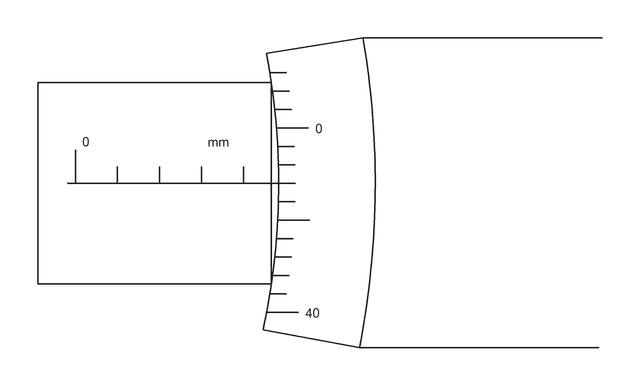
Find : (i) pitch of the screw gauge,
(ii) least count of the screw gauge, and
(iii) the diameter of the wire.
- 1133 marks
Question 113
A screw has a pitch equal to 0.5 mm. What should be the number of divisions on its head so as to read correct up to 0.001 mm with its help ?
- 1141 mark
Question 114
The pendulum used in a clock is :
- 1151 mark
Question 115
The time taken to complete one oscillation is called :
- 1161 mark
Question 116
The number of oscillations made in one second is called :
- 1171 mark
Question 117
The unit of time period is :
- 1181 mark
Question 118
The relationship between time period and frequency is :
- 1191 mark
Question 119
The maximum displacement of bob from its mean position on either side is called :
- 1201 mark
Question 120
The effective length of a pendulum is related with time period as :
- 1211 mark
Question 121
A simple pendulum is made by suspending a bob of mass 1 kg by a string of length l. Now if the length of this pendulum is increased to 4l, then its time period T will :
- 1221 mark
Question 122
The time period of a seconds' pendulum clock is :
- 1231 mark
Question 123
Time period of a simple pendulum is given by :
- 1241 mark
Question 124
The time period of a simple pendulum depends on:
- 1251 mark
Question 125
The time period of two pendulums of length 1 m and 16 m are in the ratio :
- 1261 mark
Question 126
The length of a simple pendulum is made one-fourth. Its time period becomes :
- 1271 mark
Question 127
The length of a seconds' pendulum is nearly :
- 1281 mark
Question 128
Define 'amplitude of oscillation'.
- 1292 marks
Question 129
Define the terms : (i) oscillation, (ii) amplitude, (iii) frequency, and (iv) time period as related to a simple pendulum.
- 1301 mark
Question 130
Name two factors on which the time period of a simple pendulum does not depend.
- 1312 marks
Question 131
How is the time period of a simple pendulum affected, if at all, in the following situations :
(a) the length is made four times,
(b) the acceleration due to gravity is reduced to one-fourth,
- 1321 mark
Question 132
How are the time period T and frequency f of an oscillation of a simple pendulum related ?
- 1332 marks
Question 133
Two simple pendulums A and B have equal lengths, but their bobs weigh 50 gf and 100 gf respectively. What would be the ratio of their time periods ? Give reason for your answer.
- 1341 mark
Question 134
What is a seconds' pendulum ?
- 1352 marks
Question 135
State the numerical value of the frequency of oscillation of a seconds' pendulum. Does it depend on the amplitude of oscillation ?
- 1363 marks
Question 136
What is a simple pendulum ? Is the pendulum used in a pendulum clock simple pendulum ? Give reason to your answer.
- 1373 marks
Question 137
Draw a neat diagram of a simple pendulum. Show on it the effective length of the pendulum and its one oscillation.
- 1382 marks
Question 138
Name two factors on which the time period of a simple pendulum depends. Write the relation for the time period in terms of the above named factors.
- 1393 marks
Question 139
How do you measure the time period of a given pendulum ? Why do you note the time for more than one oscillation ?
- 1402 marks
Question 140
Two simple pendulums A and B have lengths 1.0 m and 4.0 m respectively at a certain place. Which pendulum will make more oscillations in 1 minute ? Explain your answer.
- 1413 marks
Question 141
State how does the time period of a simple pendulum depend on (a) length of pendulum, (b) mass of bob, (c) amplitude of oscillation and (d) acceleration due to gravity.
- 1425 marks
Question 142
How does the time period (T) of a simple pendulum depend on its length (l) ? Draw a graph showing the variation of with l. How will you use this graph to determine the value of g (acceleration due to gravity) ?
- 1434 marks
Question 143
A simple pendulum completes 40 oscillations in one minute. Find its (a) frequency, (b) time period.
- 1443 marks
Question 144
The time period of a simple pendulum is 2 s. What is its frequency ? What name is given to such a pendulum ?
- 1454 marks
Question 145
A seconds' pendulum is taken to a place where acceleration due to gravity falls to one-fourth. How is the time period of the pendulum affected, if at all ? Give reason. What will be its new time period ?
- 1463 marks
Question 146
Find the length of a seconds' pendulum at a place where m s (Take ).
- 1473 marks
Question 147
Compare the time periods of two pendulums of length 1 m and 9 m.
- 1484 marks
Question 148
A pendulum completes 2 oscillations in 5 s. (a) What is its time period ? (b) If m s, find its length.
- 1493 marks
Question 149
The time periods of two simple pendulums at a place are in the ratio 2 : 1. What will be the ratio of their lengths ?
- 1503 marks
Question 150
It takes 0.2 s for a pendulum bob to move from mean position to one end. What is the time period of pendulum ?
- 1513 marks
Question 151
How much time does the bob of a seconds' pendulum take to move from one extreme of its oscillation to the other extreme ?
What Class 9 Physics Ch 1 covers
The sections of the chapter, in the order the book takes them. Every question above comes from one of these.
- 01Need of Unit for Measurement
- 02Systems of Unit
- 03Units of Length
- 04Units of Mass
- 05Units of Time
- 06Some Examples of Derived Units
More ways to study this chapter
The same chapter asked three other ways. Practise it, revise it, and see what the board has set on Ch 1 before.
Class 9 Physics Ch 1 questions students ask
How many questions are there in Class 9 Physics Ch 1?
151 questions. Every one is solved step by step on this page.
Are these Class 9 Physics solutions free?
Yes. Every question and its full working is free to read, with no account needed.
Can I download the Class 9 Physics Ch 1 solutions as a PDF?
There is no PDF to download. Every solution is on this page instead, which means it is searchable, always the current syllabus, and readable on a phone. Use your browser's print option if you want it on paper.