
Question 1373 marksEasy
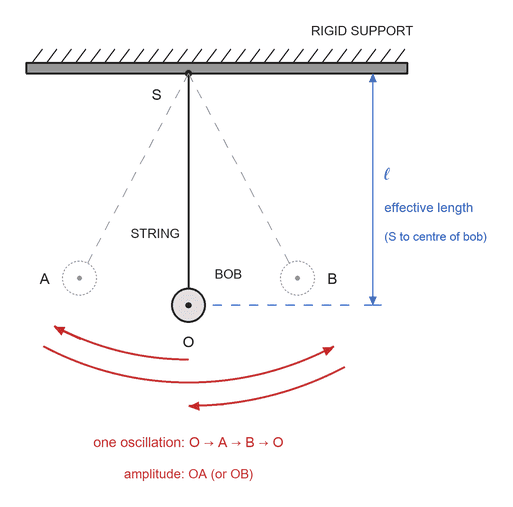
Draw a neat diagram of a simple pendulum. Show on it the effective length of the pendulum and its one oscillation.
Confirming your payment
Sign up now and get 250 free tokens.
Measurements and Experimentation · Question 137 of 151
Draw a neat diagram of a simple pendulum. Show on it the effective length of the pendulum and its one oscillation.
Solution:
Concept: A simple pendulum is an ideal pendulum: a heavy point mass (the bob) hung from a rigid support by a massless, inextensible string, swinging in a vertical plane. In practice a small heavy metal ball on a light, strong thread is used. Its effective length is measured from the point of suspension to the centre of the bob. For a pendulum: one oscillation is one complete to and fro motion; the time period T is the time for one oscillation (unit s); the frequency f is the number of oscillations in one second (unit s or Hz); the amplitude is the maximum displacement of the bob from its mean position on either side.
Step 1 — Draw the diagram.
The bob hangs from the point of suspension S on a rigid support. O is its mean (rest) position, and A and B are its extreme positions.
Step 2 — Show the effective length.
The effective length (marked ℓ in the figure) is the distance from S to the centre of the bob, that is the length of the string plus the radius of the bob.
Step 3 — Show one oscillation.
One oscillation is the motion O → A → O → B → O, shown by the three arrows (O to A, A to B through O, B back to O). The motion A → B → A is also one oscillation.
Watch out: The effective length is measured to the CENTRE of the bob, not to its top or bottom.
Therefore, the diagram shows the effective length from S to the centre of the bob and one oscillation O → A → B → O.