
Opening your dashboard
Class 9 Physics Chapter 1 Measurements and Experimentation: Competency-Based Questions (CBQ)
40 questions on Chapter 1, each worked through on its own page with the AI tutor. Class 9 Physics, ICSE 2026-27.
40 questions
1–4 marks · Mixed difficulty
- 11 mark
Question 1
Competency: Application
A space probe near the planet Mars sends a radio signal that reaches the Earth 20 minutes later. Radio signals travel at the speed of light, m s. Taking 1 A.U. = m, the distance of the probe from the Earth is :
- 21 mark
Question 2
Competency: Analysis
Three students measure the diameter of the same metal rod. One uses a metre rule (least count 0.1 cm), one a vernier callipers (least count 0.01 cm) and one a screw gauge (least count 0.001 cm). Each student writes the reading correctly, up to the least count of the instrument used. Their records are :
Anil : 1.2 cm
Bela : 1.24 cm
Chetan : 1.243 cm
Which instrument did each student use ?
- 31 mark
Question 3
Competency: Application & Analysis
A student measures the diameter of a cylinder with a vernier callipers of least count 0.01 cm. The callipers has a zero error of + 0.02 cm. The figure shows a part of the main scale (marked in cm) and the vernier scale when the cylinder is held between the jaws.

The correct diameter of the cylinder is :
- 41 mark
Question 4
Competency: Application & Analysis
A girl sits still on a playground swing and is given a small push. The swing makes 15 complete to-and-fro swings in 45 s. The ropes are then shortened so that the effective length of the swing becomes one-fourth of what it was. Treating the swing as a simple pendulum, the time it now takes for 15 complete swings is :
- 51 mark
Question 5
Competency: Understanding
Assertion (A): The masses of atoms, and of particles such as the proton and the neutron, are usually expressed in atomic mass unit (a.m.u.) and not in kilogram.
Reason (R): 1 a.m.u. is one-twelfth of the mass of one atom of carbon-12.
- 61 mark
Question 6
Competency: Analysis
Assertion (A): A screw gauge of pitch 0.5 mm with 100 divisions on its circular scale has a smaller least count than a screw gauge of pitch 1 mm with 100 divisions on its circular scale.
Reason (R): The least count of a screw gauge is the product of its pitch and the number of divisions on its circular scale.
- 72 marks
Question 7
Competency: Evaluation
In a village market, cloth is sold by the 'haath', the length of the seller's forearm from the elbow to the tip of the middle finger. A customer buys '4 haath' of the same cloth from each of two shops and measures both pieces at home with a metre rule. The lengths are given below.
Shop Length of the piece sold as 4 haath P 1.72 m Q 1.88 m The owner of shop P says, "A haath is as good a unit of length as the metre."
(a) Find the length of one haath in each shop. Why are the two values different ?
(b) Judge the shop owner's statement, giving two reasons.
- 82 marks
Question 8
Competency: Application
The label on a can of cooking oil gives the density of the oil as 0.92 g cm.
(a) Density is a derived quantity. Starting from the relation density = mass ÷ volume, obtain the S.I. unit of density in terms of the fundamental units.
(b) Express the density of the oil in the S.I. unit, and find the mass in kilogram of 5 litre of the oil. (1 litre = 1000 cm)
- 92 marks
Question 9
Competency: Analysis
The Earth takes very nearly days to go once round the Sun. Suppose a country decides to use a calendar in which every year has exactly 365 days, with no leap year.
(a) After 120 years, by how many days would this calendar be out of step with the seasons ?
(b) Explain how the calendar we use avoids this, and state whether the year 2028 has 365 or 366 days.
- 102 marks
Question 10
Competency: Analysis & Evaluation
A vernier callipers has 10 divisions on its vernier scale and a least count of 0.01 cm. When its jaws are closed, the zero of the vernier scale lies to the left of the zero of the main scale and the 7th vernier division coincides with a main scale division.
Riya and Kabir use this callipers to measure the diameter of the same marble. Both observe a reading of 1.63 cm. Riya writes the diameter as 1.60 cm and Kabir writes it as 1.66 cm.
(a) Find the zero error of the callipers, with its sign.
(b) Who has written the correct diameter ? Justify your answer by calculation and point out the mistake made by the other student.
- 114 marks
Question 11
Competency: Analysis & Application
Case study: A group of Class 9 students wants to find the acceleration due to gravity in the school laboratory. They time 20 oscillations of a simple pendulum for five different effective lengths, work out the time period each time, and plot against the effective length . Their graph is shown below. (Take = 9.87)
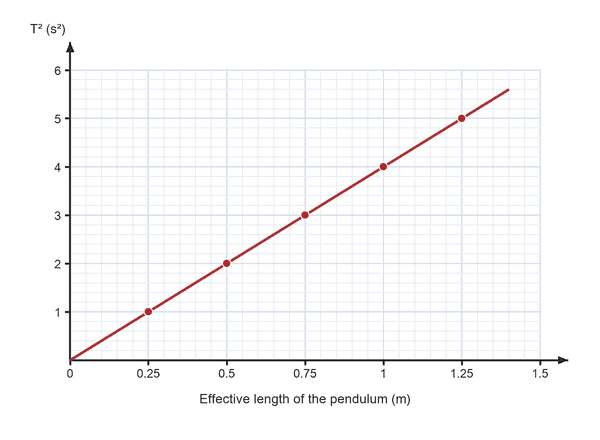
(a) Read from the graph the value of for an effective length of 0.25 m. How long does this pendulum take for 20 oscillations ?
(b) Find the slope of the graph and use it to calculate .
(c) One student says, "To double the time period, we must double the length of the pendulum." Use the graph to judge this statement. Also find the length of a seconds' pendulum in this laboratory.
- 124 marks
Question 12
Competency: Analysis & Evaluation
Case study: A workshop buys copper wire that is meant to have a diameter of 1.20 mm. A wire is accepted only if its diameter lies between 1.18 mm and 1.22 mm. The inspector uses a screw gauge whose screw moves forward by 1 mm when the thimble is given 2 complete rotations. Its circular scale has 50 divisions. When the flat end of the screw just touches the stud, the zero mark of the circular scale is below the base line and the 3rd division of the circular scale is in line with the base line. The readings for three wires are given below.
Wire Main scale reading Circular scale division in line with the base line X 1.0 mm 24 Y 1.0 mm 26 Z 1.0 mm 20 (a) Find the pitch, the least count and the zero error of the screw gauge.
(b) Find the correct diameter of each wire.
(c) Which of the wires should be accepted ? A new assistant forgets to apply the correction for zero error. For which wires will his decision be wrong ?
- 134 marks
Question 13
Competency: Application & Analysis
Case study: A science club is making a wall chart of distances in space. The members collect the data given below. (1 A.U. = m; 1 light year = m; speed of light = m s)
Distance from the Sun to Distance in metre the Earth the planet Neptune the star Sirius (a) Express the distance of Neptune from the Sun in A.U. Why is the A.U. a more convenient unit than the metre for the chart of the solar system ?
(b) Express the distance of Sirius in light year, correct to one decimal place.
(c) A member writes on the chart, "When we look at Sirius tonight, we see the star as it is tonight." Judge this statement using your answer to (b). Also find the time, in minutes, that sunlight takes to reach Neptune.
- 144 marks
Question 14
Competency: Application & Creation
One sheet of paper of a notebook is roughly 0.01 cm thick. You are given only a vernier callipers of least count 0.01 cm.
(a) Explain why one reading of a single sheet taken with this callipers cannot be relied upon.
(b) Design a method, using the same callipers, to find the thickness of one sheet correct to about 0.0001 cm. Write the steps and two precautions.
(c) In a trial of such a method, 100 sheets pressed together gave an observed reading of 0.86 cm on a callipers with a zero error of − 0.02 cm. Calculate the thickness of one sheet.
- 154 marks
Question 15
Competency: Analysis & Evaluation
Case study: Meera investigates what the time period of a simple pendulum depends on. She uses two metal bobs of the same size but of different masses, and in each trial she measures the time taken for 20 oscillations. Her results are given below.
Trial Mass of the bob (g) Effective length (cm) Amplitude (cm) Time for 20 oscillations (s) 1 50 25 2 20.0 2 100 25 2 20.0 3 50 25 4 20.0 4 100 100 2 40.0 (a) Calculate the time period of the pendulum in trial 1 and in trial 4. Why does Meera time 20 oscillations and not just one ?
(b) Which two trials should be compared to see the effect of the mass of the bob ? Which two show the effect of the amplitude ? State what each comparison shows.
(c) Comparing trials 1 and 4, Meera's friend concludes, "A heavier bob swings more slowly." Judge this conclusion, and state what trials 2 and 4 show about the time period.
- 161 mark
Question 16
Competency: Understanding
Nisha made a list of things she noticed during a school picnic :
(1) the length of the rope of the swing
(2) the honesty of the shopkeeper at the stall
(3) the time taken by a ball to roll down the slide
(4) how tasty the lunch was
(5) the mass of her water bottle
Which of these are physical quantities ?
- 171 mark
Question 17
Competency: Understanding
Three students record their laboratory measurements in different units of length, mass and time, as shown in the table.
Student Unit of length Unit of mass Unit of time Asha centimetre gram second Bilal metre kilogram second Chetan foot pound second Which option names the system of units used by each student correctly ?
- 181 mark
Question 18
Competency: Analysis
At a school sports day, Hari the sprinter ran 100 m in 12.5 s and Isha the cyclist covered 18 km in 1 h. (Hypothetical data.)
Speed is a derived quantity, so the two speeds can be compared fairly only when they are written in the same unit. Which statement is correct ?
- 191 mark
Question 19
Competency: Application
A grain of rice has a mass of about 25 mg. (Hypothetical data for a typical grain.)
The number of such grains in 1 kg of rice is nearly :
- 201 mark
Question 20
Competency: Application
A purely lunar calendar has 12 lunar months in a year, each lunar month being taken as 29.5 days. The Earth takes days to go once round the Sun, and the seasons repeat after this time.
By how many days does a date of this calendar fall earlier in the seasons every year ?
- 211 mark
Question 21
Competency: Analysis
Three instruments are available in a laboratory :
P : a vernier callipers whose 20 vernier divisions are equal in length to 19 divisions of its main scale, which is graduated in mm.
Q : a screw gauge of pitch 1 mm with 50 divisions on its circular scale.
R : a metre rule graduated in mm.
A student writes a length as 4.35 mm. Each instrument is free from zero error and each reading is written correctly, up to the least count of the instrument. Which instrument or instruments could have given the reading 4.35 mm ?
- 221 mark
Question 22
Competency: Analysis
A student uses a screw gauge in which the screw advances 1 mm (one main scale division) for one complete rotation of the thimble. Its circular scale has 100 divisions. Fig. (a) shows the readings when the flat end of the screw just touches the stud. Fig. (b) shows the readings when a wire is held between the stud and the screw.
Fig. (a)

Fig. (b)
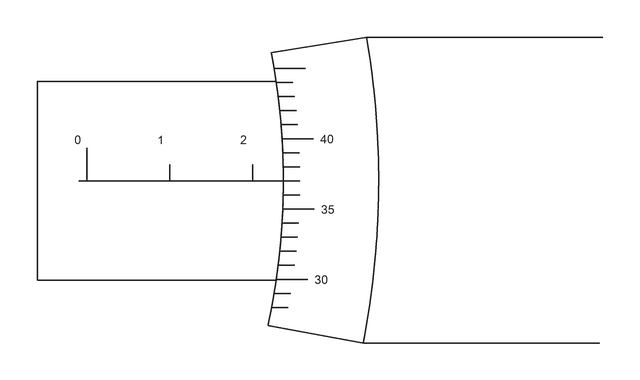
The correct diameter of the wire is :
- 231 mark
Question 23
Competency: Analysis
Assertion (A): A length of 1 m has the same numerical value in the C.G.S. system and in the M.K.S. system of units.
Reason (R): The unit of length in the C.G.S. system is the centimetre, and 1 m is equal to 100 cm.
- 241 mark
Question 24
Competency: Analysis
Assertion (A): A pendulum clock keeps nearly the same rate even when the swings of its pendulum slowly die down.
Reason (R): The time period of a simple pendulum depends on the amplitude of oscillation.
- 251 mark
Question 25
Competency: Application
The dial of a mechanical stop watch is divided into 300 equal divisions, and its long hand makes one complete rotation of the dial in 30 s. A timekeeper stops the watch after the long hand has made 2 complete rotations and is on the 125th division. (Hypothetical data.)
The time recorded is :
- 262 marks
Question 26
Competency: Application
A laboratory record describes a metal rod as 250 cm long and 4000 g in mass. (Hypothetical data.)
(a) Express the length and the mass in the units of the M.K.S. system, which are also the S.I. units of length and mass.
(b) A catalogue from another country gives the same rod in feet and pounds. Name the system of units that uses these units of length and mass.
- 272 marks
Question 27
Competency: Application
A photograph taken through a microscope shows a cell magnified 500 times, that is, the length of the cell in the photograph is 500 times its actual length. The length of the cell in the photograph is 3.5 cm.
(a) Find the actual length of the cell in micron (m).
(b) Express this length in metre.
- 282 marks
Question 28
Competency: Analysis
Two wrist watches, A and B, were set to the correct time at noon on the same day. Watch A gains 2 s every day and watch B loses 3 s every day. (Hypothetical data.)
(a) Which watch keeps the better time ? Give a reason.
(b) After how many days will the two watches show times that differ by exactly 1 minute ?
- 292 marks
Question 29
Competency: Application
A rectangular water tank is 2.0 m long, 1.5 m wide and 1.0 m deep. It is filled completely with water. (Density of water = 1000 kg m and 1 litre = 1000 cm.)
(a) Find the volume of water in m and in litre.
(b) Find the mass of the water in kg and in metric tonne.
- 302 marks
Question 30
Competency: Evaluation
A carpenter uses a metre rule graduated in mm to measure a plank 2.0 m long and a wire 8 mm thick. Assume that each reading may be wrong by one least count of the metre rule.
(a) Find the largest possible error as a percentage of the reading in each case.
(b) The carpenter says, "My metre rule is equally good for both jobs." Judge this statement, and name the instrument from the laboratory that suits the wire better.
- 312 marks
Question 31
Competency: Creativity
A student has to make a seconds' pendulum for a school exhibition. She has a thread, a small metal bob, a clamp stand, a metre rule and a stop watch, but no table of lengths.
Design a method to find, by trial, the effective length of a seconds' pendulum. Write the steps, and say how you will know that you have the right length.
- 323 marks
Question 32
Competency: Analysis
A student measures the thickness of a metal washer with a vernier callipers whose main scale is graduated in mm. Twenty divisions of its vernier scale are equal in length to 19 divisions of the main scale, and the callipers has no zero error. (Hypothetical data.) The figure shows the main scale (in cm) and the vernier scale when the washer is held between the jaws.
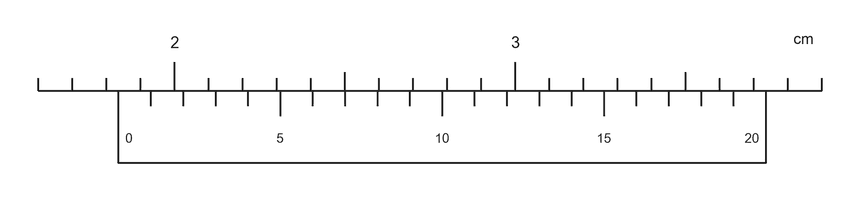
(a) Find the least count of the callipers, in cm.
(b) Read the thickness of the washer from the figure.
(c) The student writes the thickness as 1.8 cm. Why is this not the best record of the reading ?
- 333 marks
Question 33
Competency: Analysis
A science club wants to build a scale model of space in which 1 A.U. is shown by 1 cm. (1 A.U. m and 1 light year m.)
(a) The planet Jupiter is 5.2 A.U. from the Sun. How far from the Sun will it be in the model ?
(b) The nearest star, Proxima Centauri, is about 4.2 light years from the Sun. How far from the Sun will it be in the model ? Give the answer in km.
(c) Why is the light year, and not the A.U., used for distances to stars ?
- 343 marks
Question 34
Competency: Evaluation
An electronic timer records the times of two runners in a 100 m race as 10.52 s for Pooja and 10.54 s for Qadir. The school stop watch has a least count of 0.1 s, and the reaction time of a person who starts and stops a stop watch is about 0.2 s. (Hypothetical data.)
(a) What time would the stop watch show for each runner, correct to its least count ?
(b) Compare the difference between the two times with the least count of the stop watch and with the reaction time.
(c) Can the school stop watch decide the winner ? Name a better instrument for the race, and give a reason.
- 353 marks
Question 35
Competency: Application
The atomic mass unit (u) is defined as one-twelfth of the mass of one atom of carbon-12. Take 1 u kg.
(a) Write the mass of one atom of carbon-12 in u and in kg.
(b) Find the number of atoms in 1.2 g of carbon-12.
(c) Why do scientists prefer to give the mass of an atom in u and not in kg ?
- 363 marks
Question 36
Competency: Application
For an experiment, Sana hangs a metal bob of diameter 3.0 cm from a clamp by a thread. She measures the length of the thread from the point of suspension to the top of the bob as 96.5 cm. (Take m s and . Hypothetical data.)
(a) Find the effective length of the pendulum.
(b) Find its time period, and the time it takes for 20 oscillations.
(c) Find by how much the calculated time for 20 oscillations would be too small if she wrongly took 96.5 cm as the effective length.
- 374 marks
Question 37
Competency: Evaluation
Case study: A group of students measures the diameter of a steel ball with a vernier callipers of least count 0.01 cm. When the jaws are closed, the zero of the vernier scale lies to the right of the zero of the main scale and the 3rd vernier division coincides with a main scale division. The observed readings of the diameter of the ball are given below. (Hypothetical data.)
Reading 1 2 3 4 5 6 Observed diameter (cm) 2.46 2.45 2.46 2.47 2.46 2.66 (a) Find the zero error of the callipers, with its sign.
(b) Using the first five readings, find the mean observed diameter and the correct diameter of the ball.
(c) The student who took the sixth reading says that it should also be used in finding the mean. Judge this, using the readings.
- 384 marks
Question 38
Competency: Application
Case study: During a thunderstorm, three students P, Q and R, standing at different places, each noted the time between seeing a lightning flash and hearing its thunder. (Take the speed of sound in air as 340 m s and the speed of light as m s. Hypothetical data.)
Student P Q R Time between flash and thunder (s) 3.0 5.5 8.0 (a) Find the distance of each student from the place of the flash. Take the flash to be seen at the instant it occurs.
(b) Express the distance of R in km. Find the time that light takes to travel this distance, in microsecond (s).
(c) Use your answer to (b) to justify the assumption made in (a). Which student is nearest to the flash ?
- 394 marks
Question 39
Competency: Analysis
Case study: The pendulum clock in a school corridor is made with a pendulum meant to be a seconds' pendulum, so the clock counts 2 s for every complete oscillation. The clock was set correctly at noon one day. After exactly one true day of 24 h (86 400 s) it was found to show 5 minutes less than the true time. The effective length of its pendulum is 100.0 cm. (Hypothetical data.)
(a) How many seconds does the clock show for one true day ? How many oscillations does the pendulum make in that true day ?
(b) Find the actual time period of the pendulum. Is the pendulum too long or too short ?
(c) Using the fact that the time period is proportional to the square root of the effective length, find the effective length at which the clock will keep the correct time. By how much must the length be changed ?
- 404 marks
Question 40
Competency: Evaluation
Case study: A teacher wants to make a scale model of a hydrogen atom for the school exhibition. The table gives the approximate sizes. (1 Å m and 1 fermi m.)
Part Approximate diameter Hydrogen atom 1 Å Its nucleus (a proton) 1 fermi She plans to show the atom as a circle of diameter 100 m marked on the playground.
(a) Express both sizes in metre. How many times larger than the nucleus is the atom ?
(b) What should be the diameter of the nucleus in the model ? Give it in mm, and name a common object of about this size.
(c) A student suggests a smaller model drawn on a chart paper, with the atom shown as a circle 20 cm across. Find the diameter of the nucleus in that model, in micron (m). The unaided eye can just make out a dot about 0.1 mm across. Judge whether the chart-paper model can show the nucleus, and say which model the teacher should use.