
Question 945 marksMedium
What is meant by zero error of a vernier callipers ? How is it determined ? Draw neat diagrams to explain it. How is it taken in account to get the correct measurement ?
Confirming your payment
Sign up now and get 250 free tokens.
Measurements and Experimentation · Question 94 of 151
What is meant by zero error of a vernier callipers ? How is it determined ? Draw neat diagrams to explain it. How is it taken in account to get the correct measurement ?
Solution:
Concept: With the jaws closed, the vernier zero should lie exactly on the main-scale zero. If it lies to the right, the zero error is positive, + p × L.C., where p is the coinciding vernier division. If it lies to the left, the zero error is negative, − (n − p) × L.C., where n is the total number of vernier divisions. Correct reading = observed reading − zero error, where the zero error is used with its own sign. So a positive zero error is subtracted, and a negative zero error ends up being added.
Step 1 — Explain the zero error.
When the movable jaw is brought into contact with the fixed jaw , the vernier zero should coincide with the main-scale zero. If, because of a mechanical fault, it does not, the callipers has a zero error, equal to the distance between the two zeros.
Step 2 — Determine it.
Close the jaws, see on which side of the main-scale zero the vernier zero lies, and find which vernier division coincides with a main scale mark.
Step 3 — Positive zero error.
If the vernier zero lies to the right of the main-scale zero and the p-th vernier division coincides, the zero error is + p × L.C. For example, with L.C. 0.01 cm and the 6th division coinciding,
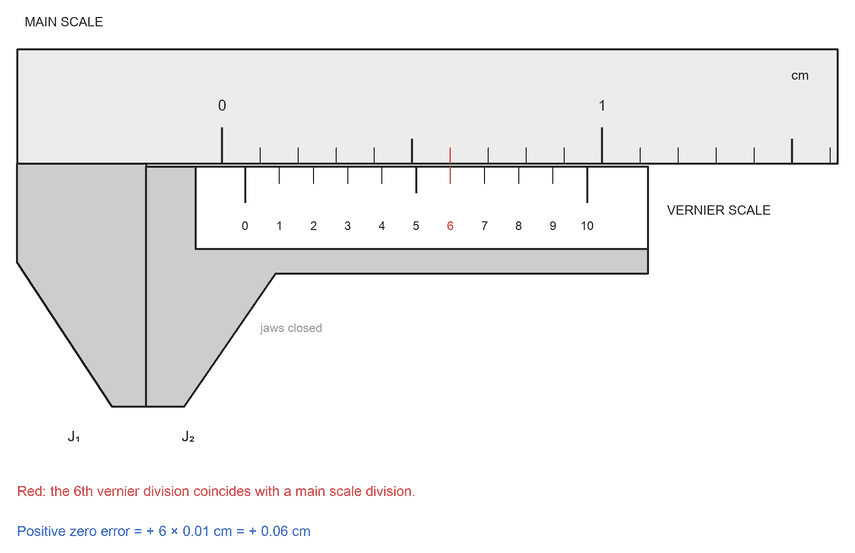
Step 4 — Negative zero error.
If the vernier zero lies to the left of the main-scale zero and the p-th of n vernier divisions coincides, the zero error is − (n − p) × L.C. For example, with n = 10 and the 6th division coinciding,

Step 5 — Correct the reading.
The zero error, with its sign, is always subtracted from the observed reading.
For example, an observed reading of 3.36 cm with a zero error of −0.04 cm gives
Watch out: Subtract the zero error WITH its sign: a negative error is effectively added.
Therefore, the zero error is the reading with the jaws closed (+p × L.C. or −(n − p) × L.C.), and the correct reading is the observed reading minus the zero error.