
Opening your dashboard
Class 9 Maths Chapter 20: Area and Perimeter of Plane Figures Solutions
101 textbook questions with step-by-step answers, free to read, for ICSE 2026-27.
Get talked through Ch 20, not just shown the answer
Reading a finished solution is not the same as being able to do it. The AI tutor takes one question at a time and works it with you, in your own words, until you can.
- Ask it out loud, in your own words
- It gives you the next step, not the answer
- Stuck on part (ii)? Start there
101 questions with solutions
1–3 marks · Mixed difficulty
The first 32 solutions are on this page. This chapter is a long one, so the rest open on their own page to keep this one quick to load.
- 11 mark
Question 1
Length and corresponding altitude of a triangle is doubled. The area of triangle will become :
Solve with AIAnswer
(A) double
(B) half
- Correct
(C) four times
(D) one-fourth
Answer: (C) four times
Concept: The area of a triangle is , where the height (altitude) is the perpendicular distance from the opposite vertex to the line of that base.
Step 1 — Write the old area.
Let the base be and the altitude on it be . Then the old area is .
Step 2 — Double both lengths.
The new base is and the new altitude is . We put them into the same formula.
So the new area is 4 times the old area.
Watch out: Both the base and the height are doubled, so the area is multiplied by 2 × 2 = 4, not by 2.
Why the other options are wrong:
- (A) double: Doubling only one of the two lengths would double the area; here both are doubled.
- (B) half: The area grows when the lengths grow, so it cannot become half.
- (D) one-fourth: One-fourth would happen if both lengths were halved, not doubled.
Therefore, the area becomes four times the old area, option (C).
- 21 mark
Question 2
If each side of an equilateral triangle is halved, its area will be :
Solve with AIAnswer
(A) halved
(B) four times
(C) unaltered
- Correct
(D) one-fourth
Answer: (D) one-fourth
Concept: For an equilateral triangle of side : and . Both come from Pythagoras' theorem, because the altitude bisects the base.
Step 1 — Write the old area.
Let the side be . The old area is .
Step 2 — Halve the side.
The new side is . We square it inside the same formula.
So the new area is one-fourth of the old area.
Watch out: The area depends on , so halving the side multiplies the area by .
Why the other options are wrong:
- (A) halved: Halved would be right only if the area depended on itself; it depends on .
- (B) four times: A smaller side gives a smaller area, so it cannot become four times.
- (C) unaltered: A smaller side gives a smaller area, so it cannot stay the same.
Therefore, the area becomes one-fourth of the old area, option (D).
- 31 mark
Question 3
The area of a triangle is 37·5 cm². If its base is 12·5 cm; the corresponding altitude is :
Solve with AIAnswer
(A) 3 cm
(B) 25 cm
- Correct
(C) 6 cm
(D) 12 cm
Answer: (C) 6 cm
Concept: The area of a triangle is , where the height (altitude) is the perpendicular distance from the opposite vertex to the line of that base.
Step 1 — Use the area formula.
Let the altitude be cm. Half of the base times the altitude must give the area.
Watch out: Do not forget the : the altitude is , not .
Why the other options are wrong:
- (A) 3 cm: This is , the area divided by the base with the factor 2 left out.
- (B) 25 cm: With cm the area would be , which is 156.25 cm², not 37.5 cm².
- (D) 12 cm: With cm the area would be 75 cm², twice the given area.
Therefore, the corresponding altitude is 6 cm, option (C).
- 41 mark
Question 4
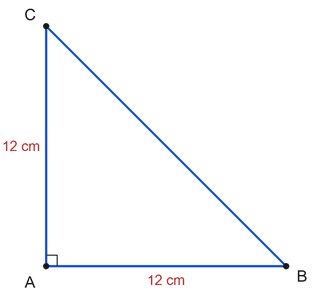
ABC is a triangle with AB = AC = 12 cm and ∠A = 90°, the area of the triangle ABC is :
 Solve with AI
Answer
(A) 144 cm²
(B) 36 cm²
- Correct
(C) 72 cm²
(D) 108 cm²
Answer: (C) 72 cm²
Concept: In a right-angled triangle, the two sides that make the right angle are perpendicular, so one is the base and the other is the height: . By Pythagoras' theorem, .
Step 1 — Choose the base and height.
Since ∠A = 90°, the sides AB and AC are perpendicular, so AB is the base and AC is the height.
Step 2 — Find the area.
We use half of base times height.
Watch out: The two equal sides make the right angle, so they are the base and height; the is still needed.
Why the other options are wrong:
- (A) 144 cm²: This is with the left out, which is the area of a square of side 12 cm.
- (B) 36 cm²: This is , half the true area.
- (D) 108 cm²: This is , which is not the area formula.
Therefore, the area of triangle ABC is 72 cm², option (C).
- 51 mark
Question 5
The sides of a triangle are 9 cm, 12 cm and 15 cm; the area of the triangle is :
Solve with AIAnswer
- Correct
(A) 54 cm²
(B) 96 cm²
(C) 108 cm²
(D) 135 cm²
Answer: (A) 54 cm²
Concept: In a right-angled triangle, the two sides that make the right angle are perpendicular, so one is the base and the other is the height: . By Pythagoras' theorem, .
Step 1 — Test for a right angle.
We check whether the square of the longest side equals the sum of the squares of the other two.
They are equal, so by the converse of Pythagoras' theorem the triangle is right-angled, with legs 9 cm and 12 cm.
Step 2 — Find the area.
The two legs are the base and the height.
Watch out: The hypotenuse (15 cm) is not a height; use the two shorter sides, which meet at the right angle.
Why the other options are wrong:
- (B) 96 cm²: 96 cm² does not come from these sides at all; the area is cm².
- (C) 108 cm²: This is , with the left out.
- (D) 135 cm²: This is , a leg times the hypotenuse, and the hypotenuse is not perpendicular to that leg.
Therefore, the area of the triangle is 54 cm², option (A).
- 63 marks
Question 6
Find the area of a triangle whose sides are 18 cm, 24 cm and 30 cm.
Also, find the length of altitude corresponding to the largest side of the triangle.
Solve with AIWritten solution
Solution:
Concept: In a right-angled triangle, the two sides that make the right angle are perpendicular, so one is the base and the other is the height: . By Pythagoras' theorem, .
Given: Sides 18 cm, 24 cm and 30 cm.
Step 1 — Test for a right angle.
We compare the square of the longest side with the sum of the squares of the other two.
They are equal, so the triangle is right-angled and the legs are 18 cm and 24 cm.
Step 2 — Find the area.
The two legs are the base and the height.
Step 3 — Find the altitude on the largest side.
Let cm be the altitude on the 30 cm side. The same area must come out with 30 cm as the base.
Watch out: The altitude to the hypotenuse is not one of the legs; find it from the area.
Therefore, the area is 216 cm² and the altitude on the largest side is 14.4 cm.
- 73 marks
Question 7
The lengths of the sides of a triangle are in the ratio 3 : 4 : 5. Find the area of the triangle if its perimeter is 144 cm.
Solve with AIWritten solution
Solution:
Concept: In a right-angled triangle, the two sides that make the right angle are perpendicular, so one is the base and the other is the height: . By Pythagoras' theorem, .
Given: Sides in the ratio 3 : 4 : 5 and perimeter 144 cm.
Step 1 — Find the sides.
Since the sides are in the ratio 3 : 4 : 5, let them be , and cm. Their sum is the perimeter.
So the sides are 36 cm, 48 cm and 60 cm.
Step 2 — Test for a right angle.
We compare the square of the longest side with the sum of the squares of the other two.
They are equal, so the triangle is right-angled with legs 36 cm and 48 cm.
Step 3 — Find the area.
The legs are the base and the height.
Watch out: Find the actual sides before using any formula; the ratio numbers 3, 4, 5 are not the lengths.
Therefore, the area of the triangle is 864 cm².
- 83 marks
Question 8
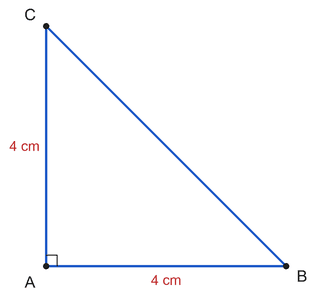
ABC is a triangle in which AB = AC = 4 cm and ∠A = 90°.
Calculate :
(i) the area of Δ ABC,
(ii) the length of perpendicular from A to BC.
Solve with AIWritten solution
Solution:
Concept: In a right-angled triangle, the two sides that make the right angle are perpendicular, so one is the base and the other is the height: . By Pythagoras' theorem, .
Given: AB and AC are both 4 cm, and ∠A = 90°.
Step 1 — Find the area.
Since ∠A = 90°, AB and AC are perpendicular, so they are the base and the height.
Step 2 — Find BC.
BC is the hypotenuse of the right-angled triangle, so we use Pythagoras' theorem.
Step 3 — Find the perpendicular from A to BC.
Let the perpendicular be cm. With BC as the base, the area is still 8 cm².
Taking :
Watch out: The perpendicular from A to BC is not AB or AC; it is found from the area with BC as the base.
Therefore, (i) the area of Δ ABC is 8 cm²; (ii) the perpendicular from A to BC is cm ≈ 2.83 cm.
- 93 marks
Question 9
The area of an equilateral triangle is sq. cm. Find its perimeter.
Solve with AIWritten solution
Solution:
Concept: For an equilateral triangle of side : and . Both come from Pythagoras' theorem, because the altitude bisects the base.
Given: Area cm².
Step 1 — Find the side.
Let the side be cm. We put the given area into the formula and solve for .
We take the positive root, because a length cannot be negative.
Step 2 — Find the perimeter.
An equilateral triangle has three equal sides.
Watch out: The on both sides cancels; do not replace it by 1.732 here.
Therefore, the perimeter of the triangle is 36 cm.
- 103 marks
Question 10
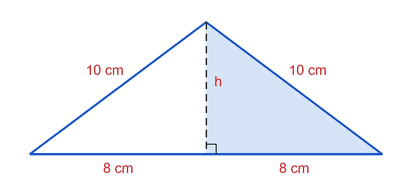
Find the area of an isosceles triangle with perimeter 36 cm and base 16 cm.
Solve with AIWritten solution
Solution:
Concept: In an isosceles triangle, the altitude drawn to the base bisects the base. So half the base, the height and one equal side form a right-angled triangle, and Pythagoras' theorem links them.
Given: Perimeter 36 cm and base 16 cm.
Step 1 — Find each equal side.
The two equal sides together make the perimeter minus the base.
Step 2 — Find the height.
The altitude bisects the base of 16 cm into two parts of 8 cm, so we use Pythagoras' theorem.
Step 3 — Find the area.
We use half of base times height.
Watch out: Use half the base (8 cm), not the whole base, in Pythagoras' theorem.
Therefore, the area of the triangle is 48 cm².
- 113 marks
Question 11
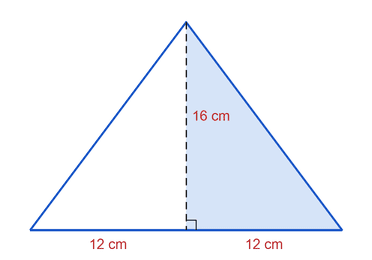
The base of an isosceles triangle is 24 cm and its area is 192 sq. cm. Find its perimeter.
Solve with AIWritten solution
Solution:
Concept: In an isosceles triangle, the altitude drawn to the base bisects the base. So half the base, the height and one equal side form a right-angled triangle, and Pythagoras' theorem links them.
Given: Base 24 cm and area 192 cm².
Step 1 — Find the height.
Let the height be cm. Half of the base times the height gives the area.
Step 2 — Find each equal side.
The altitude bisects the base into 12 cm and 12 cm, so each equal side is a hypotenuse.
Step 3 — Find the perimeter.
We add the three sides.
Watch out: The perimeter has two equal sides and the base; do not forget the base.
Therefore, the perimeter of the triangle is 64 cm.
- 123 marks
Question 12
The given figure shows a right-angled triangle ABC and an equilateral triangle BCD. Find the area of the shaded portion.
 Solve with AI
Written solution
Solution:
Concept: In a right-angled triangle, the two sides that make the right angle are perpendicular, so one is the base and the other is the height: . By Pythagoras' theorem, .
For an equilateral triangle of side : and . Both come from Pythagoras' theorem, because the altitude bisects the base.
Given: Right-angled Δ ABC (∠B = 90°), AC = 16 cm, BC = 8 cm; BCD is equilateral.
Step 1 — Find AB.
Triangle ABC is right-angled at B, with hypotenuse AC = 16 cm and BC = 8 cm, so we use Pythagoras' theorem.
Step 2 — Find the area of triangle ABC.
AB and BC meet at the right angle, so they are the height and the base.
Step 3 — Find the area of triangle BCD.
Triangle BCD is equilateral with side BC = 8 cm.
Step 4 — Find the shaded area.
The shaded part ABD is what is left of triangle ABC when triangle BCD is taken away.
Taking :
Watch out: The 16 cm is the hypotenuse AC, so AB is found by subtracting squares, not adding them.
Therefore, the area of the shaded portion is cm² ≈ 27.712 cm².
- 133 marks
Question 13
Find the area and the perimeter of quadrilateral ABCD, given below; if, AB = 8 cm, AD = 10 cm, BD = 12 cm, DC = 13 cm and ∠DBC = 90°.
 Solve with AI
Written solution
Solution:
Concept: Heron's formula: for a triangle with sides , , and semi-perimeter , . It needs only the three sides.
Given: AB = 8 cm, AD = 10 cm, BD = 12 cm, DC = 13 cm and ∠DBC = 90°.
Step 1 — Split the quadrilateral.
The diagonal BD divides ABCD into triangle ABD (three sides known) and triangle DBC (right-angled at B).
Step 2 — Find the area of triangle ABD.
The sides are 8 cm, 10 cm and 12 cm, so we use Heron's formula. First the semi-perimeter:
Now the formula:
Step 3 — Find BC.
Triangle DBC is right-angled at B with hypotenuse DC = 13 cm and BD = 12 cm.
Step 4 — Find the area of triangle DBC.
BD and BC meet at the right angle, so they are the base and the height.
Step 5 — Add the two areas.
The two triangles together make the quadrilateral.
Step 6 — Find the perimeter.
The perimeter is the sum of the four outer sides; the diagonal BD is inside and is not included.
Watch out: The diagonal BD is used for the areas, but it is not part of the perimeter.
Therefore, the area of ABCD is about 69.69 cm² (≈ 69.7 cm²) and its perimeter is 36 cm.
- 143 marks
Question 14
The base of a triangular field is three times its height. If the cost of cultivating the field at ₹ 36·72 per 100 m² is ₹ 49,572; find its base and height.
Solve with AIWritten solution
Solution:
Concept: The area of a triangle is , where the height (altitude) is the perpendicular distance from the opposite vertex to the line of that base.
Given: Base = 3 × height; cost ₹ 49,572 at ₹ 36.72 per 100 m².
Step 1 — Find the area of the field.
Each 100 m² costs ₹ 36.72, so the number of 100 m² units is the total cost divided by 36.72.
So the area is 1350 lots of 100 m².
Step 2 — Find the height.
Let the height be m, so the base is m. Half of base times height is the area.
We take the positive root, because a length cannot be negative.
Step 3 — Find the base.
The base is three times the height.
Watch out: The rate is per 100 m², so multiply by 100 after dividing the cost by the rate.
Therefore, the base of the field is 900 m and its height is 300 m.
- 153 marks
Question 15
The sides of a triangular field are in the ratio 5 : 3 : 4 and its perimeter is 180 m. Find :
(i) its area.
(ii) altitude of the triangle corresponding to its largest side.
(iii) the cost of levelling the field at the rate of ₹ 10 per square metre.
Solve with AIWritten solution
Solution:
Concept: In a right-angled triangle, the two sides that make the right angle are perpendicular, so one is the base and the other is the height: . By Pythagoras' theorem, .
Given: Sides in the ratio 5 : 3 : 4, perimeter 180 m, levelling at ₹ 10 per m².
Step 1 — Find the sides.
Since the sides are in the ratio 5 : 3 : 4, let them be , and m. Their sum is the perimeter.
So the sides are 75 m, 45 m and 60 m.
Step 2 — Test for a right angle.
We compare the square of the longest side with the sum of the squares of the other two.
They are equal, so the triangle is right-angled with legs 45 m and 60 m.
Step 3 — Find the area (part i).
The legs are the base and the height.
Step 4 — Find the altitude on the largest side (part ii).
Let m be the altitude on the 75 m side. The area is the same with 75 m as the base.
Step 5 — Find the cost of levelling (part iii).
Each square metre costs ₹ 10, so we multiply the area by 10.
So the cost is ₹ 13,500.
Watch out: The largest side (75 m) is the hypotenuse; the right angle is between the 45 m and 60 m sides.
Therefore, (i) the area is 1350 m²; (ii) the altitude on the largest side is 36 m; (iii) the cost of levelling is ₹ 13,500.
- 163 marks
Question 16
Each of equal sides of an isosceles triangle is 4 cm greater than its height. If the base of the triangle is 24 cm; calculate the perimeter and the area of the triangle.
Solve with AIWritten solution
Solution:
Concept: In an isosceles triangle, the altitude drawn to the base bisects the base. So half the base, the height and one equal side form a right-angled triangle, and Pythagoras' theorem links them.
Given: Each equal side = height + 4 cm; base 24 cm.
Step 1 — Set up the equation.
Let the height be cm, so each equal side is cm.

The height bisects the base, so half the base is 12 cm, and Pythagoras' theorem in one half of the triangle gives:
Step 2 — Find the sides.
Each equal side is 4 cm more than the height.
Step 3 — Find the perimeter.
We add the three sides.
Step 4 — Find the area.
We use half of base times height.
Watch out: Expand fully as ; it is not .
Therefore, the perimeter is 64 cm and the area is 192 cm².
- 173 marks
Question 17
Calculate the area and the height of an equilateral triangle whose perimeter is 60 cm.
Solve with AIWritten solution
Solution:
Concept: For an equilateral triangle of side : and . Both come from Pythagoras' theorem, because the altitude bisects the base.
Given: An equilateral triangle with perimeter 60 cm.
Step 1 — Find the side.
The three sides are equal, so each side is one-third of the perimeter.
Step 2 — Find the area.
We use the formula for an equilateral triangle.
Taking :
Step 3 — Find the height.
We use the height formula for an equilateral triangle.
Taking :
Watch out: The height uses and the area uses ; do not mix them up.
Therefore, the area is cm² ≈ 173.2 cm² and the height is cm ≈ 17.32 cm.
- 183 marks
Question 18
In triangle ABC; angle A = 90°, side AB = x cm, AC = (x + 5) cm and area = 150 cm².
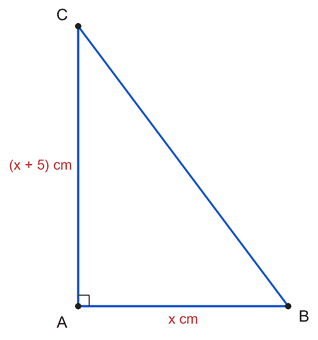
Find the sides of the triangle.
Solve with AIWritten solution
Solution:
Concept: In a right-angled triangle, the two sides that make the right angle are perpendicular, so one is the base and the other is the height: . By Pythagoras' theorem, .
Given: ∠A = 90°, AB = x cm, AC = (x + 5) cm, area 150 cm².
Step 1 — Set up the equation.
Since ∠A = 90°, AB and AC are the base and the height, so half their product is the area.
Step 2 — Choose the root.
The roots are and . A length cannot be negative, so .
So AB is 15 cm and AC is 15 + 5 = 20 cm.
Step 3 — Find BC.
BC is the hypotenuse, so we use Pythagoras' theorem.
Watch out: Reject , because a side cannot have a negative length.
Therefore, the sides are AB = 15 cm, AC = 20 cm and BC = 25 cm.
- 193 marks
Question 19
If the difference between the sides of a right angled triangle is 3 cm and its area is 54 cm²; find its perimeter.
Solve with AIWritten solution
Solution:
Concept: In a right-angled triangle, the two sides that make the right angle are perpendicular, so one is the base and the other is the height: . By Pythagoras' theorem, .
Given: The two sides containing the right angle differ by 3 cm; area 54 cm².
Step 1 — Set up the equation.
The two sides that make the right angle are the base and the height. Let them be cm and cm, so half their product is the area.
Step 2 — Choose the root.
The roots are and . A length cannot be negative, so the two sides are 9 cm and 12 cm.
Step 3 — Find the hypotenuse.
We use Pythagoras' theorem.
Step 4 — Find the perimeter.
We add the three sides.
Watch out: The sides that differ by 3 cm are the two that make the right angle (base and height), not the hypotenuse.
Therefore, the perimeter of the triangle is 36 cm.
- 201 mark
Question 20
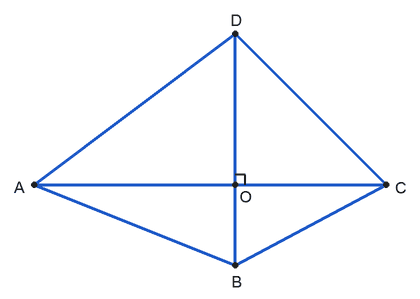
The area of the given figure is :
 Solve with AI
Answer
(A) AC × BD
- Correct
(B) × AC × BD
(C) × AB × BD
(D) × (AD + BC) × BD
Answer: (B) × AC × BD
Concept: A diagonal divides a quadrilateral into two triangles on the same base. So .
Step 1 — Split along the diagonal AC.
The diagonal AC divides the figure into triangles ABC and ADC. Since BD ⊥ AC at O, OB is the height of triangle ABC and OD is the height of triangle ADC, both on the base AC.
Step 2 — Add the two areas.
We add half of base times height for each triangle and take out the common factor.
Since , the area is .
Watch out: When the diagonals cut at right angles, the area is half the product of the diagonals, not the full product.
Why the other options are wrong:
- (A) AC × BD: The product of the diagonals is the area of the rectangle drawn round the figure, which is twice the area of ABCD.
- (C) × AB × BD: AB is a side, not a diagonal, and BD is not the height on AB.
- (D) × (AD + BC) × BD: This is the trapezium formula, but AD and BC are not parallel sides of this figure.
Therefore, the area of the figure is , option (B).
- 211 mark
Question 21
If two adjacent sides and a diagonal of a rectangle are x, y and d respectively. The area of the rectangle is :
Solve with AIAnswer
- Correct
(A)
(B)
(C)
(D)
Answer: (A)
Concept: A rectangle of length and breadth has area . \nIts perimeter is . \nA square of side has area and perimeter .
Step 1 — Identify the length and breadth.
Two adjacent sides of a rectangle are its length and breadth, so they are and .
Step 2 — Use the area formula.
The area of a rectangle is length times breadth, so the area is . The diagonal is not needed.
Watch out: Adjacent sides of a rectangle are perpendicular, so their product is the area; a side and a diagonal are not perpendicular.
Why the other options are wrong:
- (B) : is the area only when the rectangle is a square ().
- (C) : A side and a diagonal of a rectangle are never perpendicular, so is not an area of this figure.
- (D) : A side and a diagonal of a rectangle are never perpendicular, so is not an area of this figure.
Therefore, the area of the rectangle is , option (A).
- 221 mark
Question 22
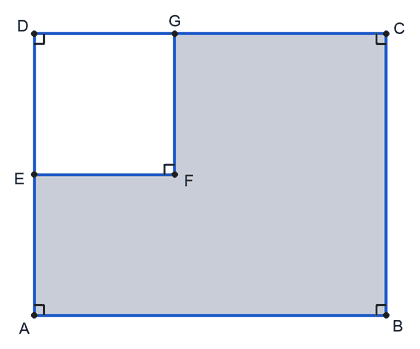
A square DEFG of side 8 cm is inscribed in a rectangle of adjacent sides 20 cm and 16 cm as shown in the figure. The area of the shaded portion is :
 Solve with AI
Answer
(A) 64 cm²
(B) 128 cm²
- Correct
(C) 256 cm²
(D) 320 cm²
Answer: (C) 256 cm²
Concept: A rectangle of length and breadth has area . \nIts perimeter is . \nA square of side has area and perimeter .
Step 1 — Find the area of the rectangle.
We use length times breadth.
Step 2 — Find the area of the square.
The square DEFG has side 8 cm.
Step 3 — Find the shaded area.
The shaded part is the rectangle with the square removed.
Watch out: The square sits inside the rectangle, so its area is subtracted, not added.
Why the other options are wrong:
- (A) 64 cm²: 64 cm² is the area of the unshaded square.
- (B) 128 cm²: 128 cm² is twice the square; it is not the rectangle minus the square.
- (D) 320 cm²: 320 cm² is the whole rectangle; the square has not been removed.
Therefore, the area of the shaded portion is 256 cm², option (C).
- 231 mark
Question 23
The perimeter of a square is 72 cm, its area is :
Solve with AIAnswer
(A) cm²
(B) cm²
- Correct
(C) 324 cm²
(D) 356 cm²
Answer: (C) 324 cm²
Concept: A rectangle of length and breadth has area . \nIts perimeter is . \nA square of side has area and perimeter .
Step 1 — Find the side.
A square has four equal sides, so the side is one-fourth of the perimeter.
Step 2 — Find the area.
The area of a square is side times side.
Watch out: Divide the perimeter by 4 to get the side before squaring.
Why the other options are wrong:
- (A) cm²: The side is the whole number 18 cm, so the area has no surd in it.
- (B) cm²: The side is the whole number 18 cm, so the area has no surd in it.
- (D) 356 cm²: 356 is not ; .
Therefore, the area of the square is 324 cm², option (C).
- 241 mark
Question 24
Area of a rhombus is 360 cm². If one diagonal of it is 20 cm; the other diagonal is :
Solve with AIAnswer
(A) 24 cm
(B) 18 cm
(C) 40 cm
- Correct
(D) 36 cm
Answer: (D) 36 cm
Concept: The diagonals of a rhombus bisect each other at right angles, so . Half of each diagonal and one side form a right-angled triangle.
Step 1 — Use the rhombus formula.
Let the other diagonal be cm. Half the product of the diagonals is the area.
Watch out: The in the formula means the other diagonal is , not .
Why the other options are wrong:
- (A) 24 cm: With 24 cm the area would be ½ × 20 × 24 = 240 cm².
- (B) 18 cm: 18 is , the formula used without the ; it gives an area of 180 cm².
- (C) 40 cm: With 40 cm the area would be ½ × 20 × 40 = 400 cm².
Therefore, the other diagonal is 36 cm, option (D).
- 253 marks
Question 25
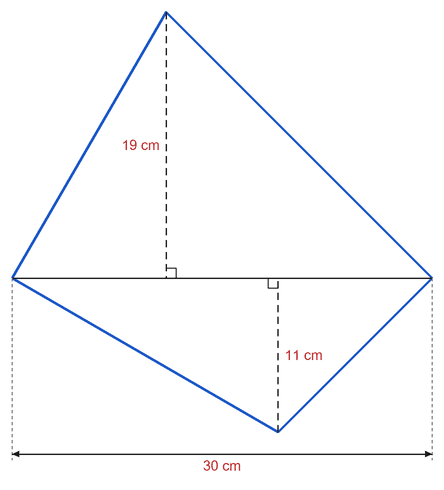
Find the area of a quadrilateral one of whose diagonals is 30 cm long and the perpendiculars from the other two vertices are 19 cm and 11 cm respectively.
 Solve with AI
Written solution
Solution:
Concept: A diagonal divides a quadrilateral into two triangles on the same base. So .
Given: A diagonal of 30 cm and perpendiculars of 19 cm and 11 cm on it.
Step 1 — Use the diagonal formula.
The diagonal 30 cm splits the quadrilateral into two triangles on the same base, with heights 19 cm and 11 cm.
Watch out: Add the two perpendiculars; each one is the height of one of the two triangles.
Therefore, the area of the quadrilateral is 450 cm².
- 263 marks
Question 26
The diagonals of a quadrilateral are 16 cm and 13 cm. If they intersect each other at right angles; find the area of the quadrilateral.
 Solve with AI
Written solution
Solution:
Concept: A diagonal divides a quadrilateral into two triangles on the same base. So .
Given: Diagonals 16 cm and 13 cm, cutting at right angles.
Step 1 — Use half the product of the diagonals.
When the diagonals cut at right angles, each diagonal is the base of two triangles whose heights add up to the other diagonal.
Watch out: The formula has a half; the full product 208 is twice the area.
Therefore, the area of the quadrilateral is 104 cm².
- 273 marks
Question 27
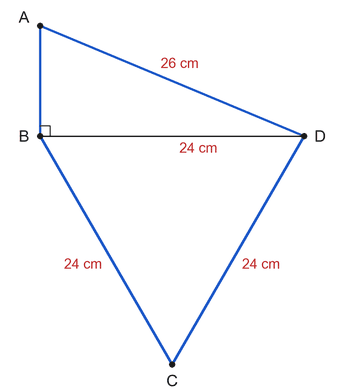
Calculate the area of quadrilateral ABCD, in which ∠ABD = 90°, triangle BCD is an equilateral triangle of side 24 cm and AD = 26 cm.
 Solve with AI
Written solution
Solution:
Concept: In a right-angled triangle, the two sides that make the right angle are perpendicular, so one is the base and the other is the height: . By Pythagoras' theorem, .
For an equilateral triangle of side : and . Both come from Pythagoras' theorem, because the altitude bisects the base.
Given: ∠ABD = 90°, BCD equilateral with side 24 cm, AD = 26 cm.
Step 1 — Split the quadrilateral.
The diagonal BD divides ABCD into triangle ABD, right-angled at B, and the equilateral triangle BCD. So BD = 24 cm.
Step 2 — Find AB.
In right triangle ABD the hypotenuse is AD = 26 cm, so we use Pythagoras' theorem.
Step 3 — Find the area of triangle ABD.
AB and BD meet at the right angle, so they are the height and the base.
Step 4 — Find the area of triangle BCD.
We use the equilateral-triangle formula with side 24 cm, taking .
Step 5 — Add the two areas.
The two triangles together make ABCD.
Watch out: BD is a side of the equilateral triangle, so BD = 24 cm; AD = 26 cm is the hypotenuse of triangle ABD.
Therefore, the area of ABCD is cm² ≈ 369.41 cm².
- 283 marks
Question 28
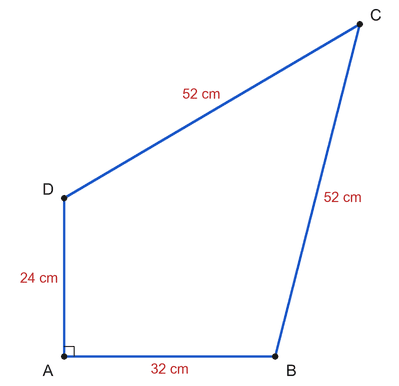
Calculate the area of quadrilateral ABCD in which AB = 32 cm, AD = 24 cm, ∠A = 90° and BC = CD = 52 cm.
 Solve with AI
Written solution
Solution:
Concept: In a right-angled triangle, the two sides that make the right angle are perpendicular, so one is the base and the other is the height: . By Pythagoras' theorem, .
In an isosceles triangle, the altitude drawn to the base bisects the base. So half the base, the height and one equal side form a right-angled triangle, and Pythagoras' theorem links them.
Given: AB = 32 cm, AD = 24 cm, ∠A = 90°, and BC and CD are both 52 cm.
Step 1 — Find BD.
Triangle ABD is right-angled at A, so its hypotenuse BD comes from Pythagoras' theorem.
Step 2 — Find the area of triangle ABD.
AB and AD meet at the right angle, so they are the base and the height.
Step 3 — Find the height of triangle BCD.
Triangle BCD is isosceles, because BC and CD are both 52 cm. So the altitude from C bisects BD into two parts of 20 cm.
Step 4 — Find the area of triangle BCD.
We use half of base times height with base BD = 40 cm.
Step 5 — Add the two areas.
The diagonal BD splits ABCD into these two triangles.
Watch out: Use half of BD (20 cm) when finding the height of the isosceles triangle BCD.
Therefore, the area of quadrilateral ABCD is 1344 cm².
- 293 marks
Question 29
The perimeter of a rectangular field is km. If the length of the field is twice its width; find the area of the rectangle in sq. metres.
Solve with AIWritten solution
Solution:
Concept: A rectangle of length and breadth has area . \nIts perimeter is . \nA square of side has area and perimeter .
Given: Perimeter km; length = 2 × width.
Step 1 — Change the perimeter to metres.
The answer is wanted in square metres, so we first change kilometres to metres (1 km = 1000 m).
Step 2 — Find the width and length.
Let the width be m, so the length is m. Twice the sum of length and width is the perimeter.
So the width is 100 m and the length is 200 m.
Step 3 — Find the area.
We use length times width.
Watch out: Change km to m before finding the sides, so the area comes out in square metres.
Therefore, the area of the field is 20,000 m².
- 303 marks
Question 30
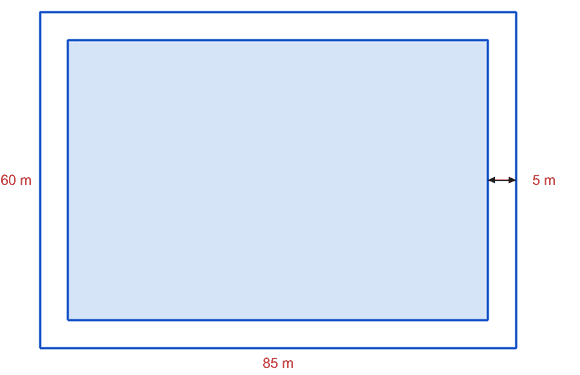
A rectangular plot 85 m long and 60 m broad is to be covered with grass leaving 5 m all around.
Find the area to be laid with grass.
Solve with AIWritten solution
Solution:
Concept: A rectangle of length and breadth has area . \nIts perimeter is . \nA square of side has area and perimeter .
Given: A plot 85 m by 60 m with a 5 m margin all round.
Step 1 — Find the size of the grass plot.
A strip 5 m wide is left on both ends of each side, so each measurement loses 5 + 5 = 10 m.
Step 2 — Find the grass area.
We use length times breadth.
Watch out: Subtract 5 m from both ends of each side (10 m in all), not just once.
Therefore, the area to be laid with grass is 3750 m².
- 313 marks
Question 31
The length and the breadth of a rectangle are 6 cm and 4 cm respectively. Find the height of a triangle whose base is 6 cm and area is 3 times that of the rectangle.
Solve with AIWritten solution
Solution:
Concept: The area of a triangle is , where the height (altitude) is the perpendicular distance from the opposite vertex to the line of that base.
A rectangle of length and breadth has area . \nIts perimeter is . \nA square of side has area and perimeter .
Given: Rectangle 6 cm by 4 cm; triangle on base 6 cm with 3 times its area.
Step 1 — Find the area of the triangle.
The triangle's area is 3 times the rectangle's area.
Step 2 — Find the height.
Let the height be cm. Half of the base 6 cm times the height is 72 cm².
Watch out: The triangle's area has the factor , so its height is not simply 72 ÷ 6.
Therefore, the height of the triangle is 24 cm.
- 323 marks
Question 32
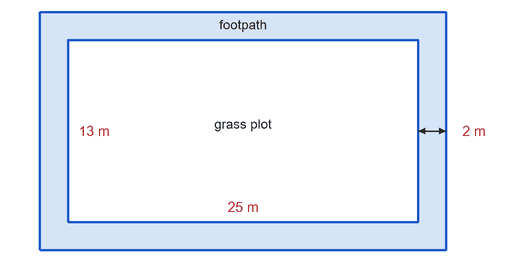
How many tiles, each of area 400 cm², will be needed to pave a footpath which is 2 m wide and surrounds a grass plot 25 m long and 13 m wide ?
 Solve with AI
Written solution
Solution:
Concept: A rectangle of length and breadth has area . \nIts perimeter is . \nA square of side has area and perimeter .
Given: A grass plot 25 m by 13 m with a path 2 m wide all round; tiles of 400 cm².
Step 1 — Find the outer rectangle.
The path is 2 m wide on every side, so each measurement of the plot grows by 2 + 2 = 4 m.
Step 2 — Find the area of the path.
The path is the outer rectangle minus the grass plot.
Step 3 — Change to square centimetres.
The tile area is in cm². Since 1 m is 100 cm, a square of side 1 m is 100 cm by 100 cm.
So we multiply the area in m² by 10,000.
Step 4 — Count the tiles.
Each tile covers 400 cm², so we divide.
Watch out: The path surrounds the plot, so add 2 m on both sides (4 m) to each measurement, and use the same units before dividing.
Therefore, 4200 tiles are needed.
- 333 marks
Question 33
The cost of enclosing a rectangular garden with a fence all round, at the rate of 75 paise per metre, is ₹ 300. If the length of the garden is 120 metres, find the area of the field in square metres.
- 343 marks
Question 34
The width of a rectangular room is of its length, x, and its perimeter is y. Write an equation connecting x and y. Find the length of the room when the perimeter is 4400 cm.
- 353 marks
Question 35
The length of a rectangular verandah is 3 m more than its breadth. The numerical value of its area is equal to the numerical value of its perimeter.
(i) Taking x as the breadth of the verandah, write an equation in x that represents the above statement.
(ii) Solve the equation obtained in (i) above and hence find the dimensions of the verandah.
- 363 marks
Question 36
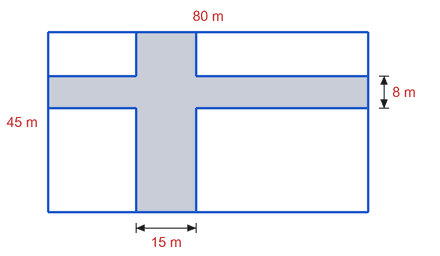
The diagram, given below, shows two paths drawn inside a rectangular field 80 m long and 45 m wide. The widths of the two paths are 8 m and 15 m as shown. Find the area of the shaded portion.
- 373 marks
Question 37
The rate for a 1·20 m wide carpet is ₹ 40 per metre; find the cost of covering a hall 45 m long and 32 m wide with this carpet. Also, find the cost of carpeting the same hall if the carpet, 80 cm wide, is at ₹ 25 per metre.
- 383 marks
Question 38
Find the area and perimeter of a square plot of land, the length of whose diagonal is 15 metres. Give your answer correct to 2 places of decimals.
- 393 marks
Question 39
The shaded region of the given diagram represents the lawn in the form of a house. On the three sides of the lawn there are flower-beds having a uniform width of 2 m.

(i) Find the length and the breadth of the lawn.
(ii) Hence, or otherwise, find the area of the flower-beds.
- 403 marks
Question 40
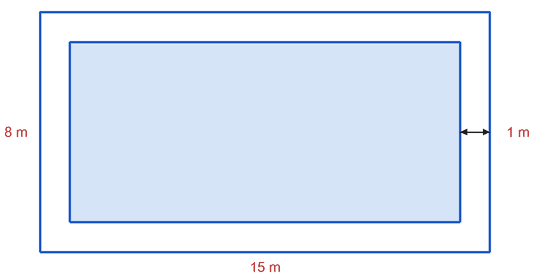
A floor which measures 15m × 8m is to be laid with tiles measuring 50 cm × 25cm. Find the number of tiles required.
Further, if a carpet is laid on the floor so that a space of 1 m exists between its edges and the edges of the floor, what fraction of the floor is left uncovered.
- 413 marks
Question 41
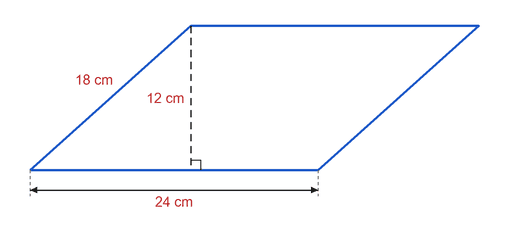
Two adjacent sides of parallelogram are 24 cm and 18 cm. If the distance between the longer sides is 12 cm; find the distance between the shorter sides.
- 423 marks
Question 42
Two adjacent sides of a parallelogram are 28 cm and 26 cm. If one diagonal of it is 30 cm long; find the area of the parallelogram.

Also, find the distance between its shorter sides.
- 433 marks
Question 43
The area of a rhombus is 216 sq. cm. If its one diagonal is 24 cm; find :
(i) length of its other diagonal,
(ii) length of its side,
(iii) perimeter of the rhombus.
- 443 marks
Question 44
The perimeter of a rhombus is 52 cm. If one diagonal is 24 cm; find :
(i) the length of its other diagonal,
(ii) its area.
- 453 marks
Question 45
The perimeter of a rhombus is 46 cm. If the height of the rhombus is 8 cm; find its area.
- 463 marks
Question 46
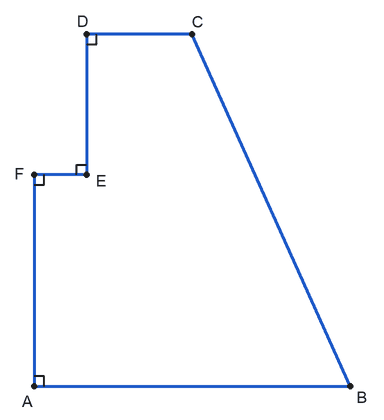
The given figure shows the cross-section of a concrete structure. Calculate the area of cross-section if AB = 1·8 m, CD = 0·6 m, DE = 0·8 m, EF = 0·3 m and AF = 1·2 m.
- 473 marks
Question 47
Calculate the area of the figure given below : which is not drawn to scale.
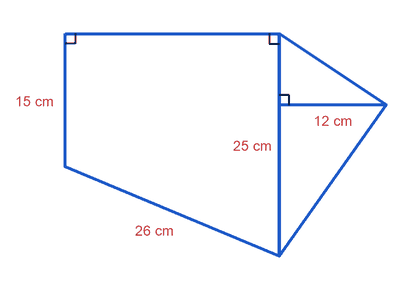
- 483 marks
Question 48
The following diagram shows a pentagonal field ABCDE in which the lengths of AF, FG, GH and HD are 50 m, 40 m, 15 m and 25 m respectively; and the lengths of perpendiculars BF, CH and EG are 50 m, 25 m and 60 m respectively. Determine the area of the field.
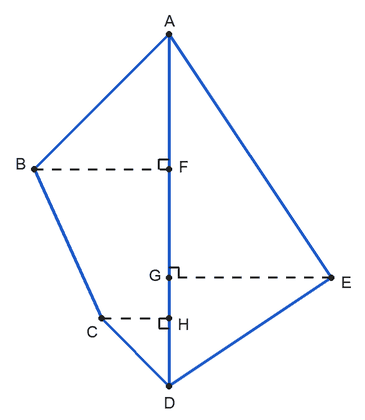
- 491 mark
Question 49
In the given figure, AB = BC, ∠ABC = 90°, AC = cm and BPC (shaded portion) is semi-circle. If , the area of shaded portion is :
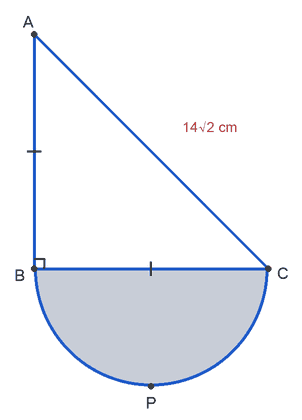
- 501 mark
Question 50
The diameter of a circle is 14 cm. If it is doubled, the perimeter of the resulting circle will become :
- 511 mark
Question 51
In the given figure, OABC is a square of side 14 cm. Taking , the area of the shaded portion is :
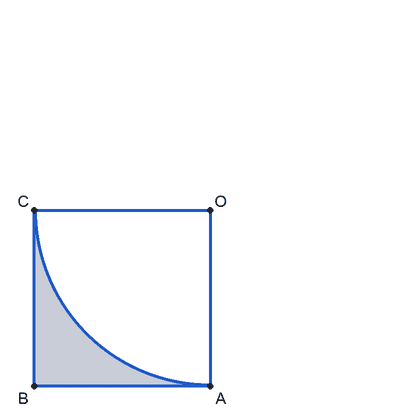
- 521 mark
Question 52
If the radius of a circle is doubled, then its area will become :
- 531 mark
Question 53
The radii of two circles are 14 cm and 28 cm. If , the area of the shaded portion is :
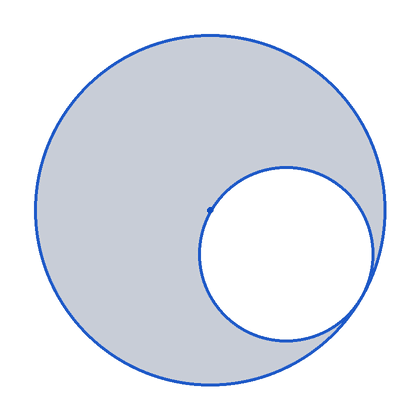
- 543 marks
Question 54
The diameter of a circle is 28 cm. Find its :
(i) circumference
(ii) area.
- 553 marks
Question 55
The circumference of a circular field is 308 m. Find its :
(i) radius
(ii) area.
- 563 marks
Question 56
The sum of the circumference and diameter of a circle is 116 cm. Find its radius.
- 573 marks
Question 57
The radii of two circles are 25 cm and 18 cm. Find the radius of the circle which has circumference equal to the sum of circumferences of these two circles.
- 583 marks
Question 58
The radii of two circles are 48 cm and 13 cm. Find the area of the circle which has its circumference equal to the difference of the circumferences of the given two circles.
- 593 marks
Question 59
The diameters of two circles are 32 cm and 24 cm. Find the radius of the circle having its area equal to sum of the areas of the two given circles.
- 603 marks
Question 60
The radius of a circle is 5 m. Find the circumference of the circle whose area is 49 times the area of the given circle.
- 613 marks
Question 61
A circle of largest area is cut from a rectangular piece of card-board with dimensions 55 cm and 42 cm. Find the ratio between the area of the circle cut and the area of the remaining card-board.
- 623 marks
Question 62
The following figure shows a square card-board ABCD of side 28 cm. Four identical circles of largest possible size are cut from this card as shown below.
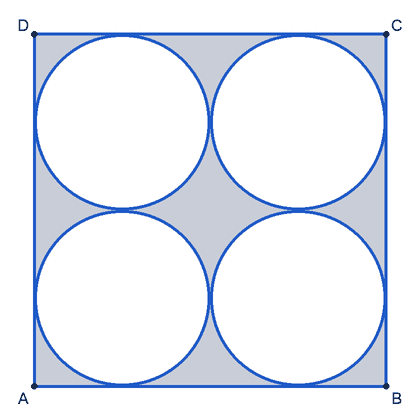
Find the area of the remaining card-board.
- 633 marks
Question 63
The radii of two circles are in the ratio 3 : 8. If the difference between their areas is cm², find the area of the smaller circle.
- 643 marks
Question 64
The diameters of three circles are in the ratio 3 : 5 : 6. If the sum of the circumferences of these circles be 308 cm; find the difference between the areas of the largest and the smallest of these circles.
- 653 marks
Question 65
Find the area of a ring shaped region enclosed between two concentric circles of radii 20 cm and 15 cm.
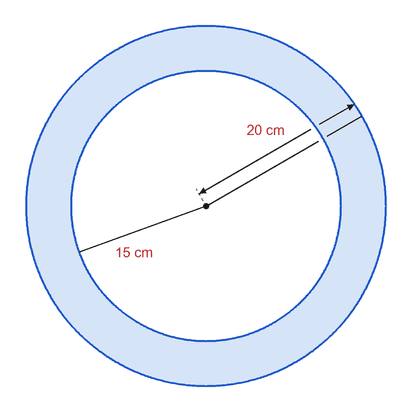
- 663 marks
Question 66
The circumference of a given circular park is 55 m. It is surrounded by a path of uniform width 3·5 m.
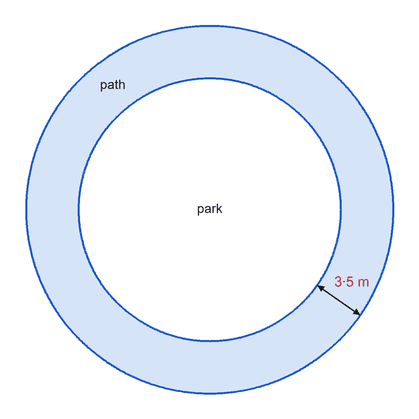
Find the area of the path.
- 673 marks
Question 67
There are two circular gardens A and B. The circumference of garden A is 1·760 km and the area of garden B is 25 times the area of garden A. Find the circumference of garden B.
- 683 marks
Question 68
A wheel has diameter 84 cm. Find how many complete revolutions must it make to cover 3·168 km.
- 693 marks
Question 69
Each wheel of a car is of diameter 80 cm. How many complete revolutions does each wheel make in 10 minutes when the car is travelling at a speed of 66 km per hour ?
- 703 marks
Question 70
An express train is running between two stations with a uniform speed. If the diameter of each wheel of the train is 42 cm and each wheel makes 1200 revolutions per minute, find the speed of the train.
- 713 marks
Question 71
The minute hand of a clock is 8 cm long. Find the area swept by the minute hand between 8.30 a.m. and 9.05 a.m.
- 723 marks
Question 72
The shaded portion of the figure, given alongside, shows two concentric circles.
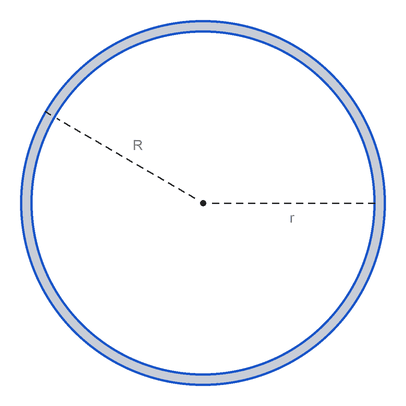
If the circumference of the two circles be 396 cm and 374 cm, find the area of the shaded portion.
- 733 marks
Question 73
AD is altitude of an isosceles triangle ABC in which AB = AC = 30 cm and BC = 36 cm. A point O is marked on AD in such a way that ∠BOC = 90°.
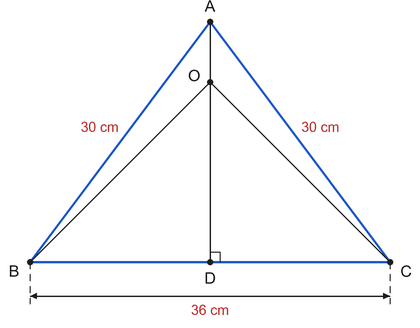
Find the area of quadrilateral ABOC.
Hint (printed in the book):
Area of quadrilateral ABOC = Ar. (Δ ABC) – Ar. (Δ BOC)
It can easily be shown that Δ BOD ≡ Δ COD ⇒ OB = OC = x cm (let) and OB² + OC² = BC² as ∠BOC = 90°
- 743 marks
Question 74
A footpath of uniform width runs all around the outside of a rectangular field 30 m long and 24 m wide.
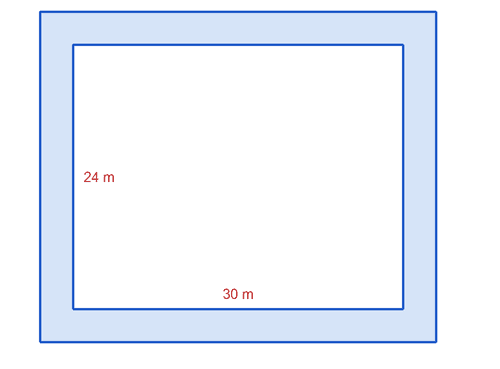
If the path occupies an area of 360 m², find its width.
- 753 marks
Question 75
A wire when bent in the form of a square encloses an area of 484 m². Find the largest area enclosed by the same wire when bent to form :
(i) an equilateral triangle.
(ii) a rectangle of breadth 16 m.
- 763 marks
Question 76
For each trapezium given below; find its area.
(i)
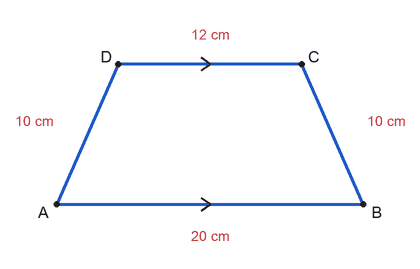
(ii)
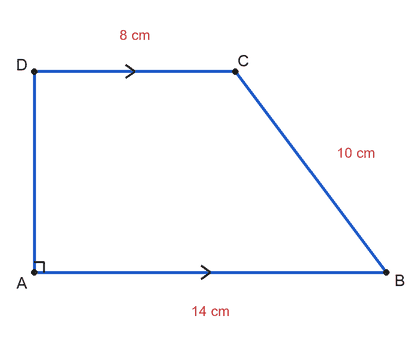
(iii)
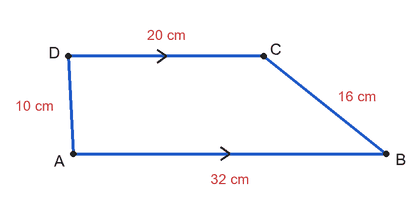
(iv)

- 773 marks
Question 77
The perimeter of a rectangular board is 70 cm. Taking its length as x cm, find its width in terms of x.
If the area of the rectangular board is 300 cm²; find its dimensions.
- 783 marks
Question 78
The area of a rectangle is 640 m². Taking its length as x m; find, in terms of x, the width of the rectangle. If the perimeter of the rectangle is 104 m; find its dimensions.
- 793 marks
Question 79
The length of a rectangle is twice the side of a square and its width is 6 cm greater than the side of the square. If area of the rectangle is three times the area of the square; find the dimensions of each.
- 803 marks
Question 80
ABCD is a square with each side 12 cm. P is a point on BC such that area of Δ ABP : area of trapezium APCD = 1 : 5.
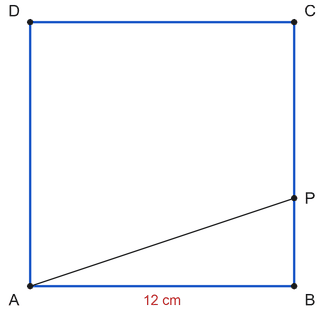
Find the length of CP.
- 813 marks
Question 81
A rectangular plot of land measures 45m × 30m. A boundary wall of height 2·4 m is built all around the plot at a distance of 1m from the plot.
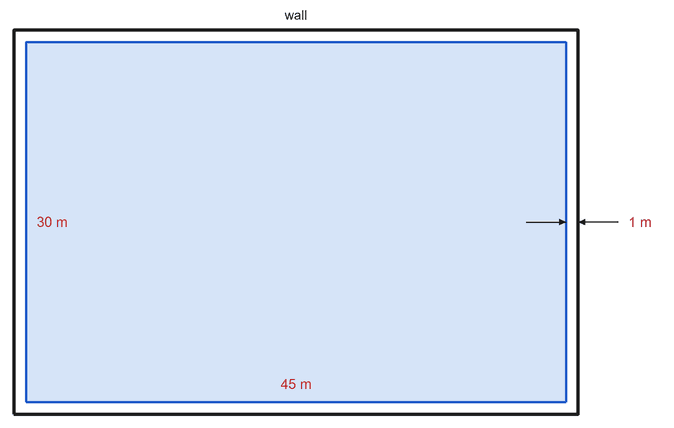
Find the area of the inner surface of the boundary wall.
- 823 marks
Question 82
A wire when bent in the form of a square encloses an area = 576 cm². Find the largest area enclosed by the same wire when bent to form:
(i) an equilateral triangle.
(ii) a rectangle whose adjacent sides differ by 4 cm.
- 833 marks
Question 83
The area of a parallelogram is y cm² and its height is h cm. The base of another parallelogram is x cm more than the base of the first parallelogram and its area is twice the area of the first. Find, in terms of y, h and x, the expression for the height of the second parallelogram.
Hint (printed in the book):
Base of 1st parallelogram cm ⇒ Base of 2nd parallelogram cm and height ⇒ height
- 843 marks
Question 84
The distance between parallel sides of a trapezium is 15 cm and the length of the line segment joining the mid-points of its non-parallel sides is 26 cm.
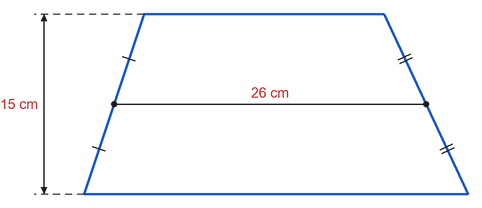
Find the area of the trapezium.
- 853 marks
Question 85
The diagonal of a rectangular plot is 34 m and its perimeter is 92 m. Find its area.
- 863 marks
Question 86
The cost of fencing a circular field at the rate of ₹ 240 per metre is ₹ 52,800. The field is to be ploughed at the rate of ₹ 12.50 per m². Find the cost of ploughing the field.
- 873 marks
Question 87
Two circles touch each other externally. The sum of their areas is cm² and the distance between their centres is 10 cm. Find the radii of the two circles.
- 883 marks
Question 88
The given figure shows a rectangle ABCD inscribed in a circle as shown alongside.
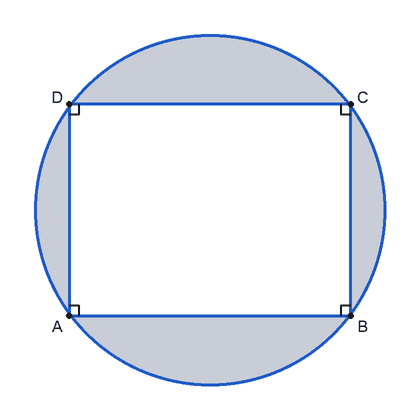
If AB = 28 cm and BC = 21 cm, find the area of the shaded portion of the given figure.
- 893 marks
Question 89
A square is inscribed in a circle of radius 7 cm.
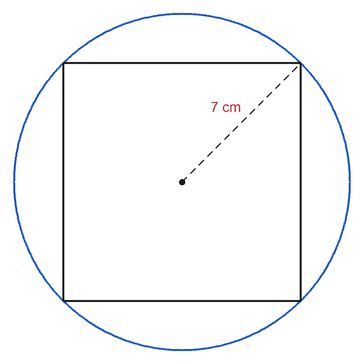
Find the area of the square.
- 903 marks
Question 90
A metal wire, when bent in the form of an equilateral triangle of largest area, encloses an area of cm². If the same wire is bent into the form of a circle of largest area, find the area of this circle.
- 913 marks
Question 91
The perimeter of a triangle is 450 m and its sides are in the ratio 12 : 5 : 13. Find the area of the triangle.
- 923 marks
Question 92
A triangle and a parallelogram have the same base and the same area. If the sides of the triangle are 26 cm, 28 cm and 30 cm and the parallelogram stands on the base 28 cm, find the height of the parallelogram.
- 933 marks
Question 93
Using the information in the following figure, find the area of the trapezium.
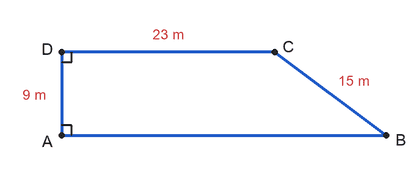
- 943 marks
Question 94
Sum of the areas of two squares is 400 cm². If the difference of their perimeters is 16 cm, find the sides of the two squares.
- 953 marks
Question 95
Find the area and the perimeter of a square with diagonal 24 cm.
[Take √2 = 1·41].
- 963 marks
Question 96
A steel wire, when bent in the form of a square, encloses an area of 121 cm². The same wire is bent in the form of a circle. Find area of the circle.
- 973 marks
Question 97
The perimeter of a semicircular plate is 108 cm, find its area.
- 983 marks
Question 98
Two circles touch externally. The sum of their areas is sq. cm and the distance between their centres is 14 cm. Find the radii of the circles.
- 993 marks
Question 99
The diameters of the front and the rear wheels of a tractor are 63 cm and 1·54 m respectively. The rear wheel is rotating at revolutions per minute. Find :
(i) the revolutions per minute made by the front wheel.
(ii) the distance travelled by the tractor in 40 minutes.
- 1003 marks
Question 100
Two circles touch each other externally. The sum of their areas is cm² and the distance between their centres is 12 cm. Find the diameters of the circle.
Hint (printed in the book):
Let the radii of two circles be R cm and r cm
∴ and R + r = 12 cm ⇒ R² + r² = 74 and R + r = 12 cm
First method :
R + r = 12 ⇒ r = 12 – R ∴ R² + r² = 74 i.e. (12 – r)² + r² = 74
Solve this quadratic equation to get the value of r and then value of R.
Second method :
(R + r)² + (R – r)² = 2(R² + r²) ⇒ 12² + (R – r)² = 2 × 74 ⇒ (R – r)² = 4 ⇒ R – r = 2
Now solve R – r = 2 and R + r = 12.
- 1013 marks
Question 101
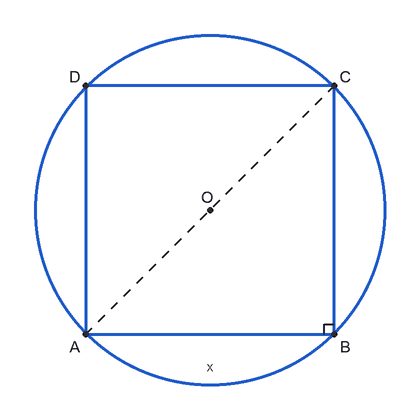
If a square is inscribed in a circle, find the ratio of the areas of the circle and the square.
Hint (printed in the book):
If AB = x ⇒ AC = . Diameter of the circle = diagonal of the square ⇒ i.e. . Required
What Class 9 Maths Ch 20 covers
The sections of the chapter, in the order the book takes them. Every question above comes from one of these.
- 01Area and Perimeter of Triangles
- 02Some Special Types of Triangles
- 03Area and Perimeter of All Types of Quadrilaterals
- 04Some Special Types of Quadrilaterals
- 05Circumference of a Circle
- 06Area of a Circle
More ways to study this chapter
The same chapter asked three other ways. Practise it, revise it, and see what the board has set on Ch 20 before.
Class 9 Maths Ch 20 questions students ask
How many questions are there in Class 9 Maths Ch 20?
101 questions. Every one is solved step by step on this page.
Are these Class 9 Maths solutions free?
Yes. Every question and its full working is free to read, with no account needed.
Can I download the Class 9 Maths Ch 20 solutions as a PDF?
There is no PDF to download. Every solution is on this page instead, which means it is searchable, always the current syllabus, and readable on a phone. Use your browser's print option if you want it on paper.