Area and Perimeter of Plane Figures · Question 73 of 101
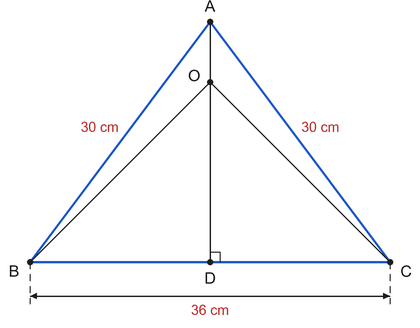
AD is altitude of an isosceles triangle ABC in which AB = AC = 30 cm and BC = 36 cm.
Question 733 marksMedium
AD is altitude of an isosceles triangle ABC in which AB = AC = 30 cm and BC = 36 cm. A point O is marked on AD in such a way that ∠BOC = 90°.
Find the area of quadrilateral ABOC.
Hint (printed in the book):
Area of quadrilateral ABOC = Ar. (Δ ABC) – Ar. (Δ BOC) =21×BC×AD−21×OB×OC
It can easily be shown that Δ BOD ≡ Δ COD ⇒ OB = OC = x cm (let) and OB² + OC² = BC² as ∠BOC = 90°
Solution:
Concept: In an isosceles triangle, the altitude drawn to the base bisects the base. So half the base, the height and one equal side form a right-angled triangle, and Pythagoras' theorem links them.
In a right-angled triangle, the two sides that make the right angle are perpendicular, so one is the base and the other is the height: area=21×leg1×leg2. By Pythagoras' theorem, hypotenuse2=leg12+leg22.
Given: AB and AC are both 30 cm, BC = 36 cm, AD ⊥ BC, and O lies on AD with ∠BOC = 90°.
Step 1 — Find AD.
In an isosceles triangle the altitude AD bisects the base, so BD = 18 cm. Triangle ABD is right-angled at D.
AD=302−182=900−324=576=24 cm
Step 2 — Find the area of triangle ABC.
BC is the base and AD is the height.
Ar(△ABC)=21×36×24=432 cm2
Step 3 — Show that OB = OC.
Triangles BOD and COD have BD = CD and OD common, and both angles at D are 90°. So they are congruent (S.A.S.).
Hence OB = OC. Let each be x cm.
Step 4 — Find the area of triangle BOC.
Since ∠BOC = 90°, Pythagoras' theorem in triangle BOC gives:
x2+x22x2x2=362=1296=648
OB and OC meet at the right angle, so they are the base and the height.
Ar(△BOC)=21×x×x=21×648=324 cm2
Step 5 — Find the area of ABOC.
The quadrilateral ABOC is triangle ABC with triangle BOC taken away.
Ar(ABOC)=432−324=108 cm2
Watch out: You do not need x itself: the area of triangle BOC is 21x2, and x2=648.
Therefore, the area of quadrilateral ABOC is 108 cm².