
Question 283 marksMedium
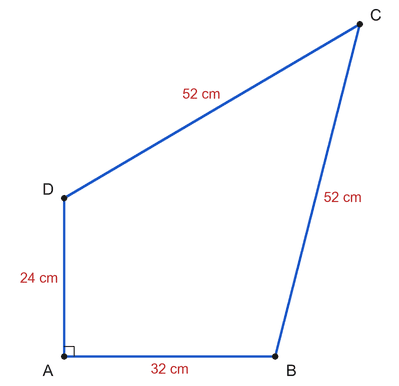
Calculate the area of quadrilateral ABCD in which AB = 32 cm, AD = 24 cm, ∠A = 90° and BC = CD = 52 cm.
Confirming your payment
Sign up now and get 250 free tokens.
Area and Perimeter of Plane Figures · Question 28 of 101
Calculate the area of quadrilateral ABCD in which AB = 32 cm, AD = 24 cm, ∠A = 90° and BC = CD = 52 cm.
Solution:
Concept: In a right-angled triangle, the two sides that make the right angle are perpendicular, so one is the base and the other is the height: . By Pythagoras' theorem, .
In an isosceles triangle, the altitude drawn to the base bisects the base. So half the base, the height and one equal side form a right-angled triangle, and Pythagoras' theorem links them.
Given: AB = 32 cm, AD = 24 cm, ∠A = 90°, and BC and CD are both 52 cm.
Step 1 — Find BD.
Triangle ABD is right-angled at A, so its hypotenuse BD comes from Pythagoras' theorem.
Step 2 — Find the area of triangle ABD.
AB and AD meet at the right angle, so they are the base and the height.
Step 3 — Find the height of triangle BCD.
Triangle BCD is isosceles, because BC and CD are both 52 cm. So the altitude from C bisects BD into two parts of 20 cm.
Step 4 — Find the area of triangle BCD.
We use half of base times height with base BD = 40 cm.
Step 5 — Add the two areas.
The diagonal BD splits ABCD into these two triangles.
Watch out: Use half of BD (20 cm) when finding the height of the isosceles triangle BCD.
Therefore, the area of quadrilateral ABCD is 1344 cm².