
Question 463 marksMedium
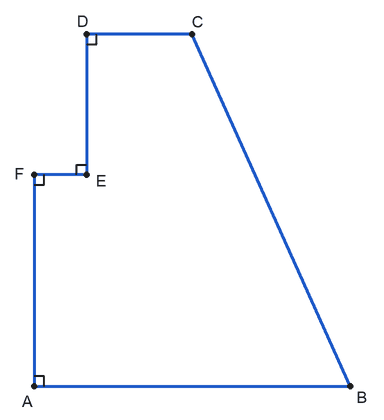
The given figure shows the cross-section of a concrete structure. Calculate the area of cross-section if AB = 1·8 m, CD = 0·6 m, DE = 0·8 m, EF = 0·3 m and AF = 1·2 m.
Confirming your payment
Sign up now and get 250 free tokens.
Area and Perimeter of Plane Figures · Question 46 of 101
The given figure shows the cross-section of a concrete structure. Calculate the area of cross-section if AB = 1·8 m, CD = 0·6 m, DE = 0·8 m, EF = 0·3 m and AF = 1·2 m.
Solution:
Concept: The area of a trapezium is .
Given: AB = 1.8 m, CD = 0.6 m, DE = 0.8 m, EF = 0.3 m, AF = 1.2 m; right angles at A, F, D and E.
Step 1 — Complete the corner.
The cross-section is a trapezium with a small rectangle cut out of its top-left corner. Produce AF upwards and CD to the left to meet at a point P. Then PDEF is a rectangle.
So PF equals DE (0.8 m), and PD equals FE (0.3 m).
Step 2 — Find the trapezium ABCP.
AB and PC are parallel (both horizontal). The distance between them is AP, which is made of AF and FP. The top side PC is made of PD and DC.
Step 3 — Find the rectangle PDEF.
This corner is not part of the cross-section.
Step 4 — Find the cross-section.
We take the rectangle away from the trapezium.
Watch out: The top parallel side PC is 0.9 m (it includes PD, 0.3 m), and the height AP is AF + DE, which is 2 m.
Therefore, the area of the cross-section is 2.46 m².