
Opening your dashboard
Class 9 Maths Chapter 20 Area and Perimeter of Plane Figures: Competency-Based Questions (CBQ)
40 questions on Chapter 20, each worked through on its own page with the AI tutor. Class 9 Maths, ICSE 2026-27.
40 questions
1–5 marks · Mixed difficulty
- 11 mark
Question 1
Competency: Understanding
A farmer has a field. He has two jobs to do.
- Job 1: buy barbed wire to put once round the field.
- Job 2: buy seed to sow the whole field.
Which measurement of the field does he need for each job?
- 21 mark
Question 2
Competency: Application
An athlete trains on a circular track of radius 35 m. Her coach wants her to run at least 2 km without stopping.
What is the least number of complete rounds she must run? (Take .)
- 31 mark
Question 3
Competency: Analysis
A shop sells circular pizzas of the same thickness. For the same price a customer can buy either
- one large pizza of diameter 30 cm, or
- two small pizzas of diameter 15 cm each.
Which statement about the amount of pizza is correct?
- 41 mark
Question 4
Competency: Application
A kite has the shape of a rhombus. Its two sticks, which are the diagonals of the rhombus, are 60 cm and 80 cm long.
A coloured tape is to be stuck all along the edge of the kite. What length of tape is needed?
- 51 mark
Question 5
Competency: Evaluation
Assertion (A): A triangular flower bed with sides 5 m, 12 m and 13 m has an area of 30 m².
Reason (R): The triangle is right-angled, and the area of a right-angled triangle is half the product of the sides containing the right angle.
- 61 mark
Question 6
Competency: Application
A triangular park has two sides of 34 m each and a third side of 32 m. Grass is to be laid in the whole park at ₹ 5 per square metre.
The cost of laying the grass is
- 72 marks
Question 7
Competency: Application
A lace is to be stitched all round the edge of a circular table cloth of diameter 1.4 m. The shop sells lace only in whole metres, at ₹ 35 per metre.
How many metres of lace must be bought, and what will it cost? (Take .)
- 82 marks
Question 8
Competency: Evaluation
A cloth banner is 3 m long and 50 cm wide. Printing costs ₹ 200 per square metre. Tanvi works out the bill like this:
"Area m². Cost ₹ 30,000."
Find the mistake in Tanvi's work. Write the correct area and the correct cost.
- 92 marks
Question 9
Competency: Analysis
A window is made of a rectangle with a semicircle on top, as shown. The rectangle is 1.4 m wide and 1 m high. A wooden frame runs all round the outer edge of the window.
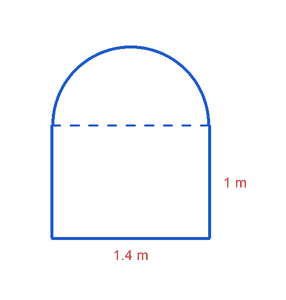
Find the length of the frame. Explain why the dashed line is not counted. (Take .)
- 102 marks
Question 10
Competency: Application
A goat is tied to a peg at one corner of a square field of side 20 m. The rope is 14 m long. The field has a wall all round it, so the goat cannot go outside.

Find the area of the field in which the goat can graze, and the area in which it cannot. (Take .)
- 113 marks
Question 11
Competency: Analysis
A floor tile is a regular hexagon of side 20 cm. The dashed lines through its centre divide it into six equilateral triangles.

(a) Find the area of one tile. (Take .)
(b) A floor of area 10 m² is to be covered with such tiles. Ignoring the gaps and the cutting at the edges, find the least number of tiles that must be bought.
- 123 marks
Question 12
Competency: Creativity
A school wants a new rectangular notice board. It must satisfy all these conditions.
- Its area must be exactly 2.4 m².
- The wooden frame round it must not be longer than 6.5 m.
- Its length and breadth must each be a whole number of tens of centimetres (such as 0.8 m, 1.3 m or 2 m).
Design a notice board that satisfies all the conditions. Show that your design works, and give one set of measurements with the right area that does not work.
- 133 marks
Question 13
Competency: Analysis & Evaluation
A town has two parks. Park A is a circle of radius 35 m. Park B is a square of side 55 m. Grass is to be laid in both parks at ₹ 20 per square metre.
The contractor says, "The boundaries of the two parks are equally long. So the two parks need the same amount of grass, and the cost will be the same."
(a) Check whether the boundaries are equally long.
(b) Is the contractor's conclusion correct? Find the cost of laying grass in each park. (Take .)
- 145 marks
Question 14
Competency: Application & Analysis
Case study — The school sports field
A school sports field is made of a rectangle 90 m long and 70 m wide, with a semicircle on each of its 70 m ends. The running track goes along the outer edge of the field.
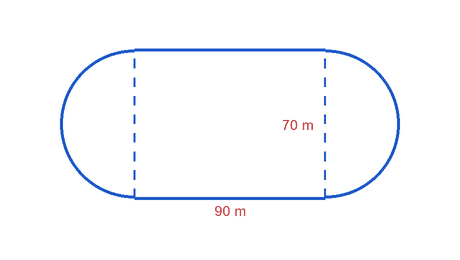
Take .
(a) Find the length of one round of the track.
(b) The whole field is to be covered with turf at ₹ 40 per square metre. Find the area of the field and the cost of the turf.
(c) In a one-round race, Rhea runs along the edge of the field. Sana runs in the next lane, always 1.4 m outside the edge. How much farther than Rhea does Sana run in one round? How should the starting points be placed to make the race fair?
- 154 marks
Question 15
Competency: Analysis & Evaluation
Case study — Three plots for sale
A land agent shows a buyer three plots.
Plot Shape and measurements Price P Rectangle, 40 m by 25 m ₹ 12,00,000 Q Right-angled triangle; the sides containing the right angle are 48 m and 40 m ₹ 10,56,000 R Trapezium; parallel sides 50 m and 30 m, 26 m apart ₹ 13,00,000 (a) Find the area of each plot.
(b) Find the price per square metre of each plot.
(c) The agent says, "Plot R is the best buy, because it is the biggest." Do you agree? Which plot gives the buyer the best value for money? Justify your answer.
- 161 mark
Question 16
Competency: Analysis
Three triangular flags P, Q and R are cut for a school function. Each flag has a base of 6 cm. In the figure, the top corner of every flag lies on the dashed line, which is parallel to the bases and 4 cm above them. The top corner of P is directly above the middle of its base, the top corner of Q is directly above the left end of its base, and the top corner of R is 2 cm to the right of the right end of its base.
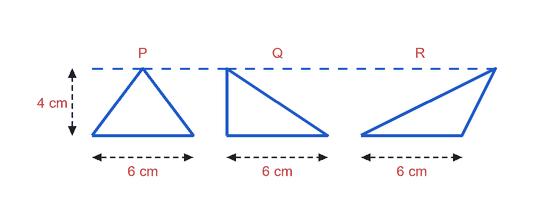
Which statement is correct?
- 171 mark
Question 17
Competency: Analysis
A circular running track has lanes that are each 1.4 m wide. Asha runs one full lap along the inner edge of the innermost lane. Bela runs one full lap along the inner edge of the very next lane, just outside Asha's lane.
By how much is Bela's lap longer than Asha's? (Take .)
- 181 mark
Question 18
Competency: Application
For a Rangoli competition, coloured powder is spread evenly over circular designs, so the amount of powder needed is proportional to the area of the design.
A circular design of diameter 20 cm needs 30 g of powder. How much powder will a circular design of diameter 60 cm need?
- 191 mark
Question 19
Competency: Application
The screen of a tablet is a rectangle. Its width is 20 cm and its diagonal is 25 cm.
What is the area of the screen?
- 201 mark
Question 20
Competency: Analysis & Evaluation
Assertion (A): A rectangle with sides 12 cm and 5 cm and a parallelogram with base 12 cm, height 5 cm and slant side 6.5 cm have the same area, but the rectangle has the smaller perimeter.
Reason (R): The slant side of a parallelogram is longer than the perpendicular distance between its parallel sides.
- 211 mark
Question 21
Competency: Evaluation
Assertion (A): Heron's formula can be used to find the area of a triangular plot whose sides are 7 m, 9 m and 17 m.
Reason (R): In any triangle, the sum of any two sides is greater than the third side.
- 221 mark
Question 22
Competency: Analysis
A triangular sail has sides 10 m, 10 m and 12 m. Its area is 48 m². Sam finds the altitude (height) drawn to each of the three sides.
Which statement is correct?
- 231 mark
Question 23
Competency: Application
A ribbon 80 cm long is tied once round a round cake box. 3 cm of the ribbon is used up in the knot, and the rest goes exactly once round the box.
What is the diameter of the box? (Take .)
- 241 mark
Question 24
Competency: Analysis
A rectangular card, 12 cm by 8 cm, has a square of side 3 cm cut away from one corner, as shown in the figure.
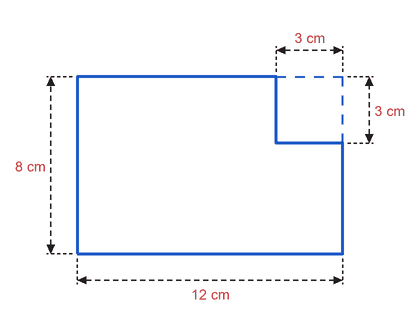
Compare the new card with the original rectangle.
- 251 mark
Question 25
Competency: Application
The cross-section of a canal is a trapezium, as shown in the figure. The water surface is 14 m wide, the bottom of the canal is 6 m wide and the canal is 2.5 m deep.
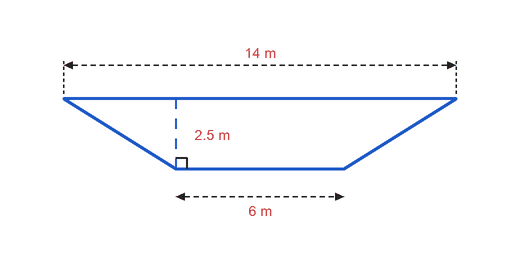
What is the area of this cross-section?
- 262 marks
Question 26
Competency: Application
The second hand of a wall clock is 14 cm long. Taking , find the distance moved by the tip of the second hand in 1 hour. Give your answer in metres.
- 272 marks
Question 27
Competency: Application
A tailor has a triangular piece of cloth with sides 17 cm, 25 cm and 28 cm. She wants to replace it with a rectangular piece of cloth of the same area and 10 cm wide.
How long must the rectangular piece be?
- 282 marks
Question 28
Competency: Analysis
Four rods, each 25 cm long, are joined end to end by hinges to make a rhombus-shaped frame, so the frame can be pushed into different shapes.
(a) Find the area enclosed by the frame when one of its diagonals is 14 cm long.
(b) Find the area when the frame is pushed until one of its diagonals is 30 cm long. The rods have not changed, so explain why the area has changed.
- 292 marks
Question 29
Competency: Evaluation
A tree trunk is nearly circular. A forest worker measures its girth, which is the distance once round it, and finds it to be 1.65 m. She says, "The trunk is less than 50 cm across, so it will pass through our 50 cm wide gate."
Find the diameter of the trunk and decide whether she is right. (Take .)
- 302 marks
Question 30
Competency: Application
A classroom wall is 8 m long and 3.5 m high. It has a door 2 m by 1 m and a window 1.5 m by 1 m, which are not to be painted. One litre of paint covers 10 m² of wall, and paint is sold only in 1-litre tins.
How many tins must be bought to paint the wall once?
- 312 marks
Question 31
Competency: Evaluation
Rohan wants the area of an equilateral triangle of side 10 cm. He writes:
"Area cm²."
Explain why Rohan's answer cannot be right, and find the correct area. (Take .)
- 323 marks
Question 32
Competency: Application
A rectangular field is 60 m long and 40 m wide. A farmer fences it with 3 rounds of barbed wire along its boundary. A gate 3 m wide is left in one side, and no wire is used across the gate. Barbed wire costs ₹ 24 per metre.
(a) Find the length of wire needed for one round.
(b) Find the total cost of the wire for 3 rounds.
- 333 marks
Question 33
Competency: Analysis
(Hypothetical data.) A school robot has wheels of diameter 14 cm. It is programmed to make 50 complete turns of its wheels, which takes it to the door of the lab. The wheels are then changed to bigger wheels of diameter 21 cm, and the same program of 50 turns is run from the same starting point. (Take .)
(a) Find the distance of the door from the starting point, in metres.
(b) How far does the robot travel with the bigger wheels?
(c) By how many metres does it overshoot the door, and by what percentage is the distance travelled increased?
- 343 marks
Question 34
Competency: Creativity & Analysis
The school garden club wants a trapezium-shaped flower bed of area exactly 54 m². The distance between its parallel sides must be 6 m. Each parallel side must be a whole number of metres, and the two parallel sides must have different lengths.
(a) Design a bed that works. Give the lengths of its parallel sides and show that its area is 54 m².
(b) Give a second design with different lengths.
(c) A border edging is fixed along the two parallel sides only, at ₹ 120 per metre. Show that every correct design needs the same length of edging, and find its cost.
- 353 marks
Question 35
Competency: Application
A rectangular field is 250 m long and 160 m wide. A farmer plans to plant saplings so that each sapling has a square of 2 m by 2 m to itself. (1 hectare m².)
(a) Find the area of the field in square metres and in hectares.
(b) How many saplings can be planted?
(c) The farmer also puts one round of wire fence along the whole boundary of the field. How long is the fence?
- 363 marks
Question 36
Competency: Analysis
A school ground is a rectangle 40 m long and 30 m wide. A quarter circle of radius 7 m is cut off from each corner for flower beds, as shown in the figure. The rest of the ground is the playing area, which is bounded by four straight edges and four curved edges. (Take .)
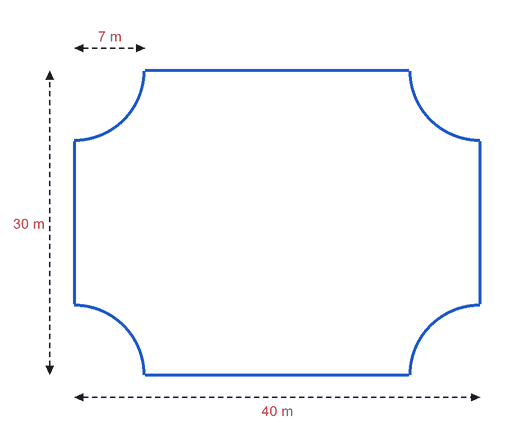
(a) Find the total area of the four flower beds.
(b) Find the area of the playing area.
(c) Find the length of the boundary of the playing area.
- 375 marks
Question 37
Competency: Analysis & Evaluation
Case study — Rose beds in a park
(Hypothetical data.) A park has three triangular rose beds, A, B and C. The table gives the sides of each bed and the number of rose plants in it.
Bed Sides (m) Number of plants A 9, 10, 17 90 B 14, 25, 25 336 C 20, 21, 29 315 (a) Find the area of each bed.
(b) Find the number of plants per square metre in each bed.
(c) The gardener decides that no bed may have more than 2 plants per square metre. Which bed must lose plants, and how many plants must be taken out?
- 384 marks
Question 38
Competency: Application & Analysis
Case study — An archery target
A practice archery target is made of a gold circle in the centre with four rings round it, as shown in the figure. Every ring is 7 cm wide. The circles are numbered 1 to 5 from the centre, and the table gives the outer radius of each. (Take .)
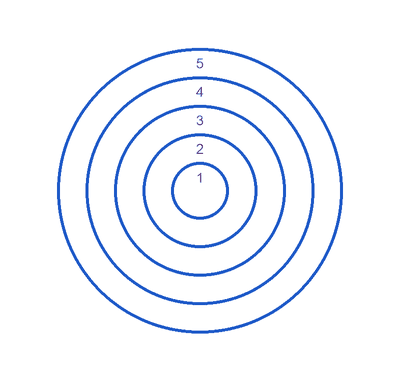
Ring 1 (gold circle) 2 3 4 5 (outermost) Outer radius (cm) 7 14 21 28 35 (a) Find the area of the gold circle and the area of ring 2.
(b) Find the area of the whole target and the area of ring 5.
(c) What percentage of the whole target is covered by ring 5? Ring 5 is as wide as ring 1's radius, so explain in one sentence why it still covers so much more.
- 395 marks
Question 39
Competency: Analysis
Case study — Folding a square sheet
Riya has a square sheet of paper of side 20 cm. She folds each of the four corners to the centre of the sheet. The new shape is a smaller square whose corners are the mid-points of the sides of the old square, as shown by the dashed lines in the figure. She repeats the same fold on each new square. Her notebook shows some of the results.
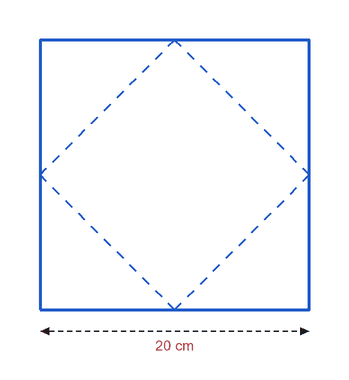
Number of folds 0 1 2 3 4 Side of the square (cm) 20 ? 10 ? 5 Area of the square (cm²) 400 ? 100 ? 25 (a) Find the area of the square after 1 fold by finding the area of the four corner triangles that are folded in. Hence write the area after 3 folds.
(b) Find the side of the square after 1 fold and its perimeter. (Take .) How much shorter is this perimeter than the perimeter of the original sheet?
(c) After how many folds will the area first be less than 10 cm²? Show your working.
- 404 marks
Question 40
Competency: Analysis & Evaluation
Case study — Two road signs
A road-safety department makes two kinds of reflective sign boards: a triangular warning sign, which is an equilateral triangle of side 60 cm, and a circular sign of diameter 56 cm, as shown in the figure. A reflective sheet covers the whole face of each sign, and red tape is stuck all along its edge. (Take and .)
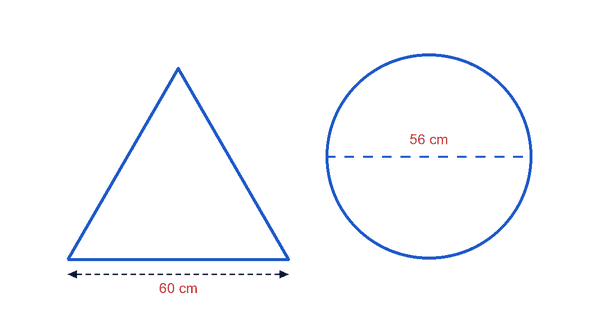
(a) Find the area of the sheet and the length of the tape for the triangular sign.
(b) Find the area of the sheet and the length of the tape for the circular sign.
(c) The triangular sign needs more tape but less sheet. By how much in each case? Explain why a shape with a longer edge can still have a smaller area.