
Opening your dashboard
Class 9 Biology Chapter 9: Economic Importance of Bacteria and Fungi Solutions
61 textbook questions with step-by-step answers, free to read, for ICSE 2026-27.
Get talked through Ch 9, not just shown the answer
Reading a finished solution is not the same as being able to do it. The AI tutor takes one question at a time and works it with you, in your own words, until you can.
- Ask it out loud, in your own words
- It gives you the next step, not the answer
- Stuck on part (ii)? Start there
61 questions with solutions
1–10 marks · Mixed difficulty
- 11 mark
Question 1
Name the four common shapes of bacteria.
Solve with AIWritten solution
Solution:
Concept: Bacteria are grouped by the shape of their single cell, as seen under a microscope.
Step 1 — Recall what is asked.
The question asks for the four common shapes in which bacterial cells occur.
Step 2 — Name each shape.
Each shape has its own name:
- Cocci (singular coccus) are spherical or round.
- Bacilli (singular bacillus) are rod-shaped.
- Spirilla (singular spirillum) are spiral, like a corkscrew.
- Vibrios are comma-shaped, with a single curve.
Watch out: A spirillum has several spiral turns, while a vibrio is only slightly curved like a comma.
Therefore, the four common shapes are cocci (spherical), bacilli (rod-shaped), spirilla (spiral) and vibrios (comma-shaped).
- 23 marks
Question 2
Give the technical terms for the following patterns of occurrence of bacteria
(i) In pairs ..........
(ii) In long chains ..........
(iii) In clusters ..........
Solve with AIWritten solution
Solution:
Concept: After a round bacterium (coccus) divides, the daughter cells often stay stuck together. How they stay together gives each group its name: diplo- means two, strepto- means a twisted chain and staphylo- means a bunch of grapes.
Step 1 — (i) In pairs.
When the two cells stay together as a pair, they are called diplococci.
Step 2 — (ii) In long chains.
When the cells keep dividing in one direction and form a chain, they are called streptococci.
Step 3 — (iii) In clusters.
When the cells divide in different directions and form an irregular bunch, they are called staphylococci.
Watch out: These terms describe how round bacteria (cocci) are grouped, not a new shape of cell.
Therefore, (i) diplococci, (ii) streptococci, (iii) staphylococci.
- 31 mark
Question 3
List the kinds of nutrition in bacteria.
Solve with AIWritten solution
Solution:
Concept: Nutrition is the way an organism obtains its food. Most bacteria have no chlorophyll, so they cannot make their own food and depend on food made by others (heterotrophic nutrition).
Step 1 — Saprotrophic nutrition.
Saprotrophic bacteria draw their food from dead and decaying plants and animals. They break it down and absorb it, which also makes them decomposers.
Step 2 — Parasitic nutrition.
Parasitic bacteria draw their food from the body of a living host, and many of them cause disease in it.
Step 3 — A few make their own food.
A few bacteria are autotrophic: some contain chlorophyll-like pigments and make food by photosynthesis, and some others get the energy to make food from chemical reactions.
Watch out: "Saprotrophic" means feeding on dead matter; "parasitic" means feeding on a living host.
Therefore, most bacteria are heterotrophic, either saprotrophic or parasitic, and a few are autotrophic.
- 41 mark
Question 4
What is the common method of reproduction in bacteria ?
Solve with AIWritten solution
Solution:
Concept: Bacteria reproduce asexually, most commonly by binary fission, which means splitting into two.
Step 1 — The cell grows.
When food and warmth are available, the bacterium grows to its full size.
Step 2 — The DNA is copied.
Its single circular chromosome (DNA) makes a copy of itself, so there are two copies.
Step 3 — The cell splits.
The cell pinches in at the middle and a cross wall forms, giving two daughter cells, each with one copy of the DNA. In good conditions some bacteria divide about every 20 minutes.
Watch out: Spore formation is a way of surviving bad conditions, not the common method of reproduction.
Therefore, the common method of reproduction in bacteria is binary fission.
- 52 marks
Question 5
Why do bacteria produce spores ?
Solve with AIWritten solution
Solution:
Concept: A bacterial spore (endospore) is a resting stage with a thick protective wall. It helps the bacterium survive; it does not increase their number.
Step 1 — When the spore is formed.
When conditions become unfavourable, for example when the surroundings dry up or food runs short, some bacteria form a spore inside the cell.
Step 2 — Why the spore survives.
The spore has a thick, tough wall, so it can withstand extreme dryness, very high or low temperatures and harmful chemicals, sometimes for many years.
Step 3 — What happens later.
When favourable conditions return, the spore germinates and becomes an active bacterium again.
Watch out: Only some bacteria form spores, and one bacterium forms only one spore.
Therefore, bacteria produce spores to survive unfavourable conditions such as drying up, extreme temperatures and harmful chemicals.
- 61 mark
Question 6
Bacteria are no more classified as plants primarily because :
Solve with AIAnswer
- Correct
(A) they are unicellular and prokaryotic
(B) they are motile
(C) many of them are parasitic
(D) they have no chlorophyll.
Answer: (A) they are unicellular and prokaryotic
Concept: In the Five Kingdom classification, bacteria are placed in kingdom Monera, because their cells are prokaryotic (no true nucleus) and each bacterium is a single cell. Plants are eukaryotic and mostly multicellular.
Step 1 — Recall what makes a plant.
Plant cells have a true nucleus enclosed by a nuclear membrane, and most plants are made of many cells.
Step 2 — Compare with bacteria.
A bacterium is one cell with no nuclear membrane, so it cannot be a plant. This basic difference in cell structure is option (A).
Watch out: The main reason is the type of cell (prokaryotic), not nutrition or movement.
Why the other options are wrong:
- (B) they are motile: many bacteria cannot move at all, and the ability to move is not what decides a kingdom.
- (C) many of them are parasitic: many bacteria are saprotrophic or even autotrophic, and the mode of nutrition is not the main reason.
- (D) they have no chlorophyll: some bacteria (such as cyanobacteria) do contain chlorophyll, and fungi lack it too, so this is not the primary reason.
Therefore, bacteria are no longer classified as plants mainly because they are unicellular and prokaryotic, option (A).
- 71 mark
Question 7
A particular species of which one of the following, is the source bacterium of the antibiotic, discovered next to penicillin, for the treatment of tuberculosis?
Solve with AIAnswer
(A) Escherichia
- Correct
(B) Streptomyces
(C) Rhizobium
(D) Nitrobacter
Answer: (B) Streptomyces
Concept: An antibiotic is a chemical made by a microorganism that kills or stops the growth of other microbes. After penicillin, the next great antibiotic was streptomycin (1943), the first effective drug against tuberculosis.
Step 1 — Identify the antibiotic.
The antibiotic discovered after penicillin and used against tuberculosis is streptomycin, found in Selman Waksman's laboratory.
Step 2 — Find its source.
Streptomycin is obtained from the soil bacterium Streptomyces griseus, so the answer is option (B).
Watch out: Streptomyces is a bacterium, even though it grows as fine threads like a fungus.
Why the other options are wrong:
- (A) Escherichia: Escherichia coli is a gut bacterium used in genetic engineering, for example to make human insulin; it is not the source of streptomycin.
- (C) Rhizobium: Rhizobium fixes nitrogen in the root nodules of leguminous plants; it makes no antibiotic against tuberculosis.
- (D) Nitrobacter: Nitrobacter is a nitrifying bacterium that changes nitrites into nitrates.
Therefore, the antibiotic streptomycin comes from Streptomyces, option (B).
- 81 mark
Question 8
Which bacteria is rod shaped ?
Solve with AIAnswer
(A) Coccus
(B) Spirillum
- Correct
(C) Bacillus
(D) Vibrio
Answer: (C) Bacillus
Concept: Bacteria are named by shape: cocci are round, bacilli are rods, spirilla are spirals and vibrios are commas.
Step 1 — Recall the rod-shaped type.
The word bacillus means "a little rod", so rod-shaped bacteria are bacilli.
Step 2 — Match with the options.
Bacillus is option (C).
Watch out: Do not confuse Bacillus (rod) with coccus (round).
Why the other options are wrong:
- (A) Coccus: a coccus is round (spherical), not rod-shaped.
- (B) Spirillum: a spirillum is spiral, like a corkscrew.
- (D) Vibrio: a vibrio is comma-shaped, with a single curve.
Therefore, the rod-shaped bacterium is the bacillus, option (C).
- 91 mark
Question 9
Which bacteria fixes nitrogen in the soil ?
Solve with AIAnswer
(A) Nitrobacter
(B) Nitrosomonas
(C) Rhizobium
- Correct
(D) Clostridium
Answer: (D) Clostridium
Concept: Nitrogen fixation changes the free nitrogen gas of the air into nitrogen compounds. Some bacteria do this while living free in the soil (Azotobacter, Clostridium), and Rhizobium does it while living inside the root nodules of leguminous plants.
Step 1 — Read the stem carefully.
The stem asks which bacterium fixes nitrogen in the soil, that is, as a free-living soil bacterium.
Step 2 — Check the nitrogen fixers among the options.
Clostridium is a free-living soil bacterium that fixes nitrogen, so the answer is option (D).
Watch out: Nitrifying bacteria (Nitrosomonas, Nitrobacter) do not fix nitrogen; they only change ammonium compounds into nitrites and nitrates.
Note: Rhizobium is a nitrogen fixer too, and the nitrogen it fixes does enrich the soil. The book keys Clostridium because the stem asks for a bacterium that fixes nitrogen while living free in the soil.
Why the other options are wrong:
- (A) Nitrobacter: Nitrobacter is a nitrifying bacterium that changes nitrites into nitrates; it does not fix free nitrogen.
- (B) Nitrosomonas: Nitrosomonas is a nitrifying bacterium that changes ammonium compounds into nitrites.
- (C) Rhizobium: Rhizobium also fixes nitrogen, but only while living inside the root nodules of leguminous plants, not free in the soil.
Therefore, the free-living bacterium that fixes nitrogen in the soil is Clostridium, option (D).
- 101 mark
Question 10
Cell wall of bacteria is composed of :
Solve with AIAnswer
(A) Cellulose
- Correct
(B) Peptidoglycan
(C) Glycogen
(D) Lipoproteins
Answer: (B) Peptidoglycan
Concept: The bacterial cell wall is a stiff, non-living layer outside the cell membrane. It is made of peptidoglycan, a mesh of sugar chains joined by short protein links.
Step 1 — Recall the wall material.
Plant cell walls are made of cellulose, fungal walls of chitin, and bacterial walls of peptidoglycan.
Step 2 — Match with the options.
Peptidoglycan is option (B).
Watch out: The bacterial cell wall is not made of cellulose, unlike a plant cell wall.
Why the other options are wrong:
- (A) Cellulose: cellulose forms the cell walls of plants, not of bacteria.
- (C) Glycogen: glycogen is a stored food found as granules inside cells, not a wall material.
- (D) Lipoproteins: lipoproteins occur only in small amounts in some bacteria; they are not the main material of the wall.
Therefore, the cell wall of bacteria is made of peptidoglycan, option (B).
- 111 mark
Question 11
Which of the following structures is suspended in the cytoplasm of a bacterial cell ?
Solve with AIAnswer
(A) Plasma
(B) Capsule
- Correct
(C) Plasmid
(D) Flagellum
Answer: (C) Plasmid
Concept: A bacterial cell keeps its main DNA as one circular chromosome in the cytoplasm. It may also contain small extra rings of DNA called plasmids, which lie free (suspended) in the cytoplasm.
Step 1 — Look for a structure inside the cytoplasm.
Of the options, only the plasmid lies inside the cell, floating in the cytoplasm.
Step 2 — Match with the options.
Plasmid is option (C).
Watch out: The capsule and the flagellum lie on the outside of the cell; only the plasmid is inside the cytoplasm.
Why the other options are wrong:
- (A) Plasma: plasma is the liquid part of blood; it is not a structure of a bacterial cell.
- (B) Capsule: the capsule is a slimy layer outside the cell wall.
- (D) Flagellum: the flagellum is attached at the cell membrane and projects outside through the cell wall and capsule.
Therefore, the plasmid is suspended in the cytoplasm of a bacterial cell, option (C).
- 121 mark
Question 12
Bacteria mainly reproduces by means of :
Solve with AIAnswer
(A) Multiple fission
(B) Budding
- Correct
(C) Binary fission
(D) Regeneration
Answer: (C) Binary fission
Concept: In binary fission one cell divides into two daughter cells after its DNA has been copied. This is the usual way bacteria multiply.
Step 1 — Recall how bacteria multiply.
A bacterium copies its circular DNA and then splits into two equal daughter cells.
Step 2 — Match with the options.
Binary fission is option (C).
Watch out: Binary means two; a bacterium divides into just two cells at a time.
Why the other options are wrong:
- (A) Multiple fission: multiple fission forms many daughter cells at once, as in the malaria parasite Plasmodium.
- (B) Budding: budding is the usual method in yeast (and is also seen in Hydra).
- (D) Regeneration: regeneration is regrowing a whole body from a piece, as in Planaria.
Therefore, bacteria mainly reproduce by binary fission, option (C).
- 131 mark
Question 13
Bacteria are refered to as prokaryotes because:
Solve with AIAnswer
(A) They have no chlorophyll
(B) They are unicellular
(C) They are free living
- Correct
(D) They do not have a well defined nucleus enclosed in a nuclear membrane.
Answer: (D) They do not have a well defined nucleus enclosed in a nuclear membrane.
Concept: Pro means before and karyon means nucleus. A prokaryote has no well-defined nucleus: its DNA lies in the cytoplasm without a nuclear membrane.
Step 1 — Recall the meaning of prokaryote.
The name describes the nucleus: a prokaryotic cell has no nucleus enclosed in a nuclear membrane.
Step 2 — Match with the options.
This is option (D).
Watch out: Being unicellular does not make an organism a prokaryote; Amoeba and yeast are unicellular but eukaryotic.
Why the other options are wrong:
- (A) They have no chlorophyll: fungi and animals also lack chlorophyll, yet they are eukaryotes.
- (B) They are unicellular: Amoeba and yeast are unicellular, yet they have a true nucleus.
- (C) They are free living: being free-living is about way of life, not cell structure; many bacteria are parasites.
Therefore, bacteria are called prokaryotes because they have no well-defined nucleus enclosed in a nuclear membrane, option (D).
- 141 mark
Question 14
Which of the following diseases can be prevented by TAB ?
Solve with AIAnswer
(A) Tuberculosis
- Correct
(B) Typhoid
(C) Tetanus
(D) Taeniasis
Answer: (B) Typhoid
Concept: A vaccine builds up the body's resistance to one disease. TAB stands for the vaccine against Typhoid and paratyphoid A and B, made from killed typhoid and paratyphoid bacteria.
Step 1 — Expand TAB.
The letters stand for Typhoid, paratyphoid A and paratyphoid B.
Step 2 — Match with the options.
So TAB prevents typhoid, option (B).
Step 3 — Today's practice.
The old TAB vaccine is now rarely used; typhoid is prevented today with newer typhoid vaccines (the typhoid conjugate and Vi vaccines).
Watch out: TAB does not protect against tuberculosis; that is BCG.
Why the other options are wrong:
- (A) Tuberculosis: tuberculosis is prevented by the BCG vaccine.
- (C) Tetanus: tetanus is prevented by tetanus toxoid.
- (D) Taeniasis: taeniasis is a tapeworm infection, prevented by cooking pork and beef properly, not by TAB.
Therefore, TAB prevents typhoid, option (B).
- 151 mark
Question 15
A preparation consisting of weakened or dead germ substances is :
Solve with AIAnswer
(A) Toxins
(B) Antitoxins
(C) Toxoids
- Correct
(D) Vaccines
Answer: (D) Vaccines
Concept: A vaccine is a preparation of weakened or killed germs (or their substances). Given to a healthy person, it makes the body produce antibodies, so the person resists that disease later.
Step 1 — Read the description.
The stem describes a preparation of weakened or dead germ substances.
Step 2 — Match with the options.
This is the definition of a vaccine, option (D).
Watch out: A toxoid is also used to immunise, but it is made from a toxin, not from weakened or dead germs.
Why the other options are wrong:
- (A) Toxins: toxins are the poisons released by disease-causing bacteria; they cause disease.
- (B) Antitoxins: antitoxins are antibodies, made in the body or in an immunised animal, that neutralise toxins.
- (C) Toxoids: toxoids are toxins made harmless (used against tetanus and diphtheria); they contain no germs.
Therefore, a preparation of weakened or dead germ substances is a vaccine, option (D).
- 165 marks
Question 16
Name the following :
(a) The locomotory structure of a bacterium that enables it to swim.
(b) The process of flavouring tea by certain bacteria.
(c) The process of making leather from the animals' skin.
(d) Bacterial disease of mustard.
(e) The scientist who discovered the antibiotic streptomycin.
Solve with AIWritten solution
Solution:
Concept: Each answer is a one-word name from the features and uses of bacteria described in the chapter.
Step 1 — (a) Swimming structure.
A bacterium swims with its whip-like flagellum (plural flagella). A tiny motor at its base spins the flagellum round like a propeller, and this pushes the cell through the water.
Step 2 — (b) Flavouring of tea.
The book calls the process that develops the flavour of tea leaves curing of tea.
Step 3 — (c) Making leather.
Turning animal skin (hide) into leather is called tanning. Bacteria help by breaking down the soft, perishable parts of the hide.
Step 4 — (d) Disease of mustard.
Mustard (and cauliflower) suffer from black rot, caused by the bacterium Xanthomonas campestris.
Step 5 — (e) Discoverer of streptomycin.
Streptomycin was discovered in 1943 in the laboratory of Selman Waksman, who received the Nobel Prize for it.
Note: today we know that the flavour and colour of black tea come mainly from the tea leaf's own enzymes (oxidation, often loosely called fermentation); bacteria matter only in a few special teas. "Curing" is the answer the book expects.
Therefore, (a) flagellum, (b) curing of tea, (c) tanning, (d) black rot, (e) Selman Waksman.
- 173 marks
Question 17
Match the items in Column A with those in Column B.
Column A Column B (i) Penicillium (a) Bacteria occurring in chains. (ii) Diplococci (b) Antibiotic. (iii) Streptococci (c) Bacteria occurring in pairs. Solve with AIWritten solution
Solution:
Concept: Diplo- means two and strepto- means a twisted chain; Penicillium is the mould that gives penicillin.
Step 1 — (i) Penicillium.
Penicillium is a fungus (mould) from which the first antibiotic, penicillin, was obtained. So it matches (b) Antibiotic.
Step 2 — (ii) Diplococci.
Diplococci are round bacteria that stay together in twos. So they match (c) Bacteria occurring in pairs.
Step 3 — (iii) Streptococci.
Streptococci are round bacteria that form chains. So they match (a) Bacteria occurring in chains.
Watch out: Penicillium is a fungus, not a bacterium.
Therefore, (i) → (b), (ii) → (c), (iii) → (a).
- 185 marks
Question 18
Fill in the blanks :
(a) The first antibiotic pencillin was discovered by .......... .
(b) .......... bacteria is found living in the nodules on the roots of leguminous plants.
(c) The hormone .......... was the first substance produced by Escherichia coli.
(d) .......... is an example of denitrifying bacteria.
(e) .......... and .......... are the two heterotrophic modes of nutrition in bacteria.
Solve with AIWritten solution
Solution:
Concept: Each blank is a key name from the uses of bacteria in medicine and agriculture and from their nutrition.
Step 1 — (a) Discoverer of penicillin.
Penicillin was discovered in 1928 by Alexander Fleming.
Step 2 — (b) Bacteria in root nodules.
Rhizobium lives in the root nodules of leguminous plants and fixes nitrogen.
Step 3 — (c) First product of E. coli.
The book's answer is the hormone insulin: human insulin made by genetically engineered Escherichia coli was the first such product to become a medicine (1982).
Step 4 — (d) Denitrifying bacteria.
Pseudomonas changes soil nitrates back into free nitrogen gas.
Step 5 — (e) Heterotrophic modes.
Bacteria that cannot make their own food are either saprotrophic (feeding on dead matter) or parasitic (feeding on a living host).
Note: strictly, the hormone somatostatin was the first human protein made in E. coli (1977), a year before insulin; "insulin" is the answer the book expects.
Therefore, (a) Alexander Fleming, (b) Rhizobium, (c) insulin, (d) Pseudomonas, (e) saprotrophic and parasitic.
- 192 marks
Question 19
Name the bacteria that converts
(a) ammonium compounds to nitrites
(b) nitrites to nitrates.
Solve with AIWritten solution
Solution:
Concept: Nitrification changes ammonium compounds in the soil into nitrates in two steps, and each step is done by a different bacterium.
Step 1 — (a) Ammonium compounds to nitrites.
The first step is done by Nitrosomonas.
Step 2 — (b) Nitrites to nitrates.
The second step is done by Nitrobacter.
Watch out: Keep the order: Nitrosomonas makes nitrites first, then Nitrobacter makes nitrates.
Therefore, (a) Nitrosomonas, (b) Nitrobacter.
- 201 mark
Question 20
In what form bacteria may be present in the air?
Solve with AIWritten solution
Solution:
Concept: Bacteria are carried about in the air because they are tiny and light, and their spores can survive drying.
Step 1 — Recall how bacteria travel in air.
Bacteria in the air are found mostly as spores, the resting stages that survive dryness.
Step 2 — What carries them.
They are usually carried on dust particles and in tiny water droplets, which is how many of them spread.
Therefore, bacteria are present in the air mostly as spores carried on dust particles and droplets.
- 212 marks
Question 21
Why is spore formation in bacteria not considered a form of reproduction ?
Solve with AIWritten solution
Solution:
Concept: Reproduction means producing new individuals, so the number of organisms increases.
Step 1 — How many spores a bacterium forms.
A spore-forming bacterium makes only one spore inside its cell.
Step 2 — What the spore gives.
When conditions improve, that one spore germinates into only one bacterium. So one bacterium gives one bacterium and the number does not increase.
Step 3 — What the spore is for.
The spore only helps the bacterium survive unfavourable conditions (a resting stage).
Watch out: A spore here is a survival stage, unlike the spores of fungi, which are many and do multiply the organism.
Therefore, spore formation in bacteria is not reproduction, because one bacterium forms one spore and the number does not increase.
- 222 marks
Question 22
In what respect do you consider bacteria as simple organisms ?
Solve with AIWritten solution
Solution:
Concept: Bacteria show the simplest cell organisation of all living things.
Step 1 — One cell.
Each bacterium is a single cell (unicellular), only a few micrometres long.
Step 2 — No true nucleus.
Its DNA is one circular chromosome lying in the cytoplasm, with no nuclear membrane (prokaryotic).
Step 3 — No membrane-bound organelles.
It has no mitochondria, chloroplasts or other organelles surrounded by membranes.
Step 4 — Simple reproduction.
It reproduces by simple splitting into two (binary fission).
Therefore, bacteria are simple organisms because each is a single prokaryotic cell without a true nucleus or membrane-bound organelles, and it reproduces by simple fission.
- 2310 marks
Question 23
Define the terms :
(a) Antibiotics
(b) Antitoxins
(c) Serum
(d) Botulism
(e) Pasteurization
Solve with AIWritten solution
Solution:
Concept: Each term is defined as it is used in this chapter, in the section on the uses and harm of bacteria.
Step 1 — (a) Antibiotics.
Antibiotics are chemical substances produced by living microorganisms (bacteria or fungi) that kill or stop the growth of some disease-causing bacteria and fungi, for example penicillin.
Step 2 — (b) Antitoxins.
Antitoxins are substances (antibodies) produced in an animal's body that react with and neutralise the toxins (poisons) released by germs.
Step 3 — (c) Serum.
Serum is blood plasma from which the clotting protein fibrinogen has been removed. A serum taken from an immunised animal contains antitoxins and is used to treat diseases such as tetanus and snake bite.
Step 4 — (d) Botulism.
Botulism is a very serious, often fatal food poisoning caused by the toxin of the bacterium Clostridium botulinum, which can grow without air in badly processed tinned and sealed foods.
Step 5 — (e) Pasteurization.
Pasteurization is the partial sterilization of milk by heating it to about 63 °C for 30 minutes (or 72 °C for 15 seconds) and then chilling it quickly. It kills most bacteria, including the disease-causing ones, but not all of them.
Watch out: Pasteurization is only partial sterilization, so pasteurized milk must still be kept cool.
Note: the book gives "about 60 °C for 30 minutes"; the standard values used today are 63 °C for 30 minutes or 72 °C for 15 seconds.
Therefore, the five terms are defined as above.
- 245 marks
Question 24
Give two examples of each :
(a) Bacterial diseases of cattle
(b) Bacterial diseases in plants
(c) Bacterial diseases in humans
(d) Nitrifying bacteria
(e) Free living nitrogen - fixing bacteria found in soil
Solve with AIWritten solution
Solution:
Concept: The examples are taken from the chapter's lists of harmful and useful bacteria.
Step 1 — (a) Diseases of cattle.
Anthrax and bovine tuberculosis are bacterial diseases of cattle.
Step 2 — (b) Diseases of plants.
Black rot of mustard and cauliflower, and bacterial blight of cowpea, are bacterial diseases of plants.
Step 3 — (c) Diseases of humans.
Cholera and typhoid are bacterial diseases of humans (others are tuberculosis, diphtheria and tetanus).
Step 4 — (d) Nitrifying bacteria.
Nitrosomonas and Nitrobacter change ammonium compounds into nitrites and then nitrates.
Step 5 — (e) Free-living nitrogen fixers.
Azotobacter and Clostridium live free in the soil and fix nitrogen.
Watch out: Rhizobium is a nitrogen fixer but not free-living; it lives in root nodules.
Therefore, (a) anthrax and bovine tuberculosis, (b) black rot of mustard and bacterial blight of cowpea, (c) cholera and typhoid, (d) Nitrosomonas and Nitrobacter, (e) Azotobacter and Clostridium.
- 254 marks
Question 25
Write the full forms of the following abbreviations :
(a) TAB
(b) BCG
(c) DNA
(d) GMO
Solve with AIWritten solution
Solution:
Concept: Each abbreviation is made of the first letters of a vaccine, a molecule or a type of organism.
Step 1 — (a) TAB.
TAB stands for Typhoid–paratyphoid A and B (vaccine).
Step 2 — (b) BCG.
BCG stands for Bacillus Calmette–Guérin, the vaccine against tuberculosis.
Step 3 — (c) DNA.
DNA stands for Deoxyribonucleic acid, the hereditary material.
Step 4 — (d) GMO.
GMO stands for Genetically Modified Organism.
Therefore, (a) Typhoid–paratyphoid A and B, (b) Bacillus Calmette–Guérin, (c) Deoxyribonucleic acid, (d) Genetically Modified Organism.
- 264 marks
Question 26
Give reasons :
(a) Every room in the house should get direct sunlight at least for a short time.
(b) Tinned and sealed food is not always safe to eat.
Solve with AIWritten solution
Solution:
Concept: Germs need moisture and suitable conditions to grow. Ultraviolet rays in sunlight kill many germs, and some bacteria can grow without air (anaerobic).
Step 1 — (a) Direct sunlight in every room.
Direct sunlight contains ultraviolet rays, which kill many bacteria and mould spores. Sunlight also warms and dries the room, and microbes cannot grow without moisture. Ordinary window glass stops much of the ultraviolet, so the sunlight should come in directly.
Step 2 — (b) Tinned food is not always safe.
If the food was not heated enough before sealing, spores of the botulism bacterium (Clostridium botulinum) may survive. Inside the airless tin they grow, produce a deadly toxin and gas, and the tin bulges at its ends. Such tins must be thrown away.
Watch out: A sealed tin is not proof of safety; a bulging tin is a warning sign.
Therefore, (a) sunlight kills germs and keeps rooms dry, and (b) tinned food may contain the toxin of anaerobic botulism bacteria.
- 274 marks
Question 27
State the differences between
(a) Decay and putrefaction.
(b) Pasteurization and sterilization of food/objects/ equipments.
Solve with AIWritten solution
Solution:
Concept: Decay and putrefaction differ in how completely organic matter is broken down; pasteurization and sterilization differ in how completely germs are killed.
Step 1 — (a) Decay and putrefaction.
Compare the two kinds of breakdown by bacteria:
Decay Putrefaction Complete breakdown of organic matter by bacteria. Incomplete breakdown, mainly of proteins. Usually takes place in the presence of air. Mostly takes place without air. No foul smell is given out (e.g. cow dung exposed to air). A foul smell is given out. Step 2 — (b) Pasteurization and sterilization.
Compare the two ways of killing germs:
Pasteurization Sterilization Partial sterilization: kills most bacteria, including disease-causing ones. Kills all microbes, including their spores. Milk is heated to about 63 °C for 30 minutes (or 72 °C for 15 seconds), then chilled quickly. Heating to about 121 °C under pressure, as in an autoclave or pressure cooker. Used mainly for milk and juices; taste is hardly changed. Used for canned food and for hospital and laboratory equipment. Watch out: Plain boiling kills active bacteria but not their spores, so it is not full sterilization.
Note: the book gives about 60 °C for pasteurization and about 110 °C for sterilization; the standard values used today are shown in the table.
Therefore, decay is complete and odourless while putrefaction is incomplete and foul-smelling, and pasteurization kills most germs while sterilization kills all of them.
- 282 marks
Question 28
Would there be any bacteria in an aquarium ?
Solve with AIWritten solution
Solution:
Concept: Bacteria are found almost everywhere there is water and food for them, including an aquarium.
Step 1 — Answer the question.
Yes, an aquarium contains many bacteria, in the water and especially in the gravel at the bottom and in the filter.
Step 2 — Why they are there.
Fish wastes, uneaten food and dead plant parts collect at the bottom. Decomposing bacteria feed on them and break them down.
Step 3 — Why they are useful.
Nitrifying bacteria change the harmful ammonia from fish wastes into nitrites and then into nitrates, which are far less harmful and are used by the aquarium plants.
Therefore, yes, there are bacteria in an aquarium; they decompose wastes and recycle them into nitrates.
- 293 marks
Question 29
How do bacteria obtain their nourishment ?
Solve with AIWritten solution
Solution:
Concept: Most bacteria have no chlorophyll, so they cannot make their own food; they are heterotrophic.
Step 1 — Saprotrophic bacteria.
These feed on dead and decaying organic matter.
Step 2 — Parasitic bacteria.
These feed on the body of a living host and often cause disease.
Step 3 — How the food is taken in.
Bacteria cannot swallow food. They secrete enzymes into the food around them; the enzymes make the food soluble, and the solution is then absorbed through the cell wall and membrane.
Step 4 — The exceptions.
A few bacteria are autotrophic and make their own food, by photosynthesis or by using energy from chemical reactions.
Watch out: Digestion in bacteria happens outside the cell (extracellular), before absorption.
Therefore, most bacteria obtain nourishment as saprotrophs or parasites by digesting food outside the cell and absorbing it, while a few make their own food.
- 303 marks
Question 30
Describe any two uses of bacteria in industry.
Solve with AIWritten solution
Solution:
Concept: Industries use the ability of bacteria to break down or change plant and animal materials.
Step 1 — Vinegar.
Bacteria such as Acetobacter change alcohol into acetic acid, which is sold as vinegar.
Step 2 — Retting of fibres.
In retting, bacteria rot away the soft tissue around the fibres of hemp and flax, loosening the fibres that are used for rope and linen.
Step 3 — Other uses.
Bacteria also help in tanning of leather (they break down the soft, perishable parts of the hide) and in the processing of coffee and tobacco.
Note: the book also lists the curing of tea; today we know the flavour of black tea comes mainly from the leaf's own enzymes, so it is better not used as an example.
Therefore, two uses of bacteria in industry are the making of vinegar and the retting of fibres (tanning of leather is another).
- 313 marks
Question 31
What are antibiotics ? Name any two examples.
Solve with AIWritten solution
Solution:
Concept: An antibiotic is a germ-killing chemical made by one microorganism that acts against other microorganisms.
Step 1 — Define antibiotics.
Antibiotics are chemical substances produced by living microorganisms (bacteria or fungi) that can kill or stop the growth of some disease-causing bacteria and fungi.
Step 2 — Give two examples.
Penicillin comes from the mould Penicillium, and streptomycin comes from the bacterium Streptomyces griseus. Tetracycline and erythromycin are other examples.
Watch out: Antibiotics act on bacteria (and some on fungi), not on viruses, so they do not cure a cold or flu.
Therefore, antibiotics are germ-killing chemicals made by microorganisms; two examples are penicillin and streptomycin.
- 323 marks
Question 32
Briefly describe how nitrogen of the atmosphere is converted to nitrates by leguminous plants.
Solve with AIWritten solution
Solution:
Concept: Leguminous plants (peas, beans, gram) have root nodules containing the nitrogen-fixing bacterium Rhizobium. The plant and the bacterium help each other (symbiosis).
Step 1 — Nodules hold Rhizobium.
The roots of a leguminous plant bear small swellings called nodules, in which Rhizobium lives.
Step 2 — Rhizobium fixes nitrogen.
Rhizobium takes free nitrogen from the air in the soil and converts it into ammonia, a nitrogen compound.
Step 3 — The plant uses it.
The plant takes these nitrogen compounds and builds them into amino acids and proteins. In return the bacteria get food and shelter.
Step 4 — Nitrates form in the soil.
When the roots and nodules decay, their nitrogen compounds are released. Soil bacteria change them into nitrates (nitrification), which enrich the soil for the next crop.
Watch out: Rhizobium fixes nitrogen only inside the nodules, not free in the soil.
Note: the book says the nodule bacteria form nitrates directly; in fact they fix nitrogen as ammonia, and nitrates form later in the soil.
Therefore, atmospheric nitrogen is fixed by Rhizobium in the root nodules of leguminous plants, and the nitrogen compounds formed end up as nitrates in the soil.
- 333 marks
Question 33
State how the nitrates in the soil get converted to nitrogen of the atmosphere.
Solve with AIWritten solution
Solution:
Concept: The return of nitrogen gas from soil nitrates to the air is called denitrification.
Step 1 — Where it happens.
Nitrates are present in the soil, and denitrification is fastest in waterlogged, poorly aerated soil.
Step 2 — Which bacteria do it.
Denitrifying bacteria, such as Pseudomonas, break down the nitrates and release free nitrogen gas ().
Step 3 — Where the nitrogen goes.
The nitrogen gas escapes into the atmosphere, which completes the nitrogen cycle.
Watch out: Denitrification is the opposite of nitrogen fixation; it removes nitrogen from the soil.
Therefore, denitrifying bacteria such as Pseudomonas convert soil nitrates into nitrogen gas, which returns to the atmosphere.
- 347 marks
Question 34
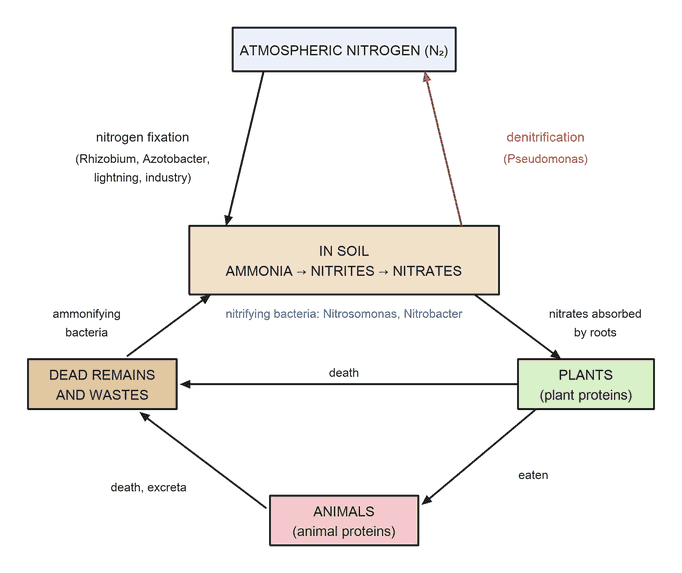
Draw a diagram showing the Nitrogen cycle and answer the following questions.
(a) Define the terms : (i) Nitrification (ii) Denitrification
(b) Distinguish between biological nitrogen fixation and industrial nitrogen fixation.
(c) Name the kind of relationship that exists between Rhizobium and leguminous plants.
Solve with AIWritten solution
Solution:
Concept: Nitrogen moves between the air, the soil and living things in a cycle, and bacteria carry out most of its steps.
Step 1 — Draw the nitrogen cycle.
Draw and label the cycle as shown below. Nitrogen gas is fixed into the soil, taken up by plants as nitrates, passed to animals as proteins, returned to the soil when they die, and sent back to the air by denitrification.
Step 2 — (a)(i) Nitrification.
Nitrification is the change of ammonia (ammonium compounds) in the soil into nitrites by Nitrosomonas, and then into nitrates by Nitrobacter.
Step 3 — (a)(ii) Denitrification.
Denitrification is the breakdown of soil nitrates by denitrifying bacteria (e.g. Pseudomonas), releasing free nitrogen gas into the atmosphere.
Step 4 — (b) Biological and industrial fixation.
Compare the two ways of fixing nitrogen:
Biological nitrogen fixation Industrial nitrogen fixation Done by living organisms: bacteria such as Rhizobium (in root nodules), Azotobacter and Clostridium. Done in factories by a chemical process, to make nitrogen fertilizers. Takes place at normal temperature and pressure, using enzymes. Needs high temperature and pressure and a catalyst. Step 5 — (c) Rhizobium and legumes.
Rhizobium and the leguminous plant live together and both benefit: the plant gets nitrogen compounds, and the bacteria get food and shelter. This relationship is symbiosis (mutualism).
Watch out: Nitrification (ammonia → nitrates) is not the same as nitrogen fixation (nitrogen gas → nitrogen compounds).
Therefore, the diagram shows the nitrogen cycle; nitrification turns ammonia into nitrates and denitrification returns nitrogen gas to the air; biological fixation uses living organisms at normal conditions while industrial fixation uses factories at high temperature and pressure; and Rhizobium and legumes show symbiosis.
- 351 mark
Question 35
Which is the most common variety of cultivated mushroom ?
Solve with AIWritten solution
Solution:
Concept: Several mushrooms are cultivated in India: the white button mushroom, the oyster mushroom (Pleurotus) and the paddy straw mushroom (Volvariella).
Step 1 — Pick the most common one.
Of these, the most widely cultivated variety is the white button mushroom.
Step 2 — Give its scientific name.
Its scientific name is Agaricus bisporus.
Therefore, the most common cultivated mushroom is the white button mushroom, Agaricus bisporus.
- 361 mark
Question 36
What is meant by "mushroom seed" ?
Solve with AIWritten solution
Solution:
Concept: Mushrooms are fungi and do not grow from seeds; they are started from their thread-like mycelium.
Step 1 — What the mushroom seed is.
"Mushroom seed", also called spawn, is the mycelium of the selected type of mushroom, usually grown on cereal grains.
Step 2 — How it is used.
In the step called spawning, this spawn is mixed into the compost, where the mycelium spreads.
Watch out: The word "seed" here is only a common name; the spawn is mycelium.
Therefore, "mushroom seed" is the spawn: the mycelium of the selected mushroom, introduced into the compost during spawning.
- 372 marks
Question 37
What is done in the step called "casing" ?
Solve with AIWritten solution
Solution:
Concept: Casing is the step of mushroom cultivation that comes after spawning.
Step 1 — What is done.
A thin layer of soil (casing soil) is spread over the compost in which the mycelium has spread.
Step 2 — Why it is done.
The casing layer:
- gives support to the growing mushrooms;
- provides humidity;
- prevents quick drying of the compost; and
- helps to regulate the temperature.
Therefore, in casing a thin layer of soil is spread over the spawned compost to support the mushrooms and keep the compost moist.
- 381 mark
Question 38
Production of ethanol () occurs in one of the life processes of :
Solve with AIAnswer
(A) Bread mould
- Correct
(B) Yeast
(C) Mushroom
(D) Penicillium
Answer: (B) Yeast
Concept: In the absence of oxygen, yeast respires anaerobically and breaks glucose into ethanol and carbon dioxide. This is alcoholic fermentation.
Step 1 — Recall which fungus makes ethanol.
Yeast is the fungus used in breweries because it produces ethanol.
Step 2 — Match with the options.
Yeast is option (B).
Why the other options are wrong:
- (A) Bread mould: bread mould (Rhizopus) spoils bread; it is not the organism used to make ethanol.
- (C) Mushroom: mushrooms are grown as food, not for making ethanol.
- (D) Penicillium: Penicillium is used for the antibiotic penicillin and for flavouring some cheeses.
Therefore, ethanol is produced during the anaerobic respiration of yeast, option (B).
- 391 mark
Question 39
Which among the following statements is incorrect about fungi ?
Solve with AIAnswer
(A) They are multicellular organisms except yeasts.
(B) They are heterotrophic and are either parasitic or saprophytic.
- Correct
(C) They prefer cold and dry conditions to grow.
(D) They are immobile unlike bacteria.
Answer: (C) They prefer cold and dry conditions to grow.
Concept: Fungi grow best in warm and moist (humid) conditions; this is why bread grows mould quickly in the rainy season.
Step 1 — Note what is asked.
The question asks for the incorrect statement about fungi.
Step 2 — Check each statement.
Statements (A), (B) and (D) are true. Statement (C) says fungi prefer cold and dry conditions, which is the opposite of the truth, so (C) is the answer.
Watch out: The question asks for the INCORRECT statement, so the true statements are the wrong choices.
Why the other options are wrong:
- (A) They are multicellular organisms except yeasts: this is true: fungi are multicellular, made of hyphae, and yeasts are the one-celled exception.
- (B) They are heterotrophic and are either parasitic or saprophytic: this is true: having no chlorophyll, fungi are heterotrophic, either parasitic or saprophytic.
- (D) They are immobile unlike bacteria: this is true as a rule: fungi cannot move about, while many bacteria swim with flagella.
Therefore, the incorrect statement is that fungi prefer cold and dry conditions, option (C).
- 401 mark
Question 40
Yeast is used in the production of :
Solve with AIAnswer
- Correct
(A) Ethyl alcohol
(B) Acetic acid
(C) Cheese
(D) Curd
Answer: (A) Ethyl alcohol
Concept: Yeast ferments sugar into ethyl alcohol (ethanol) and carbon dioxide; this is the basis of wine and beer making.
Step 1 — Recall what yeast produces.
During fermentation yeast produces ethyl alcohol.
Step 2 — Match with the options.
Ethyl alcohol is option (A).
Why the other options are wrong:
- (B) Acetic acid: acetic acid (vinegar) is made by bacteria such as Acetobacter acting on alcohol.
- (C) Cheese: cheese is made by curdling milk with lactic acid bacteria and then ripening it, sometimes with moulds.
- (D) Curd: curd is formed by lactic acid bacteria (Lactobacillus).
Therefore, yeast is used in the production of ethyl alcohol, option (A).
- 411 mark
Question 41
Which of the following is a unicellular organism ?
Solve with AIAnswer
(A) Rhizopus
(B) Mould
- Correct
(C) Yeast
(D) Mushroom
Answer: (C) Yeast
Concept: Most fungi are made of many thread-like hyphae, but yeast is a fungus made of a single cell.
Step 1 — Look for the one-celled fungus.
Of the options, only yeast is unicellular.
Step 2 — Match with the options.
Yeast is option (C).
Why the other options are wrong:
- (A) Rhizopus: Rhizopus is a mould made of many hyphae (a mycelium).
- (B) Mould: moulds are multicellular, made of thread-like hyphae.
- (D) Mushroom: a mushroom is a large multicellular fungus.
Therefore, the unicellular organism is yeast, option (C).
- 421 mark
Question 42
The scientific name of white button mushroom is :
Solve with AIAnswer
(A) Volvariella
(B) Aspergillus
(C) Pleurotus
- Correct
(D) Agaricus bisporus
Answer: (D) Agaricus bisporus
Concept: The white button mushroom, the most popular cultivated mushroom in India, is Agaricus bisporus.
Step 1 — Recall the scientific name.
The white button mushroom belongs to the genus Agaricus; its species is A. bisporus.
Step 2 — Match with the options.
This is option (D).
Why the other options are wrong:
- (A) Volvariella: Volvariella is the paddy straw mushroom.
- (B) Aspergillus: Aspergillus is a common mould, not a mushroom.
- (C) Pleurotus: Pleurotus is the oyster mushroom.
Therefore, the scientific name of the white button mushroom is Agaricus bisporus, option (D).
- 431 mark
Question 43
The entire mass of hyphae is termed as :
Solve with AIAnswer
(A) Sporangium
(B) Sporangiophore
(C) Both (a) and (b)
- Correct
(D) Mycelium
Answer: (D) Mycelium
Concept: A fungus such as Rhizopus is made of fine threads called hyphae; the whole mass of hyphae is the mycelium.
Step 1 — Recall the term.
All the hyphae of a fungus, taken together, form its mycelium.
Step 2 — Match with the options.
Mycelium is option (D).
Why the other options are wrong:
- (A) Sporangium: a sporangium is the round case at the tip of a hypha that holds the spores.
- (B) Sporangiophore: a sporangiophore is a single upright hypha that bears a sporangium.
- (C) Both (a) and (b): neither the sporangium nor the sporangiophore is the whole mass of hyphae.
Therefore, the entire mass of hyphae is the mycelium, option (D).
- 441 mark
Question 44
The heterotrophic mode of nutrition in fungi is:
Solve with AIAnswer
(A) Symbiotic
- Correct
(B) Saprophytic
(C) Parasitic
(D) Heterozoic
Answer: (B) Saprophytic
Concept: Fungi have no chlorophyll, so they are heterotrophic. Most fungi (moulds, yeast, mushrooms) are saprophytic: they release enzymes onto dead organic matter and absorb the digested food.
Step 1 — Find the main heterotrophic mode.
The typical way fungi feed is on dead and decaying matter, which is saprophytic nutrition.
Step 2 — Match with the options.
Saprophytic is option (B).
Watch out: Parasitic fungi exist, but most fungi are saprophytes.
Why the other options are wrong:
- (A) Symbiotic: a symbiotic association is found only in some fungi, as in lichens and mycorrhiza.
- (C) Parasitic: only some fungi are parasites (such as the ringworm fungus); most fungi are saprophytes.
- (D) Heterozoic: "heterozoic" is not a mode of nutrition; fungi never take in food by swallowing it.
Therefore, the main heterotrophic mode of nutrition in fungi is saprophytic, option (B).
- 451 mark
Question 45
The stored food material in Yeast is in the form of :
Solve with AIAnswer
- Correct
(A) Glycogen and fat
(B) Starch and Cellulose
(C) Glycogen and Protein
(D) None of these
Answer: (A) Glycogen and fat
Concept: A yeast cell stores its reserve food as glycogen granules and fat (in fat vacuoles) in its cytoplasm.
Step 1 — Recall the yeast cell.
The labelled yeast cell shows glycogen granules and fat vacuoles as its stored food.
Step 2 — Match with the options.
Glycogen and fat is option (A).
Watch out: Fungi store glycogen like animals, not starch like plants.
Why the other options are wrong:
- (B) Starch and Cellulose: starch is the stored food of plants, and cellulose is a plant wall material; yeast stores neither.
- (C) Glycogen and Protein: glycogen is right, but protein is not the stored food of the yeast cell.
- (D) None of these: glycogen and fat are the correct answer, so "none of these" is wrong.
Therefore, the stored food in yeast is glycogen and fat, option (A).
- 461 mark
Question 46
Which of the following properties of fungi separates them from plants ?
Solve with AIAnswer
- Correct
(A) Absence of chlorophyll
(B) Autotrophic mode of nutrition
(C) Lack of a stem
(D) Poisonous and non-edible
Answer: (A) Absence of chlorophyll
Concept: Plants have chlorophyll and make their own food. Fungi have no chlorophyll and absorb ready-made food, so they are placed in a separate kingdom.
Step 1 — Find the key difference.
A plant makes food by photosynthesis; a fungus cannot, because it lacks chlorophyll.
Step 2 — Match with the options.
Absence of chlorophyll is option (A).
Why the other options are wrong:
- (B) Autotrophic mode of nutrition: fungi are heterotrophic, not autotrophic; autotrophic nutrition is a feature of plants.
- (C) Lack of a stem: not having a stem does not separate fungi from plants, because some plants, such as liverworts, also have no stem.
- (D) Poisonous and non-edible: many fungi, such as button mushrooms and yeast, are edible and harmless.
Therefore, the property that separates fungi from plants is the absence of chlorophyll, option (A).
- 471 mark
Question 47
The main products produced by microorganisms during fermentation are :
Solve with AIAnswer
- Correct
(A) Ethanol or lactic acid
(B) Ethanol and uric acid
(C) Amino acid and lactic acid
(D) Ethanol or uric acid
Answer: (A) Ethanol or lactic acid
Concept: Fermentation is the breakdown of carbohydrates by microorganisms without oxygen. Yeast gives ethanol and carbon dioxide; lactic acid bacteria give lactic acid.
Step 1 — Recall the products.
The main products are ethanol (from yeast) or lactic acid (from lactic acid bacteria).
Step 2 — Match with the options.
Ethanol or lactic acid is option (A).
Why the other options are wrong:
- (B) Ethanol and uric acid: uric acid is a nitrogen-containing waste of animals, not a fermentation product.
- (C) Amino acid and lactic acid: amino acids come from the digestion of proteins; they are not the main products of fermentation.
- (D) Ethanol or uric acid: uric acid is not a fermentation product, so this pair is wrong.
Therefore, the main products of fermentation are ethanol or lactic acid, option (A).
- 485 marks
Question 48
Fill in the blanks :
(a) The specific genus to which several species of yeast belong is .......... .
(b) .......... is a unicellular fungi.
(c) Alcoholics may develop body ailments like .......... due to over consumption of alcohol.
(d) The curd from which moisture has been removed is termed as ..........
(e) Cheese is a good source of vitamin .......... and ..........
Solve with AIWritten solution
Solution:
Concept: The blanks come from the chapter's account of yeast, alcohol and cheese.
Step 1 — (a) Genus of yeast.
Several species of yeast belong to the genus Saccharomyces.
Step 2 — (b) Unicellular fungus.
Yeast is a unicellular fungus.
Step 3 — (c) Ailment from alcohol.
Drinking too much alcohol over a long time damages the liver, causing liver cirrhosis.
Step 4 — (d) Curd without moisture.
When moisture is removed from curd, it is called cottage cheese.
Step 5 — (e) Vitamins in cheese.
Cheese is a good source of vitamin A and vitamin B.
Therefore, (a) Saccharomyces, (b) yeast, (c) liver cirrhosis, (d) cottage cheese, (e) A and B.
- 494 marks
Question 49
Define the terms : (a) Fermentation (b) Spawning
Solve with AIWritten solution
Solution:
Concept: Fermentation is a process carried out by microbes; spawning is a step in mushroom cultivation.
Step 1 — (a) Fermentation.
Fermentation is the process in which microorganisms (yeast and bacteria) break down carbohydrates into simpler products, ethanol or lactic acid, without oxygen.
Step 2 — (b) Spawning.
Spawning is the step in mushroom cultivation in which "mushroom seed", the mycelium of the selected mushroom, is introduced into the compost and allowed to spread through it.
Therefore, fermentation is the anaerobic breakdown of carbohydrates by microbes, and spawning is introducing mushroom mycelium into the compost.
- 501 mark
Question 50
Where can the mould Rhizopus be most easily found ?
Solve with AIWritten solution
Solution:
Concept: Rhizopus is the common bread mould; it grows where food, warmth and moisture are present.
Step 1 — Its usual home.
Rhizopus is found most easily on moist bread kept in a warm, humid place for a few days.
Step 2 — Other places.
It also grows on rotting fruits, animal dung and leather goods.
Therefore, Rhizopus is most easily found on moist, stale bread.
- 512 marks
Question 51
Write the chemical equation of fermentation.
Solve with AIWritten solution
Solution:
Concept: In fermentation, yeast breaks down glucose without oxygen into ethanol (ethyl alcohol) and carbon dioxide, releasing a small amount of energy.
Step 1 — Write the word equation.
Glucose is changed into ethanol and carbon dioxide:
Glucose → ethanol + carbon dioxide + energy
Step 2 — Write the chemical equation.
Using formulae, the equation is:
Step 3 — Check that it balances.
Count each kind of atom on the right side (2 ethanol and 2 carbon dioxide molecules):
These match the 6 carbon, 12 hydrogen and 6 oxygen atoms of one glucose molecule, so the equation is balanced.
Watch out: Only 2 ATP are released per glucose, far less than in aerobic respiration.
Therefore, C₆H₁₂O₆ → 2C₂H₅OH + 2CO₂ + energy.
- 521 mark
Question 52
Name three vitamins which are richly found in mushrooms.
Solve with AIWritten solution
Solution:
Concept: Mushrooms are good sources of vitamins and minerals, especially some B-group vitamins.
Step 1 — Name three vitamins.
Mushrooms contain a good amount of niacin, pantothenic acid and biotin.
Step 2 — Why they are useful.
These vitamins are well kept during cooking, canning and drying.
Therefore, three vitamins richly found in mushrooms are niacin, pantothenic acid and biotin.
- 532 marks
Question 53
Describe the role of certain fungi in industrial production.
Solve with AIWritten solution
Solution:
Concept: Fungi such as yeast and moulds are used in industries that depend on fermentation and on the chemicals fungi make.
Step 1 — Wine and beer.
Yeast (Saccharomyces cerevisiae) ferments the sugar of grapes or barley malt into ethanol and carbon dioxide.
Step 2 — Bread.
Yeast ferments sugar in the dough; the carbon dioxide makes the dough rise, giving soft, spongy bread.
Step 3 — Cheese.
Species of Penicillium are used to ripen some cheeses and give them their flavour.
Step 4 — Antibiotics.
Penicillium chrysogenum is grown in large tanks to make the antibiotic penicillin.
Therefore, fungi are used industrially to make wine and beer, bread, flavoured cheeses and penicillin.
- 544 marks
Question 54
Differentiate between :
(a) Saprophyte and Parasite
(b) Aerobic and anaerobic respiration with regard to the products formed.
Solve with AIWritten solution
Solution:
Concept: Saprophytes and parasites differ in their source of food; aerobic and anaerobic respiration differ in their end products and the energy released.
Step 1 — (a) Saprophyte and parasite.
Compare the two by their food source:
Saprophyte Parasite Gets nourishment from dead and decaying organic matter. Gets nourishment from the body of a living host. Does not harm a living organism, e.g. Rhizopus, yeast. Usually harms its host, e.g. the ringworm fungus. Step 2 — (b) Aerobic and anaerobic respiration.
Compare the two by their products:
Aerobic respiration Anaerobic respiration Glucose is completely broken down to carbon dioxide and water. Glucose is incompletely broken down to ethanol and carbon dioxide (yeast) or lactic acid (muscles, some bacteria). Much energy is released (38 ATP per glucose, as counted in the book). Little energy is released (2 ATP per glucose). Watch out: Anaerobic respiration in yeast gives ethanol, but in our muscles it gives lactic acid.
Note: current estimates put the yield of aerobic respiration at about 30–32 ATP per glucose; 38 is the older textbook count.
Therefore, a saprophyte feeds on dead matter and a parasite on a living host, and aerobic respiration gives carbon dioxide and water while anaerobic respiration gives ethanol and carbon dioxide or lactic acid.
- 553 marks
Question 55
Discuss the role of yeasts in bakeries and breweries.
Solve with AIWritten solution
Solution:
Concept: Yeast ferments sugar into ethanol and carbon dioxide. Bakeries use the carbon dioxide; breweries use the ethanol.
Step 1 — Write the fermentation equation.
Yeast breaks down glucose without oxygen:
Step 2 — In bakeries.
Yeast is mixed into dough of flour, water, salt and fat. Some starch of the flour is changed into sugar, which the yeast ferments. The carbon dioxide formed is trapped as bubbles, so the dough rises (leavening), to about three times its volume. On baking, the gas expands and the bread becomes light and spongy.
Step 3 — In breweries.
Yeast (Saccharomyces cerevisiae) ferments the sugar of crushed grapes (for wine) or barley malt (for beer) into ethanol and carbon dioxide. When the ethanol reaches about 12–15 %, it kills the yeast and fermentation stops.
Watch out: In bread the alcohol escapes during baking; it is the carbon dioxide that matters.
Therefore, in bakeries yeast's carbon dioxide makes dough rise, and in breweries yeast's ethanol makes wine and beer.
- 563 marks
Question 56
Write in proper sequence the five major steps in the cultivation of the common edible mushroom.
Solve with AIWritten solution
Solution:
Concept: The white button mushroom (Agaricus bisporus) is cultivated indoors on compost in five major steps.
Step 1 — Composting.
A compost of wheat or paddy straw, chicken manure and fertilizer is prepared and kept at about 50 °C for around a week.
Step 2 — Spawning.
"Mushroom seed" (spawn), the mycelium of the chosen mushroom, is mixed into the compost and allowed to spread.
Step 3 — Casing.
A thin layer of soil is spread over the compost to support the mushrooms and keep the compost moist.
Step 4 — Cropping and harvesting.
Tiny pin heads appear, grow to the button stage and then to marketable size, and the full-grown mushrooms are picked.
Step 5 — Preservation.
Because mushrooms spoil quickly, their shelf life is increased by vacuum cooling, gamma radiation and cool storage, or freeze drying.
Watch out: Casing comes after spawning; the soil layer is added once the mycelium is in the compost.
Therefore, the five steps in order are composting, spawning, casing, cropping and harvesting, and preservation.
- 574 marks
Question 57
Would you consider bacteria and yeast as plants? Give reason.
Solve with AIWritten solution
Solution:
Concept: In the Five Kingdom classification, plants are eukaryotic, multicellular and make their own food with chlorophyll. Neither bacteria nor yeast fits this.
Step 1 — Give the answer.
No, neither bacteria nor yeast is a plant.
Step 2 — Why bacteria are not plants.
Bacteria are prokaryotic (no nucleus enclosed in a nuclear membrane) and unicellular, so they are placed in kingdom Monera.
Step 3 — Why yeast is not a plant.
Yeast is a fungus: it has no chlorophyll and its nutrition is heterotrophic (saprophytic), so it is placed in kingdom Fungi.
Watch out: Yeast has a true nucleus, so it is NOT a prokaryote like bacteria; it is excluded from plants for another reason.
Therefore, bacteria and yeast are not plants: bacteria are prokaryotes (Monera) and yeast is a heterotrophic fungus (Fungi).
- 583 marks
Question 58
Both bacteria and yeast reproduce by asexual method, but how does this method differ in them ?
Solve with AIWritten solution
Solution:
Concept: Both bacteria and yeast reproduce asexually, but bacteria split into two equal cells (binary fission) while yeast forms buds (budding).
Step 1 — Bacteria: binary fission.
The circular DNA is copied, the cell pinches in at the middle and divides into two equal daughter cells. The parent cell no longer exists as such.
Step 2 — Yeast: budding.
A small outgrowth (bud) forms on the parent cell. The nucleus divides and one nucleus passes into the bud. The bud grows and separates, or stays attached to form a chain of buds. The parent cell remains.
Step 3 — Compare the two.
Summarise the difference:
Bacteria Yeast Binary fission Budding Two equal daughter cells A small bud and a larger parent cell Parent cell is used up in the division Parent cell continues to live Therefore, bacteria reproduce by binary fission into two equal cells, while yeast reproduces by budding, in which the parent remains.
- 595 marks
Question 59
If you leave a piece of moist bread covered under a small bell jar at a warm place, mould grows on it in a few days. Answer the following with reference to this observation :
(a) What would happen if the bread was not covered by the bell-jar ?
(b) What would happen if moist bread was placed in a refrigerator ?
(c) What appears first on the bread—the mycelia or the spores ?
Solve with AIWritten solution
Solution:
Concept: Moulds grow from spores that land on food, and they need moisture and warmth to grow.
Step 1 — (a) Bread not covered.
In the open, the bread dries up quickly. Moulds cannot grow without moisture, so little or no mould grows. The bell jar keeps the air around the bread humid.
Step 2 — (b) Bread in a refrigerator.
The low temperature slows down the germination and growth of mould spores, so little or no mould appears for many days. Over a long time some mould may still grow slowly.
Step 3 — (c) Mycelium or spores first.
The spores that landed on the bread first grow into a white, cottony mycelium, which appears first. New black spores form later in sporangia at the tips of the sporangiophores.
Watch out: A refrigerator slows mould growth a great deal but does not stop it completely.
Therefore, (a) little or no mould would grow as the bread dries, (b) mould growth would be very slow in the cold, and (c) the mycelium appears first.
- 603 marks
Question 60
Draw a neat diagram of the unicellular fungus 'Yeast' and label its six important parts.
Solve with AIWritten solution
Solution:
Concept: A yeast cell is oval (ovoid), with a distinct cell wall and a nucleus, and it stores food as glycogen and fat.
Step 1 — Draw the cell.
Draw an oval cell with a thick outline and label it as shown below:
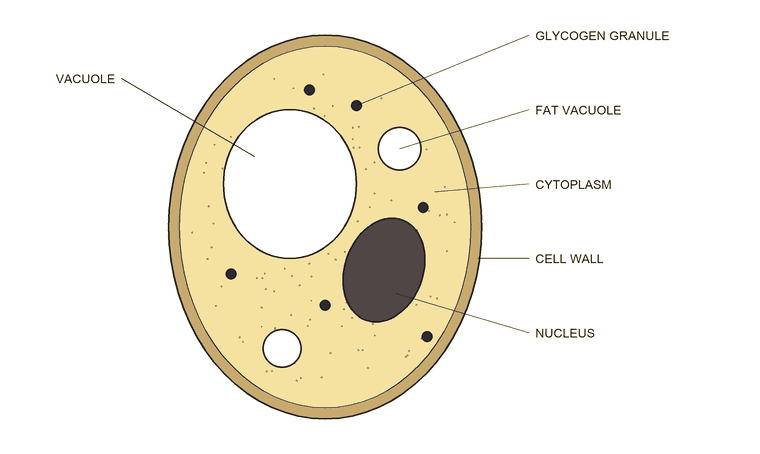
Step 2 — Know each labelled part.
The six parts are:
- Cell wall: the firm outer covering that gives the cell its shape.
- Cytoplasm: the jelly-like material filling the cell.
- Nucleus: controls the cell's activities.
- Vacuole: a large sap-filled space.
- Glycogen granule: stored carbohydrate food.
- Fat vacuole: stored fat.
Therefore, the six labelled parts are cell wall, cytoplasm, nucleus, vacuole, glycogen granule and fat vacuole.
- 615 marks
Question 61
The figure shown alongside represents an organism. Study the figure and answer the following questions.
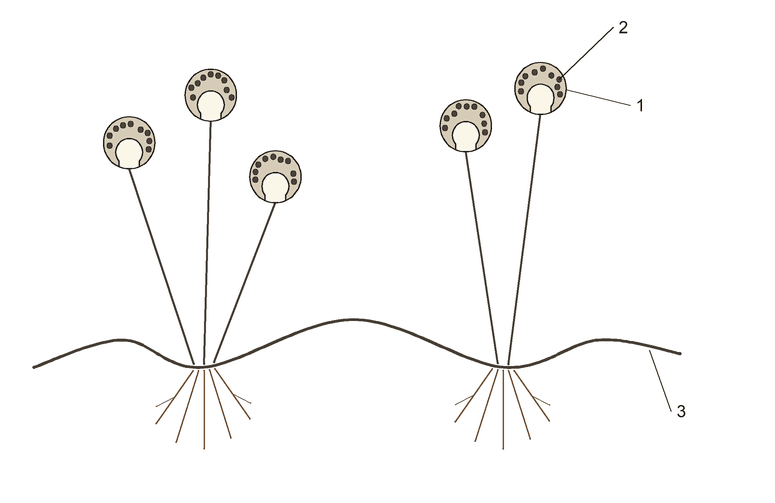
(a) Identify the organism and write its common as well as scientific name.
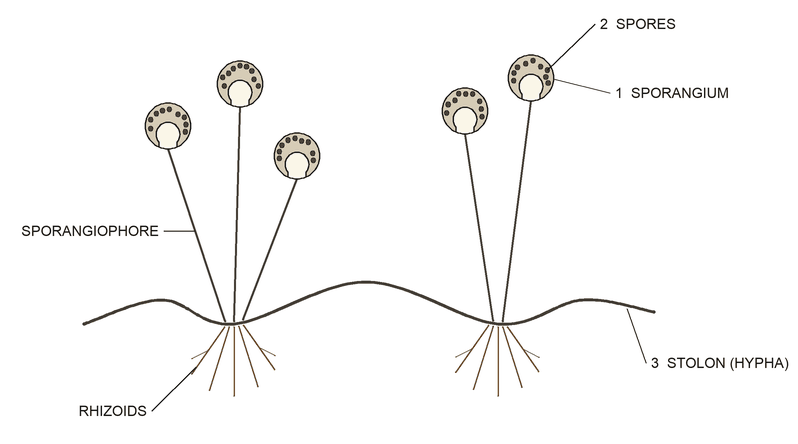
(b) Label the parts shown as 1, 2 and 3.
(c) Name two suitable habitats of the organism shown.
(d) Mention its main mode of reproduction.
(e) What specific kinds of digestion occur in it ?
Solve with AIWritten solution
Solution:
Concept: A fungus with upright stalks bearing round black-dotted cases, a horizontal hypha and root-like threads is the common bread mould.
Step 1 — (a) Identify the organism.
Its common name is bread mould, and its scientific name is Rhizopus (Rhizopus stolonifer).
Step 2 — (b) Label the parts.
Part 1 is the sporangium, the round case at the tip of an upright hypha; part 2 is the spores inside it; part 3 is the stolon, the horizontal hypha of the mycelium.
Step 3 — (c) Two habitats.
It grows on moist bread and on rotting fruits (also on animal dung and leather goods) in warm, humid weather.
Step 4 — (d) Main mode of reproduction.
It reproduces mainly asexually by spores formed in the sporangia. The sporangium bursts, and the spores are carried by air to new food, where they grow into new mycelia.
Step 5 — (e) Kind of digestion.
Its digestion is extracellular: the hyphae release enzymes onto the food outside the body, and the digested food is absorbed. This is saprophytic nutrition.
Watch out: Part 1 is the case (sporangium) and part 2 is what is inside it (spores).
Therefore, (a) bread mould, Rhizopus; (b) 1 sporangium, 2 spores, 3 stolon; (c) moist bread and rotting fruits; (d) asexual reproduction by spores; (e) extracellular digestion (saprophytic).
What Class 9 Biology Ch 9 covers
The sections of the chapter, in the order the book takes them. Every question above comes from one of these.
- 01Bacteria – A General Study
- 02Useful Role of Bacteria in Medicine
- 03Bacteria – Role in Agriculture
- 04Bacteria – Role in Industry
- 05Spoilage of Food by Bacteria
- 06Bacterial Diseases in Plants and Animals
More ways to study this chapter
The same chapter asked three other ways. Practise it, revise it, and see what the board has set on Ch 9 before.
Class 9 Biology Ch 9 questions students ask
How many questions are there in Class 9 Biology Ch 9?
61 questions. Every one is solved step by step on this page.
Are these Class 9 Biology solutions free?
Yes. Every question and its full working is free to read, with no account needed.
Can I download the Class 9 Biology Ch 9 solutions as a PDF?
There is no PDF to download. Every solution is on this page instead, which means it is searchable, always the current syllabus, and readable on a phone. Use your browser's print option if you want it on paper.