Solution:
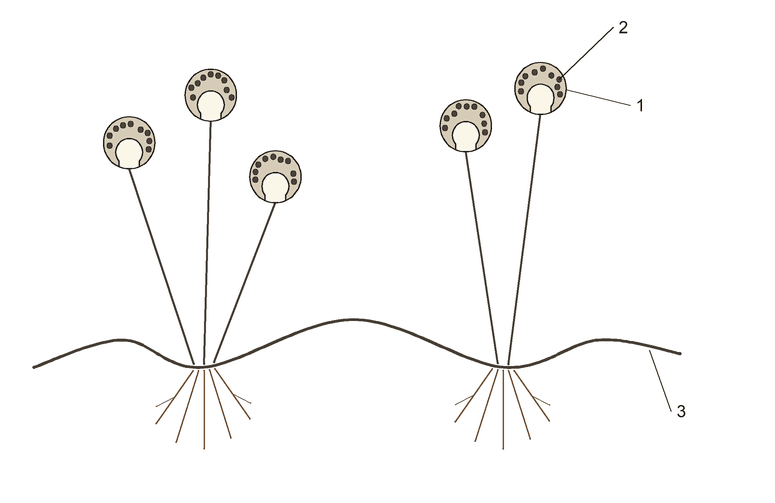
Concept: A fungus with upright stalks bearing round black-dotted cases, a horizontal hypha and root-like threads is the common bread mould.
Step 1 — (a) Identify the organism.
Its common name is bread mould, and its scientific name is Rhizopus (Rhizopus stolonifer).
Step 2 — (b) Label the parts.
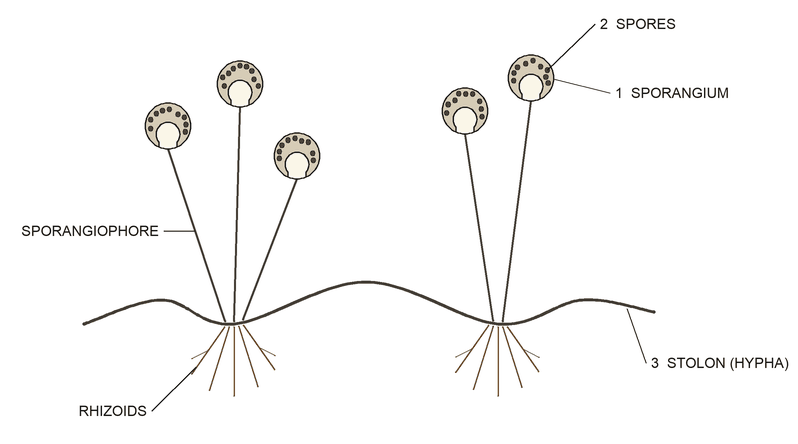
Part 1 is the sporangium, the round case at the tip of an upright hypha; part 2 is the spores inside it; part 3 is the stolon, the horizontal hypha of the mycelium.
Step 3 — (c) Two habitats.
It grows on moist bread and on rotting fruits (also on animal dung and leather goods) in warm, humid weather.
Step 4 — (d) Main mode of reproduction.
It reproduces mainly asexually by spores formed in the sporangia. The sporangium bursts, and the spores are carried by air to new food, where they grow into new mycelia.
Step 5 — (e) Kind of digestion.
Its digestion is extracellular: the hyphae release enzymes onto the food outside the body, and the digested food is absorbed. This is saprophytic nutrition.
Watch out: Part 1 is the case (sporangium) and part 2 is what is inside it (spores).
Therefore, (a) bread mould, Rhizopus; (b) 1 sporangium, 2 spores, 3 stolon; (c) moist bread and rotting fruits; (d) asexual reproduction by spores; (e) extracellular digestion (saprophytic).