
Opening your dashboard
Class 9 Biology Chapter 9 Economic Importance of Bacteria and Fungi: Competency-Based Questions (CBQ)
40 questions on Chapter 9, each worked through on its own page with the AI tutor. Class 9 Biology, ICSE 2026-27.
40 questions
1–5 marks · Mixed difficulty
- 11 mark
Question 1
Cognitive domain: Application
A family in Kochi buys a large catch of fresh fish when the price is low. They want to keep the cleaned fish in good condition for about two months, without salting or drying it. Which way of storing the fish is the most suitable ?
- 21 mark
Question 2
Cognitive domain: Analysis
The figure shows a bacterial cell. Four of its parts are numbered 1 to 4.
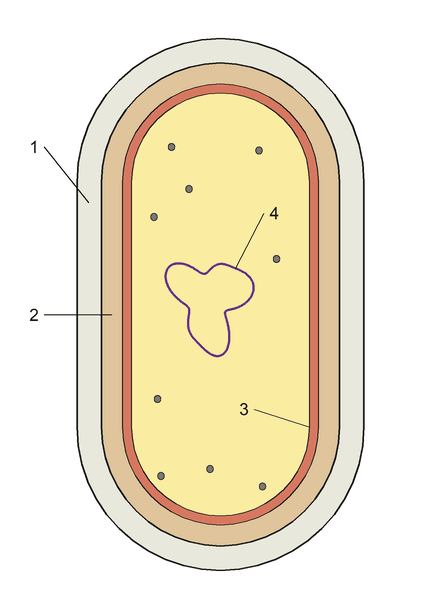
A scientist is testing a new chemical. It breaks down peptidoglycan but has no effect on cellulose or on any other substance. Which numbered part of the bacterial cell will this chemical damage ?
- 31 mark
Question 3
Cognitive domain: Analysis
A student is given two kinds of bacteria, P and Q. She tries to grow each kind in two different places and records whether it grows.
Where the bacteria were placed Bacteria P Bacteria Q On dead, decaying cauliflower leaves Grew well Did not grow Inside the leaves of a living cauliflower plant Did not grow Grew well, and the plant became diseased Which conclusion do these results support ?
- 41 mark
Question 4
Cognitive domain: Application
Students of a hotel management course are making cheese. They curdle the milk with lactic acid bacteria, separate the curd from the whey and process the curd into cottage cheese. In a hurry, one group skips the salting step and keeps its cheese for ripening straightaway. What is most likely to go wrong with this group's cheese ?
- 51 mark
Question 5
Cognitive domain: Understanding
Assertion (A): Dough to which yeast has been added swells up to about three times its original volume when it is left for some time.
Reason (R): Yeast ferments the sugar formed from the starch of the flour and produces carbon dioxide gas.
- 61 mark
Question 6
Cognitive domain: Understanding
Assertion (A): A field in which denitrifying bacteria are very active becomes richer and richer in nitrates.
Reason (R): Denitrifying bacteria such as Pseudomonas break down the nitrates of the soil and release nitrogen gas into the atmosphere.
- 71 mark
Question 7
Cognitive domain: Application
A medicine company grows the bacteria that cause diphtheria and collects the poisonous proteins released by them. It then treats these poisons so that they become inactive and harmless. When this preparation is injected, the person does not fall ill, but the body is still stimulated to defend itself against diphtheria.
Complete the sentence :
The inactivated poisons in this preparation are called ______, and they protect the person because they can still stimulate the body to produce the respective ______.
- 81 mark
Question 8
Cognitive domain: Understanding
During the monsoon in Mumbai, Farah found greenish-white cottony patches on a pair of leather shoes that had been lying in a closed, damp cupboard. Another pair, kept on an open rack in a dry, airy room, had no such patches.
Complete the sentence :
The cottony patches are ______, a kind of fungus, and they grew only on the first pair because these fungi grow well where the surroundings are warm and ______.
- 91 mark
Question 9
Cognitive domain: Application
Kavita's grandmother makes mango pickle with plenty of salt. A jar of this pickle stays good for more than a year, though cut mango kept without salt spoils in a few days.
Complete the sentence :
Most bacteria that enter the salty pickle die, because the strong concentration of salt draws ______ out of its cell, and so the cell undergoes ______.
- 102 marks
Question 10
Cognitive domain: Evaluation
A laboratory tests three newly found antibiotics, K, L and M.
Antibiotic Disease-producing microorganisms killed Side-effects in the patient Normal bacteria of the patient's body K Many kinds None seen Not killed L Many kinds None seen Most are killed M Only one kind Skin rashes Not killed The manager wants to choose L, saying, "L kills the largest number of bacteria, so it must be the best." Do you agree ? Which antibiotic would you choose ? Justify your answer.
- 112 marks
Question 11
Cognitive domain: Analysis
A juice seller in Kolhapur forgot a covered jug of fresh sugarcane juice on his cart for two days. Nothing had been added to the juice. When he opened the jug, the juice was frothing with bubbles and had a smell of alcohol.
Name the organism that caused this change and explain how it reached the juice. What are the bubbles made of, and how were they formed ?
- 122 marks
Question 12
Cognitive domain: Application
A dairy farmer near Anand calls a veterinary doctor to look at two of his cows. Cow P has swellings on its body and is giving much less milk than before. Cow Q has a dry, husky cough, and the doctor finds that its lungs are affected. Both diseases are caused by bacteria.
Name the disease that each cow is most likely to have. The germ of which of these two diseases is feared as a bioweapon, and why would such a weapon be so dangerous ?
- 135 marks
Question 13
Cognitive domain: Analysis
Case: A soil scientist took three samples of the same garden soil. Sample 1 was left untreated. In Sample 2, one kind of soil bacteria (X) was made inactive. In Sample 3, another kind of soil bacteria (Y) was made inactive. She mixed the same amount of an ammonium compound into each sample and kept all three moist and warm. No plants were grown in them. After three weeks she measured three nitrogen-containing substances in each sample. All the amounts are given as the mass of nitrogen they contain (mg of nitrogen per kg of soil).
Sample Ammonium compounds (mg per kg of soil) Nitrites (mg per kg of soil) Nitrates (mg per kg of soil) 1 4 1 45 2 46 0 4 3 5 42 3 (a) In Sample 1, most of the ammonium compound has disappeared. What has it been changed into, and what is this process called ?
(b) Identify the bacteria X and Y. Give a reason from the table for each.
(c) Wheat seedlings are now planted in all three samples. Wheat takes up most of its nitrogen in the form of nitrates. In which sample will the seedlings find the most nitrogen in this form ? Explain.
(d) Sample 1 is kept for another month, still without plants, and nothing is washed out of it. Its nitrates fall from 45 mg to 20 mg per kg. How much nitrate has been lost, where has its nitrogen gone, and which kind of bacteria is responsible ?
- 144 marks
Question 14
Cognitive domain: Evaluation
Case: A women's self-help group in Nashik packs tomato puree in tins. They prepare two batches of 50 tins each. The puree of Batch A is boiled in an open pan and then sealed in the tins. The puree of Batch B is heated in a large pressure-cooker at about and then sealed. After one month in the store room they examine the tins.
Batch How the puree was heated Tins packed Tins with bulging ends A Boiled in an open pan 50 9 B In a pressure-cooker at about 50 0 (a) Calculate the percentage of tins in Batch A that have bulging ends. What has made their ends bulge ?
(b) The puree of Batch A was boiled, yet some of its tins went bad. The puree of Batch B did not. Explain the difference.
(c) One member says, "Let us open the bulging tins, boil the puree once more and sell it. Nothing should be wasted." Is this a sound decision ? Justify your answer.
- 155 marks
Question 15
Cognitive domain: Creativity
Case: The canteen of a school in Guwahati often has to throw away bread that has turned mouldy. The science club wants to find out which conditions the bread mould (Rhizopus) needs, so that it can advise the canteen on how to store bread. The club has slices of fresh bread from one loaf, clean transparent zip-lock bags, water, a warm cupboard and a refrigerator.
(a) Design an investigation with four bags to find out whether moisture and warmth are needed for the mould to grow. State what goes into each bag and where each bag is kept. Name two things that must be kept the same for all four bags.
(b) What should the club observe and record, and for how long ? Give one safety precaution.
(c) No mould is put on the bread by the club. Explain how the mould can still appear on it.
(d) State the result you expect, and write the advice the club should give to the canteen.
- 161 mark
Question 16
Cognitive domain: Analysis
The figure shows four stages, P, Q, R and S, of the division of one bacterium into two. The stages are drawn in a jumbled order. The small circle inside each cell is its circular DNA.
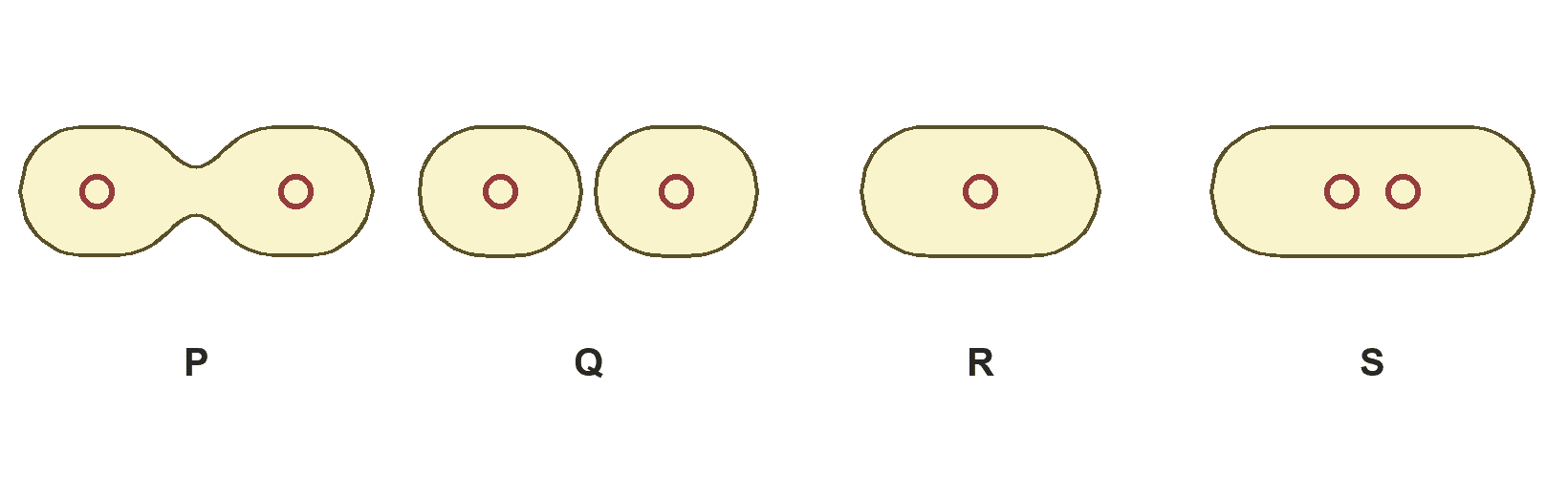
Which option gives the correct order of the stages, from the start of the division to its end ?
- 171 mark
Question 17
Cognitive domain: Application
A pond near a school in Rajasthan dries up in the hot summer. Under a microscope, in one field of view of a drop of the dry mud mixed with water, a student counts 50 bacteria of one kind. Each of them has drawn its contents into a small rounded body with a thick, hard wall, lying inside its old cell wall. When the rains fill the pond again, every one of these rounded bodies becomes active. (Hypothetical data.)
Before any bacterium has divided, how many bacteria come out of these 50 rounded bodies ?
- 181 mark
Question 18
Cognitive domain: Analysis
Two equal heaps of cow dung mixed with dry leaves are left for six weeks. Heap X is kept loose and turned over every few days so that air reaches all of it, and it slowly changes into dark, crumbly, soil-like material with no foul smell. Heap Y is packed tightly into a waterlogged pit; it gives out a foul smell, and much of its material is still unbroken after six weeks. Bacteria act on both heaps. Which statement is correct ?
- 191 mark
Question 19
Cognitive domain: Analysis
A student looks at three organisms, P, Q and R, which are a bacterium, yeast and the bread mould Rhizopus, in some order. She records these features :
Feature Organism P Organism Q Organism R True nucleus enclosed in a nuclear membrane Absent Present Present Body One cell One cell Network of thread-like hyphae Asexual method of multiplying Splitting in two (fission) Budding Spores formed in sporangia Which option identifies the three organisms correctly ?
- 201 mark
Question 20
Cognitive domain: Application
After heavy rain, the Sharma family on a picnic near Pune finds a patch of white, umbrella-shaped mushrooms growing in a field. The child wants to cook them for lunch. Which advice is the most sensible ?
- 211 mark
Question 21
Cognitive domain: Understanding
In a food-technology class, students compare how wine, beer and bread are made. Which statement is correct ?
- 221 mark
Question 22
Cognitive domain: Understanding
A dairy farmer in Gujarat feeds his buffaloes mostly on dry grass and straw, which are rich in cellulose. A student asks how the buffaloes manage to digest so much cellulose. Which answer matches the textbook ?
- 231 mark
Question 23
Cognitive domain: Evaluation
A group of Class 9 students plans a 10-day trek in the hills. They will have no refrigerator, and they must carry their food in rucksacks for several days in warm weather. The teacher asks them to choose the plan that keeps the food safe to eat for the longest time. Which plan is the best ?
- 241 mark
Question 24
Cognitive domain: Analysis
Assertion (A): Yeast is placed among the fungi and not among the bacteria.
Reason (R): Yeast can ferment sugar into ethanol and carbon dioxide.
- 251 mark
Question 25
Cognitive domain: Analysis
Assertion (A): Food that was sealed in a tin after all the air had been removed can never be spoiled by bacteria.
Reason (R): A special bacterium that causes the serious food poisoning called botulism is sometimes found in tinned and sealed foods.
- 262 marks
Question 26
Cognitive domain: Evaluation
A farmer in Haryana notices that the leaves of his cauliflower plants have turned black along the veins and that the heads are rotting. The agriculture officer says that it is black rot and advises him to spray an antibiotic on the plants. The farmer's son says, "Antibiotics are medicines for human beings, so they cannot be used on plants."
Judge the son's statement. Name the kind of organism that causes black rot.
- 272 marks
Question 27
Cognitive domain: Application
A large bakery in Hyderabad finds that its packed bread develops mould quickly in the humid season. Mould spores in the air of the packing hall settle on the bread. The owner fits ultra-violet lamps in the hall.
(a) How do the lamps help the bakery ?
(b) Name two other kinds of places where ultra-violet light is used in the same way.
- 282 marks
Question 28
Cognitive domain: Analysis
Under a powerful microscope, a microbiologist watches two bacteria of the same species but of different strains, D and E. A hollow, tube-like extension of cell D joins it to cell E. After a time, the two cells separate. Tests show that cell E now has a small circular DNA molecule, called a plasmid, that it did not have before.
(a) Name this process and say in which direction the plasmid moved.
(b) Explain why this is not the same as the common method of reproduction in bacteria.
- 292 marks
Question 29
Cognitive domain: Analysis
Two identical flasks are kept at the same warm temperature, with the same amount of yeast and water in each. Flask 1 has glucose dissolved in the water. Flask 2 has the same mass of cane sugar (sucrose).
(a) In which flask can the yeast cells absorb the sugar directly ? What must happen to the sugar in the other flask before the yeast can absorb it ?
(b) Yeast respires in the absence of air. Name the gas that appears as bubbles in both flasks.
- 302 marks
Question 30
Cognitive domain: Evaluation
Mr Das is a landless labourer in Odisha. He has one spare room in his house and wants to grow edible mushrooms in it on paddy straw. A neighbour says, "Farming needs a large piece of land, so you cannot earn anything by growing mushrooms in one room."
(a) Give two points from the textbook which show that the neighbour's view is not correct for mushrooms.
(b) State one precaution that Mr Das must take in the room.
- 312 marks
Question 31
Cognitive domain: Analysis
A farmer in Karnataka leaves a field fallow, with no crop of any kind, for one season. Tests then show that the soil has more nitrogen compounds than before. No leguminous plant grew in the field.
How could the nitrogen compounds in the soil have increased ? Name two kinds of bacteria that could be responsible.
- 323 marks
Question 32
Cognitive domain: Analysis
In a school laboratory, Neha spreads some harmless bacteria on a dish of nutrient jelly. After three days, a fuzzy green mould has landed on one corner of the dish. The bacteria have grown all over the dish except for a clear ring around the mould.
(a) What does the clear ring suggest ? Which scientist observed a similar effect, and which mould was involved in his discovery ?
(b) Neha says, "The mould makes a substance that can be sold at once as a medicine for people." Give one reason why this conclusion is too early.
- 333 marks
Question 33
Cognitive domain: Creativity
A school nurse wants to explain to Class 6 children the difference between an antibiotic and a vaccine.
Create a simple everyday comparison (an analogy) for the two, and then complete a table with three rows that shows how they differ. Choose the rows yourself.
- 343 marks
Question 34
Cognitive domain: Evaluation
A shop owner puts up three notices about medicines. Judge each notice using the textbook's definitions, and say whether it is acceptable or not.
- Notice 1: "Our antibiotic is made by crushing fresh tulsi leaves."
- Notice 2: "Our antibiotic is the best, because it kills the normal bacteria of your body along with the germs."
- Notice 3: "Our vaccine contains full-strength living germs, so that your child is surely protected."
- 353 marks
Question 35
Cognitive domain: Understanding
A science club keeps six organisms in a chart : Rhizobium, Nitrobacter, Pseudomonas, Lactobacillus, Saccharomyces cerevisiae and Penicillium chrysogenum.
(a) Sort the six organisms into those which are bacteria and those which are fungi.
(b) State one useful job done by each of Nitrobacter, Pseudomonas and Saccharomyces cerevisiae.
- 363 marks
Question 36
Cognitive domain: Analysis
A student reads in the textbook that most bacteria have no chlorophyll, and so they depend on readymade food from other sources. Then she sees a pond covered with green slime that is made of bacteria. She says, "This green slime proves that the textbook is wrong."
(a) Is the textbook wrong ? Give a reason.
(b) Name the two kinds of heterotrophic nutrition in bacteria, and say from which food source each kind obtains its nourishment.
- 375 marks
Question 37
Cognitive domain: Analysis
Case: Two villages, A and B, each have about 2000 people. In January 2022, a health camp in Village A vaccinated its people against typhoid. Village B had no such camp. The bar chart shows the number of typhoid cases in each village in three years (hypothetical data).

(a) Read the number of cases in Village A in 2021 and in 2023, and find the percentage fall in these cases.
(b) Your textbook names the TAB vaccine for typhoid. What kind of germs does it contain, and what does the body produce after a vaccine is injected ?
(c) A panchayat member of Village B suggests that every healthy villager should take an antibiotic every month instead. Give one reason from the textbook why this is not a good idea.
- 385 marks
Question 38
Cognitive domain: Analysis
Case: A small winery in Nashik ferments crushed grapes with yeast in a large tank. The owner measures the alcohol and the sugar in the liquid each day for ten days (hypothetical data). The graphs show the readings.
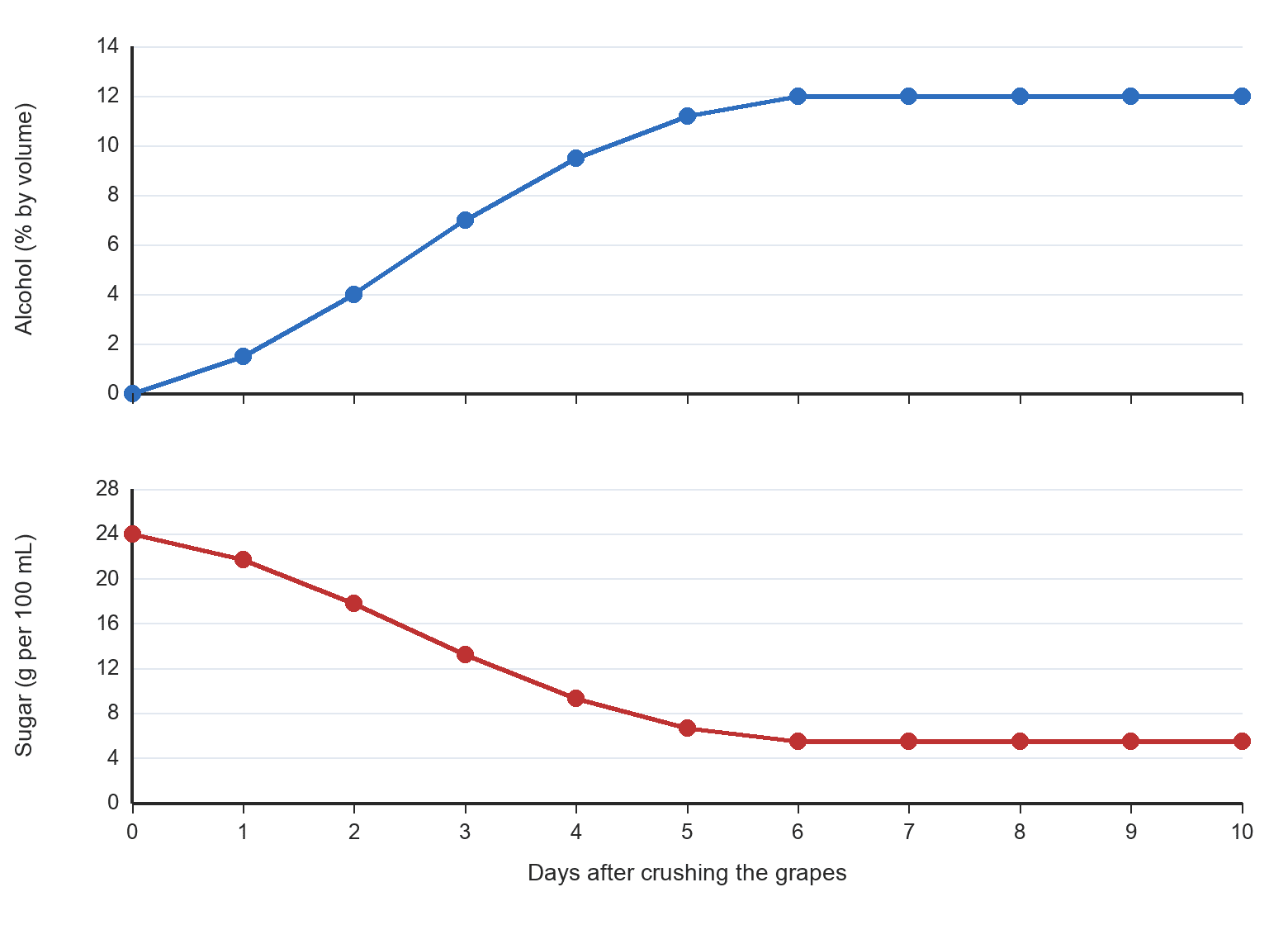
(a) What was the percentage of alcohol on day 4, and on which day did it first reach 12% ? About how much sugar (g per 100 mL) was left at the end ?
(b) The owner says, "Fermentation stopped on day 6 because the yeast had used up all the sugar." Use the sugar graph to show that he is wrong, and state what actually stopped the fermentation.
(c) The owner now wants a drink with much more alcohol than the wine. Name the process by which such drinks are obtained.
- 394 marks
Question 39
Cognitive domain: Application
Case: A hospital pharmacist explains to a group of students how some medicines are made by bacteria. With genetic engineering, a human gene can be introduced into certain bacteria such as Escherichia coli. These bacterial cultures grow very rapidly, and the product of the gene is extracted from them. Earlier, the hormone needed by people with diabetes was obtained only from the pancreas of slaughtered cattle and pigs, and it was slightly different from the human hormone.
A student writes three steps in a jumbled order :
- P : The substance made under the control of the gene is extracted from the bacterial culture.
- Q : The human gene is introduced into E. coli.
- R : The bacterial culture grows very rapidly.
(a) Name the hormone, needed by people with diabetes, that E. coli now makes in this way.
(b) Write the three steps P, Q and R in the correct order.
(c) Give two reasons why making this hormone in E. coli is better than obtaining it from animals.
- 405 marks
Question 40
Cognitive domain: Evaluation
Case: A farmer in a village of Maharashtra keeps four cows. His family needs cooking fuel every day, and his two-acre field needs manure. A local officer lists three ways of using the cow dung (hypothetical data) :
Way of using the dung Fuel for cooking Manure for the field Smoke in the kitchen Option 1 : Make dung cakes and burn them Yes No A lot Option 2 : Feed the dung to a biogas ("gobar gas") plant Yes Yes Very little Option 3 : Heap the dung in the open to rot No Yes None (a) In a biogas plant, which kind of micro-organism acts on the dung, and which gas is the main fuel produced ?
(b) Which option serves both the needs of the farmer ? State the dual purpose of such a plant.
(c) Option 3 also gives manure. Give two reasons why the officer would still advise the farmer to choose Option 2.