Solution:
Concept: Nitrogen moves between the air, the soil and living things in a cycle, and bacteria carry out most of its steps.
Step 1 — Draw the nitrogen cycle.
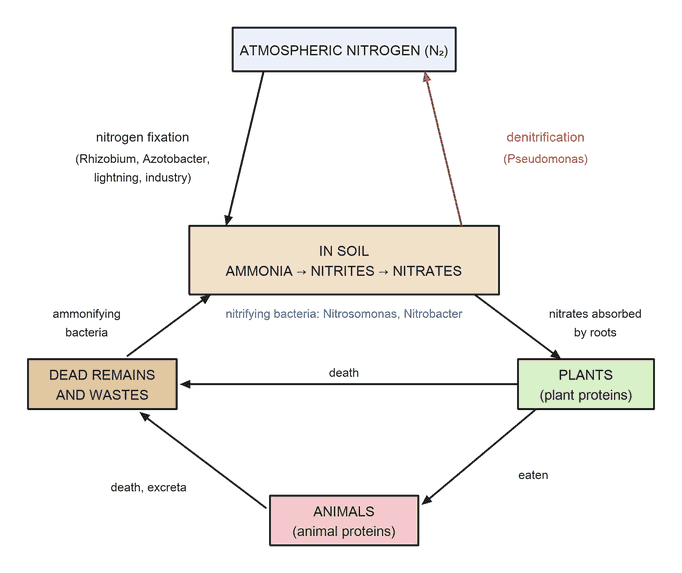
Draw and label the cycle as shown below. Nitrogen gas is fixed into the soil, taken up by plants as nitrates, passed to animals as proteins, returned to the soil when they die, and sent back to the air by denitrification.
Step 2 — (a)(i) Nitrification.
Nitrification is the change of ammonia (ammonium compounds) in the soil into nitrites by Nitrosomonas, and then into nitrates by Nitrobacter.
Step 3 — (a)(ii) Denitrification.
Denitrification is the breakdown of soil nitrates by denitrifying bacteria (e.g. Pseudomonas), releasing free nitrogen gas into the atmosphere.
Step 4 — (b) Biological and industrial fixation.
Compare the two ways of fixing nitrogen:
| Biological nitrogen fixation | Industrial nitrogen fixation |
|---|
| Done by living organisms: bacteria such as Rhizobium (in root nodules), Azotobacter and Clostridium. | Done in factories by a chemical process, to make nitrogen fertilizers. |
| Takes place at normal temperature and pressure, using enzymes. | Needs high temperature and pressure and a catalyst. |
Step 5 — (c) Rhizobium and legumes.
Rhizobium and the leguminous plant live together and both benefit: the plant gets nitrogen compounds, and the bacteria get food and shelter. This relationship is symbiosis (mutualism).
Watch out: Nitrification (ammonia → nitrates) is not the same as nitrogen fixation (nitrogen gas → nitrogen compounds).
Therefore, the diagram shows the nitrogen cycle; nitrification turns ammonia into nitrates and denitrification returns nitrogen gas to the air; biological fixation uses living organisms at normal conditions while industrial fixation uses factories at high temperature and pressure; and Rhizobium and legumes show symbiosis.
